Home / MLP / Week 4 / Real questions
MLP week 4 - real exam questions
60 questions pulled from past papers whose wording matches this week's topics, newest first, duplicates removed. Pick your answers, then press Check answers. Figures and answer keys are the originals.
Elapsed 00:00
A matrix-factorization recommender is set up on MovieLens-100k as follows:
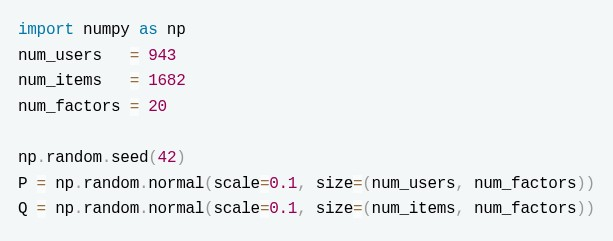 Which of the following statements is TRUE?
- Evaluating the expression
 returns the full predicted-rating matrix, of shape
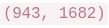 .
- The model has
 trainable parameters.
- Increasing
 reduces the risk of overfitting on the sparse rating matrix.
- The predicted rating of user
 for item
 is the cosine similarity between
 and
 .
Consider two regularization models, Model A (Ridge) and Model B (Lasso), trained on a dataset where two input features are highly collinear ( X1≈X2 ).
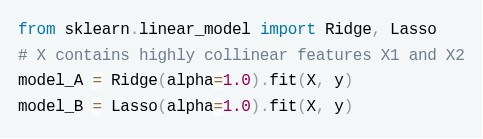 Which of the following statements accurately describe the expected behavior of these models and their evaluation metrics under severe collinearity?
- Model B (Lasso) will distribute the regression coefficients evenly across both X1 and X2 to balance the penalty, while Model A (Ridge) will force one of the coefficients to be exactly zero.
- Model A (Ridge) will shrink the coefficients of X1 and X2 toward zero but keep them roughly equal, whereas Model B (Lasso) will unstablely select one feature to keep and drive the coefficient of the other exactly to zero.
- If the target variable y contains extreme outliers, evaluating these models using Mean Squared Error (MSE) will penalize those large errors more heavily than Mean Absolute Error (MAE).
- Minimizing the MSE loss function during the training of Model A and Model B mathematically guarantees that the sum of the residual errors ( y−ŷ ) will always equal zero.
Consider the following models:
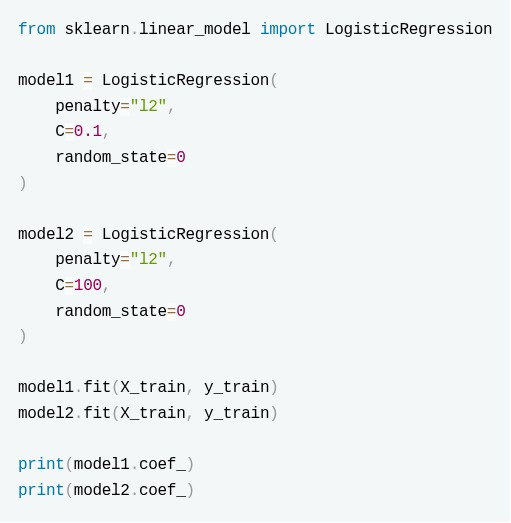 Which of the following explains the two models correctly?
- model1 will apply weaker regularization compared to model2, resulting in smaller coefficients.
- model2 will apply stronger regularization compared to model1, resulting in more coefficients close to zero.
- model1 is more likely to have smaller magnitude coefficients because it uses stronger regularization.
- Both models apply the same amount of regularization because the penalty type is the same.
Consider the following implementation of PCA:
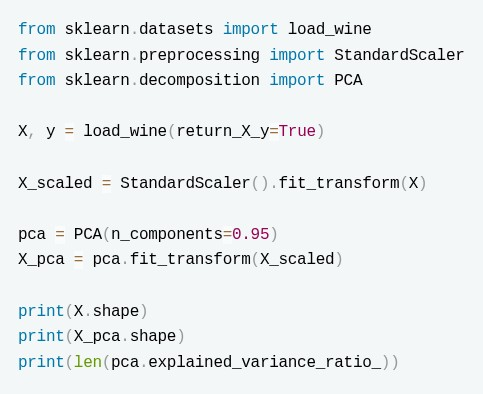 Which of the following are correct?
- X_pca.shape[1] is equal to the original number of features.
- The sum of pca.explained_variance_ratio_ is at least 0.95.
- len(pca.explained_variance_ratio_) is equal to X_pca.shape[1].
- The principal components correspond to the original features with the highest variance.
Consider the following two ensemble regression architectures trained on the same dataset:
 How do these two models differ in their output strategy to produce the final prediction
 for a given test instance, and how does adding more estimators affect them?
How do these two models differ in their output strategy to produce the final prediction for a given test instance, and how does adding more estimators affect them?- ensemble1 computes a weighted sum of predictions where later trees have higher weights; ensemble2 takes a simple arithmetic mean of all trees.
- ensemble1 reduces variance by averaging independent predictions from 100 trees, meaning increasing n_estimators to 500 will ideally not cause overfitting.
- ensemble2 reduces bias sequentially, meaning increasing n_estimators to 500 carries no risk of overfitting.
- Both models output predictions by calculating the majority vote across the terminal leaf nodes of all individual base estimators.
Consider the following code snippet:
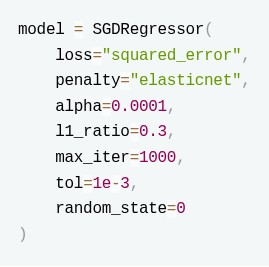 Which of the following holds true?
- The model performs no regularization.
- The model performs regularization and the regularization can also perfrom some feature selection.
- The model performs regularization and the regularization cant perfrom some feature selection.
- The model is very likely to be prone to overfitting
Select the correct statements regarding the following code snippet:
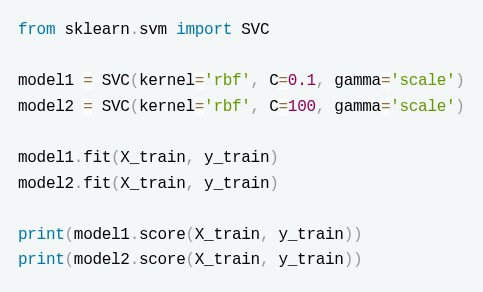
- model2 is more likely to have a lower bias and higher variance compared to model1.
- Increasing the value of C allowed model2 to penalize misclassification errors more strongly.
- model1 must always perform better on the test set because it has lower training accuracy.
- The gamma parameter has no effect because the kernel is already set to 'rbf'.
A forecasting model achieves an R2 score of 0.98 on the test set. However, it was trained using a feature that contains the sales value of the next day. Which of the following is the most appropriate conclusion?
- The model has low bias.
- The model has successfully captured seasonality.
- The evaluation is unreliable due to data leakage.
- The model has underfit the data.
Consider the following adaboost models:
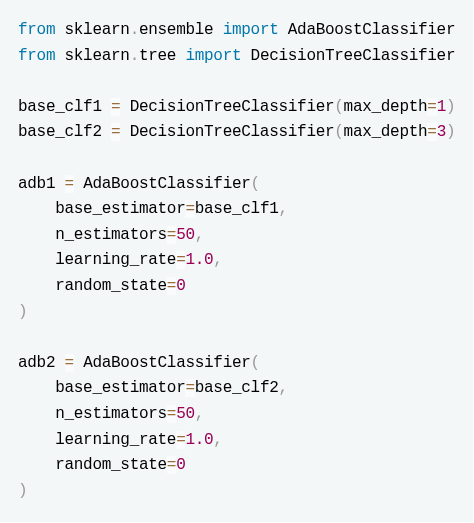 Which of the following statements are MOST accurate?
- adb1 is less likely to overfit than adb2 because its base trees are shallower.
- Increasing n_estimators always improves test accuracy for AdaBoost.
- Learning rate affects the contribution of each base learner; a smaller learning rate always reduces training accuracy.
- adb2 with deeper trees will have lower bias but higher variance than adb1.
Select all the false statements amongst the given statements:
- RandomForest uses sampling without replacement for bagging.
- Boosting reduces bias by sequentially training models
- Bagging reduces bias by training multiple models on different subsets of data and averaging their predictions.
- Boosting trains all base models independently in parallel.
Consider the given 2 different lasso regression models trained on the same dataset:
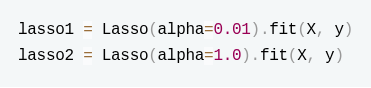 Statements: 1. The coefficients of lasso2 are more likely to be smaller in magnitude than those of lasso1. 2. lasso1 may have fewer zero coefficients than lasso2. 3. The predictions of lasso1 on the training data will exactly match y. 4. Increasing alpha always increases model accuracy on unseen data. Which of the given statements are correct?
- 2 and 3
- 1 and 2
- 3 and 4
- 1 and 4
The adfuller() function in statsmodels is used to test:
- Whether a time series has seasonal patterns
- Whether a time series is stationary
- Whether the data follows a normal distribution
- Whether the variance of the data changes over time
What will typically happen if series_with_nans contains NaNs (null values) ?
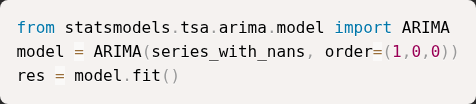
- statsmodels will automatically impute NaNs and fit silently.
- fit() will raise an error or drop NaNs depending on the estimator; user should handle NaNs beforehand.
- NaNs are treated as zeros.
- The model will only use the NaN values to estimate variance.
A newly launched movie has no ratings, but metadata such as genre, cast, and director is available. Which algorithm can still recommend it?
- User-based Collaborative Filtering
- Item-based Collaborative Filtering
- Content-based filtering
- Matrix factorization without regularization
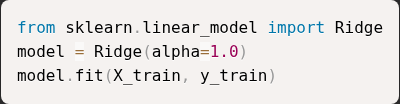
What is the role of the alpha=1.0 parameter in the given sklearn code to build a regression model?
- It applies L1 regularization and sets some coefficients to zero.
- It removes regularization completely and behaves like Linear Regression.
- It adds L2 regularization that penalizes large coefficients to prevent overfitting.
- It makes the model ignore the intercept term.
Which of the following is a hyper parameter?
- "intercept_" in LinearRegression
- "degree" in PolynomialFeatures
- "n_neighbors" in KNeighborsClassifier
- "max_depth" in DecisionTreeClassifier
Identify the errors in the following code:
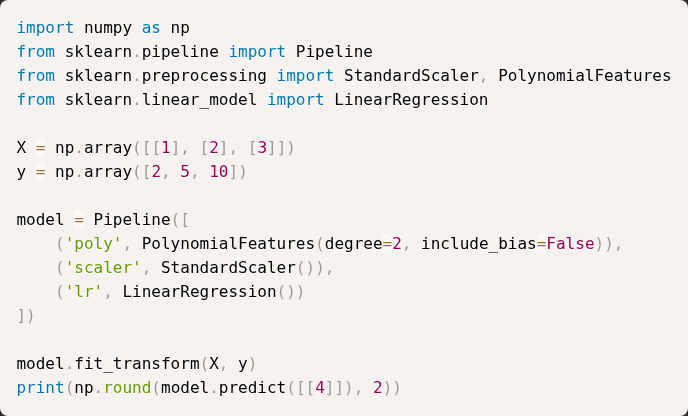
- include_bias has to be kept true for polynomial features.
- MinMaxScalar should be used for simple LinearRegression Models
- model.fit_transform should be replace with model.fit
- model.predict should be replaced with model.predict_proba
Following is the code to tune the degree parameter of a polynomial regression model.
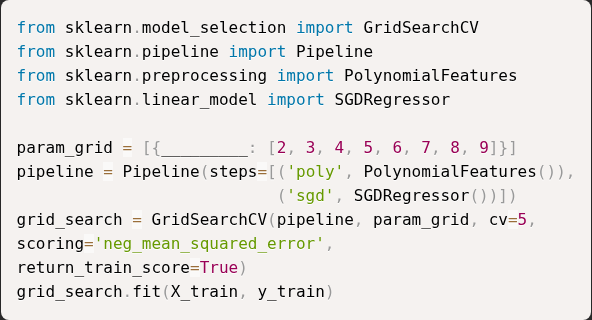 What should the blank space contain?
- "degree"
- "PolynomialFeatures_degree"
- "sgd__degree"
- "poly__degree"
Which of the following techniques can be used for hyperparameter tuning in Ridge Regression? Select all correct options.
- GridSearchCV
- ElasticNetCV
- RandomizedSearchCV
- Mini batch gradient descent
The following code attempts to implement Ridge regression on the Boston housing dataset but contains an error. The missing part should be correctly filled in to avoid issues during training.
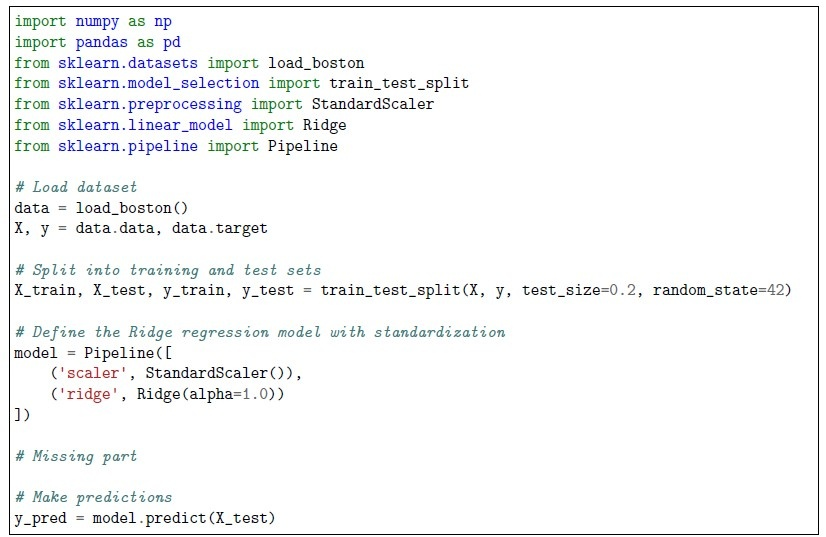 The following code attempts to implement Ridge regression on the Boston housing dataset but contains an error. The missing part should be correctly filled in to avoid issues during training.
Which of the following correctly fills the missing part while ensuring proper preprocessing?
The following code attempts to implement Ridge regression on the Boston housing dataset but contains an error. The missing part should be correctly filled in to avoid issues during training.
Which of the following correctly fills the missing part while ensuring proper preprocessing?



Which of the following techniques can be used for hyperparameter tuning in SGD Regression?
- GridSearchCV
- ElasticNetCV
- SelectKBest
- Feature Scaling with StandardScaler
Which of the following statements are true with regard to logistic regression?
- The decision boundary of a logistic regression model is always a straight line.
- The solver parameter in logistic regression determines the optimizationalgorithm used for training the model.
- Logistic regression can naturally handle multi-class classification without anymodifications.
- The regularization strength in logistic regression can be controlled using the Cparameter.
What is the primary risk of not performing a train-test split in a machine learning workflow?
- The training time will increase.
- The model might overfit the training data and perform poorly on new data.
- The dataset may become unbalanced.
- The model may fail to converge.
Suppose we want to transform features in a dataset using polynomial transformation. The sklearn API provides the functionality in which of the following modules?
- sklearn.dataset
- sklearn.model_selection
- sklearn.preprocessing
- sklearn.featureSelection
- sklearn.featureExtraction
Comprehension passage for this question
Consider the given Table 1: Banking data for the given subquestions stored as pandas dataframe in variable df
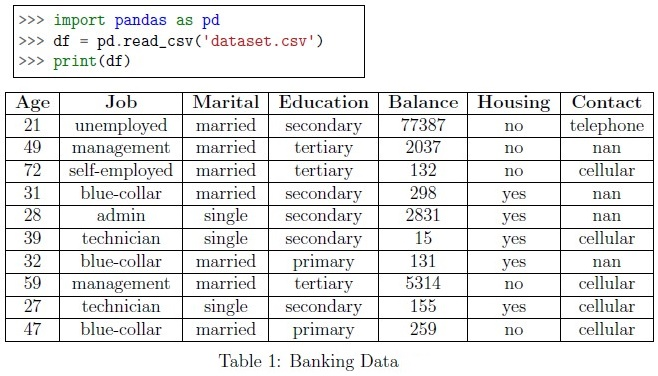 Consider the given Table 1: Banking data for the given subquestions stored as pandas dataframe in variable df
Based on the above data, answer the given subquestions.
In Contact column which of the following statistical measures can be used to replace nan values?
- Mean
- Median
- Mode
- Variance
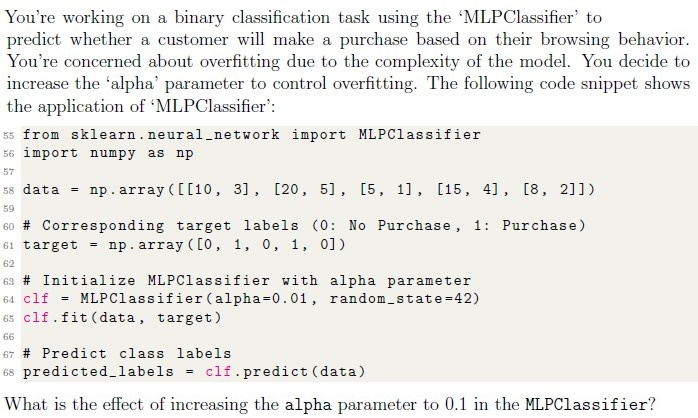
- It increases the model’s capacity to fit the training data closely, potentiallycausing overfitting.
- It adds a stronger regularization term to the loss function, reducing themodel’s complexity and helping prevent overfitting.
- It makes the model more prone to overfitting by increasing its sensitivity tonoise in the training data.
- It directly affects the learning rate, controlling how fast the model convergesduring training.
Which of the following is NOT a hyperparameter in machine learning?
- Learning rate in gradient descent
- Bias in a linear regression model
- Number of clusters in k-means
- Minimum leaf size in decision trees

- It decreases the variance among individual trees.
- It increases the variance among individual trees.
- It reduces the number of samples used for training each tree.
- It reduces overfitting by restricting tree depth.

- It increases the variance among individual trees.
- It decreases the variance among individual trees.
- It reduces the number of samples used for training each tree.
- It reduces overfitting by restricting tree depth.
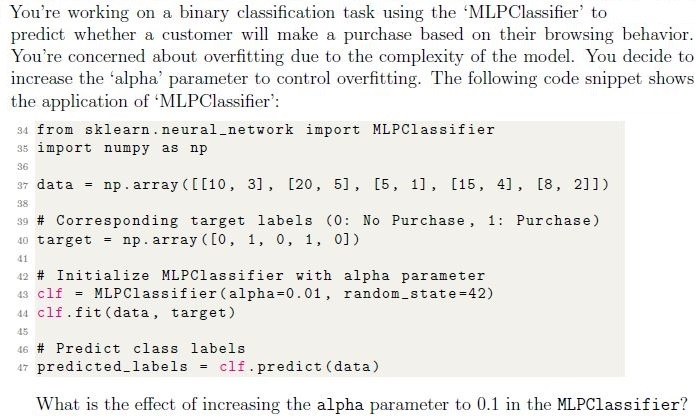
- It increases the model’s capacity to fit the training data closely, potentiallycausing overfitting.
- It adds a stronger regularization term to the loss function, reducing themodel’s complexity and helping prevent overfitting.
- It makes the model more prone to overfitting by increasing its sensitivity tonoise in the training data.
- It directly affects the learning rate, controlling how fast the model convergesduring training.
Which of the following are techniques for dimensionality reduction?
- PCA (Principal Component Analysis)
- StandardScaler
- Lasso Regression
- t-SNE (t-distributed Stochastic Neighbor Embedding)
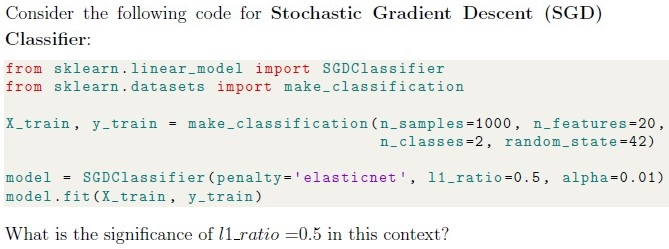
- It assigns equal weightage to L1 and L2 regularizations.
- It applies only L2 regularization.
- It applies only L1 regularization.
- It disables regularization completely.
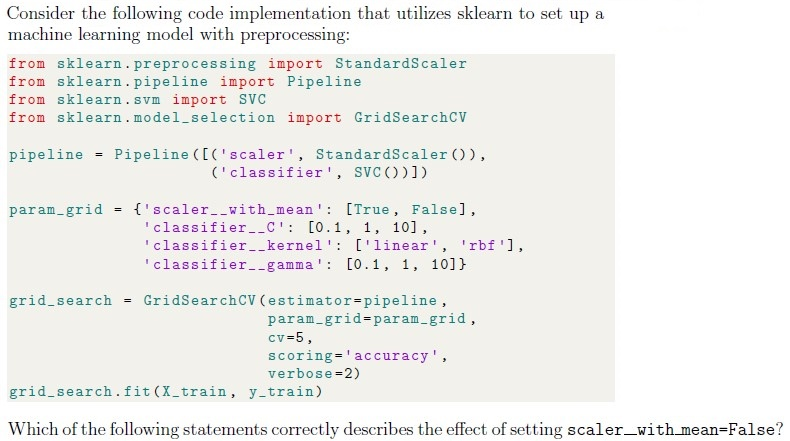
- The data will be standardized without centering, preserving the mean of thedataset.
- The data will be centered but not scaled, leading to variance issues.
- The parameter has no effect; the data will always be centered regardless ofthis setting.
- The scaling operation will be disabled entirely, leaving the data unchanged.

- LogisticRegression
- Perceptron
- RidgeClassifier
- Support Vector Machine (SVM)
- LassoClassifer

- It defines the tolerance for stopping criteria.
- It defines the learning rate schedule.
- It controls regularization strength.
- It controls the number of iterations.
Which of the following is correct about cross-validation in machine learning?
- Cross-validation helps prevent overfitting.
- It is a technique to improve the model’s accuracy.
- K-Fold cross-validation is one of the most popular types of cross-validation.
- Cross-validation is not suitable for small datasets.

- It determines whether to include a bias term in the model.
- It sets the degree of the polynomial features.
- It controls the regularization strength.
- It specifies the number of features to consider when fitting the model.
Data snooping:
- Leads to biased estimation on test sets
- Increases the risk of false positives
- Leads to better estimation on training sets
- Reduces the risk of false positives
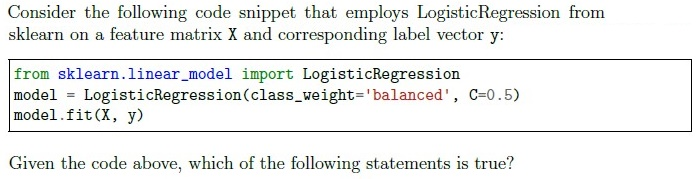
- The logistic regression model will use equal weights for both the classes in animbalanced dataset.
- The model does not use any regularization because the parameter C is set.
- The “balanced” mode uses the values of y to automatically adjust weightsinversely proportional to class frequencies in the input data.
- The value of C indicates that the model will apply a regularization.
Decision Trees are prone to:
- Low bias, low variance
- High bias, low variance
- Low bias, high variance
- High bias, high variance
What is the effect of increasing the regularization parameter alpha in Ridge Regression?
- It increases the complexity of the model.
- It reduces the complexity of the model.
- It has no effect on the model.
- It increases the model’s sensitivity to the training data.
How can we use both Ridge and Lasso Regularization in a machine learning model?
- By setting penalty parameter to l2
- By setting penalty parameter to l1
- By setting penalty parameter to elasticnet
- By setting penalty parameter to l3

- LogisticRegression
- Perceptron
- RidgeClassifier
- Support Vector Machine (SVM)
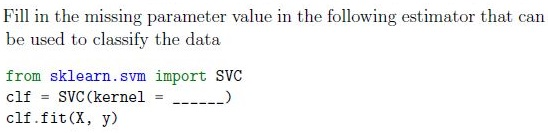
- ‘poly’,
- ‘lasso’
- ‘rbf’,
- ‘scale’
Which of the following options are true for regularization parameter C in sklearn.svm.SVC ?
- Large value of the regularization parameter C will overfit the training set andcomplex decision boundaries will form.
- Large value of the regularization parameter C will underfit the training set andsmooth decision boundaries will form.
- Small value of the regularization parameter C will overfit the training set andcomplex decision boundaries will form.
- Small value of the regularization parameter C will underfit the training set andsmooth decision boundaries will form.
- None of these
What is the solution for overfitting?
- To have less constraints/regularization
- To have more constraints/regularization
- Delete a significant portion of data
- Increase the dataset size.
- None of these.
Which of the following options are correct regarding regularization?
- It is a technique used to minimize the adjusted loss function and avoidunderfitting.
- It helps in increasing the bias of the training model.
- It determines the rows to be selected as a training dataset.
- Elastic net regularization is a combination of L1 and L2 regularization both.
Consider the Ridge regression model in scikit-learn, represented by the Ridge class. Which of the following statements about Ridge regression is correct?
- Ridge regression is designed to handle class imbalance of the dataset.
- The regularization term in Ridge regression is added to the sum of absoluteresiduals.
- Increasing the value of the regularization parameter (alpha) in Ridgeregression makes the model less sensitive to high-magnitude coefficients.
- Ridge regression is equivalent to Lasso regression when the regularizationparameter (alpha) is set to zero.
Which of these may NOT help in handling overfitting in decision trees?
- Increasing the value of min_samples_split
- Increasing the value of the pruning parameter
- Increasing the value of min_samples_leaf
- Increasing the depth of the tree
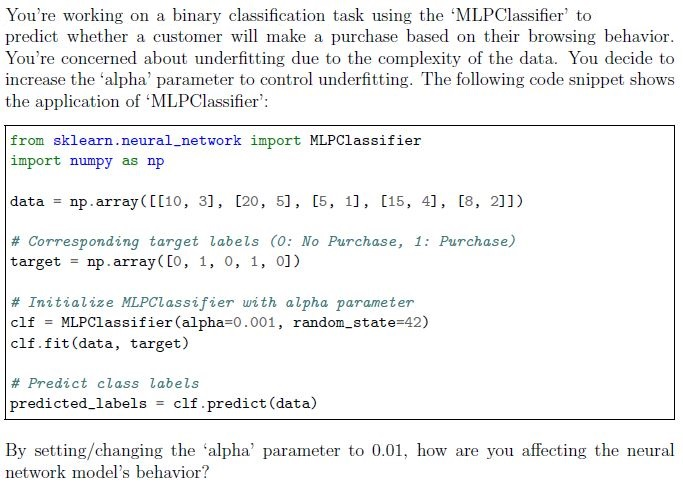
- Increasing the model’s complexity to fit the training data more closely.
- Adding a stronger regularization term to the loss function, discouragingcomplex models.
- Making the model more capable to learn more complex behaviour.
- Adjusting the learning rate to control convergence speed.
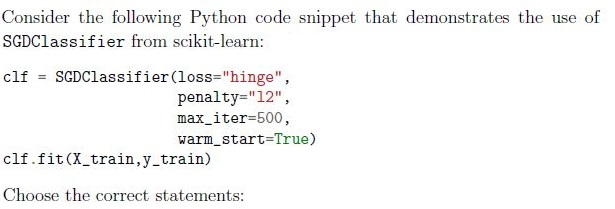
- It applies lasso penalty.
- The training may terminate after 499 iterations or lesser
- the classifier represents a perceptron model
- The classifier’s model parameters will initialized with parameters learnt fromprevious call to fit() function, if the same object is trained/fitted multiple times on new data.
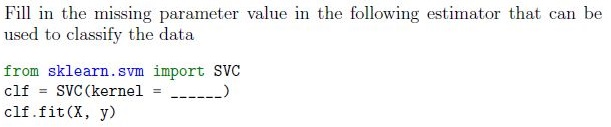
- ‘poly’,
- ‘lasso’
- ‘rbf’,
- ‘scale’
When using a Support Vector Classifier (SVC) in scikit-learn with different values of the regularization parameter (C), how does the complexity of the decision boundary change? Select all correct statements:
- Smaller values of C result in a more complex decision boundary.
- Larger values of C result in a more complex decision boundary.
- The decision boundary becomes simpler with increasing values of C.
- Very large values of C may lead to overfitting.
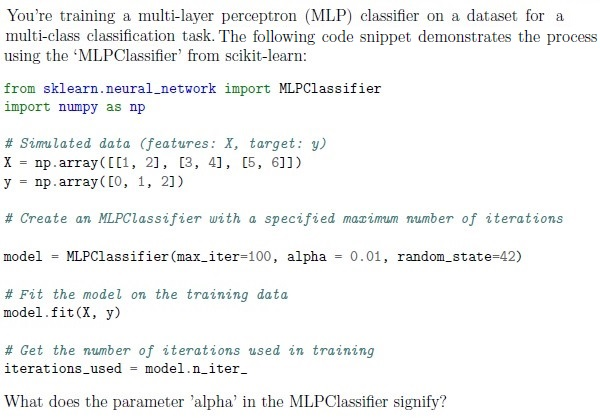
- It determines the maximum fraction of neurons to be used to train the model
- It is the learning rate
- It is the L1 regularization rate.
- It is the L2 regularization rate.
- None of these
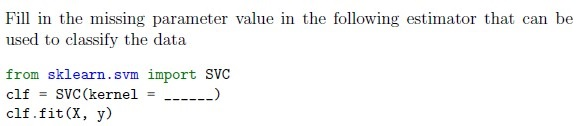
- ‘lasso’
- ‘poly’
- ‘scale’
- ‘rbf’
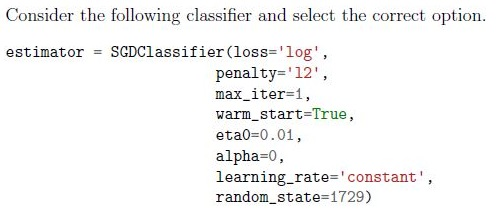
- It applies the perceptron classification with regularization.
- It applies the perceptron classification without regularization.
- It applies the logistic regression with regularization.
- It applies the logistic regression without regularization.
According to DecisionTreeClassifier parameters which of the following option will have least fitting(underfit) for the same data.




Which of the following are advantages of using ensemble methods in machine learning?
- Improved model performance
- Reduced overfitting
- Faster model training
- Simplicity of model interpretation
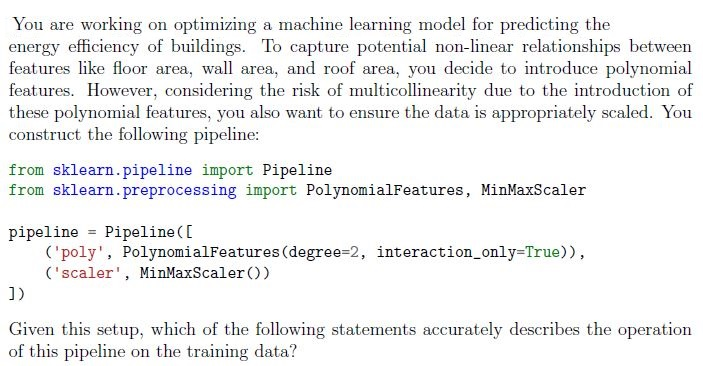
- The pipeline will generate polynomial features (including squared terms) andthen scale these features to a range between 0 and 1.
- The transformed data will consist of the original features, their squares, andinteraction terms, all scaled between 0 and 1.
- The pipeline scales the original features between 0 and 1, then subsequentlygenerates polynomial combinations including both square terms and interaction terms.
- Only interaction terms between features are generated by the pipeline, whichare then scaled between 0 and 1, without including the squared terms of individual features.
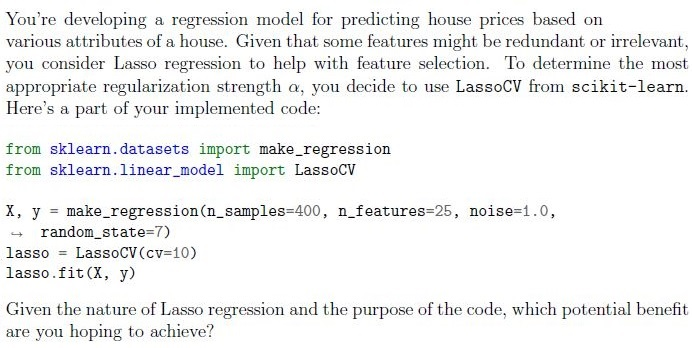
- Optimize the model’s complexity by automatically determining the best αthrough cross-validation.
- Reduce overfitting by incorporating 10-fold cross-validation during modelselection.
- Make predictions using an ensemble of 10 different Lasso models trained ondifferent subsets of the data.
- Maximize the number of features retained in the model, ensuring a complexmodel representation.