Home / Past papers / MLP End Term / this paper
IIT M FOUNDATION DIPLOMA AN EXAM - 01 Sep 2024
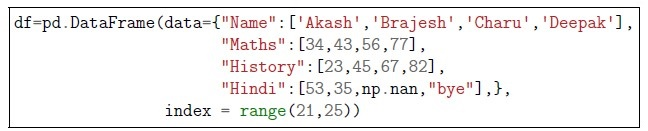 Consider the following common data and answer the subquestion:
 Consider the following code snippet: Which of the following will be equivalent to the above code snippet?




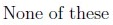
 What is the output of the following code snippet: Enter -1, if you think the above statement will generate an error.
 What is the output of the following code snippet: Enter -1, if you think the above statement will generate an error.
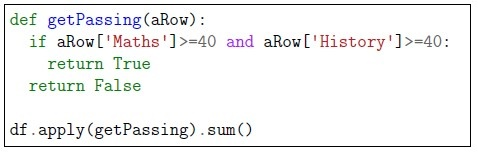 What is the output of the following code snippet: Enter -1, if you think the above statement will generate an error.
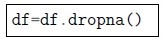 What is the output of the following code snippet: Choose correct options from following:
- The number of rows will decrease in the dataset.
- The number of columns will decrease in the dataset.
- The number of columns and number of rows, both, will decrease in thedataset.
- There will be no change.
- Insufficient information.
- load_openml()
- read_openl()
- read_data()
- fetch_openml()
- load_data()
- load_csv()
- fetch_csv()
- In some columns which has values between 0 and 1.
- A column contains entity names such as ‘Chennai’, ‘CHENNAI’ and ‘MADRAS’.
- The data has only numbers in all the columns.




- Both statements are True
- Only statement 1 is True
- Only statement 2 is True
- Both statements are False


- It does not create hyperplanes as a decision boundary
- It will correctly classify all the data point if the data is linearly separable
- It is robust to outliers
- It is mostly used for clustering the data



- Low bias, low variance
- High bias, low variance
- Low bias, high variance
- High bias, high variance


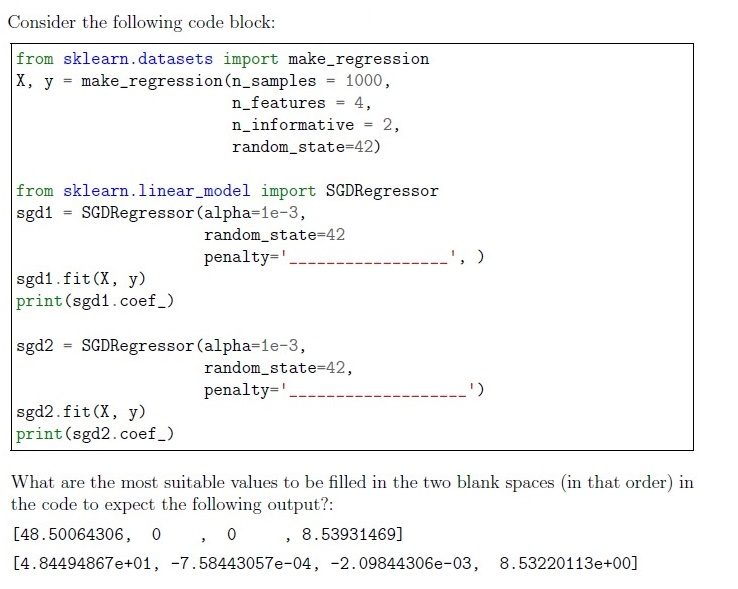
- ‘l1’, ‘l2’
- ‘l1’, None
- ‘l2’, ‘l1’
- ‘l2’, None
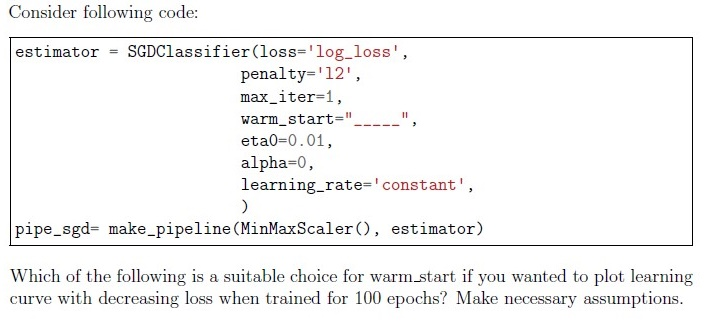
- True
- False
- Yes
- No
- None of these

- It controls the number of weak learners.
- It shrinks the contribution of each classifier.
- It sets the weight of each weak learner.
- It adjusts the speed at which the model learns.
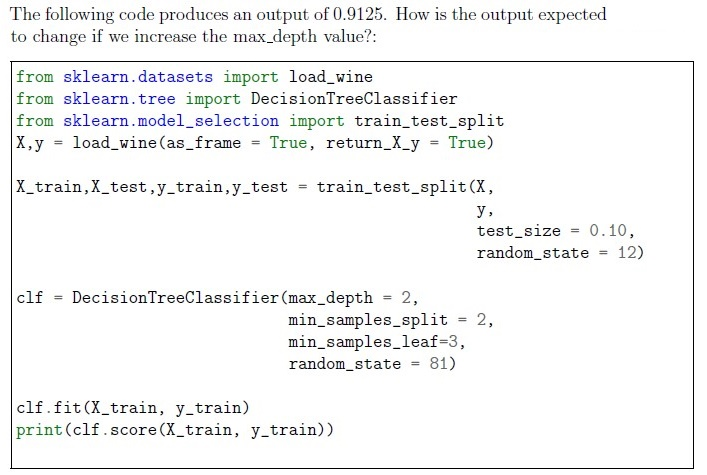
- Output score is likely to increase.
- Output score is likely to decrease.
- Output score may increase or decrease.
- Output score will remain the same.
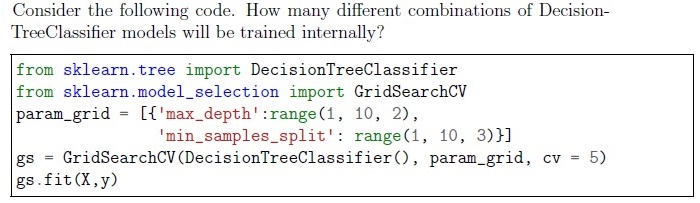
- 20
- 75
- 8
- 15
- 40
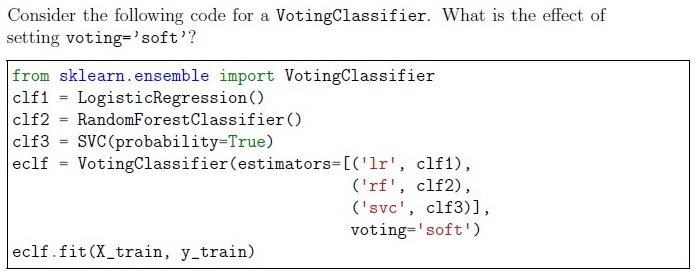
- The final predictions are based on the majority vote.
- The final predictions are based on the average of probabilities predicted byeach classifier.
- The final predictions are based on the weighted sum of the predictions.
- The final predictions are based on the classifier with the highest accuracy.
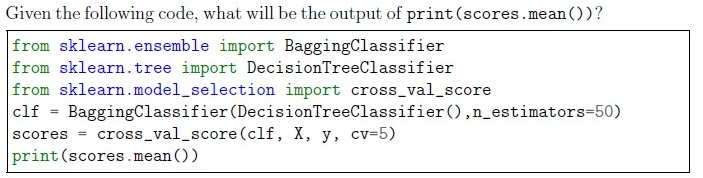
- The mean accuracy across all cross-validation folds.
- The mean precision across all cross-validation folds.
- The mean recall across all cross-validation folds.
- The mean F1 score across all cross-validation folds.

- Plotting the sum of the squared distances of samples to their closest clustercenter
- by Changing the distance metric for KMeans
- By initialising clustering centroids very far from each other
- All of these












- Perceptron
- DecisionTreeClassifier
- KNeighborClassifier
- LogisticRegression
- SGDClassifier()
- MLPClassifier()
- NNClassifier()
- MLPRegressor()




- Remove all the minority classes
- Up-sample the minority classes
- Remove all the majority classes
- Down-sample the majority classes
- create synthetic samples to balance the classes
- It is primarily used for regression problems
- It is primarily used for classification problems
- Hyperparameter tuning is required
- Hyperparameter tuning is not required
- Only 5 neighbours in the range of some radius are used to compute the labelof a sample.
- All the neighbours in the range of some radius are used to compute the labelof a sample.
- It is sensitive to outliers.
- It is not sensitive to outliers.

- Data is continuously being generated
- Data is generated every month
- Whole data is generated and its in a huge file size
- For very small dataset
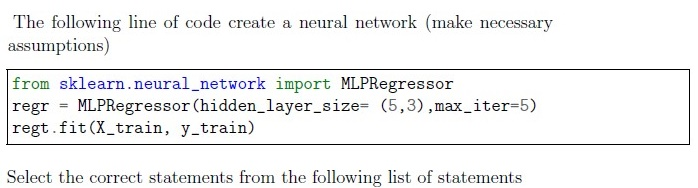
- The neural network contains 3 hidden layers with 5 neurons in each hiddenlayer
- The neural network contains 5 hidden layers with 3 neurons in each hiddenlayer
- The neural network contains 2 hidden layers with 3 neurons in the secondhidden layer
- The neural network contains 2 hidden layers with 5 neurons in the first hiddenlayer
- All of the given options are correct
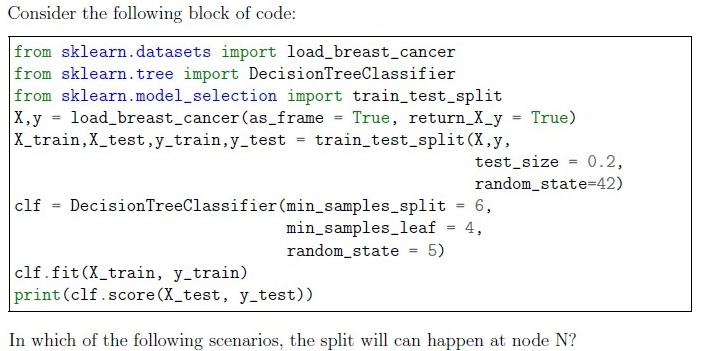
- Number of samples at node N = 15. If it is split, it will result in 9 samples in theleft child node and 6 sample in the right child node.
- Number of samples at node N = 5. If it is split, it will result in 4 samples in theleft child node and 2 samples in the right child node.
- Number of samples at node N = 12. If it is split, it will result in 3 samples in theleft child node and 9 samples in the right child node.
- Number of samples at node N = 7. If it is split, it will result in 4 samples in theleft child node and 3 samples in the right child node.
Answer key
- Q1 (MSQ, 2 marks): A, C
- Q2 (SA, 2 marks): 120
- Q3 (SA, 2 marks): 3
- Q4 (SA, 2 marks): -1
- Q5 (MCQ, 2 marks): A
- Q6 (MCQ, 2 marks): D
- Q7 (MCQ, 2 marks): B
- Q8 (MCQ, 2 marks): B
- Q9 (MCQ, 2 marks): D
- Q10 (MCQ, 2 marks): A
- Q11 (MCQ, 2 marks): C
- Q12 (MCQ, 2 marks): B
- Q13 (MCQ, 2 marks): B
- Q14 (MCQ, 2 marks): C
- Q15 (MCQ, 3 marks): E
- Q16 (MCQ, 3 marks): A
- Q17 (MCQ, 3 marks): A
- Q18 (MCQ, 3 marks): B
- Q19 (MCQ, 4 marks): A
- Q20 (MCQ, 4 marks): D
- Q21 (MCQ, 4 marks): B
- Q22 (MCQ, 4 marks): A
- Q23 (MCQ, 4 marks): A
- Q24 (MSQ, 2 marks): A, D
- Q25 (MSQ, 2 marks): A, D
- Q26 (MSQ, 2 marks): B, C, D
- Q27 (MSQ, 2 marks): B, C
- Q28 (MSQ, 2 marks): B, D
- Q29 (MSQ, 3 marks): A, D
- Q30 (MSQ, 3 marks): B, D, E
- Q31 (MSQ, 3 marks): B, D
- Q32 (MSQ, 3 marks): B, D
- Q33 (MSQ, 3 marks): A, B, C
- Q34 (MSQ, 4 marks): C, D
- Q35 (MSQ, 5 marks): A, D
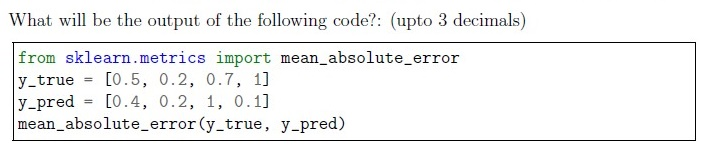
- Q36 (SA, 2 marks): 0.319 to 0.328
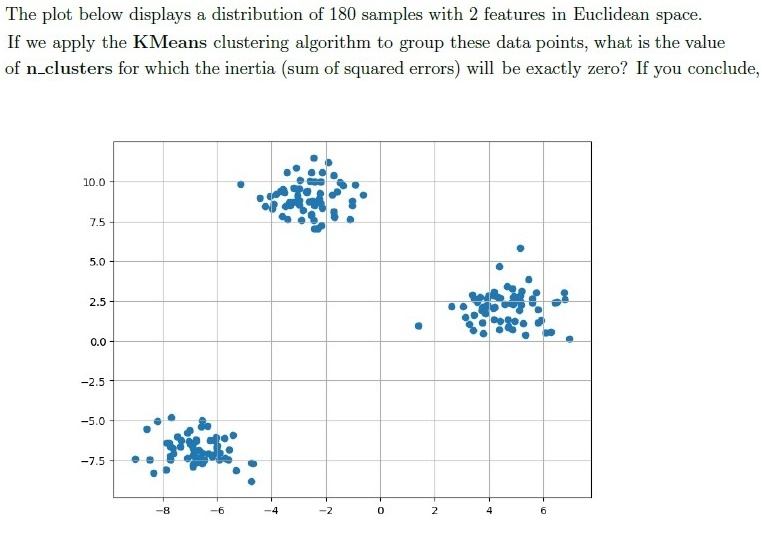
- Q37 (SA, 4 marks): 180
Concepts this paper tests
Auto-generated summary from the source site. Handy as a checklist; the lessons above explain each idea from scratch.
Here’s a structured summary of the core topics, concepts, principles, and equations essential for the Diploma-Level Machine Learning Practice (Computer-Based Exam). The summary is organized by topic clusters for clarity, followed by Mermaid knowledge graphs to visualize relationships.
1. Core Topics & Concepts
A. Data Handling with Pandas
DataFrame Operations:
- Indexing:
df.loc[](label-based),df.iloc[](position-based). - Slicing:
df.loc[23:24, 'Maths':'History']≡df.iloc[2:4, 1:3](Q2). - Handling missing data:
df.dropna()reduces rows (Q6). - Data types:
df.Hindi.apply(type).nunique()counts unique types (e.g.,int,float,str) (Q4).
- Indexing:
Chunked Data Loading:
- For large files:
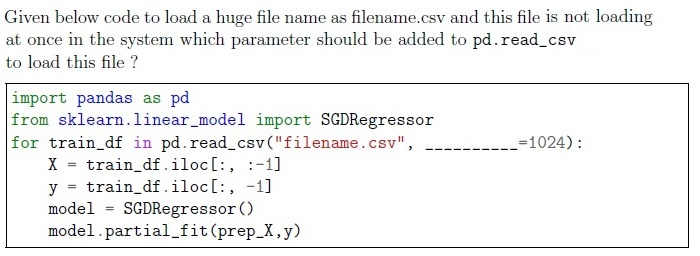
pd.read_csv("filename.csv", chunksize=1024, low_memory=False)(Q12).
- For large files:
B. Model Training & Evaluation
Train-Test Split:
train_test_split(X, y, test_size=30)for exact sample counts (Q25).- Default splits:
test_size=0.2(20% test data).
Cross-Validation:
K-Fold CV:
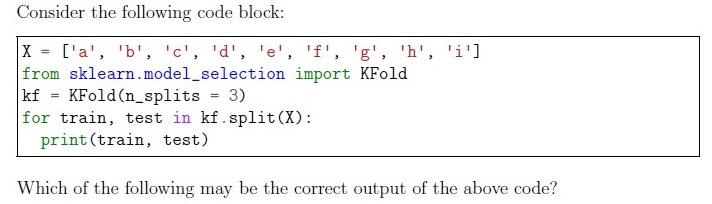
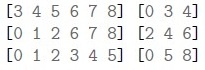
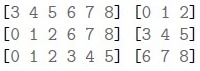
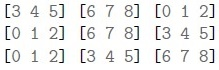
KFold(n_splits=3)splits data into 3 folds (Q9).- Output: Indices of train/test sets (e.g.,
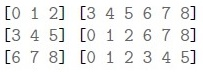
[3,4,5,6,7,8]vs[0,1,2]).
- Output: Indices of train/test sets (e.g.,
- ShuffleSplit: Randomized splits (Q26).
- Learning Curves:
sklearn.model_selection.learning_curveplots training/test errors vs. sample size (Q10).
Metrics:
- Regression:
neg_mean_squared_error,r2(Q26). - Classification:
accuracy,precision,recall,f1(Q22). - Clustering: Inertia (sum of squared distances to centroids) (Q24, Q38).
- Regression:
C. Algorithms & Hyperparameters
Decision Trees:
Hyperparameters:
max_depth: Controls tree depth (higher → overfitting) (Q20).min_samples_split: Minimum samples to split a node (Q36).min_samples_leaf: Minimum samples in a leaf (Q36).
- Prone to: High variance (overfitting) (Q15).
SVM (Support Vector Machines):
- Hard Margin SVM: Correctly classifies all points if data is linearly separable (Q13).
- Kernel Trick: Not covered in questions, but implied for non-linear data.
Naive Bayes:
- Assumes feature independence (Q11).
- No hyperparameter tuning required (Q32).
- Incremental learning:
partial_fit(Q11).
k-Nearest Neighbors (k-NN):
- RadiusNeighborsClassifier: Uses all neighbors within a radius (not fixed
k) (Q33). - Sensitive to scale (normalization recommended).
- RadiusNeighborsClassifier: Uses all neighbors within a radius (not fixed
Ensemble Methods:
- Bagging:
BaggingClassifierwithDecisionTreeClassifier(Q23). - Boosting: AdaBoost’s
learning_rateshrinks weak learner contributions (Q19). - Voting Classifier:
voting='soft'averages probabilities (Q22).
- Bagging:
Neural Networks (MLP):
MLPClassifier/MLPRegressor: Defines hidden layers viahidden_layer_sizes=(5,3)(2 layers with 5 and 3 neurons) (Q35).- Hyperparameters:
max_iter,learning_rate,alpha(L2 regularization).
Stochastic Gradient Descent (SGD):
Loss Functions:
loss='log_loss'→ Logistic regression (Q18).loss='hinge'→ Linear SVM (Q17).loss='perceptron'→ Perceptron (Q30).
- Penalties:
penalty='l1'(sparse weights) vs.penalty='l2'(Q17). - Warm Start:
warm_start=Trueenables incremental training (Q18).
Clustering (K-Means):
Inertia: Sum of squared distances to centroids (Q24).
- Inertia = 0 when
n_clusters = n_samples(Q38).
- Inertia = 0 when
- Elbow Method: Plot inertia vs.
n_clustersto find optimalk.
Imbalanced Data:
- Techniques: Upsample minority, downsample majority, or synthetic samples (SMOTE) (Q31).
D. Preprocessing & Feature Engineering
Text Data:
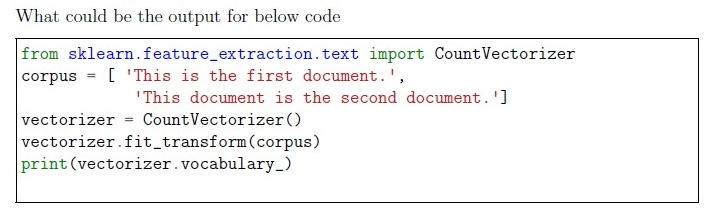
CountVectorizer: Converts text to word-count matrices (Q14).- Output: Vocabulary dictionary (e.g.,
{'this': 4, 'is': 2}).
- Output: Vocabulary dictionary (e.g.,
Polynomial Features:
PolynomialFeatures(degree=2)adds interaction terms (Q16).- Hyperparameter tuning:
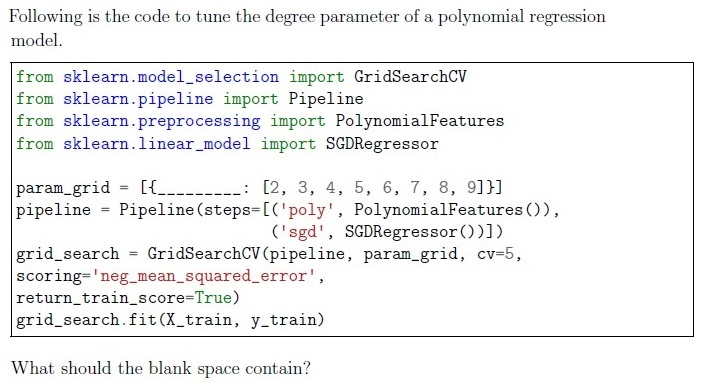
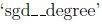
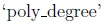
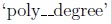
param_grid = {'poly__degree': [2, 3, ...]}.
Scaling:
MinMaxScalerorStandardScalerfor SGD/neural networks (Q18).
Handling Categorical Data:
- Inconsistent Entries: E.g., 'Chennai', 'CHENNAI', 'MADRAS' → Requires preprocessing (Q8).
E. Model Selection & Hyperparameter Tuning
Grid Search:
GridSearchCV: Exhaustively tests hyperparameter combinations (Q21).- Example:
param_grid = {'max_depth': [1,3,5], 'min_samples_split': [1,4,7]}→ 15 combinations.
- Example:
Partial Fit:
- For streaming/large data:
model.partial_fit(X, y)(Q12, Q34).
- For streaming/large data:
F. Specialized Topics
OpenML:
- Load datasets:
fetch_openml()(Q7).
- Load datasets:
Model-Specific Notes:
- Perceptron/SGD:
SGDClassifier(loss='perceptron')is a stochastic perceptron (Q30). - Logistic Regression:
SGDClassifier(loss='log_loss')(Q30). - GaussianNB: Assumes normal distribution for features (Q11).
- Perceptron/SGD:
2. Key Equations (Mathematics)
A. Regression Metrics
- Mean Absolute Error (MAE):
- Example (Q37): MAE for
y_true = [0.5, 0.2, 0.7, 1],y_pred = [0.4, 0.2, 1, 0.1]→0.325.
- Mean Squared Error (MSE):
B. Classification Metrics
- Log Loss (Cross-Entropy):
- AdaBoost Weight Update:
- : Error rate of weak learner at iteration (Q19).
C. Clustering
- Inertia (K-Means):
- : Set of centroids, : Centroid of cluster (Q24, Q38).
D. Probability (Naive Bayes)
- Conditional Probability (GaussianNB):
- Assumes feature independence (Q11).
Graph 2: Model Training & Evaluation
Graph 3: Algorithms & Hyperparameters
Graph 4: Specialized Workflows
Graph 5: Clustering & Dimensionality
4. Exam Tips
Pandas:
- Master
locvs.iloc(Q2). - Know how
dropna()affects rows/columns (Q6).
- Master
Model Evaluation:
- For regression, use
neg_mean_squared_errororr2(Q26). - For classification,
accuracyorf1(Q22).
- For regression, use
Algorithms:
- Decision Trees: High variance (Q15), tune
max_depth(Q20). - SVM: Hard margin for separable data (Q13).
- Naive Bayes: Independent features (Q11).
- Decision Trees: High variance (Q15), tune
Hyperparameter Tuning:
GridSearchCVtests all combinations (Q21).- Use
param_gridwith double underscores for pipelines (e.g.,poly__degree) (Q16).
SGD:
loss='log_loss'→ Logistic regression (Q18).penalty='l1'→ Sparse weights (Q17).
Clustering:
- Inertia = 0 when
n_clusters = n_samples(Q38). - Elbow method for optimal
k(Q24).
- Inertia = 0 when
Text Data:
CountVectorizeroutputs a vocabulary dictionary (Q14).
Imbalanced Data:
- Upsample minority or downsample majority (Q31).
Neural Networks:
hidden_layer_sizes=(5,3)→ 2 layers (Q35).
Code Snippets:
- Always check for
random_statein splits/models for reproducibility. warm_start=Trueenables incremental training (Q18).
- Always check for