Home / Past papers / MLP End Term / this paper
IIT M IMPROVEMENT FN EXAM QDD2 22 Dec - 22 Dec 2024
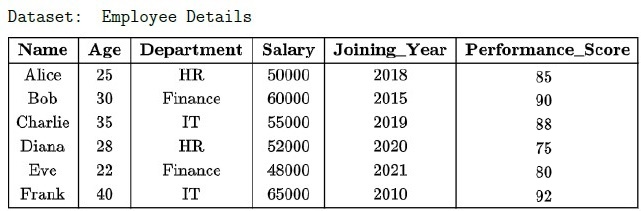













 What does the following code return?
- The row with the employee who has the lowest performance score.
- The row with the employee who has the highest performance score.
- The row with the highest salary.
- None of these.
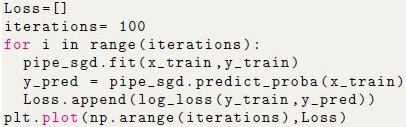
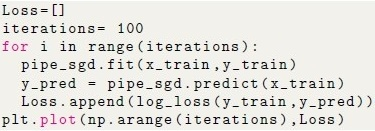
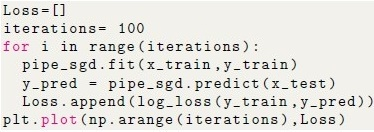
- 8
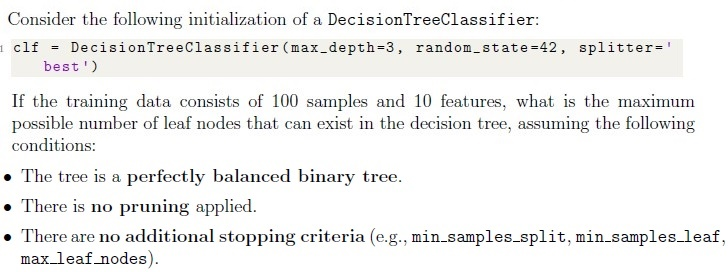
- 16
- 32
- 100
 Consider the following code:


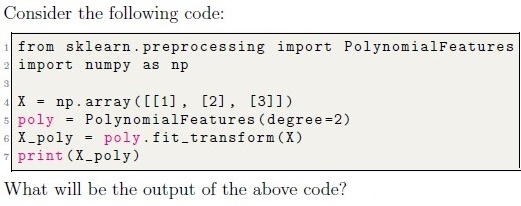


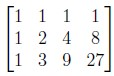






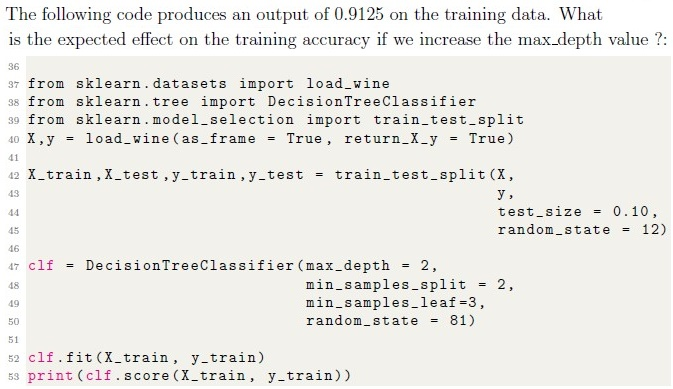
- Output score is likely to increase.
- Output score is likely to decrease.
- Output score may increase or decrease depending on other factors.
- Output score will remain the same.

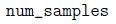
- The number of base estimators to be trained.
- The size of each sample batch for testing.
- The maximum number of features used for training.
- The number of samples to draw from X to train each base estimator
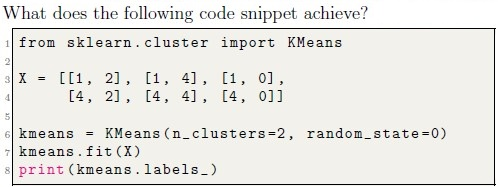
- Performs hierarchical clustering and outputs cluster distances.
- Outputs the silhouette score for the data points.
- Groups data points into 2 clusters and outputs the labels of the clusters foreach data point.
- Reduces the dimensionality of the dataset to 2 dimensions.
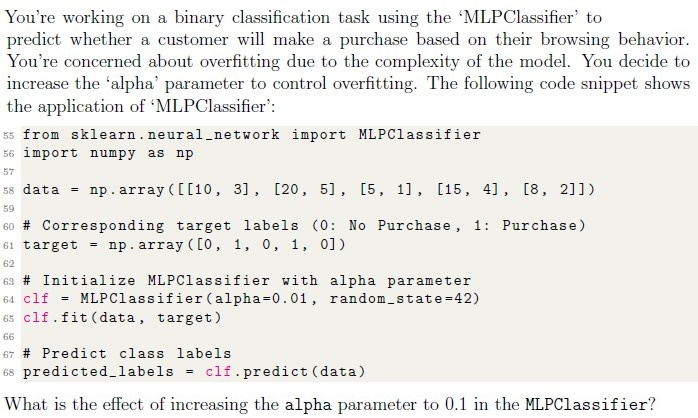
- It increases the model’s capacity to fit the training data closely, potentiallycausing overfitting.
- It adds a stronger regularization term to the loss function, reducing themodel’s complexity and helping prevent overfitting.
- It makes the model more prone to overfitting by increasing its sensitivity tonoise in the training data.
- It directly affects the learning rate, controlling how fast the model convergesduring training.
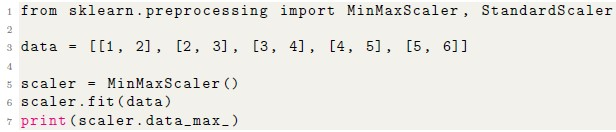
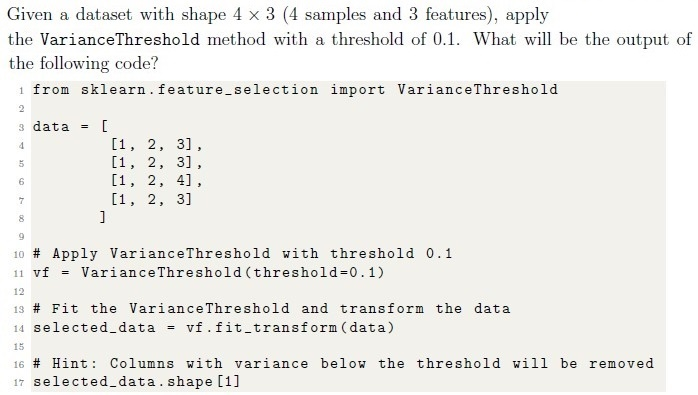
 What will be the output of the following code?
- 4
- 5
- 3
- 6
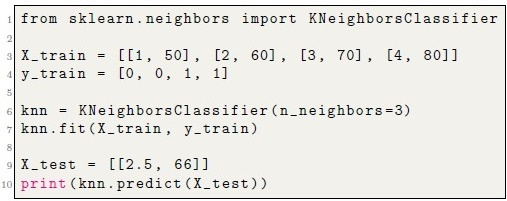
 What will be the output of the following code?
- [5, 6]
- [4, 5]
- [3, 4]
- [2, 3]





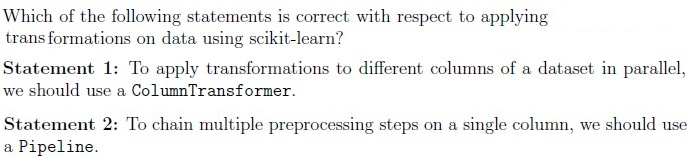
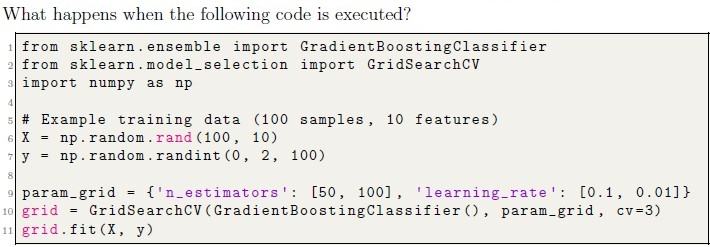
- Statement 1 False, Statement 2 False
- Statement 1 True, Statement 2 False
- Statement 1 False, Statement 2 True
- Both statements are True
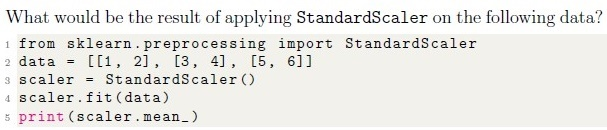


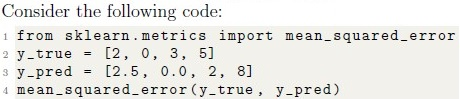
- 1.25
- 2.56
- 4.25
- 3.25
- Given code will return an error.
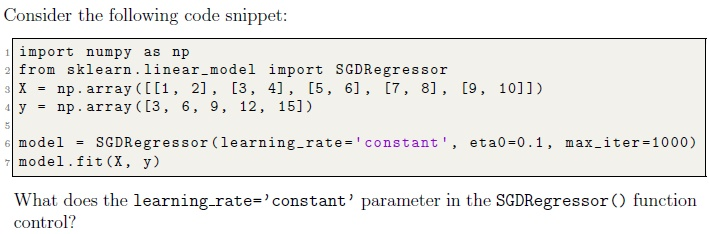
- It adjusts the learning rate based on the number of iterations.
- It specifies the learning rate to decrease as the model converges.
- It specifies the fraction of the dataset used for each step in the stochasticgradient descent.
- It defines the initial value for the learning rate and keeps it constantthroughout training.
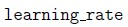
- Learning rate in gradient descent
- Bias in a linear regression model
- Number of clusters in k-means
- Minimum leaf size in decision trees
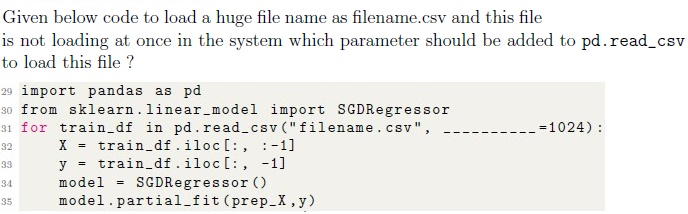




- It decreases the variance among individual trees.
- It increases the variance among individual trees.
- It reduces the number of samples used for training each tree.
- It reduces overfitting by restricting tree depth.
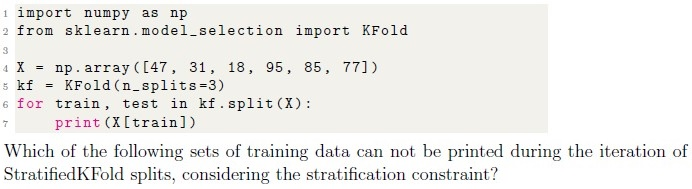 Consider the following code:
- [47, 31, 18, 95, 77]
- [31, 41, 85, 31]
- [47, 31, 18]
- [47, 31, 85, 77]
- [31, 41, 18, 95, 85, 77]
- [18, 95, 85, 77]





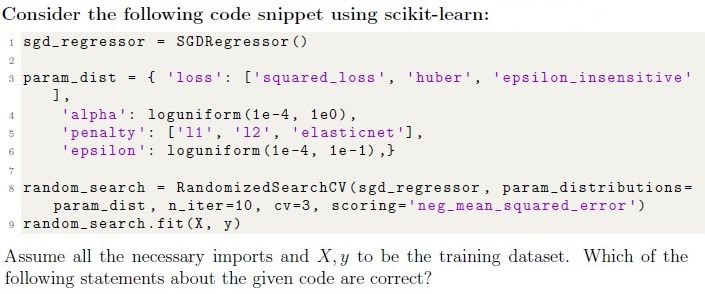
- The neural network contains 3 hidden layers with 5 neurons in each hiddenlayer
- The neural network contains 5 hidden layers with 3 neurons in each hiddenlayer
- The neural network contains 2 hidden layers with 3 neurons in the secondhidden layer
- The neural network contains 2 hidden layers with 5 neurons in the first hiddenlayer
- None of the given options are correct





- GaussianNB
- LogisticRegression
- SGDClassifier
- RandomForestClassifier








- Using an Elbow Curve.
- Computing Silhouette Scores.
- Cross-validation with multiple folds.
- All of these
- It measures how well each sample is clustered.
- A higher score indicates better-defined clusters.
- It requires ground truth labels (target variable) to compute.
- It can be used to evaluate the quality of any clustering algorithm.






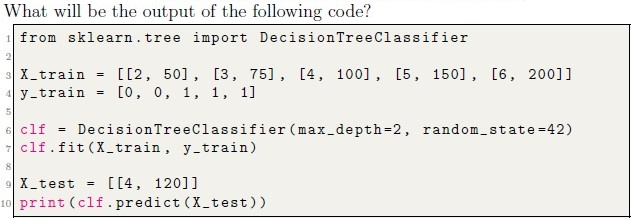
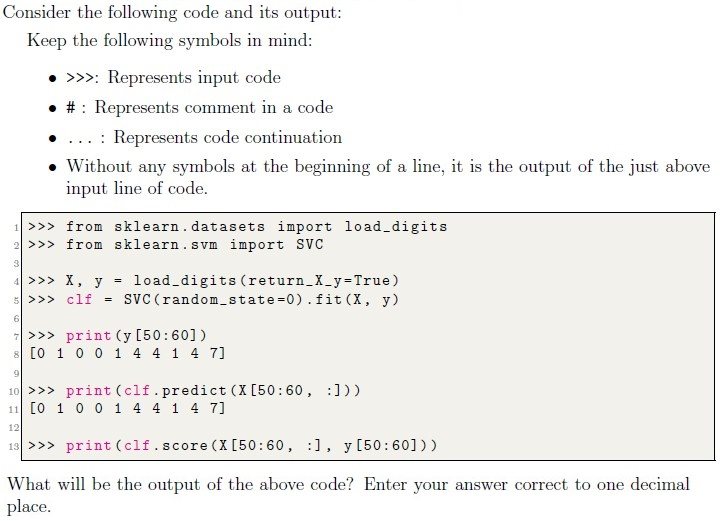
 What will be the output of the following code snippet?
Answer key
- Q1 (MCQ, 1 marks): D
- Q2 (MSQ, 3 marks): A, B
- Q3 (MSQ, 3 marks): A, B, C
- Q4 (MCQ, 1 marks): B
- Q5 (MCQ, 4 marks): A
- Q6 (MCQ, 4 marks): A
- Q7 (MCQ, 3 marks): A
- Q8 (MCQ, 3 marks): B
- Q9 (MCQ, 3 marks): A
- Q10 (MCQ, 3 marks): A
- Q11 (MCQ, 3 marks): D
- Q12 (MCQ, 3 marks): C
- Q13 (MCQ, 3 marks): B
- Q14 (MCQ, 2 marks): D
- Q15 (MCQ, 2 marks): A
- Q16 (MCQ, 2 marks): C
- Q17 (MCQ, 2 marks): D
- Q18 (MCQ, 2 marks): C
- Q19 (MCQ, 2 marks): B
- Q20 (MCQ, 2 marks): D
- Q21 (MCQ, 2 marks): B
- Q22 (MCQ, 2 marks): C
- Q23 (MCQ, 2 marks): B
- Q24 (MSQ, 4 marks): A, B, C, E
- Q25 (MSQ, 4 marks): A, C
- Q26 (MSQ, 4 marks): C, D
- Q27 (MSQ, 3 marks): A, C, D
- Q28 (MSQ, 3 marks): A, C
- Q29 (MSQ, 3 marks): A, B
- Q30 (MSQ, 3 marks): A, B, C
- Q31 (MSQ, 3 marks): A, B
- Q32 (MSQ, 3 marks): A, B, D
- Q33 (MSQ, 2 marks): A, B, D
- Q34 (SA, 3 marks): 1
- Q35 (SA, 3 marks): 1
- Q36 (SA, 3 marks): 1
- Q37 (SA, 2 marks): 1.0
Concepts this paper tests
Auto-generated summary from the source site. Handy as a checklist; the lessons above explain each idea from scratch.
Here’s a structured summary of the core topics, concepts, and equations essential for the Diploma Level: Machine Learning Practice (Computer-Based Exam). The summary is organized by key themes, followed by a Mermaid knowledge graph to visualize relationships between topics.
1. Core Topics and Concepts
A. Data Preprocessing
Handling Missing Data
df.dropna(thresh=N): Drops rows with fewer thanNnon-NaN values.df.fillna(value): Fills missing values with a specified value.- Example:
df.dropna(thresh=45)drops rows with >5 missing values (for 50 features).
Feature Scaling
StandardScaler: Standardizes features to have mean=0 and variance=1.
- Formula:
scaler.mean_returns the mean of each feature before scaling.
MinMaxScaler: Scales features to a range (default: [0, 1]).
- Formula:
scaler.data_max_returns the max value of each feature.
Encoding Categorical Data
OneHotEncoder: Converts categorical features into binary vectors.
- Example:
['cat', 'dog']→[[1, 0], [0, 1]]. - Output shape:
(n_samples, n_categories).
- Example:
PolynomialFeatures: Generates polynomial/combination features.
- Example:
degree=2for[a, b]→[1, a, b, a², ab, b²]. - Output shape:
(n_samples, 1 + n_features + C(n_features, 2) + ... ).
- Example:
Feature Selection
VarianceThreshold: Removes low-variance features.
- Example:
VarianceThreshold(threshold=0.1)removes features with variance < 0.1.
- Example:
B. Model Training and Evaluation
Linear Models
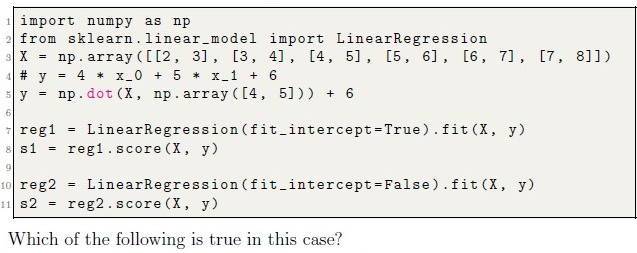
LinearRegression:
fit_intercept=True: Includes a bias term (intercept).fit_intercept=False: Forces the model through the origin.- Score (
R²): Higher forfit_intercept=Trueif data has an intercept.
SGDRegressor:
learning_rate='constant': Fixed learning rate (eta0).partial_fit: Updates model incrementally (useful for large datasets).- Loss functions:
squared_loss,huber,epsilon_insensitive.
Tree-Based Models
DecisionTreeClassifier:
Hyperparameters:
max_depth: Maximum depth of the tree.min_samples_split: Minimum samples required to split a node.criterion:gini(default) orentropy.
Attributes:
max_depth: Actual depth of the trained tree.feature_importances_: Importance of each feature.
- Maximum leaf nodes in a balanced binary tree: .
RandomForestClassifier:
max_features: Number of features to consider for splits (lower → higher variance).n_estimators: Number of trees in the forest.
Ensemble Methods
BaggingClassifier:
max_samples: Number of samples to draw for each base estimator (default: full dataset).bootstrap: Whether to sample with replacement.
AdaBoostClassifier:
- Key hyperparameters:
n_estimators,learning_rate.
- Key hyperparameters:
GradientBoostingClassifier:
- Hyperparameters:
n_estimators,learning_rate,max_depth.
- Hyperparameters:
Neural Networks
MLPClassifier/MLPRegressor:
hidden_layer_sizes: Tuple specifying neurons per layer (e.g.,(5, 3)→ 2 layers).alpha: L2 regularization strength (higher → stronger regularization).partial_fit: Incremental learning (requireswarm_start=Truefor repeated fits).
Clustering
KMeans:
- Hyperparameters:
n_clusters,init(e.g.,k-means++),max_iter. Evaluation:
- Elbow Method: Plot inertia vs.
n_clustersto find the "elbow." Silhouette Score: Measures cluster cohesion/separation (higher = better).
- Formula: , where = intra-cluster distance, = inter-cluster distance.
- Elbow Method: Plot inertia vs.
- Hyperparameters:
C. Model Evaluation
Metrics
Regression:
- Mean Squared Error (MSE): .
- R² Score: .
Classification:
- Confusion Matrix: TN, FP, FN, TP.
- ROC-AUC: Area under the ROC curve (higher = better).
- Log Loss: .
Cross-Validation
- KFold: Splits data into
kfolds (no stratification). - StratifiedKFold: Preserves class distribution in each fold.
- GridSearchCV: Exhaustive search over hyperparameter grid.
- RandomizedSearchCV: Random sampling of hyperparameter combinations.
- KFold: Splits data into
Learning Curves
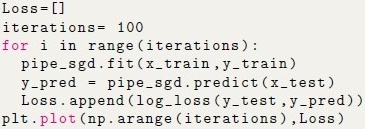
- Plot training/validation loss vs. iterations/epochs.
- Example: Track
log_lossover epochs forSGDClassifier.
D. Handling Large Datasets
Chunking:
pd.read_csv(chunksize=N): Reads file in chunks ofNrows.- Example: Incremental learning with
SGDRegressor.partial_fit.
Incremental Learning:
- Models supporting
partial_fit:SGDClassifier,GaussianNB,PassiveAggressiveClassifier.
- Models supporting
E. Dimensionality Reduction
- PCA: Not covered in the questions, but often used with
StandardScaler. - Feature Selection: Use
VarianceThresholdor model-based importance (e.g.,feature_importances_in trees).
2. Key Equations
| Concept | Equation |
|---|---|
| Standard Scaling | |
| MinMax Scaling | |
| R² Score | |
| MSE | |
| Log Loss | |
| Silhouette Score | |
| Decision Tree Leaf Nodes | (balanced binary tree) |
Graph 1: Data Preprocessing
Graph 2: Model Training
Graph 3: Model Evaluation
Graph 4: Handling Large Data
Graph 5: Clustering Evaluation
4. Exam Tips
Pandas/NumPy:
- Know
df.dropna,df.fillna,df.query, and aggregation methods (mean,median,value_counts). - Filtering:
df[df['Salary'] > 50000]ordf.loc[df['Salary'] > 50000].
- Know
Scikit-Learn:
Commands:
fit,transform,fit_transform.predictvs.predict_proba.
Hyperparameters:
- Tree depth,
n_estimators,learning_rate,alpha(regularization).
- Tree depth,
Attributes:
coef_,intercept_,feature_importances_,labels_(clustering).
Mathematics:
- Focus on scaling formulas, MSE, R², and Silhouette Score.
- Understand how
fit_interceptaffects linear models.
Algorithms:
- Decision Trees: How
max_depthandmin_samples_splitaffect overfitting. - Ensembles: Bagging vs. boosting (e.g.,
max_samplesinBaggingClassifier). - Neural Networks: Role of
alpha(regularization) andhidden_layer_sizes.
- Decision Trees: How
Evaluation:
- When to use cross-validation (e.g.,
GridSearchCV). - How to interpret learning curves (training vs. validation loss).
- When to use cross-validation (e.g.,
Large Data:
- Use
chunksizewithpd.read_csvandpartial_fitfor incremental learning.
- Use
Clustering:
- KMeans: How to choose
n_clusters(Elbow Method, Silhouette Score). - Evaluation: Silhouette Score does not require ground truth labels.
- KMeans: How to choose