Home / MLF / Week 5 / Real questions
MLF week 5 - real exam questions
50 questions pulled from past papers whose wording matches this week's topics, newest first, duplicates removed. Pick your answers, then press Check answers. Figures and answer keys are the originals.
Elapsed 00:00
Let  be a Hermitian matrix whose eigenvalues are
 Which of the following statements is/are necessarily true?
be a Hermitian matrix whose eigenvalues are Which of the following statements is/are necessarily true? is positive definite.
- There exists a nonzero vector
 such that
 , where
 denotes the conjugate transpose of
 .
- is invertible.
 is Hermitian.
Can a Hermitian matrix have an imaginary diagonal element 
- Yes
- No
Consider the matrix
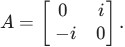 Which of the following statements is correct?
- is Hermitian only.
- is unitary only.
- is both Hermitian and unitary.
- is neither Hermitian nor unitary.
Let  be a real symmetric matrix. Consider the following statements. (1) is orthogonally diagonalizable. (2) is not diagonalizable. (3) All the eigenvalues of are real. (4) The eigenvalues of may be imaginary. (5) Eigenvectors corresponding to distinct eigenvalues of are linearly independent. (6) Eigenvectors corresponding to distinct eigenvalues of are linearly dependent. Which of the above statements are true?
- (1), (3), (5)
- (2), (4), (6)
- (2), (3), (5)
- (1), (4), (6)
Which of the following is/are Hermitian matrices?
 , where
 is a complex square matrix.
 , where is a complex square matrix.
 , where is a complex matrix, not necessarily square.
 , where is a complex square matrix.
Consider the following two matrices
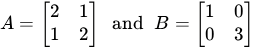 Which of the following options is/are correct

Which of the following options is/are correct  is not positive definite.
- is positive definite.
 is positive definite.
 is not positive definite.
Consider a vector  such that
 . Let
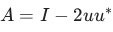 , where
 is the identity matrix. Which of the following is true?
such that . Let , where is the identity matrix. Which of the following is true?- is Hermitian and unitary.
- is Hermitian but not unitary.
- is unitary but not Hermitian.
- is neither Hermitian nor unitary.
Let
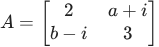 be a Hermitian matrix. Which of the following options is correct for the values of
 and
 ?
be a Hermitian matrix. Which of the following options is correct for the values of and ?

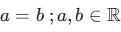

If is a real matrix of shape  , which of the following is/are true?
is a real matrix of shape , which of the following is/are true? is a positive semi-definite matrix.
 is a positive semi-definite matrix.
- is positive semi-definite if and only if is a symmetric matrix.
- is positive semi-definite if and only if is a square matrix.
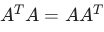
Consider the following matrix for  :
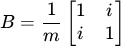 Which of the following options is/are correct?
:
Which of the following options is/are correct?- is unitary for all real values of
 other than
 .
- is unitary for
 .
- is unitary for
 .
- If , then all eigenvalues of satisfy
 .
- If is any non-zero real value, then all eigenvalues of satisfy .
Consider
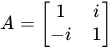 Which of the following is/are true

Which of the following is/are true  is Hermitian.
- is unitary.
- is positive semi-definite.
- is positive definite.
- is invertible.
Comprehension passage for this question
Based on the above data, answer the given subquestions.
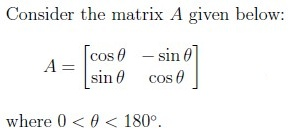
Which of the following is/are true?
- A is an orthogonal matrix
- A is invertible
- A is symmetric
Comprehension passage for this question
There is no common data for this question. There are three independent sub-questions for which you have to answer True/False.The eigenvalues of a real symmetric matrix are real.
- True
- False
Comprehension passage for this question
Based on the above data, answer the given subquestions.
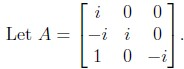
Which of the following options is /are true?
- A is not a Hermitian matrix.
- A is not a unitary matrix.
- A is diagonalizable.
- None of these

- Q is positive definite.
- Q is positive semi-definite.
- Q is negative definite.
- Q is negative semi-definite.
- None of these

- A is positive definite.
- A is positive semi-definite.
- A is negative definite.
- A is negative semi-definite.

- A is a Hermitian matrix.
- A is a unitary matrix.
- All eigenvalues of A are not real.
- Eigenvectors corresponding to different eigenvalues of A are not orthogonal.
Which of the following options is/are true regarding the projection matrix?
- It is a symmetric matrix.
- It is an orthogonal matrix.
- It is orthogonally diagonalizable.
- It is always a rank 1 matrix.
Which of the following statements about singular value decomposition (SVD) is/are true?
- Singular value decomposition is possible only for a square matrix.
- Singular value decomposition is possible only for a symmetric matrix.
- The singular values of a matrix are always non-negative.
- The singular values of matrices A and AT are the same.
Which of the following statements is/are True regarding Schur’s Theorem?
- Every square matrix is unitarily similar to an upper triangular matrix.
- The diagonal entries of the Schur form of a matrix are its eigenvalues.
- A square matrix with repeated eigenvalues cannot always be unitarily similarto an upper triangular matrix.
- Schur’s Theorem holds only for square matrices, as it requires unitarysimilarity and the presence of eigenvalues.

- A is a positive definite matrix.
- A is singular matrix.
- A is a symmetric matrix.
- A is a negative definite matrix.
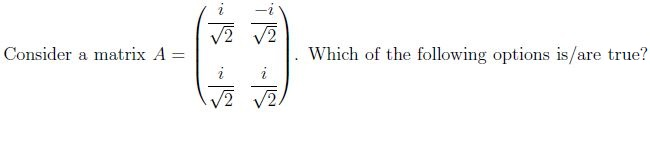
- A is a unitary matrix.
- A is Hermitian matrix.
- Eigenvectors of A are orthogonal.
- Eigenvalues of A are real.

- A is a positive definite matrix.
- A is not a singular matrix.
- A is not a symmetric matrix.
- A is a negative definite matrix.

- A is not a unitary matrix.
- A is Hermitian matrix.
- Eigenvectors of A are orthogonal.
- Eigenvalues of A are not real.

- A is positive definite.
- A is positive semi-definite.
- A is negative definite.
- A is negative semi-definite.
Consider a square matrix A of order 3 such that trace(A) = 3 and det(A) = 2. If 1 is an eigenvalue of A, then which of the following options is/are true?
- Matrix A is symmetric matrix.
- Matrix A is Hermitian matrix.
- 1 + i is an eigenvalue of A.
- 2 − i is an eigenvalue of A.
- Matrix A is diagonalizable.
Comprehension passage for this question

The matrix A is
- positive definite.
- negative definite.

- A is a Hermitian matrix.
- A is digonalizable.
- All eigenvalue of A real.
- A has eigenvalues that are neither real nor purely imaginary.
Let A be a real symmetric positive definite matrix. Which of the following options is/are true?
- The eigenvectors of A may or may not be orthogonal.
- If A is similar to a diagonal matrix B, then B is also positive definite.
- AT A is not positive definite.
- AT A is not similar to a diagonal matrix.
Consider two complex matrices A and B such that both are the Hermitian matrices. Which of the following statements is/are true?




Comprehension passage for this question

Which of the following statements is/are true about A?
- A is the Hermitian matrix.
- A is the Unitary matrix.
- All eigenvalues are real.
- Eigenvalues are complex.

- A is positive definite.
- A is positive semi-definite.
- A is negative definite.
- A is negative semi-definite.
Let A and B be symmetric matrices such that AB = BA. Then which of the following options is/are true?
- AB is a symmetric matrix.
- AB is orthogonally diagonalizable.
- BA has real eigenvalues.
- AB is not a symmetric matrix.
Let A be a n × n positive definite matrix. Then, which among the following are correct?




Let U andV be two unitary matrices. Consider the following statements: Statement 1: U + V is unitary. Statement 2: UV is unitary. Select the correct options from the following:
- Only statement 2 is correct.
- Both statement 1 and statement 2 are incorrect.
- Both statement 1 and statement 2 are correct.
- Only statement 1 is correct.

- A is Hermitian matrix.
- A is not Hermitian matrix.
- A is unitarily diagonalizable.
- A is not unitarily diagonalizable.
Comprehension passage for this question
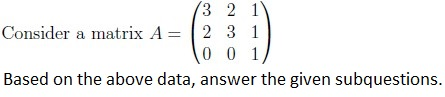
Is the matrix A positive definite?
- Yes
- No

- A − I (where I is the identity matrix of the same size) is also orthogonal.
- Both AB and BA are orthogonal.
- An and Bn are orthogonal for every n > 1.
- A and B are also symmetric matrices.
Which of the following statements is/are true for a real symmetric matrix A?
- AT A and AAT have the same rank.
- AT A and AAT have the same eigenvalues
- AT A and AAT have the same eigenvectors.
- AT A and AAT have the same singular values.
Which of the following matrices is/are Unitary but not Hermitian?

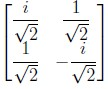
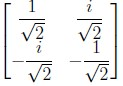

Which among the following is/are true for a Hermitian matrix?
- The eigenvalues of a Hermitian matrix are always real.
- The diagonal elements of a Hermitian matrix are always real.
- All symmetric matrices are Hermitian.
- All Hermitian matrices are symmetric.
Which of the following options are true?
- A matrix that is both unitary and Hermitian must be a diagonal matrix.
- A matrix that is both unitary and Hermitian need not be a diagonal matrix.
- If matrix A is unitary, then A* is unitary.
- If matrix A is unitary then, A* may not be unitary.
Which among the following statements is/are true?
- If a function is positive semidefinite, then it only has a global minimum.
- If a function is positive semidefinite, then it has both global minimum andglobal maximum.
- If a function is negative semidefinite, then it only has a global maximum.
- If a function is negative semidefinite, then it has both global minimum andglobal maximum.
Which among the following functions are positive definite?
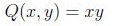


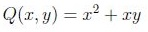
Suppose A is a symmetric positive definite matrix and Q is a orthogonal matrix, then which of the following statements is/are true?




What is the maximum possible nullity of the 4 × 4 orthogonal matrix?
Which of the following statements is/are true?
- Rank of a n × n Hermitian matrix is always equal to n.
- Rank of a n × n unitary matrix is always equal to n.
- If A is a Hermitian matrix, then AT is hermitian.
- Zero can be one of the eigen values of a unitary matrix.
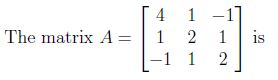
- positive definite
- positive semi-definite
- negative definite
- negative semi-definite
- None of these
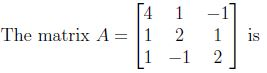
- positive definite
- positive semi-definite
- negative definite
- negative semi-definite
Which of the following statements are correct?
- Every positive definite matrix is invertible.
- A diagonal matrix with positive entries is positive definite.
- A symmetric with positive determinant is not necessarily positive definite.
- If matrix S is positive definite then S−1 may also be positive definite.