Home / Past papers / MLF End Term / this paper
IIT M DIPLOMA FN1 EXAM ETD1 11 Dec 2022 - 11 Dec 2022







- A 3 × 3 matrix can have same column space and null space.
- A 6 × 6 matrix can have same column space and null space.
- Dimension of column space is always equal to the dimension of row space.
- Column space and row space of a matrix are the same.
- Rank of a n × n Hermitian matrix is always equal to n.
- Rank of a n × n unitary matrix is always equal to n.
- If A is a Hermitian matrix, then AT is hermitian.
- Zero can be one of the eigen values of a unitary matrix.
- It is Convex function.
- Its Hessian matrix is indefinite.
- (0, 0) is a local minima of this function.
- (0, 0) is a local maxima of this function.


- 0
- 1
- 4
- 2




- Minima
- Maxima
- Saddle
- It can be either maxima or minima



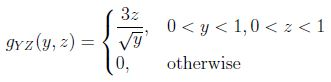
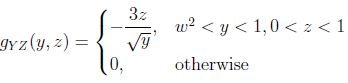
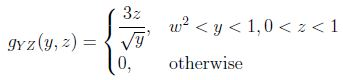

- All principal components are orthogonal to each other
- The number of principal components for n-dimensional data are at most n
- The first principal component accounts for most of the possible variability ofthe original data i.e, maximum possible variance.
- The first principal component is the eigenvector of the covariance matrixcorresponding to the maximum eigenvalue.
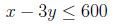
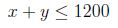
- max 12x +16y
- max 50x + 15y
- min 12x − 16y
- max 50x − 15y
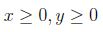

Answer key
- Q1 (SA, 2 marks): 0.4
- Q2 (SA, 2 marks): 1
- Q3 (SA, 2 marks): 1
- Q4 (SA, 2 marks): 152 to 157
- Q5 (MSQ, 3 marks): A, B, C, D
- Q6 (MSQ, 3 marks): B, C
- Q7 (MSQ, 3 marks): B, C
- Q8 (MSQ, 3 marks): B, D
- Q9 (SA, 1 marks): 0
- Q10 (SA, 3 marks): -0.39 to -0.36
- Q11 (SA, 3 marks): 5 to 7
- Q12 (SA, 3 marks): 66 to 67
- Q13 (MCQ, 2 marks): C
- Q14 (MCQ, 2 marks): C
- Q15 (MCQ, 3 marks): A
- Q16 (MCQ, 3 marks): D
- Q17 (MCQ, 4 marks): C
- Q18 (MSQ, 2 marks): A, B, C, D
- Q19 (MCQ, 1 marks): A
- Q20 (MSQ, 3 marks): A, B, C, D
Concepts this paper tests
Auto-generated summary from the source site. Handy as a checklist; the lessons above explain each idea from scratch.
Here’s a structured summary of core topics, concepts, principles, and equations essential for the "Diploma Level: Machine Learning Foundations" exam, along with Mermaid knowledge graphs to visualize relationships.
1. Core Topics & Key Concepts
A. Mathematics for Machine Learning
1. Calculus & Optimization
Limits and Continuity:
- Key Concept: A function is continuous at if .
Properties:
- Sum, product, and composition of continuous functions are continuous.
- Absolute value of a continuous function is continuous.
- Example: (since is bounded).
Lagrange Multipliers:
- Key Equation: Maximize/minimize subject to .
Steps:
- Define Lagrangian: .
- Solve .
Example: For a rectangle with perimeter , maximize area .
- Constraint: .
- Solution: (square), so .
Gradient Descent:
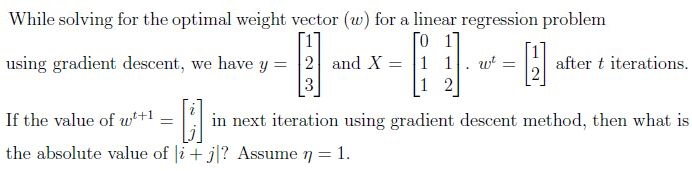
- Key Equation: .
- Example: For , compute one iteration with and initial guess .
2. Linear Algebra
Matrix Properties:
Column Space vs. Null Space:
- Column space: Span of columns of .
- Null space: Solutions to .
- Key Fact: For an matrix, if , null space is .
Hermitian and Unitary Matrices:
- Hermitian: , eigenvalues are real.
- Unitary: , eigenvalues lie on the unit circle.
Orthogonal Matrices:
- , nullity is (full rank).
Eigenvalues and Hessians:
- Hessian Matrix: .
Convexity:
- If all eigenvalues of are : Local minimum.
- If all eigenvalues are : Local maximum.
- Mixed signs: Saddle point.
- Example: For , Hessian is indefinite (eigenvalues: ).
3. Probability & Statistics
Maximum Likelihood Estimation (MLE):
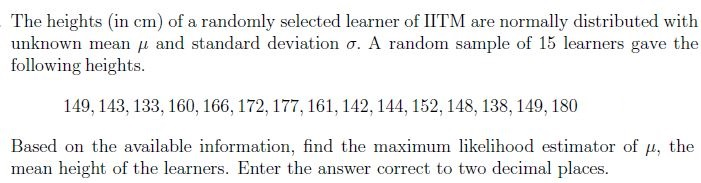
- Key Equation: For normal distribution, MLE of is the sample mean.
- Example: Given heights , MLE of is the average .
Markov’s Inequality:
- Key Equation: .
- For Exponential Distribution: (not directly Markov, but related to Chernoff bounds).
Uniform Distribution:
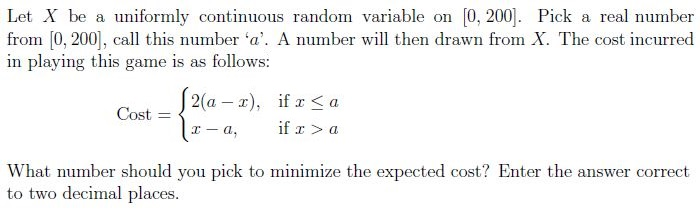
Expected Cost Minimization:
- For , minimize where:
- Optimal : Solve .
- Solution: .
Joint Distributions:
Transformation of Variables:
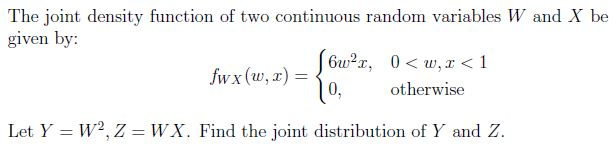
- Given , find where , .
- Use Jacobian determinant for change of variables.
4. Principal Component Analysis (PCA)
Key Properties:
- Principal components are orthogonal.
- First PC maximizes variance (eigenvector of covariance matrix with largest eigenvalue).
- Number of PCs dimensionality of data.
B. Machine Learning Foundations
1. Linear Regression
Mean Squared Loss (MSL):
- Key Equation: .
- Example: For and data , MSE = .
Gradient Descent for Regression:
- Update Rule: .
- Example: Given , compute and .
2. Optimization & KKT Conditions
Karush-Kuhn-Tucker (KKT):
Conditions for Optimality:
- Primal feasibility: , .
- Dual feasibility: .
- Complementary slackness: .
- Stationarity: .
- Example: Maximize subject to , .
3. Convexity & Positive Semi-Definiteness
Positive Semi-Definite Matrices:
- Key Condition: All eigenvalues .
Example: For , find such that is PSD.
- Hessian eigenvalues: .
- Solution: (but stricter condition may apply; here ).
2. Key Equations Summary
| Topic | Equation |
|---|---|
| Mean Squared Loss | |
| Gradient Descent | |
| Lagrange Multipliers | |
| Hessian Matrix | |
| Markov’s Inequality | |
| MLE for Normal Mean | |
| KKT Conditions | , |
| PCA Variance | |
| Positive Semi-Definite |
Graph 2: Machine Learning Foundations
Graph 3: Relationships Between Topics
4. Exam Preparation Tips
Focus on Equations:
- Memorize MSE, gradient descent update, Lagrange multipliers, and KKT conditions.
- Understand how to derive Hessians and check convexity.
Practice Calculations:
- Compute MSE for simple regression models.
- Solve optimization problems with constraints (e.g., rectangle area maximization).
- Perform one iteration of gradient descent for given functions.
Understand Proofs:
- Why is ?
- Why are eigenvalues of a Hermitian matrix real?
PCA and Statistics:
- Know how to compute MLE for normal distribution.
- Understand orthogonality in PCA and how eigenvalues relate to variance.
Probability:
- Work through expected cost minimization for uniform distributions.
- Apply Markov’s inequality to exponential distributions.
This summary covers all question types in the exam. Use the Mermaid graphs to visualize connections between topics, and prioritize equations for problem-solving.