Home / Past papers / MLF End Term / this paper
IIT M FOUNDATION DIPLOMA AN EXAM - 22 Dec 2024
Elapsed 00:00

- A is a positive definite matrix.
- A is not a singular matrix.
- A is not a symmetric matrix.
- A is a negative definite matrix.

- A is not a unitary matrix.
- A is Hermitian matrix.
- Eigenvectors of A are orthogonal.
- Eigenvalues of A are not real.
Which of the following options is/are true ?






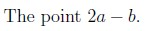

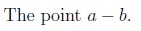
Comprehension passage - the questions below it refer to this
Based on the above data, answer the given subquestions.
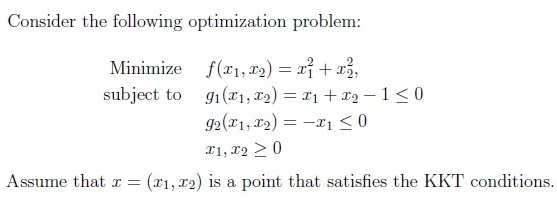
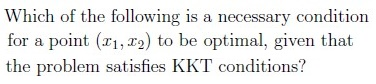

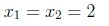

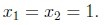
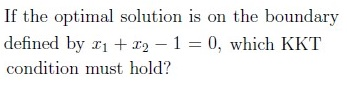
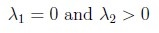



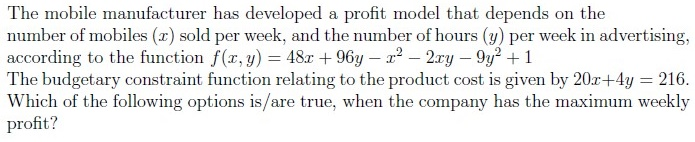
Which of the following options is/are true?


















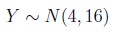
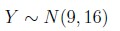
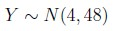

- Normal(−2, 7)
- Normal(−2, 13)
- Normal(−2, 25)
- None of these

Answer key
- Q1 (MSQ, 3 marks): A, B
- Q2 (MSQ, 3 marks): C, D
- Q3 (MSQ, 3 marks): A, B, C
- Q4 (MSQ, 3 marks): A, C
- Q5 (MCQ, 2 marks): C
- Q6 (MCQ, 3 marks): B
- Q7 (SA, 1 marks): 1
- Q8 (MSQ, 4 marks): B, D
- Q9 (MSQ, 4 marks): A, C
- Q10 (MCQ, 3 marks): D
- Q11 (MCQ, 3 marks): A
- Q12 (MCQ, 3 marks): A
- Q13 (MCQ, 2 marks): C
- Q14 (SA, 3 marks): 92
Concepts this paper tests
Auto-generated summary from the source site. Handy as a checklist; the lessons above explain each idea from scratch.
Here’s a structured summary of core topics, concepts, principles, and equations essential for the exam, followed by Mermaid knowledge graphs to visualize relationships.
Core Topics & Key Concepts
1. Linear Algebra & Matrix Properties
Quadratic Forms:
- General form: , where is symmetric.
- Positive Definite Matrix: for all .
- Singular Matrix: ⇒ at least one eigenvalue is 0.
- Symmetric Matrix: . For quadratic forms, is always symmetric (can assume ).
- Eigenvalues of and : Non-zero eigenvalues are identical.
Matrix Types:
- Unitary Matrix: (columns are orthonormal).
- Hermitian Matrix: (self-adjoint; eigenvalues are real).
- Orthogonal Eigenvectors: For symmetric/Hermitian matrices, eigenvectors are orthogonal.
Key Equations:
- Quadratic form expansion: , where:
- Determinant and nullity: .
2. Convexity
Convex Set: For any and , .
- Midpoint: is always in .
- Convex Combination: is in .
Convex Functions:
- Definition: .
Examples:
- is convex.
- is concave (but is convex).
- Composition is convex if is convex and non-decreasing, and is convex.
- Non-Convex Example: is not convex on .
3. Optimization & KKT Conditions
Karush-Kuhn-Tucker (KKT) Conditions (for constrained optimization):
- Stationarity: .
- Primal Feasibility: (for inequalities).
- Dual Feasibility: .
- Complementary Slackness: .
Boundary Conditions:
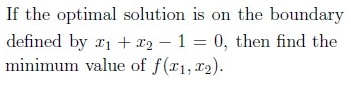
- If the optimum lies on , then .
- If , then .
Example Problem:
- Minimize subject to , .
- Optimal solution on boundary : , .
- Minimum value: .
4. Probability & Statistics
Joint/Transformed Distributions:
- For , , use the Jacobian transformation:
- Example: for , .
Order Statistics:
- For with :
Multivariate Normal Distribution:
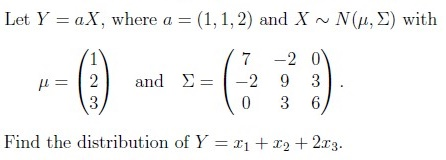
- If and , then:
- Example: .
Linear Combinations of Normals:
- If , , then:
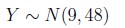
- Example: .
5. Gradient Descent
- Update Rule:
Example:
- .
- Gradient: .
- Initial point , :
- .
2. Convexity & Optimization
3. Probability & Transformations
4. Gradient Descent Workflow
Key Equations Summary
| Topic | Equation |
|---|---|
| Quadratic Form | |
| Positive Definite | for all |
| KKT Stationarity | |
| Jacobian Transformation | |
| Min of Uniforms CDF | |
| Linear Combination Norm | |
| Gradient Descent |