Home / MLT / Week 6 / Real questions
MLT week 6 - real exam questions
18 questions pulled from past papers whose wording matches this week's topics, newest first, duplicates removed. Pick your answers, then press Check answers. Figures and answer keys are the originals.
Elapsed 00:00
Which of the following statements correctly distinguishes the hard-margin SVM from the soft-margin SVM?
- The hard-margin SVM has a feasible solution only when the training data is linearly separable, whereas the soft-margin SVM always has a feasible solution.
- The hard-margin SVM allows some training points to violate the margin, whereas the soft-margin SVM forbids all margin violations.
- Increasing the regularisation parameter
 in the soft-margin SVM makes it behave less like the hard-margin SVM.
- Unlike the hard-margin SVM, the soft-margin SVM can only be used with non- linear kernels.
Assume that for a certain linear regression problem involving  features, the following weight vectors all produce an equal mean squared error:
 Which of the weight vectors is likely to be chosen by ridge regression?
features, the following weight vectors all produce an equal mean squared error: Which of the weight vectors is likely to be chosen by ridge regression?


Consider the effect of each operation below on a model's bias and variance. Which of the following statements are correct?
- Regularising the weights in a linear/logistic regression model increases bias and decreases variance.
- Increasing the maximum depth of a decision tree increases bias and decreases variance.
- Increasing the number of hidden units in a neural network decreases bias and increases variance.
- Removing all the non-support-vectors from the training set of an SVM leaves both bias and variance unchanged.
Consider one-dimensional ridge regression with no bias term. Given
 and
 , with
 , compute the optimal
 . Note that
 is
 th data point and
 is th label. (Round to 2 decimal places.)
and
, with , compute the optimal . Note that is th data point and is th label. (Round to 2 decimal places.)Consider a dataset consisting of  datapoints
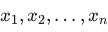 , where each
 . Let the four features be denoted by
 and
 .Suppose the features satisfy the following linear relationship:
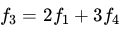 That is, one of the features is an exact linear combination of others. A linear regression model is trained to predict a target variable
 using these features. Consider the following statements: Consider the following statements: Which of the following is (are) true?
datapoints , where each . Let the four features be denoted by and .Suppose the features satisfy the following linear relationship: That is, one of the features is an exact linear combination of others. A linear regression model is trained to predict a target variable using these features. Consider the following statements: Consider the following statements: Which of the following is (are) true?- Linear regression without regularization will achieve training MSE less than or equal to that of ridge regression.
- The solution for linear regression without regularization may not be unique.
- Ridge regression (L2 regularization) will always set at least one coefficient exactly to zero.
- Lasso regression (L1 regularization) can force some feature weights to become exactly zero.
In Ridge Regression, the optimal weight vector is given by  . The regularization parameter
 is determined using 5-fold cross-validation. The following table summarizes the average Training Error and Validation Error (Mean Squared Error) obtained for various values of :
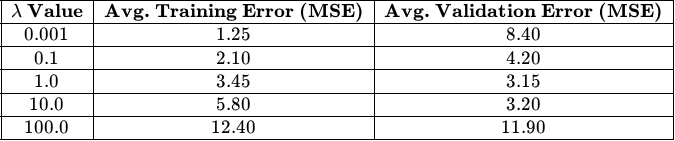 Based on the cross-validation results provided, what is the most appropriate choice for ?
. The regularization parameter is determined using 5-fold cross-validation. The following table summarizes the average Training Error and Validation Error (Mean Squared Error) obtained for various values of :
Based on the cross-validation results provided, what is the most appropriate choice for ?- 0.001
- 0.1
- 1.0
- 10.0
- 100
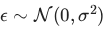
A researcher is modeling a dataset using linear regression of the form  . They are considering two different probabilistic assumptions for the independent and identically distributed (i.i.d.) noise term
 : • Assumption A: The noise follows a Gaussian distribution,
 . • Assumption B: The noise follows a Laplace distribution,
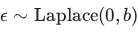 . The training dataset is known to contain several extreme outliers resulting from sensor malfunctions. Which of the following statements correctly describes the behavior of the Maximum Likelihood Estimation (MLE) for the parameter vector
 ?
. They are considering two different probabilistic assumptions for the independent and identically distributed (i.i.d.) noise term : • Assumption A: The noise follows a Gaussian distribution, . • Assumption B: The noise follows a Laplace distribution, . The training dataset is known to contain several extreme outliers resulting from sensor malfunctions. Which of the following statements correctly describes the behavior of the Maximum Likelihood Estimation (MLE) for the parameter vector ?- Under Assumption A, the MLE is equivalent to minimizing Mean Squared Error (MSE), which is highly sensitive to outliers because the penalty grows quadratically.
- Under Assumption B, the MLE is equivalent to L1 regularization, which is more robust to outliers because the penalty for large residuals grows linearly.
- Both Assumption A and Assumption B lead to the same optimal parameter vector
 regardless of the presence of outliers.
- All the given options are correct
Comprehension passage for this question
Based on the above data, answer the given subquestions.
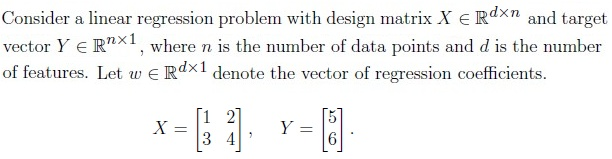
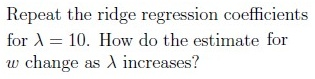
- The coefficients shrinks towards zero.
- The coefficients increases in magnitude.
- The coefficients remain unchanged.
Comprehension passage for this question
Based on the above data, answer the given subquestions.
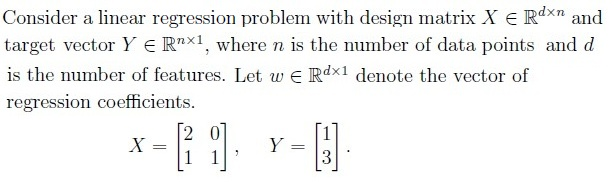
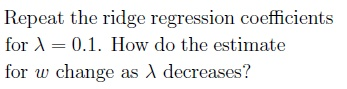
- The coefficients shrinks towards zero.
- The coefficients increases in magnitude.
- The coefficients remain unchanged.
What is the role of the regularization term in ridge regression?
- It ensures that the dataset is normally distributed.
- It penalizes large coefficients to reduce overfitting.
- It forces more coefficients to be exactly zero, performing feature selection.
- It increases the variance of the model.

- It penalizes large coefficients to reduce overfitting.
- It shrinks the coefficients but does not set them to zero.
- It forces more coefficients to be exactly zero, performing feature selection.
- It has no effect on the regression model.
Comprehension passage for this question
Based on the above data, answer the given subquestions.
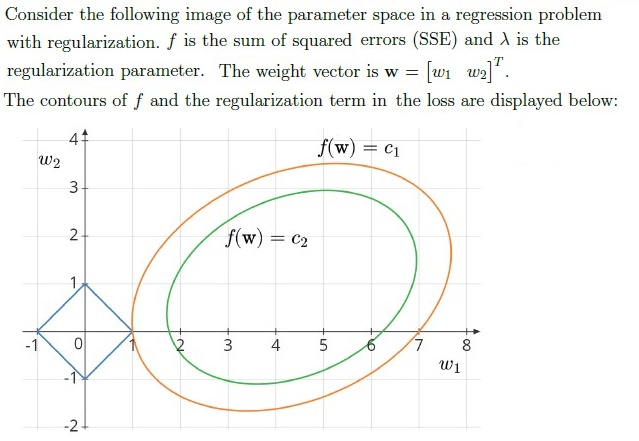
What kind of a regression problem is this?
- Ridge regression
- LASSO regression
Comprehension passage for this question
Based on the above data, answer the given subquestions.
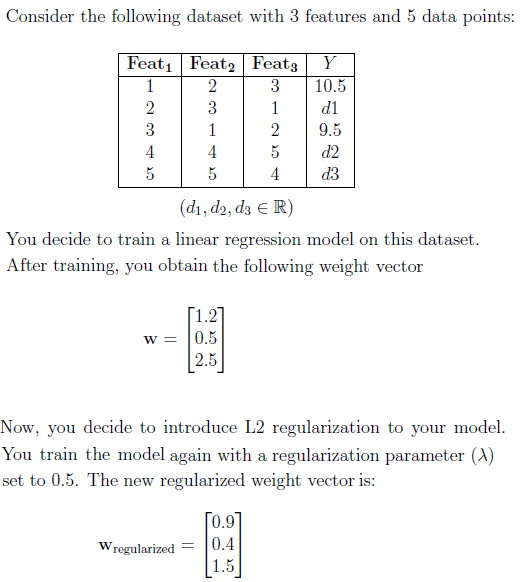
If you further reduce the regularization parameter (λ) to zero. What would be the new prediction for the target variable?
- 7.9
- 12.2
- 11.9
- None of these
Which of the following is/are the primary advantages of using L1 regularization
- L1 regularization reduces the risk of overfitting.
- L1 regularization tends to produce sparse models.
- L1 regularization always improves the model’s predictive accuracy on largedatasets.
- L1 regularization is primarily used to increase model complexity.
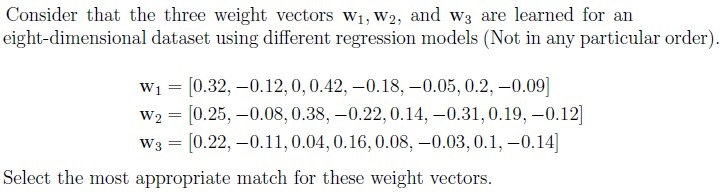
- w1 → Lasso regression, w2 → Linear regression, w3 → Ridge regression
- w1→ Ridge regression, w2 → Lasso regression, w3 → Linear regression
- w1 → Linear regression, w2 → Ridge regression, w3 → Lasso regression
- w1 → Ridge regression, w2 → Linear regression, w3 → Lasso regression
Which of the following statements is/are true?
- Ridge regression and Lasso regression both puts a limit on the length ofweight vector.
- Ridge regression puts limit on length of the weight vector but LASSOregression does not put a limit on weight vector length.
- When many features are redundant, then LASSO regression is moreappropriate than ridge regression and linear regression as LASSO regression produces sparseweights for those features.
- When many features are redundant, then linear regression is moreappropriate than ridge regression and LASSO regression
Which of the following statements is/are true regarding solution of Ridge regression problem?




In LASSO, a higher value of the regularization parameter λ leads to more sparse weights.
- TRUE
- FALSE