Home / Past papers / MLT End Term / this paper
IIT M FOUNDATION AN EXAM QDF4 31 Aug - 31 Aug 2025
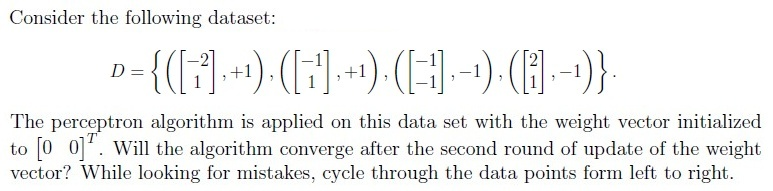
- Yes
- No









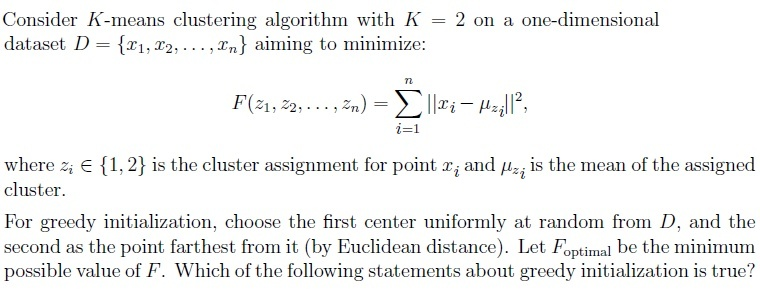
- Greedy initialization always achieves F = Foptimal by maximizing the distancebetween initial centers.
- Greedy initialization may achieve F = Foptimal or a larger value depending onthe dataset and the initial choice.
- Greedy initialization does not ensure convergence for K-means clustering.
- Greedy initialization ensures convergence to a unique solution for any dataset.




- Decision trees are prone to overfitting if the maximum depth is set tooshallow.
- Decision trees are not affected by the order of features in the dataset.
- Decision trees are sensitive to small perturbations in the dataset and canresult in different tree structures.
- Decision trees can handle both numerical and categorical features.
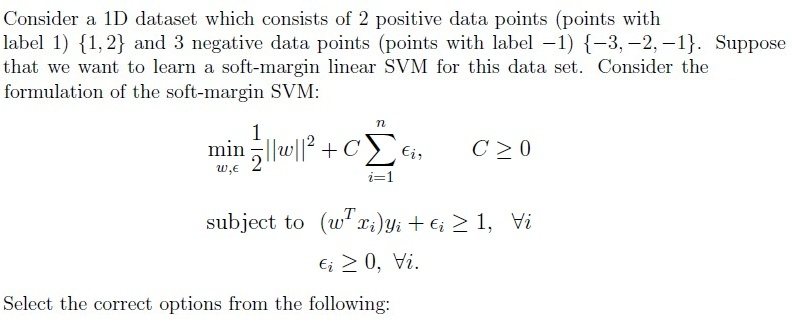








- The given data points from classes 1 and 0 can be linearly separated using ahard-margin SVM.
- A perceptron model and a hard-margin SVM can give different decisionboundary for this dataset.
- A soft-margin SVM would be a more robust choice than a hard-margin SVM forthis dataset as the dataset is not linearly separable.
- The width of the separation between the two supporting hyperplanes is 4.




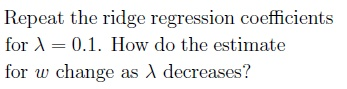
- The coefficients shrinks towards zero.
- The coefficients increases in magnitude.
- The coefficients remain unchanged.
Answer key
- Q1 (MCQ, 3 marks): B
- Q2 (MCQ, 3 marks): C
- Q3 (MCQ, 2 marks): B
- Q4 (MCQ, 2 marks): B
- Q5 (MCQ, 4 marks): D
- Q6 (MSQ, 3 marks): C, D
- Q7 (MSQ, 3 marks): A, D
- Q8 (MSQ, 3 marks): A, B
- Q9 (MSQ, 4 marks): A, B
- Q10 (SA, 3 marks): 6
- Q11 (SA, 3 marks): 1.10 to 1.14
- Q12 (SA, 3 marks): 1
- Q13 (SA, 4 marks): 0.28 to 0.34
- Q14 (MCQ, 4 marks): C
- Q15 (MCQ, 2 marks): B
- Q16 (SA, 1 marks): 7
- Q17 (SA, 3 marks): 0.0625
Concepts this paper tests
Auto-generated summary from the source site. Handy as a checklist; the lessons above explain each idea from scratch.
Here’s a structured summary of core topics, concepts, principles, and equations for the Diploma-Level Machine Learning Techniques exam, along with Mermaid knowledge graphs to visualize relationships.
Core Topics & Key Concepts
1. Perceptron Algorithm
- Concept: Linear classifier for binary classification. Updates weights iteratively if misclassification occurs.
Key Equations:
- Update rule: (if )
- Decision boundary:
- Convergence: Guaranteed if data is linearly separable (Novikoff’s theorem).
- Mistake Bound: Depends on margin and radius of data.
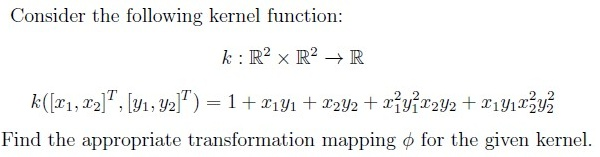
2. Kernel Methods & Feature Transformations
- Concept: Non-linear mapping of input features to higher-dimensional space using kernel functions.
Key Equations:
- Kernel trick:
- Example (Q3):
- Transformation : Must satisfy .
- Common Kernels: Linear, polynomial, RBF.
3. Support Vector Machines (SVM)
Hard-Margin SVM:
- Objective: Maximize margin .
- Constraints: .
- Support Vectors: Points lying on the margin.
Soft-Margin SVM:
- Objective: .
- Constraints: , .
Role of :
- : Ignores misclassifications (no support vectors).
- : Hard-margin behavior (all points are support vectors if separable).
4. K-Means Clustering
- Concept: Partitions data into clusters by minimizing within-cluster variance.
- Objective Function:
Initialization:
- Random: Pick points randomly.
- Greedy (K-Means++): First center random, next centers maximize distance.
- Convergence: Guaranteed to local optimum (not necessarily global).
5. Neural Networks
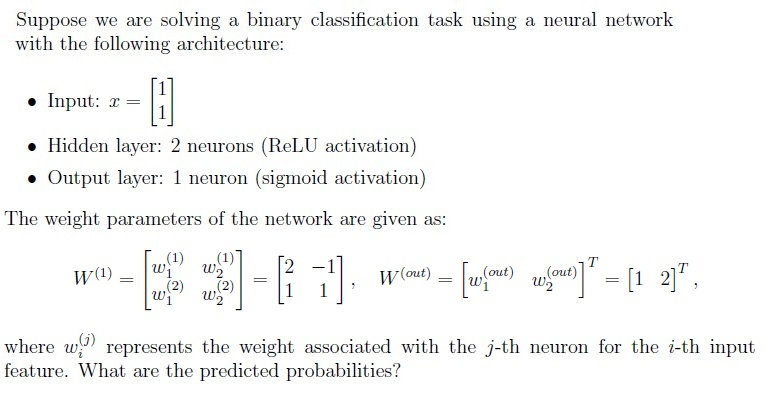
Architecture:
- Input layer → Hidden layers (ReLU, sigmoid, etc.) → Output layer.
Forward Propagation:
- Hidden layer:
- Output: (sigmoid for binary classification).
- Prediction: Output is probability .
6. Decision Trees
- Concept: Recursive partitioning of feature space.
Key Properties:
- Overfitting: Mitigated by limiting depth, pruning, or ensemble methods.
- Feature Importance: Sensitive to small data perturbations.
- Handling Data: Works for numerical and categorical features.
7. Logistic Regression
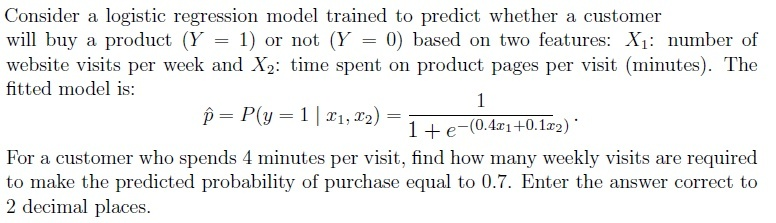
- Model: .
- Interpretation: Log-odds linear in features.
- Example (Q12): . Solve for given .
8. Random Forest
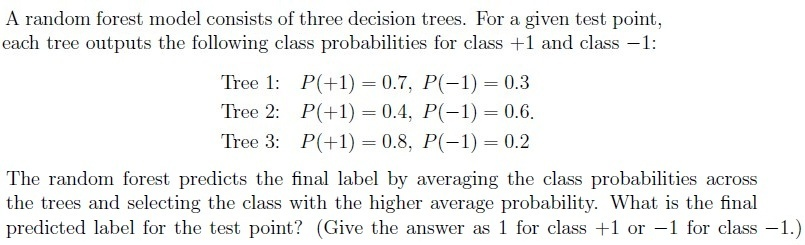
- Concept: Ensemble of decision trees. Predicts by averaging probabilities.
Example (Q13):
- Tree 1:
- Tree 2:
- Tree 3:
- Final .
9. Bayesian Methods
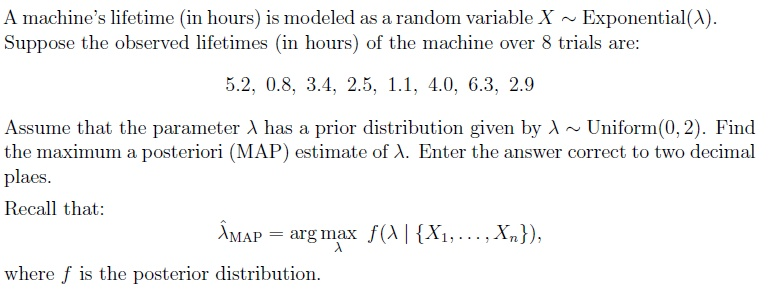
MAP Estimation: .
- Prior: .
- Likelihood: .
- Posterior: .
10. Linear Regression & Ridge Regression
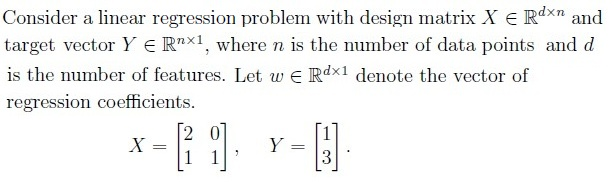
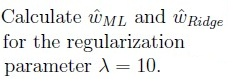
- Ordinary Least Squares (OLS): .
Ridge Regression: .
Effect of :
- High : Shrinks coefficients toward zero.
- Low : Coefficients approach OLS solution.
11. Naive Bayes
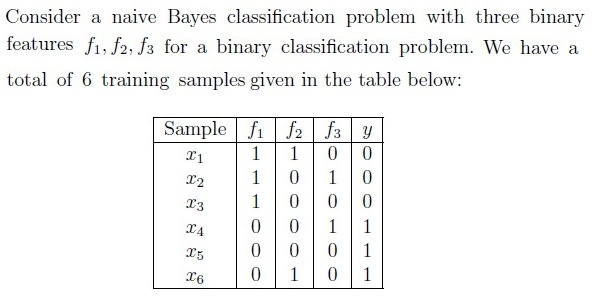
- Concept: Assumes feature independence given class.
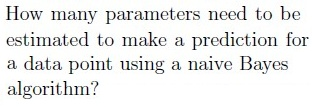
Parameters:
- For binary features and classes: for each feature-class pair.
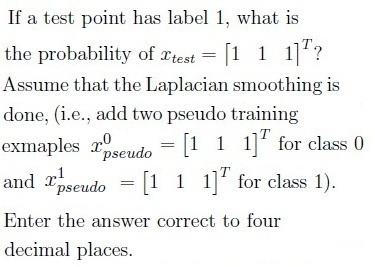
- Laplace Smoothing: Adds pseudo-counts to avoid zero probabilities.
Example (Q17-18):
- 3 binary features → 2 (class priors) + 3 × 2 (feature probabilities) = 8 parameters.
- With smoothing: 7 parameters (since one probability is determined by others).
12. Covariance & PCA
- Covariance Matrix: .
- Eigenvalues: Represent variance along principal components.
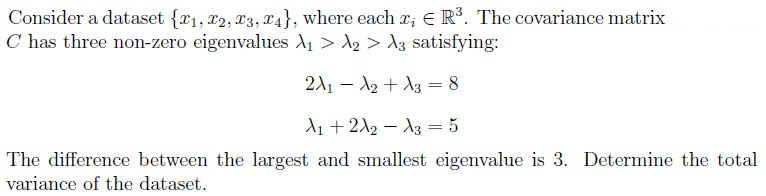
- Total Variance: Sum of eigenvalues .
Graph 2: Unsupervised Learning Relationships
Graph 3: Probabilistic Models
Graph 4: Regularization & Optimization
Key Equations Summary
| Topic | Equation |
|---|---|
| Perceptron Update | (if misclassified) |
| SVM Hard Margin | s.t. |
| SVM Soft Margin | |
| Kernel Trick | |
| Logistic Regression | |
| K-Means Objective | |
| Ridge Regression | |
| Naive Bayes | |
| MAP Estimation | |
| Covariance Matrix |
This summary covers all questions in the exam, emphasizing equations, concepts, and relationships. The Mermaid graphs provide a visual hierarchy of topics. Focus on derivations (e.g., SVM constraints, kernel transformations) and practical implications (e.g., effect of in SVM, in Ridge).