Home / Past papers / MLT End Term / this paper
IIT M DIPLOMA ET1 EXAM QPD1 S2 30 Apr 2023 - 30 Apr 2023
Elapsed 00:00




- 1
- 3
- 5
In LASSO, a higher value of the regularization parameter λ leads to more sparse weights.
- TRUE
- FALSE
Consider a decision stump. The information gain for the question at the parent is zero. If the entropy of the left-child is equal to the entropy of the parent, what is the entropy of the right child? Assume that each child has at least one data-point in it and that the entropy of the parent is non-zero.
- The entropy of the right-child is equal to half the entropy of the left-child.
- The entropy of the right-child is equal to twice the entropy of the left-child.
- The entropy of the right-child is equal to the entropy of the parent.
- The entropy of the right-child is the sum of the entropies of the parent and theleft-child.
- Yes, it will certainly converge to a weight vector.
- No, it will never converge.
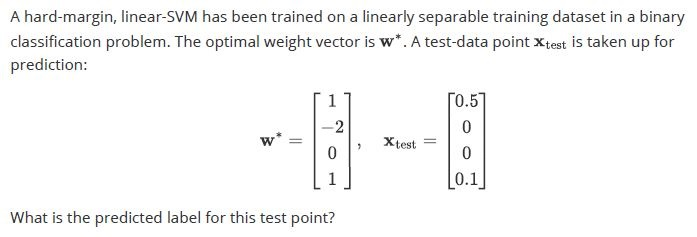
- w shown in this diagram is the optimal weight vector for a hard-margin, linear-SVM
- w shown in this diagram is not the optimal weight vector for a hard-margin,linear-SVM





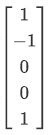

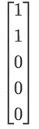
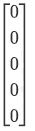












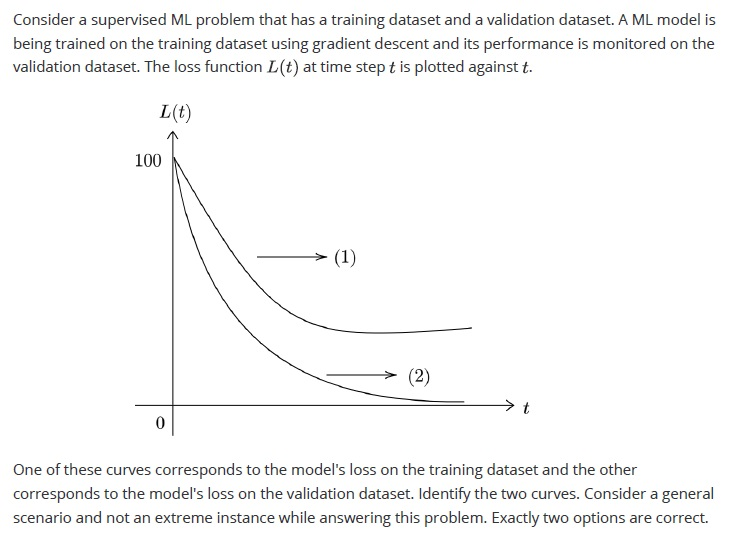
- (1) is the loss on the validation dataset
- (2) is the loss on the training dataset
- (1) is the loss on the training dataset
- (2) is the loss on the validation dataset





Choose the correct statements.
- If the performance of each estimator in the bagging algorithm is almostidentical, the benefit of using bagging to combine them may be minimal or insignificant.
- Weak learners have low bias and high variance.
- In random forests, multiple decision trees (estimators) are trainedsimultaneously, allowing for parallel processing and faster model training.
- In the random forest algorithm, multiple decision trees are trained on thesame dataset to create an ensemble model.
Comprehension passage - the questions below it refer to this
Based on the above data, answer the given subquestions.
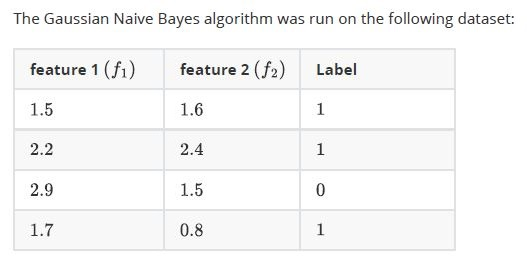
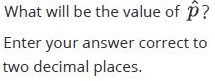

- 2.9
- 2.2
- (1.8,1.6)
- (2.9,1.5)

- 2.9
- 1.8
- (1.8,1.6)
- (2.9,1.5)
Comprehension passage - the questions below it refer to this
Based on the above data, answer the given subquestions.
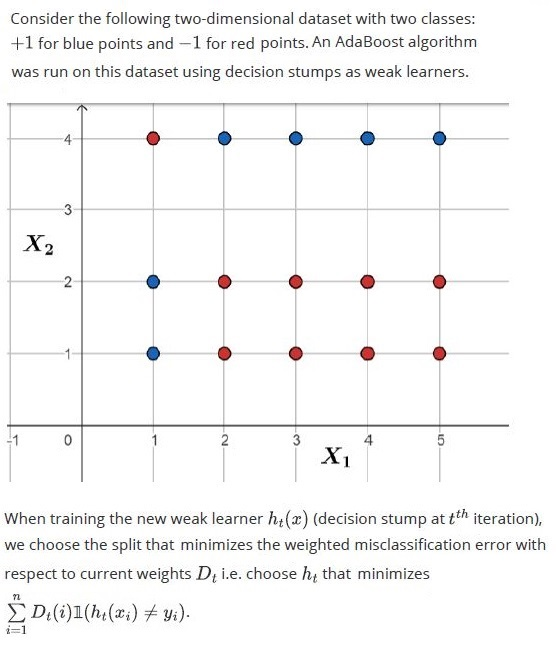
What will be the misclassification error incurred by the first decision stump?
To train the second decision stump, which pair of points will be assigned equal weights to create the training dataset?
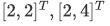
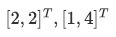
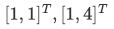
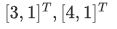
What weight will be assigned to the point [1, 1]T when training the second decision stump, assuming the weights are not normalized to add up to one? Please enter your answer rounded to two decimal places.
Answer key
- Q1 (MCQ, 5 marks): D
- Q2 (MCQ, 5 marks): C
- Q3 (MCQ, 5 marks): A
- Q4 (MCQ, 5 marks): C
- Q5 (MCQ, 5 marks): B
- Q6 (MCQ, 5 marks): B
- Q7 (MCQ, 5 marks): A
- Q8 (MCQ, 5 marks): C
- Q9 (MSQ, 5 marks): A, D
- Q10 (MSQ, 5 marks): A, B
- Q11 (MSQ, 5 marks): B, D
- Q12 (MSQ, 5 marks): A, B
- Q13 (MSQ, 3 marks): B, D
- Q14 (MSQ, 3 marks): A, C
- Q15 (SA, 5 marks): 2
- Q16 (SA, 5 marks): 2
- Q17 (SA, 5 marks): 1
- Q18 (SA, 5 marks): 460
- Q19 (SA, 1 marks): 0.74 to 0.76
- Q20 (MCQ, 2 marks): D
- Q21 (MCQ, 2 marks): C
- Q22 (SA, 3 marks): 0.2
- Q23 (MSQ, 3 marks): A, C, D
- Q24 (SA, 3 marks): 0.11 to 0.15
Concepts this paper tests
Auto-generated summary from the source site. Handy as a checklist; the lessons above explain each idea from scratch.
Here’s a structured summary of core topics, concepts, principles, and equations essential for the exam, followed by Mermaid knowledge graphs to visualize relationships.
Core Topics & Concepts
1. Kernel Methods & Feature Transformations
- Kernel Trick: Maps data to higher dimensions implicitly (e.g., polynomial kernels).
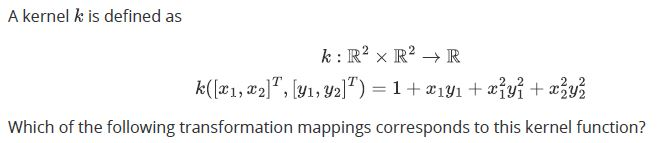
- Kernel Function: Example (Q2): Corresponding Feature Map (Q2):
2. Bayesian Estimation
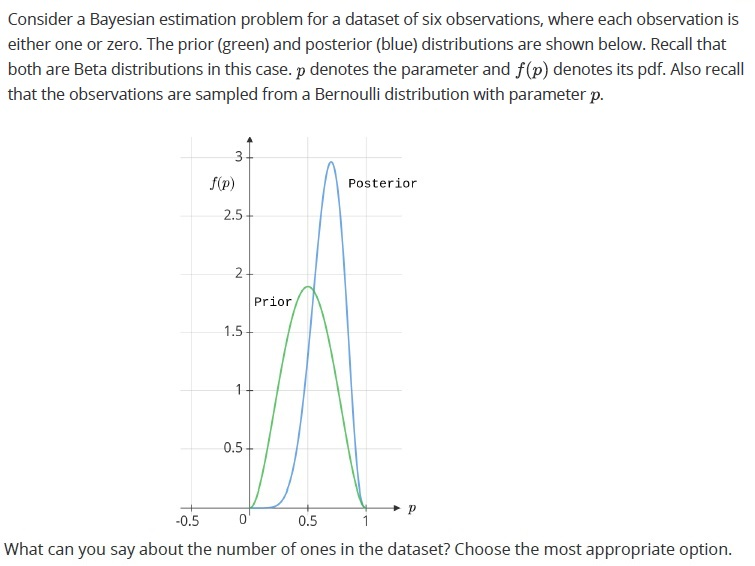
Prior/Posterior Distributions:
- Prior: (e.g., Beta distribution for Bernoulli data).
- Posterior: .
- Bernoulli Likelihood: .
- Beta-Bernoulli Conjugacy: Posterior is Beta with updated parameters: , .
- Key Insight (Q3): If posterior mode > prior mode, likely more successes (e.g., 5 successes in 6 trials).
3. Regularization (LASSO, Ridge)
LASSO (L1 Regularization): .
- Sparsity: Higher → more weights set to 0 (Q4).
Ridge (L2 Regularization): .
- Smooths weights but doesn’t enforce sparsity.
4. Decision Trees & Information Gain
- Information Gain (IG): , where is entropy.
- Entropy: .
- Key Insight (Q5): If , children’s entropy = parent’s entropy. If one child’s entropy = parent’s entropy, the other must also equal it (symmetry).
5. Perceptron & Linear Separability
- Perceptron Update Rule: if misclassified.
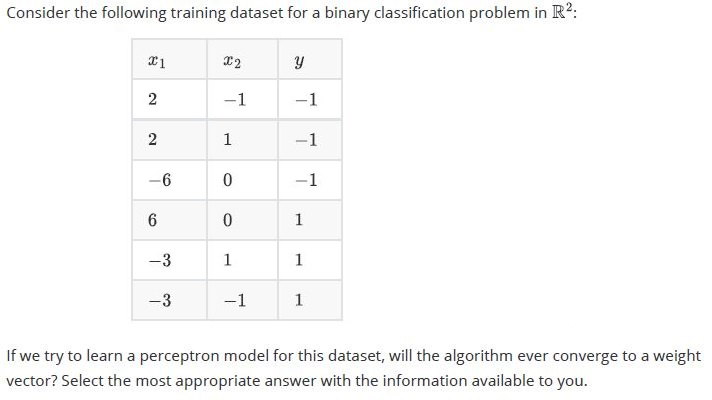
- Convergence: Converges only if data is linearly separable (Q6). If not separable, weights oscillate indefinitely.
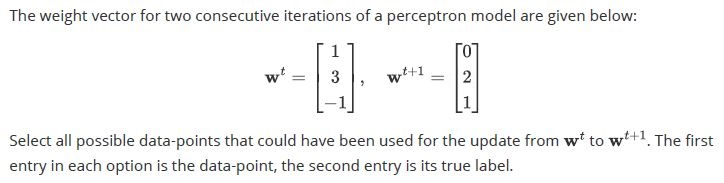
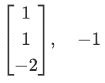
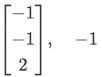
- Weight Update Analysis (Q11): Given and , solve for and such that: .
6. Support Vector Machines (SVM)
Hard-Margin SVM
- Primal Problem: s.t. .
- Dual Problem: s.t. , .
Key Insights:
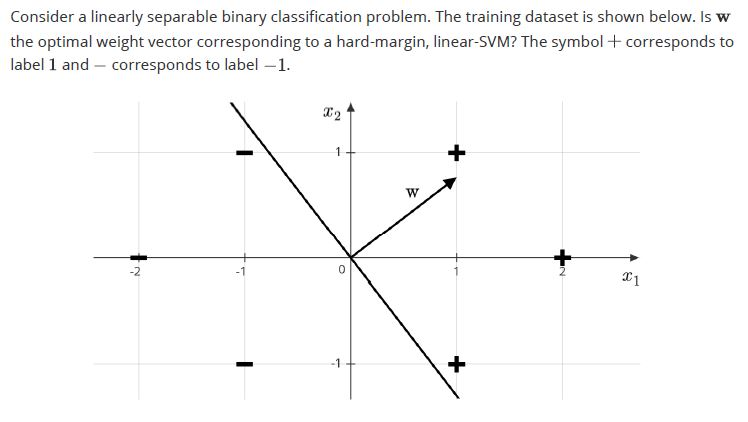
- Optimal (Q8).
- Support vectors have (Q9).
- If , point is correctly classified with margin > 1 (Q14).
Soft-Margin SVM
- Primal with Slack: s.t. , .
- Dual: s.t. , .
KKT Conditions:
- If , point is correctly classified or (Q14).
7. Linear Regression & Loss Functions
- Squared Loss: .
Impact of Features/Regularization (Q10):
- More features (): Can reduce training loss (but risk overfitting).
- More data (): May not reduce training loss (focuses on generalization).
- Regularization (L1/L2): Increases training loss (penalizes complexity).
- Learning rate: Smaller rates may refine convergence but don’t directly reduce loss.
8. Loss Function Properties (Q12)
| Loss Function | Formula | Convex? | Key Properties |
|---|---|---|---|
| Hinge Loss | Yes | Used in SVM; linear for misclassified pts. | |
| Logistic Loss | Yes | Smooth; used in logistic regression. | |
| Squared Loss | Yes | Sensitive to outliers. | |
| 0-1 Loss | No | Non-convex; used for error rate. |
Key Comparisons (Q12):
- For : Logistic loss > Hinge loss (hinge = 0).
- Squared loss grows quadratically for large .
9. Training vs. Validation Curves (Q13)
- Training Loss: Decreases monotonically with training (optimization).
- Validation Loss: Decreases initially, then may increase (overfitting).
Identification:
- Curve 1 (lower, decreasing): Training.
- Curve 2 (higher, U-shaped): Validation.
10. PCA (Principal Component Analysis)
Steps:
- Center data: .
- Compute covariance matrix .
- Eigenvalue decomposition: .
- Project onto top- eigenvectors (principal components).
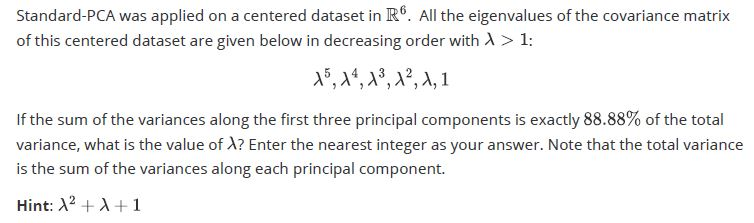
- Variance Explained (Q16): . . Given and top-3 variance = 88.88%: . Solve for .
11. K-Means Clustering
Algorithm:
- Initialize centroids .
- Assign points to nearest centroid (Euclidean distance).
- Recompute centroids as mean of assigned points.
- Repeat until convergence.
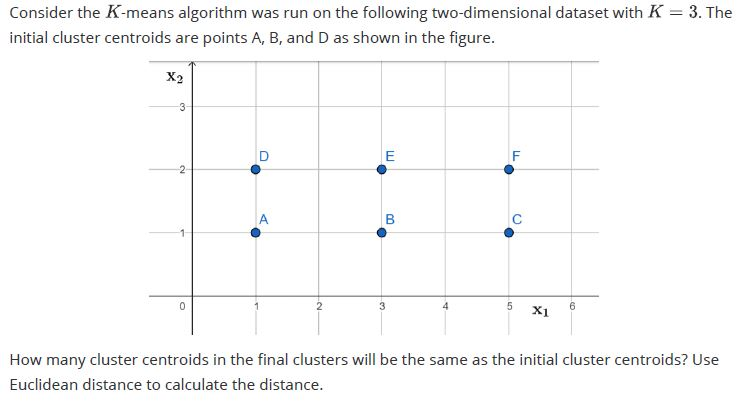
- Key Insight (Q17): Final centroids may coincide with initial centroids if points are symmetrically distributed.
12. Logistic Regression
- Sigmoid Function: .
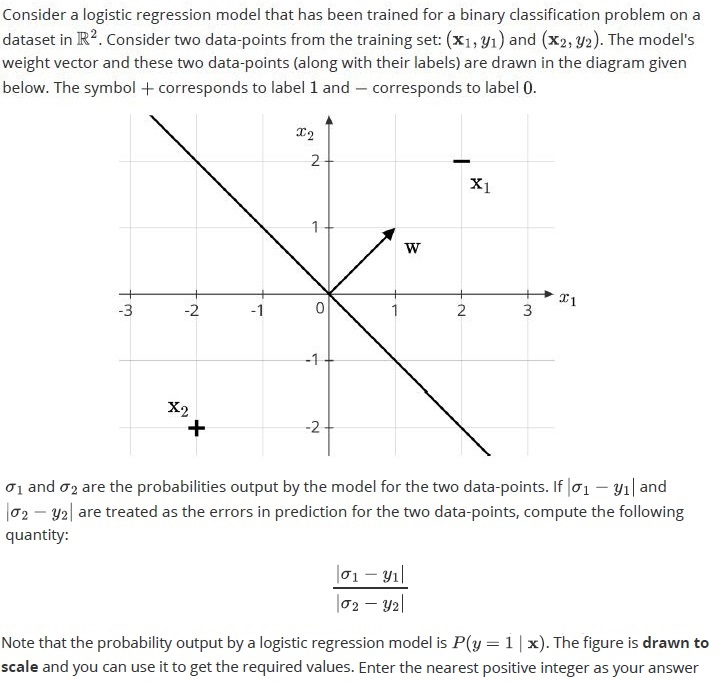
- Prediction Error (Q18): : Absolute difference between predicted probability and true label.
- Geometric Interpretation: Points farther from the decision boundary have closer to 0 or 1.
13. Neural Networks
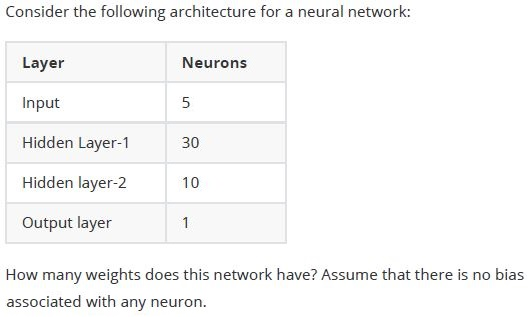
- Weight Calculation (Q19): For a fully connected network with layers , total weights: . Example: : .
14. Gaussian Naive Bayes
Assumptions:
- Features are conditionally independent given the class.
- Likelihood is Gaussian: .
Parameters (Q20–Q22):
- : Prior probability of class 1.
- : Mean of features for class .
- : Sample mean of class 1 features.
15. AdaBoost
- Weighted Misclassification Error (Q23–Q25): .
- Weight Update: , where .
- Key Insight: Misclassified points get higher weights in next iteration.
16. Ensemble Methods (Bagging, Random Forest)
Bagging (Q15):
- Trains multiple models on bootstrapped samples.
- Reduces variance (helps if base estimators are high-variance/low-bias).
- If estimators are identical, bagging offers no benefit.
Random Forest:
- Extends bagging by random feature subsets.
- Parallelizable (independent trees).