Home / MLT / Week 5 / Real questions
MLT week 5 - real exam questions
50 questions pulled from past papers whose wording matches this week's topics, newest first, duplicates removed. Pick your answers, then press Check answers. Figures and answer keys are the originals.
Elapsed 00:00
Assume that for a certain linear regression problem involving  features, the following weight vectors all produce an equal mean squared error:
 Which of the weight vectors is likely to be chosen by ridge regression?
features, the following weight vectors all produce an equal mean squared error: Which of the weight vectors is likely to be chosen by ridge regression?


Consider the following dataset with two binary features 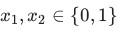 and binary label
 :
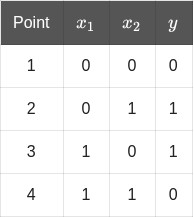 Consider the following three claims about this dataset: (i) Logistic regression (using the raw features
 , with or without a bias term) can achieve zero training error. (ii) A decision tree of depth at most
 , using axis-aligned splits on , can achieve zero training error. (iii)
 -nearest-neighbour, evaluated on this training set, achieves zero training error. Consider each point is its own nearest neighbour. Select the option that lists exactly the claims that are true.
and binary label :
Consider the following three claims about this dataset: (i) Logistic regression (using the raw features , with or without a bias term) can achieve zero training error. (ii) A decision tree of depth at most , using axis-aligned splits on , can achieve zero training error. (iii) -nearest-neighbour, evaluated on this training set, achieves zero training error. Consider each point is its own nearest neighbour. Select the option that lists exactly the claims that are true.- (i), (ii) and (iii)
- Only (ii) and (iii)
- Only (i) and (iii)
- Only (iii)
Suppose the dataset is initially linearly separable. Later, the data-generating process changes and the class boundary becomes highly nonlinear, for example:  for one class and
 for the other. Without manually creating nonlinear features, which classifier among the three is most naturally capable of representing this type of decision boundary?
for one class and for the other. Without manually creating nonlinear features, which classifier among the three is most naturally capable of representing this type of decision boundary?- Perceptron
- Logistic Regression
- Decision Tree
- None of these
Suppose the true data-generating process is a polynomial of degree . You fit three models to the data: linear regression, polynomial regression of degree , and polynomial regression of degree  . Which option correctly characterizes the bias and variance of each fitted model relative to the true model?
. You fit three models to the data: linear regression, polynomial regression of degree , and polynomial regression of degree . Which option correctly characterizes the bias and variance of each fitted model relative to the true model?- Linear: low bias, low variance; degree- : low bias, high variance; degree- : high bias, high variance.
- Linear: high bias, high variance; degree- : low bias, low variance; degree- : high bias, low variance.
- Linear: low bias, high variance; degree- : high bias, low variance; degree- : low bias, high variance.
- Linear: high bias, low variance; degree- : low bias, low variance; degree- : low bias, high variance.
Consider logistic regression on one-dimensional data, with  (the model is
 ). The current weight is
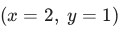
 , the training set is a single example
 , and the step size is
 . Gradient ascent is performed directly on the log-likelihood of the data. Compute
 after one gradient-ascent step. (Round to decimal places; enter
 if it cannot be determined.)
(the model is ). The current weight is , the training set is a single example , and the step size is . Gradient ascent is performed directly on the log-likelihood of the data. Compute after one gradient-ascent step. (Round to decimal places; enter if it cannot be determined.)In logistic regression, a point is classified positive only if  . What score threshold
 (with
 at the boundary of this rule) does this correspond to? (Round to decimal places.)
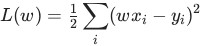
. What score threshold (with at the boundary of this rule) does this correspond to? (Round to decimal places.)Consider one-dimensional linear regression with no bias term,  . The squared-error objective over the training set is
 . The dataset is
 . Starting from
 with learning rate
 perform one gradient-descent step. What is the model's prediction at
 ?
. The squared-error objective over the training set is
. The dataset is . Starting from with learning rate perform one gradient-descent step. What is the model's prediction at ?Consider binary classification on input features  . Define the decision boundary of a trained classifier as the set of points at which its predicted label changes. For which of the following method(s) can this decision boundary be non-linear in
 ?
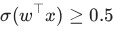
. Define the decision boundary of a trained classifier as the set of points at which its predicted label changes. For which of the following method(s) can this decision boundary be non-linear in ?- Perceptron.
- Logistic regression, predicting the positive class when
 .
- -nearest-neighbour with Euclidean distance.
- A decision tree using axis-aligned splits.
- Gaussian Naïve Bayes in which the class-conditional feature variances differ between the two classes.
- A support vector machine with a linear kernel.
- A support vector machine with an RBF (Gaussian) kernel.
Consider the effect of each operation below on a model's bias and variance. Which of the following statements are correct?
- Regularising the weights in a linear/logistic regression model increases bias and decreases variance.
- Increasing the maximum depth of a decision tree increases bias and decreases variance.
- Increasing the number of hidden units in a neural network decreases bias and increases variance.
- Removing all the non-support-vectors from the training set of an SVM leaves both bias and variance unchanged.
In logistic regression, a point is classified positive only if  . What score threshold (with at the boundary of this rule) does this correspond to? (Round to 2 decimal places.)
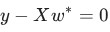
Let  be the solution to the ordinary least-squares linear regression problem
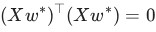
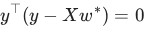
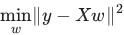 . Which of the following is always satisfied at ? Note that here
 is your feature matrix and
 is the label vector.
be the solution to the ordinary least-squares linear regression problem
. Which of the following is always satisfied at ? Note that here is your feature matrix and is the label vector.
Consider one-dimensional ridge regression with no bias term. Given
 and
 , with
 , compute the optimal
 . Note that
 is
 th data point and
 is th label. (Round to 2 decimal places.)
and
, with , compute the optimal . Note that is th data point and is th label. (Round to 2 decimal places.)Consider a binary classification dataset in which the two classes are perfectly linearly separable. You are considering a Perceptron, Logistic Regression, and a Decision Tree. If the objective is to learn a linear decision boundary and no probability estimates are required, which of the following classifiers are appropriate choices?
- Perceptron only
- Logistic Regression only
- Both Perceptron and Logistic Regression
- Decision Tree only
Under the probabilistic view of linear regression, assume 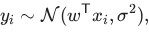 where the observations are independent. Suppose the true noise variance is
 instead of
 , while the dataset and the observed labels remain unchanged. What happens to the maximum likelihood estimator

where the observations are independent. Suppose the true noise variance is instead of , while the dataset and the observed labels remain unchanged. What happens to the maximum likelihood estimator
- It is unchanged.
- It is scaled by .
- It is scaled by
 .
- It cannot be determined without knowing .
On a machine that folds plastic film, the operating temperature can be varied between  and
 . To study the relationship between temperature and fold thickness,
 observations of temperature and the corresponding fold thickness were collected. The scatter plot along with the fitted simple linear regression line is shown below.
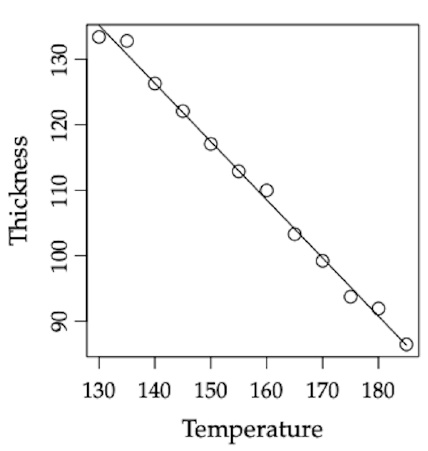 Determine, by inspecting the figure, which of the following sets of parameter estimates for the simple linear regression model is most appropriate. Note: The regression model is
 where
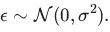 Here,
 is the estimated intercept,•
 is the estimated slope, and•
 is the estimated standard deviation of the error term.•
and . To study the relationship between temperature and fold thickness, observations of temperature and the corresponding fold thickness were collected. The scatter plot along with the fitted simple linear regression line is shown below.
Determine, by inspecting the figure, which of the following sets of parameter estimates for the simple linear regression model is most appropriate. Note: The regression model is where Here, is the estimated intercept,• is the estimated slope, and• is the estimated standard deviation of the error term.•




A student  minimizes the sum of squared errors (SSE) loss
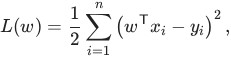 while another student
 minimizes the mean squared error (MSE) loss
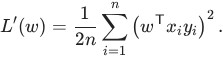 Both students use gradient descent with the same learning rate
 and the same initial parameter vector
 . Which one of the following statements is correct?
minimizes the sum of squared errors (SSE) loss
while another student minimizes the mean squared error (MSE) loss
Both students use gradient descent with the same learning rate and the same initial parameter vector . Which one of the following statements is correct?- They converge to different minimizers, because the losses differ.
- They converge to the same minimizer, but 's steps are
 times smaller; would need learning rate
 to reproduce 's trajectory.
- They converge to the same minimizer, and their iterates coincide at every step.
- They converge to the same minimizer, but 's steps are times larger.
Suppose the label vector  is orthogonal to every feature vector, i.e.
 for all
 . is the optimal weight obtained after minimizing the objective function of linear regression. Which statement is correct?
is orthogonal to every feature vector, i.e. for all . is the optimal weight obtained after minimizing the objective function of linear regression. Which statement is correct? and the training error is
 .
 and the squared training error equals
 .
- and the squared training error equals .
- The normal equations have no solution.
Consider a regression problem in which we use a neural network with the following architecture: Input layer has  neurons• Two hidden layers, each with
 neurons• Output layer with one neuron• Find the total number of parameters in the network. Ignore the biases.
neurons• Two hidden layers, each with neurons• Output layer with one neuron• Find the total number of parameters in the network. Ignore the biases.Consider a logistic regression classifier trained on a dataset for a binary classification problem with features in  and labels in
 . The weight vector learnt by the classifier is
 . Given a test data-point
 , the probability
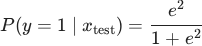 , where
 is the base of the natural logarithm. Find the value of
 and enter the nearest integer as your answer.
and labels in . The weight vector learnt by the classifier is . Given a test data-point , the probability
, where is the base of the natural logarithm. Find the value of and enter the nearest integer as your answer.Consider a dataset with two data-points for a binary classification problem with features in  .
 is a data-point from the positive class while
 is from the negative class. We now consider three linear classifiers: perceptron, logistic regression and SVM.
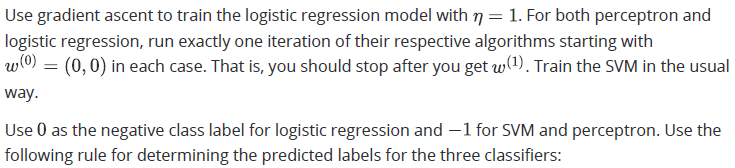 If
 is the weight vector with the largest margin, which of the following is true?

. is a data-point from the positive class while is from the negative class. We now consider three linear classifiers: perceptron, logistic regression and SVM.
If is the weight vector with the largest margin, which of the following is true?
- All three classifiers output

- Only SVM outputs
- Only SVM and perceptron output
- Only perceptron and logistic regression output
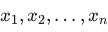
Consider a dataset consisting of  datapoints
 , where each
 . Let the four features be denoted by
 and
 .Suppose the features satisfy the following linear relationship:
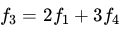 That is, one of the features is an exact linear combination of others. A linear regression model is trained to predict a target variable
 using these features. Consider the following statements: Consider the following statements: Which of the following is (are) true?
datapoints , where each . Let the four features be denoted by and .Suppose the features satisfy the following linear relationship: That is, one of the features is an exact linear combination of others. A linear regression model is trained to predict a target variable using these features. Consider the following statements: Consider the following statements: Which of the following is (are) true?- Linear regression without regularization will achieve training MSE less than or equal to that of ridge regression.
- The solution for linear regression without regularization may not be unique.
- Ridge regression (L2 regularization) will always set at least one coefficient exactly to zero.
- Lasso regression (L1 regularization) can force some feature weights to become exactly zero.
Consider a binary classification problem using logistic regression. The model predicts the probability of class  as:
 A threshold of
 is used for classification. The predicted class label is given by:
 The values of
 for the following datapoints are:
 How many datapoints will be classified as class ?
as:
A threshold of is used for classification. The predicted class label is given by:
The values of for the following datapoints are: How many datapoints will be classified as class ?Consider a regression problem in which we use a neural network with the following architecture: • Input layer has  neurons • Three hidden layers, each with neurons • Output layer with one neuron Find the total number of parameters in the network. Ignore the biases.
Consider a linear regression model applied to a dataset in which each data-point is described by two features. The first feature is always  . The
 data-point's feature-label pair is represented as
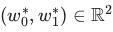
 . Let
 be the optimal weight vector that minimizes the sum of squared errors. Consider two scenarios:
 :
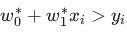 , for each data-point .
 :
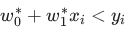 , for each data-point . Which of the following is true?
. The data-point's feature-label pair is represented as . Let be the optimal weight vector that minimizes the sum of squared errors. Consider two scenarios: : , for each data-point . : , for each data-point . Which of the following is true? is possible, but
 is impossible.
- is impossible, but is possible.
- One of or is possible.
- Both and are impossible.
In Ridge Regression, the optimal weight vector is given by  . The regularization parameter
 is determined using 5-fold cross-validation. The following table summarizes the average Training Error and Validation Error (Mean Squared Error) obtained for various values of :
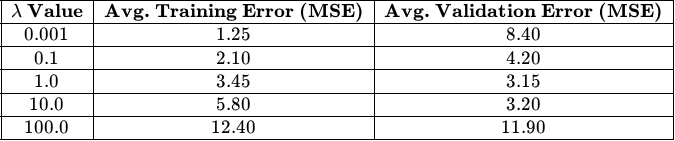 Based on the cross-validation results provided, what is the most appropriate choice for ?
. The regularization parameter is determined using 5-fold cross-validation. The following table summarizes the average Training Error and Validation Error (Mean Squared Error) obtained for various values of :
Based on the cross-validation results provided, what is the most appropriate choice for ?- 0.001
- 0.1
- 1.0
- 10.0
- 100
A researcher is modeling a dataset using linear regression of the form  . They are considering two different probabilistic assumptions for the independent and identically distributed (i.i.d.) noise term
 : • Assumption A: The noise follows a Gaussian distribution,
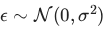 . • Assumption B: The noise follows a Laplace distribution,
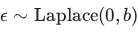 . The training dataset is known to contain several extreme outliers resulting from sensor malfunctions. Which of the following statements correctly describes the behavior of the Maximum Likelihood Estimation (MLE) for the parameter vector
 ?
. They are considering two different probabilistic assumptions for the independent and identically distributed (i.i.d.) noise term : • Assumption A: The noise follows a Gaussian distribution, . • Assumption B: The noise follows a Laplace distribution, . The training dataset is known to contain several extreme outliers resulting from sensor malfunctions. Which of the following statements correctly describes the behavior of the Maximum Likelihood Estimation (MLE) for the parameter vector ?- Under Assumption A, the MLE is equivalent to minimizing Mean Squared Error (MSE), which is highly sensitive to outliers because the penalty grows quadratically.
- Under Assumption B, the MLE is equivalent to L1 regularization, which is more robust to outliers because the penalty for large residuals grows linearly.
- Both Assumption A and Assumption B lead to the same optimal parameter vector
 regardless of the presence of outliers.
- All the given options are correct
Let the linear regression model's solution be written as  , where
 . Let
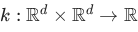 be a valid kernel function. What will be the prediction for an unseen data point
 ?
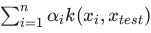
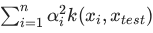
, where . Let be a valid kernel function. What will be the prediction for an unseen data point ?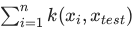

Perform a 3-NN regressor for the following dataset:
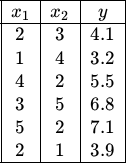 where,
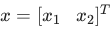 is a feature vector and is the label. What will be the predicted value for the test data point
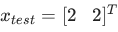 ? ___________ Enter the answer correct to one decimal place.
where, is a feature vector and is the label. What will be the predicted value for the test data point ? ___________ Enter the answer correct to one decimal place.Comprehension passage for this question
Based on the above data, answer the given subquestions.
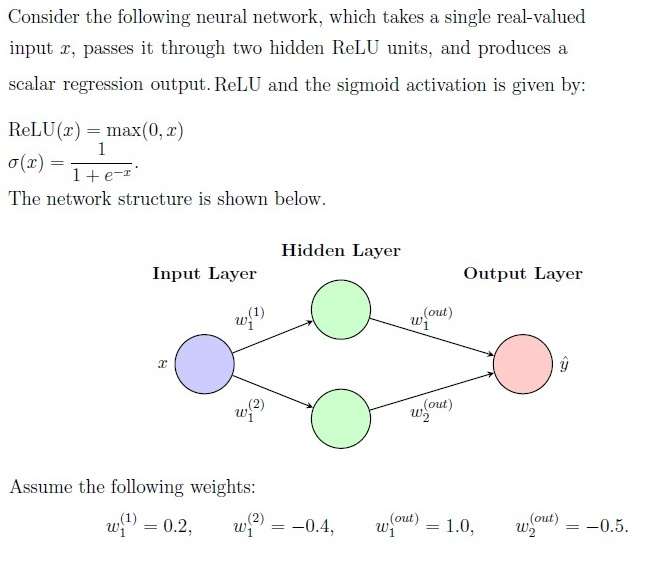
For input  , compute the the regression output
 . Enter the answer correct to one decimal place.
, compute the the regression output . Enter the answer correct to one decimal place.For a linear regression problem, which among the following are true? Select all that apply.
- Gradient descent will converge to a global minimum.
- Gradient descent will converge to a local minimum (which is not a globalminimum).
- Stochastic gradient descent is guaranteed to converge to a global minimum.
- Gradient descent will take lesser number of iterations to converge to a localminimum than stochastic gradient descent.
Comprehension passage for this question
Based on the above data, answer the given subquestions.
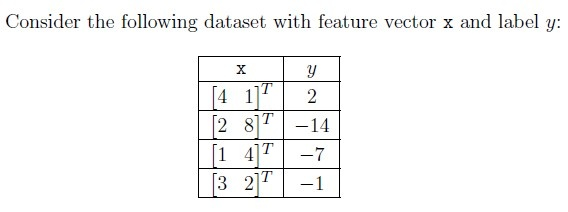
Find the mean squared error for the training dataset.
What is the role of the regularization term in ridge regression?
- It ensures that the dataset is normally distributed.
- It penalizes large coefficients to reduce overfitting.
- It forces more coefficients to be exactly zero, performing feature selection.
- It increases the variance of the model.

- It penalizes large coefficients to reduce overfitting.
- It shrinks the coefficients but does not set them to zero.
- It forces more coefficients to be exactly zero, performing feature selection.
- It has no effect on the regression model.
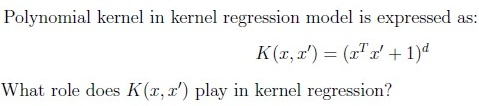
- It ensures that the regression model remains linear.
- It computes the similarity between data points in a transformed feature space.
- It allows the model to capture non-linear relationships by mapping data to ahigher-dimensional space.
- It helps in reducing the variance of the model.
- It minimizes the loss function in regression problems.
Consider a logistic regression model trained to detect spam emails. Emails containing harmful phishing links are labeled as spam (1), while regular emails are labeled as not spam (0).
A good spam detector should correctly identify almost all emails with phishing links. Even a single phishing email incorrectly classified as not spam could expose users to significant risks. However, the detector may classify some regular emails as spam. This trade-off is acceptable to ensure safety.
To ensure user safety, if the threshold is set to a low value to prioritize the detection of phishing emails, type 1. If the threshold is set to a high value to minimize false positives (misclassifying regular emails as spam), type 0.
Comprehension passage for this question
Based on the above data, answer the given subquestions.
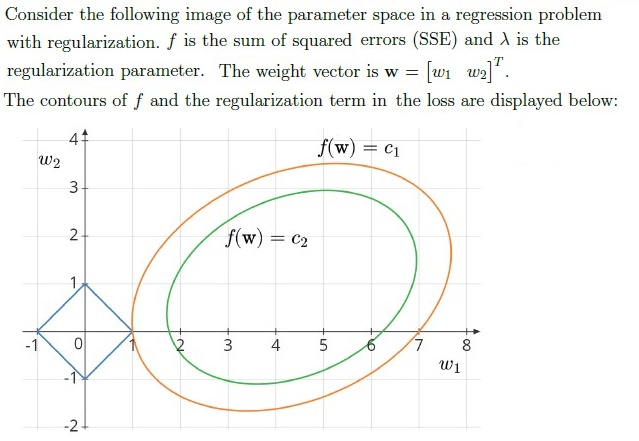
What kind of a regression problem is this?
- Ridge regression
- LASSO regression
Choose all the correct statements about neural networks
- It can not be used for both regression and classification problems
- It can have more than two hidden layers
- The activation functions have to be non-linear to separate not linearlyseparable data points
- Each neuron in the neural network may or may not have bias associated with it
Comprehension passage for this question
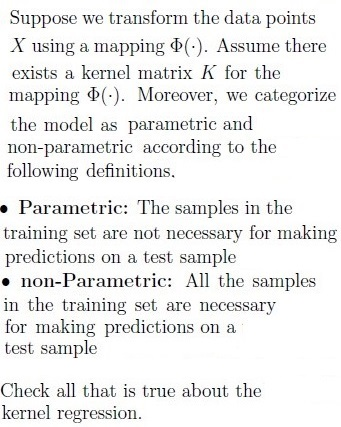
- The kernel regression is parametric
- The kernel regression is non-parametric
- The Kernel matrix K is positive semi-definite
- In general, Kernel regression is computationally expensive than a simple linearregression
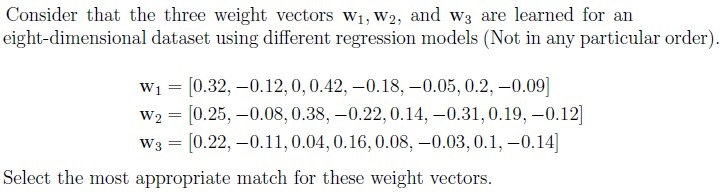
- w1 → Lasso regression, w2 → Linear regression, w3 → Ridge regression
- w1→ Ridge regression, w2 → Lasso regression, w3 → Linear regression
- w1 → Linear regression, w2 → Ridge regression, w3 → Lasso regression
- w1 → Ridge regression, w2 → Linear regression, w3 → Lasso regression
Which of the following statements is/are true?
- Ridge regression and Lasso regression both puts a limit on the length ofweight vector.
- Ridge regression puts limit on length of the weight vector but LASSOregression does not put a limit on weight vector length.
- When many features are redundant, then LASSO regression is moreappropriate than ridge regression and linear regression as LASSO regression produces sparseweights for those features.
- When many features are redundant, then linear regression is moreappropriate than ridge regression and LASSO regression
Which of the following statements is/are true regarding logistic regression and perceptron algorithm?




Which of the following statements is/are true regarding solution of Ridge regression problem?




Suppose you run gradient descent for linear regression for 500 iterations with a learning rate 0.02. You observe that the training loss (sum of squared loss) is increasing after every iteration. What may be the reason? What changes would you make to the set-up for the gradient descent to converge to a solution?
- Number of features in the training data may be too low, try increasing them.
- Number of features in the training data may be too high, try reducing them.
- Learning rate may be too low; Try increasing it.
- Learning rate may be too high; Try reducing it.
Suppose you run gradient descent for linear regression for 100 iterations with a learning rate 0.01. You observe that the training loss (sum of squared loss) is increasing after every iteration. What may be the reason? What changes would you make to the set-up for the gradient descent to converge to a solution?
- Learning rate may be too low; Try increasing it.
- Learning rate may be too high; Try reducing it.
- Number of features in the training data may be too low, try increasing them.
- Number of features in the training data may be too high, try reducing them.

- The polynomial regression model of degree 6 adds a smooth fitting to thisdata.
- The polynomial regression model of degree 98 overfits this data.
- The polynomial regression model of degree 2 adds a smooth fitting to thisdata.
- The polynomial regression model of degree 3 underfits this data.
Comprehension passage for this question
Based on the above data, answer the given subquestions.
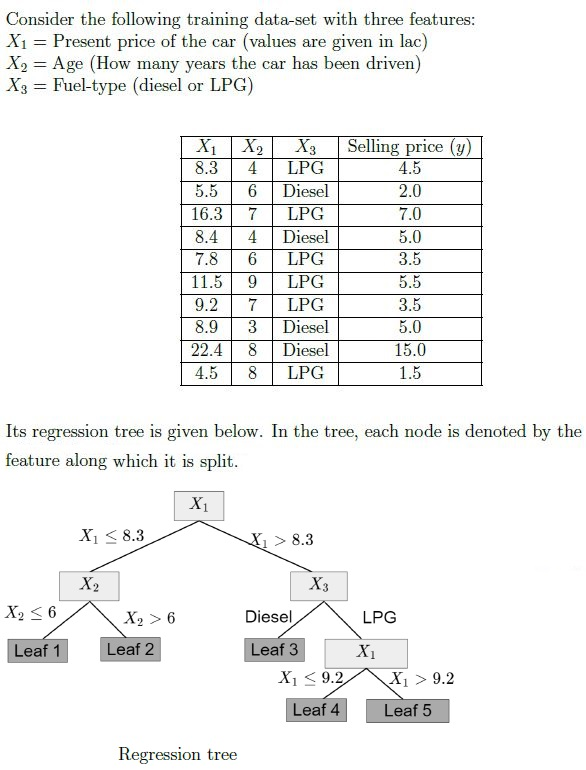
If the present price of a car which is driven for 5 years is 9.5 lac. If the car has an LPG engine, what will be the prediction for the selling price of the car according to the given regression tree? Enter your answer in lac. If your answer is 5.6 lac, enter the answer 5.6.

- The polynomial regression model of degree 5 adds a smooth fitting to thisdata.
- The polynomial regression model of degree 99 overfits this data.
- The polynomial regression model of degree 1 adds a smooth fitting to thisdata.
- The polynomial regression model of degree 2 underfits this data.
Comprehension passage for this question
Based on the above data, answer the given subquestions.
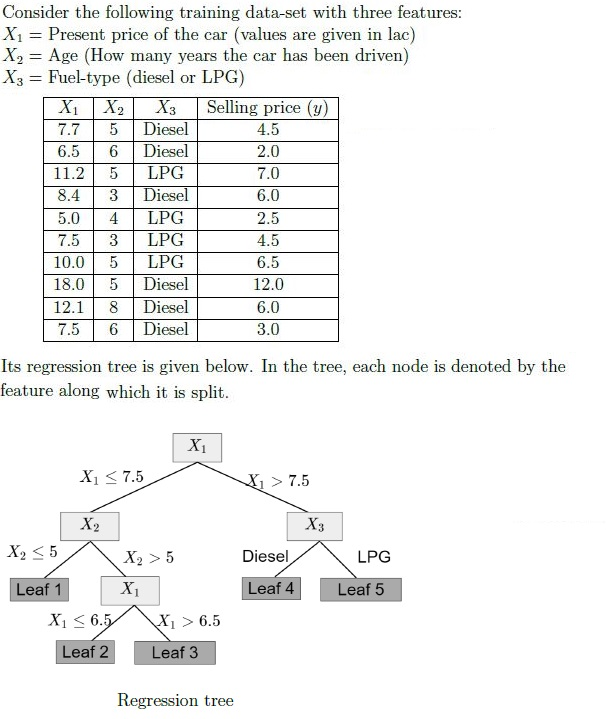
If the present price of a car which is driven for 7 years is 6.0 lac. If the car has a diesel engine, what will be the prediction for the selling price of the car according to the given regression tree? Enter your answer in lac. If your answer is 5.6 lac, enter the answer 5.6.
Which of the following could be the vector of probabilities output by a softmax regression model for 5 classes? Note that the options are independent of each other.




Consider a logistic regression model that is trained on videos to detect objectionable content. Videos with objectionable content belong to the positive class (label 1). Harmless videos belong to the negative class (label 0). A good detector should be able to correctly identify almost all videos that are objectionable. If it incorrectly classifies even a single video that has inappropriate content in it, that could have serious consequences, as millions of people might end up watching it. In this process the detector may classify some harmless videos as belonging to the positive class. But that is a price we are willing to pay. How should we choose the threshold (for inference) of this logistic regression model?
- The threshold should be a low value.
- The threshold should be a high value.
- The performance of the classifier is independent of the threshold.