Home / Past papers / MLT Quiz 1 / this paper
IIT M IMPROVEMENT AN EXAM QIP3 13 July - 13 Jul 2025
Elapsed 00:00
How does K-means++ algorithm enhance the initialization process as compared to the standard K-means algorithm?
- It ensures the algorithm converges in a fixed number of iterations.
- It improves centroid initialization by spreading them out, leading to betterseparated clusters.
- It automatically calculates the best value of K.
- It removes the need to run the algorithm multiple times.

- 2
- 3
- 5
- 4
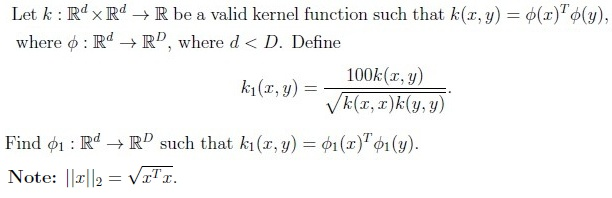
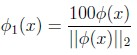
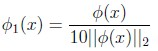
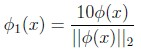

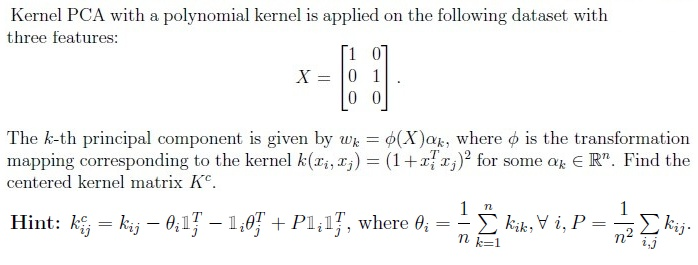
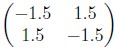
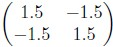


You are presented with a dataset that has latent variables that influences your data. You are asked to use Expectation-Maximization algorithm to best capture the data. How would you define the steps in the EM (Expectation and Maximization) algorithm?
- E-step: Estimate the latent variables in the dataset, M-step: Maximize thelikelihood over the model parameters.
- E-step: Estimate the number of latent variables in the dataset, M-step:Maximize the likelihood over the model parameters.
- E-step: Estimate the likelihood over the model parameters, M-step: Maximizethe number of latent variables in the dataset.
- E-step: Estimate the likelihood over the model parameters, M-step: Maximizethe number of parameters in the model.
Which of the following statements is/are true?
- EM algorithm converges to a global optimum.
- Lloyd’s algorithm converges to a local optimum.
- Poor initialization does not affect the clusters produced by EM algorithm.
- Poor initialization leads to a slower convergence of Lloyd’s algorithm.
- Lloyd’s algorithm is sensitive to the number of clusters (k).
For a linear regression problem, which among the following are true? Select all that apply.
- Gradient descent will converge to a global minimum.
- Gradient descent will converge to a local minimum (which is not a globalminimum).
- Stochastic gradient descent is guaranteed to converge to a global minimum.
- Gradient descent will take lesser number of iterations to converge to a localminimum than stochastic gradient descent.
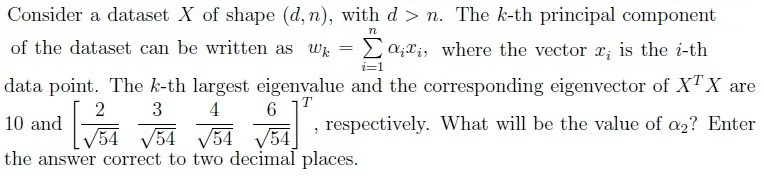
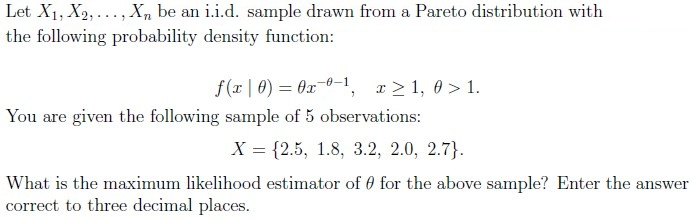

Comprehension passage - the questions below it refer to this
Based on the above data, answer the given subquestions.
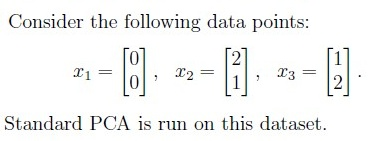
Which of the following represents the covariance matrix C?


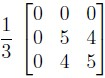
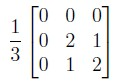
What is the variance of the dataset along the first principal component?
Find the residues after projecting the data points onto the first principal component.
 Find the residues after projecting the data points onto the first principal component.




Comprehension passage - the questions below it refer to this
Based on the above data, answer the given subquestions.
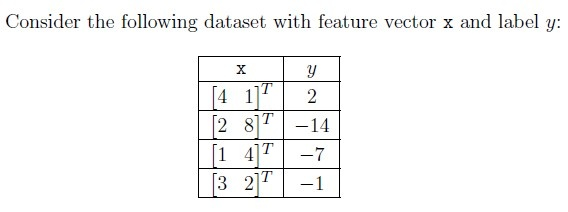
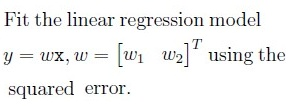
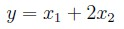
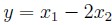
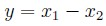
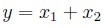
Find the mean squared error for the training dataset.
Answer key
- Q1 (MCQ, 2 marks): B
- Q2 (MCQ, 2 marks): B
- Q3 (MCQ, 4 marks): C
- Q4 (MCQ, 4 marks): B
- Q5 (MCQ, 3 marks): A
- Q6 (MSQ, 3 marks): B, D, E
- Q7 (MSQ, 3 marks): A, D
- Q8 (SA, 3 marks): 0.12 to 0.13
- Q9 (SA, 3 marks): 1.147 to 1.150
- Q10 (SA, 2 marks): 5250
- Q11 (MCQ, 2 marks): B
- Q12 (SA, 2 marks): 1
- Q13 (MCQ, 3 marks): B
- Q14 (MCQ, 3 marks): B
- Q15 (SA, 1 marks): 0
Concepts this paper tests
Auto-generated summary from the source site. Handy as a checklist; the lessons above explain each idea from scratch.
Summary of Core Topics, Concepts, Principles, and Equations
1. K-means and K-means++ Algorithm
Core Concepts:
- K-means is a clustering algorithm that partitions data into K clusters.
- K-means++ improves the initialization process of K-means by spreading out the initial centroids.
Key Equations:
- Objective function:
- Convergence: The algorithm converges when the objective value stabilizes.
2. Kernel Functions and Kernel PCA
Core Concepts:
- Kernel functions map data into higher-dimensional spaces.
- Kernel PCA is a non-linear extension of PCA using kernel functions.
Key Equations:
- Kernel function:
- Centered kernel matrix:
- Polynomial kernel:
3. Expectation-Maximization (EM) Algorithm
Core Concepts:
- EM algorithm is used for finding maximum likelihood estimates in models with latent variables.
- E-step: Estimate the latent variables.
- M-step: Maximize the likelihood over the model parameters.
Key Principles:
- EM algorithm converges to a local optimum.
- Poor initialization can affect the convergence and the quality of clusters.
4. Gradient Descent and Stochastic Gradient Descent
Core Concepts:
- Gradient descent is an optimization algorithm used to minimize some function by iteratively moving in the direction of steepest descent.
- Stochastic gradient descent (SGD) is a variant of gradient descent that uses a subset of the data to compute the gradient.
Key Principles:
- Gradient descent converges to a global minimum for convex functions.
- SGD can be faster but may require more iterations to converge.
5. Principal Component Analysis (PCA)
Core Concepts:
- PCA is a dimensionality reduction technique that transforms data into a set of orthogonal axes.
- The principal components are the directions of maximum variance.
Key Equations:
- Principal component:
- Covariance matrix:
- Variance along the first principal component:
6. Maximum Likelihood Estimation (MLE)
Core Concepts:
- MLE is a method of estimating the parameters of a statistical model.
- For a Pareto distribution, the MLE of the shape parameter can be derived from the likelihood function.
Key Equations:
- Pareto distribution:
- Likelihood function:
7. Linear Regression
Core Concepts:
- Linear regression models the relationship between a dependent variable and one or more independent variables.
- The model is fitted using the least squares method.
Key Equations:
- Linear regression model:
- Mean squared error: