Home / MLT / Week 12 / Real questions
MLT week 12 - real exam questions
18 questions pulled from past papers whose wording matches this week's topics, newest first, duplicates removed. Pick your answers, then press Check answers. Figures and answer keys are the originals.
Elapsed 00:00
You build a fully-connected feed-forward neural network. The input is a  -dimensional vector; the network has two hidden layers of
 and
 neurons respectively, followed by an output layer of
 neurons. Every layer is densely connected to the next.
 , compute the total number of weight parameters in the network. (Enter
 if it cannot be determined.)
-dimensional vector; the network has two hidden layers of and neurons respectively, followed by an output layer of neurons. Every layer is densely connected to the next. , compute the total number of weight parameters in the network. (Enter if it cannot be determined.)Consider the effect of each operation below on a model's bias and variance. Which of the following statements are correct?
- Regularising the weights in a linear/logistic regression model increases bias and decreases variance.
- Increasing the maximum depth of a decision tree increases bias and decreases variance.
- Increasing the number of hidden units in a neural network decreases bias and increases variance.
- Removing all the non-support-vectors from the training set of an SVM leaves both bias and variance unchanged.
You build a fully-connected feed-forward neural network for a classification task. The input is a  - dimensional vector; the network has two hidden layers of
 neurons each, followed by an output layer of
 neurons. Every layer is densely (fully) connected to the next. Ignoring all bias terms, compute the total number of weight parameters in the network. (Enter if it cannot be determined.)
- dimensional vector; the network has two hidden layers of neurons each, followed by an output layer of neurons. Every layer is densely (fully) connected to the next. Ignoring all bias terms, compute the total number of weight parameters in the network. (Enter if it cannot be determined.)Consider a regression problem in which we use a neural network with the following architecture: Input layer has  neurons• Two hidden layers, each with
 neurons• Output layer with one neuron• Find the total number of parameters in the network. Ignore the biases.
neurons• Two hidden layers, each with neurons• Output layer with one neuron• Find the total number of parameters in the network. Ignore the biases.Consider a regression problem in which we use a neural network with the following architecture: • Input layer has  neurons • Three hidden layers, each with neurons • Output layer with one neuron Find the total number of parameters in the network. Ignore the biases.
Comprehension passage for this question
Based on the above data, answer the given subquestions.
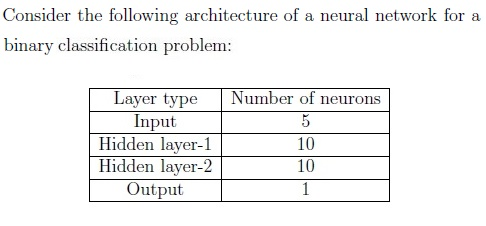
What is the most appropriate choice of activation function for the output layer if the binary cross-entropy loss is used?
- Sigmoid
- Linear
- ReLU
Comprehension passage for this question
Based on the above data, answer the given subquestions.
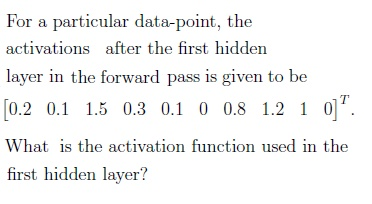
- ReLU
- Sigmoid
Comprehension passage for this question
Based on the above data, answer the given subquestions.
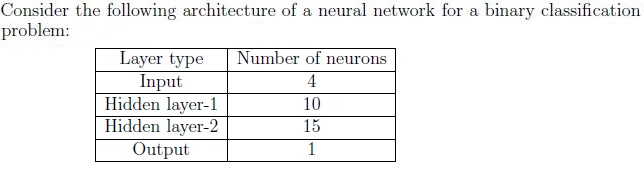
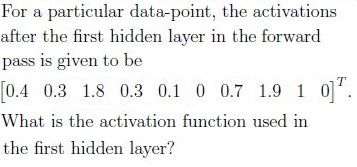
- ReLU
- Sigmoid
Consider a simple neural network with one hidden layer. The network has the following architecture: Input layer with 3 neurons. Hidden layer with 2 neurons, using the sigmoid activation function. Output layer with 1 neuron, using the linear activation function. The weights and biases for the network are as follows: Hidden Layer: Neuron 1: Weights: [0.5, -0.2, 0.8] Bias: 0.1 Neuron 2: Weights: [0.4, 0, 0.2] Bias: -0.4 Output Layer: Neuron 1: Weights: [0.2, 0.4] Bias: -0.3 Assume that the input values are [0.6, 0.3, 0.8]. Calculate output of Neuron 1 in hidden layer
Choose all the correct statements about neural networks
- It can not be used for both regression and classification problems
- It can have more than two hidden layers
- The activation functions have to be non-linear to separate not linearlyseparable data points
- Each neuron in the neural network may or may not have bias associated with it
What will be the result of applying ReLU to the following values?: -2.7, 3.9, -1.0, 4.2, 6.4, -7.3
- 1, 3.9, 1, 4.2, 6.4, 1
- 0, 1, 0, 1, 1, 0
- -2.7, 0, -1.0, 0, 0, -7.3
- -1, +1, -1, +1, +1, -1
- 0, 3.9, 0, 4.2, 6.4, 0
Consider a neural network with 8 inputs and 2 outputs. If there are 4 hidden layers each with 4 neurons, how many parameters need to be learnt if there is a bias associated with each neuron in the hidden and output layers?
What will be the result of applying ReLU to the following values?: -3.7, 4.9, -2.0, 5.2, 7.4, -8.3
- 1, 4.9, 1, 5.2, 7.4, 1
- 0, 1, 0, 1, 1, 0
- 0, 4.9, 0, 5.2, 7.4, 0
- -1, +1, -1, +1, +1, -1
- -3.7, 0, -2.0, 0, 0, -8.3
Consider a neural network with 10 inputs and 2 outputs. If there are 5 hidden layers each with 5 neurons, how many parameters need to be learnt if there is a bias associated with each neuron in the hidden and output layers?
The following is the activation vector output by some hidden layer in a neural network when some input vector is given to it:
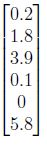 The following is the activation vector output by some hidden layer in a neural network when some input vector is given to it: Which of the following could be the activation function used in this layer?
- Softmax
- Sigmoid
- ReLU
- Tanh
Consider a neural network for a multi-class, image classification problem. When the network is trained on the images as they are, it does a good job on the test data. Call the dataset (train + test) for this setup D1 and the network N1. Assume that we now turn all images upside down, in both the training and test dataset. Now, the network with the same architecture is trained from scratch on this modified dataset. Call the dataset (train + test) for this setup D2 and network N2. Select the most appropriate option.
- The network N2 will not be able to learn anything from D2. Its test accuracy onD2 will be very low.
- The network N2 will be able to learn useful patterns from D2. In fact, theperformance of network N2 on D2 will be similar to N1 on D1.
- The network N2 will be able to learn somewhat useful patterns from D2. Butthe performance of N1 on D1 will be much better than N2 on D2.
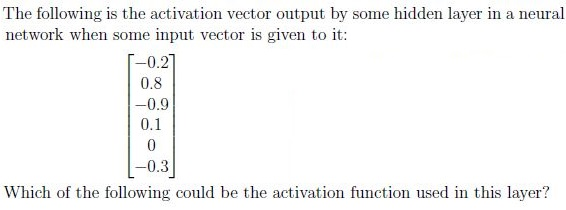
- Softmax
- Sigmoid
- ReLU
- Tanh
Which of the following could be the vector of probabilities output by a softmax regression model for 5 classes? Note that the options are independent of each other.



