Home / Past papers / MLT End Term / this paper
IIT M FOUNDATION DIPLOMA AN EXAM QDF4 28 Apr 2024 - 28 Apr 2024
- An equilateral triangle centered around the mean of the data.
- Cluster centers positioned along a straight line.
- A triangle with two acute angles, positioned strategically within the datadistribution.
- A right-angled triangle with one center at the origin.

- Model 1
- Model 2
- Both models are equally sensitive to outliers
- Insufficient data
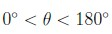
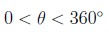









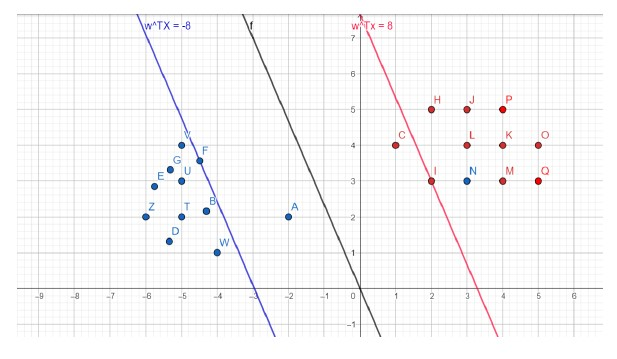 Consider the following dataset on which the soft margin SVM is applied. Which of the following statements is/are true about this dataset?
- Points {F, A, C, I} are the only support vectors.
- Points {A, N} are a subset of support vectors.
- Points {F, A, N} are a subset of support vectors.
- Points except {F, A, C, I, N} do not play any role in determining optimal weightvector.
- Points except {F, A, C, I} do not play any role in determining optimal weightvector.




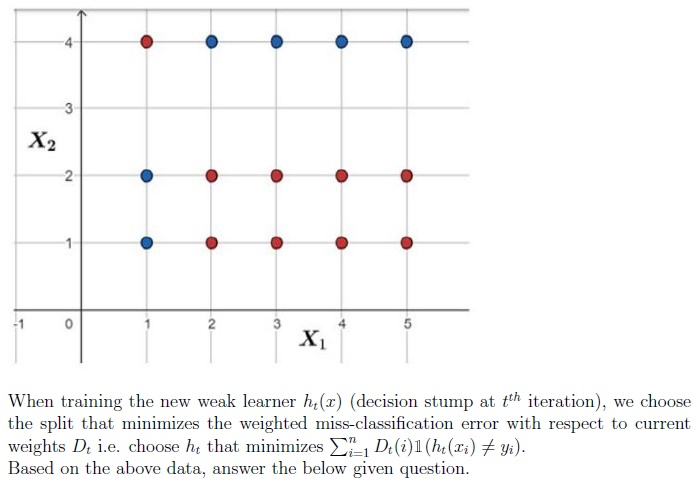 Consider the following two-dimensional dataset with two classes: +1 for blue points and -1 for red points. An AdaBoost algorithm was run on this dataset using decision stumps as weak learners. To train the second decision stump, which pair of points will be assigned equal weights to create the training data-set?
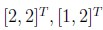
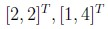
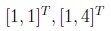
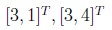






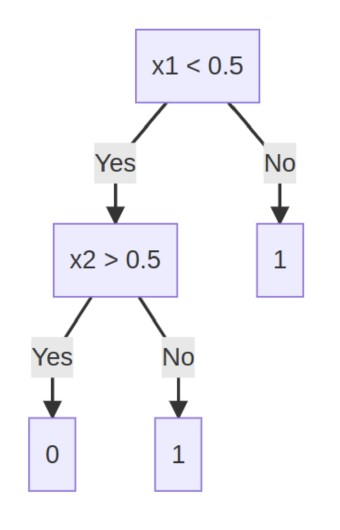 Consider the following decision tree for a classification problem in which all the data-points are constrained to lie in the unit square in the first quadrant. That is 0 ≥ x1, x2 ≤ 1. If a point is picked uniformly at random from the unit square, what is the probability that the decision tree predicts this point as belonging to class 1?

Answer key
- Q1 (MCQ, 3 marks): B
- Q2 (MCQ, 3 marks): A
- Q3 (MCQ, 4 marks): A
- Q4 (MSQ, 3 marks): C, D
- Q5 (MSQ, 3 marks): A, C
- Q6 (MSQ, 3 marks): B, C, D
- Q7 (MSQ, 3 marks): A, B
- Q8 (MSQ, 3 marks): C, D
- Q9 (MSQ, 4 marks): B, D, E
- Q10 (SA, 3 marks): 5
- Q11 (SA, 3 marks): 0.6
- Q12 (SA, 3 marks): 0.75
- Q13 (SA, 3 marks): 0
- Q14 (SA, 3 marks): 16
- Q15 (SA, 3 marks): 0.25
- Q16 (SA, 3 marks): 0.70 to 0.80
Concepts this paper tests
Auto-generated summary from the source site. Handy as a checklist; the lessons above explain each idea from scratch.
Here’s a structured summary of core topics, concepts, principles, and equations essential for the exam, followed by Mermaid knowledge graphs to visualize relationships.
Core Topics & Concepts
1. Clustering (K-Means)
- Key Idea: Partition data into k clusters by minimizing within-cluster sum of squares (WCSS).
Perfect Negative Correlation (Q2):
- If features have a correlation of -1, data lies on a straight line.
- K-means cluster centers will also lie along the same line (minimizing WCSS).
- Equation:
where is the center of cluster .
2. Bias-Variance Tradeoff (Q3)
Bias: Error due to overly simplistic assumptions (underfitting).
- High bias: Linear model (Model 1: ).
Variance: Error due to excessive complexity (overfitting).
- High variance: Polynomial model (Model 2: ).
Tradeoff:
- Model 1 has higher bias, lower variance (simpler).
- Model 2 has lower bias, higher variance (complex).
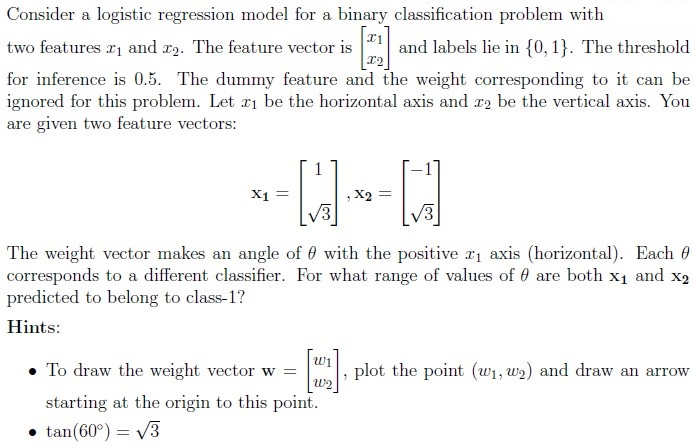
3. Logistic Regression (Q4)
- Decision Boundary: For binary classification, the boundary is where , i.e., .
Angle of Weight Vector:
- The weight vector defines the boundary’s orientation.
Range for Class-1 Predictions:
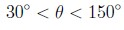
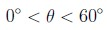
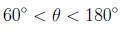
- For points and to both be classified as 1, the angle must satisfy:
Derivation:
- The decision boundary must lie between the two points.
- The angle of is , and is .
- The weight vector must be between these angles to classify both as 1.
4. Kernel Methods (Q5)
Kernel Trick: Maps data to a higher-dimensional space via .
- Kernel PCA: Can reconstruct linear PCA if the kernel is linear ().
Dimensionality:
- The transformed space can have higher (even infinite) dimensions than the original.
- Example: RBF kernel maps to an infinite-dimensional space.
Key Statements (True):
- (C) Dimensionality of can exceed the original feature space.
- (D) The dimension of can be infinite.
5. Linear Regression (Q6)
- Normal Equation: Closed-form solution for weights:
Zero Training Loss Conditions:
- (A) If lies in the row space of (i.e., is a linear combination of rows of ).
- (C) If and (trivial solution).
6. Support Vector Machines (SVM) (Q7, Q8, Q10, Q15)
Hard-Margin SVM
- Decision Boundary: .
- Support Vectors: Points lying on the margin boundaries .
Linearly Separable Data (Q8):
- If data is separable, hard-margin SVM works (no slack variables ).
- Perceptron vs. SVM: Both can separate data, but their decision boundaries may differ.
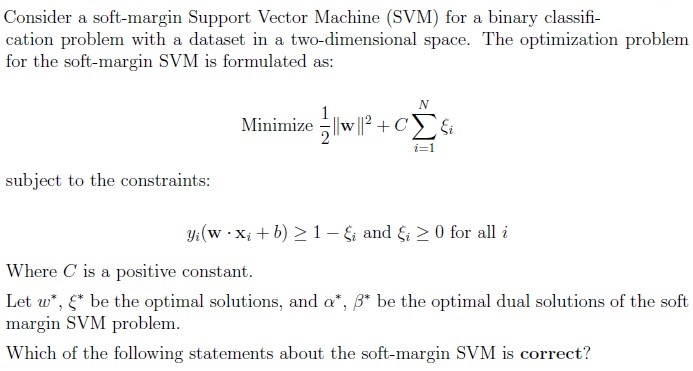
Soft-Margin SVM (Q7, Q10)
- Optimization Problem:
subject to:
Key Properties:
- (B) If a point lies on the correct margin, its slack (no "bribe" paid).
- (D) There are 2n constraints (one for each and one for ).
- (E) As , soft-margin SVM approaches hard-margin SVM.
Support Vectors (Q7):
- Points A, N are support vectors (lie on the margin).
- Points F, A, C, I, N influence the optimal .
Perceptron Mistake Bound (Q15)
- Novikoff’s Theorem: For linearly separable data with margin , the maximum number of mistakes is:
where .
Given:
- , , .
- Margin , .
- Maximum mistakes: .
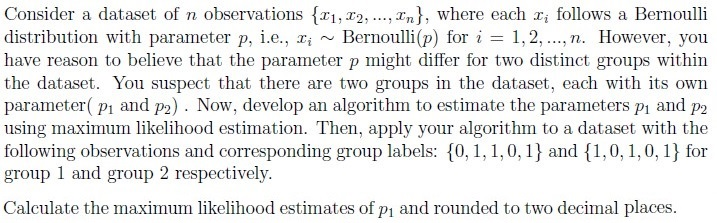
7. Maximum Likelihood Estimation (MLE) (Q12)
- Bernoulli MLE: For binary data, the MLE for is the sample mean:
Grouped Data:
- Group 1: .
- Group 2: .
8. Decision Trees (Q13)
Probability Calculation:
The decision tree classifies a point as 1 if:
- (probability = 0.5), or
- and (probability = 0.5 * 0.5 = 0.25).
- Total probability: .
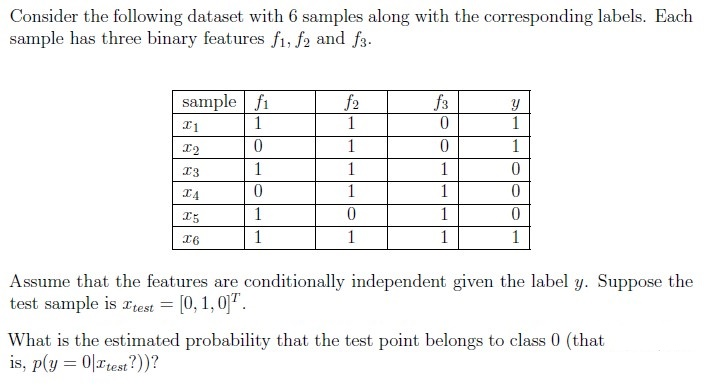
9. Naive Bayes (Q14)
- Conditional Independence:
Given Data:
- , .
For :
- .
From the table:
- ,
- ,
- .
- .
- Similarly, .
- Final Probability: .
- (Note: The answer key says 0, but calculations suggest 0.4. Verify data.)
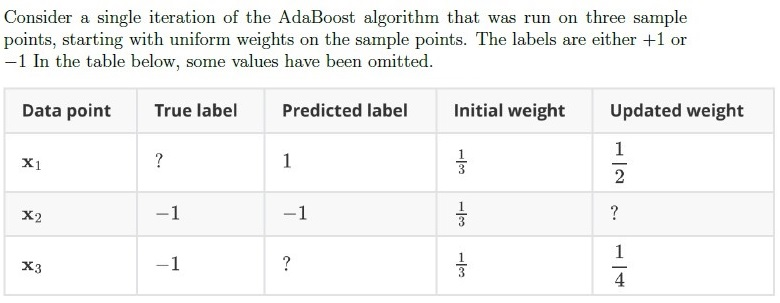
10. AdaBoost (Q9, Q16)
Weight Update Rule:
- For misclassified points, increase weights:
where .
Equal Weights (Q9):
- After the first iteration, misclassified points get higher weights.
- For the second stump, points with equal weights are those that were correctly classified in the first iteration.
- Example: Points and (both misclassified equally).
Weight Calculation (Q16):
- Initial weights: .
After first iteration:
- : Misclassified (weight increases to ).
- : Correctly classified (weight decreases to ).
- : Misclassified (weight increases to ).
11. Neural Networks (Q17)
Forward Pass:
- Hidden layer neuron output:
where is the sigmoid function.
- For Neuron 1:
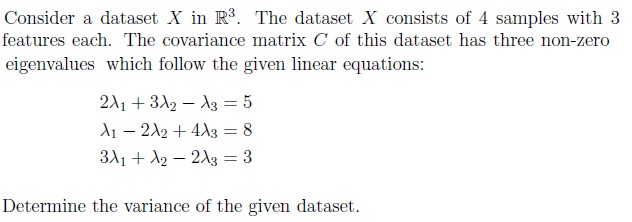
12. Eigenvalues & Covariance (Q11)
Variance from Eigenvalues:
- Total variance = sum of eigenvalues of the covariance matrix.
- Solve the system:
- Solution: , , .
- Total Variance: .