Home / MLP / Week 8 / Real questions
MLP week 8 - real exam questions
22 questions pulled from past papers whose wording matches this week's topics, newest first, duplicates removed. Pick your answers, then press Check answers. Figures and answer keys are the originals.
Elapsed 00:00
Select the correct statements regarding the following code snippet:
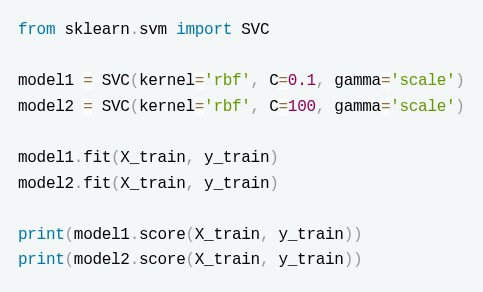
- model2 is more likely to have a lower bias and higher variance compared to model1.
- Increasing the value of C allowed model2 to penalize misclassification errors more strongly.
- model1 must always perform better on the test set because it has lower training accuracy.
- The gamma parameter has no effect because the kernel is already set to 'rbf'.
Which of the following algorithms may get impacted by feature scaling?
- LinearRegression
- DecisionTree
- SVM
- NaiveBayes

- LogisticRegression
- Perceptron
- RidgeClassifier
- Support Vector Machine (SVM)
- LassoClassifer

- The boundaries become more complex and tightly fitted to the training data.
- The boundaries become more regular and smooth.
- Decision boundaries are unaffected by C.
- The number of support vectors decreases.
Which options are correct for Support Vectors in SVM ?
- Support vectors are the data points nearest to the hyperplane
- Using these support vectors, we maximize the margin of the classifier.
- Using these support vectors, we minimize the margin of the classifier.
- None of these
Which of the following is true for a hard margin SVM algorithm ?
- It does not create hyperplanes as a decision boundary
- It will correctly classify all the data point if the data is linearly separable
- It is robust to outliers
- It is mostly used for clustering the data

- LogisticRegression
- Perceptron
- RidgeClassifier
- Support Vector Machine (SVM)
What is the default loss value in SGDClassifier API and it gives which classifier?
- ‘log loss’, LogisticRegressor
- ‘log loss’, LogisticClassifier
- ‘hinge’, SVM
- ‘hinge’, Perceptron
Which of the following scikit-learn model supports incremental learning through partial_fit method ?
- SGDClassifier
- LinearRegression
- Perceptron
- SVC
Which of the following options are true for regularization parameter C in sklearn.svm.SVC ?
- Large value of the regularization parameter C will overfit the training set andcomplex decision boundaries will form.
- Large value of the regularization parameter C will underfit the training set andsmooth decision boundaries will form.
- Small value of the regularization parameter C will overfit the training set andcomplex decision boundaries will form.
- Small value of the regularization parameter C will underfit the training set andsmooth decision boundaries will form.
- None of these
You’re working on a dataset containing customer purchase data, and you want to segment the customers into distinct groups based on their purchasing behavior. Each data point represents a customer and includes features like “Total Amount Spent” and “Number of Items Purchased.” Which algorithm is suitable for this scenario?
- Linear Regression
- Decision Tree
- K-means Clustering
- Support Vector Machine
- None of these
You’re building a machine learning pipeline to preprocess data and train a model on a classification task. You decide to use a pipeline that includes data preprocessing and a support vector machine (SVM) classifier. The following code snippet demonstrates the pipeline creation and usage:
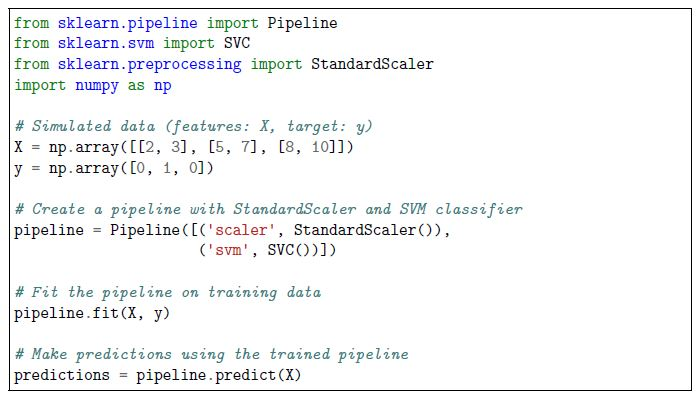 You’re building a machine learning pipeline to preprocess data and train a model on a classification task. You decide to use a pipeline that includes data preprocessing and a support vector machine (SVM) classifier. The following code snippet demonstrates the pipeline creation and usage: What is the purpose of using the pipeline in this code snippet?
- The pipeline combines multiple models for better model performance.
- The pipeline allows for simultaneous training of the scaler and classifier.
- The pipeline simplifies the code by encapsulating preprocessing and modelingsteps.
- The pipeline ensures that only linear SVM can be used for this classificationtask.
When using a Support Vector Classifier (SVC) in scikit-learn with different values of the regularization parameter (C), how does the complexity of the decision boundary change? Select all correct statements:
- Smaller values of C result in a more complex decision boundary.
- Larger values of C result in a more complex decision boundary.
- The decision boundary becomes simpler with increasing values of C.
- Very large values of C may lead to overfitting.
Which of the following are correct about sklearn.svm.SVC:
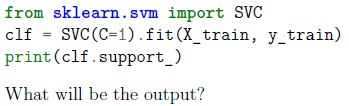 Which of the following are correct about sklearn.svm.SVC:
 - It will print number of support vectors
- It will print an array of support vectors
- It will print an array of probabilities representing distance from decisionboundary with each data point.
- It will print indices of the support vectors from the training set.
Which of the following options is true for the gamma parameter in a non-linear soft margin SVM?
- For high values of gamma, the points need to be very close to each other inorder to be considered in the same class
- For low values of gamma, the points need to be very close to each other inorder to be considered in the same class
- Gamma doesn’t affect the SVM model at all
- None of these
Consider following code snippet:
 Consider following code snippet: Above classifier uses:
- hinge but quadratically penalized.
- logistic regression.
- linear SVM.
- None of these.
- perceptron.
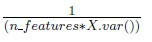
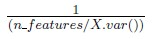
Which of the following options represents the correct value of gamma for SVC_classifier = SVC(gamma = ’auto’)?

Consider the following scatter plots of four different input datasets:
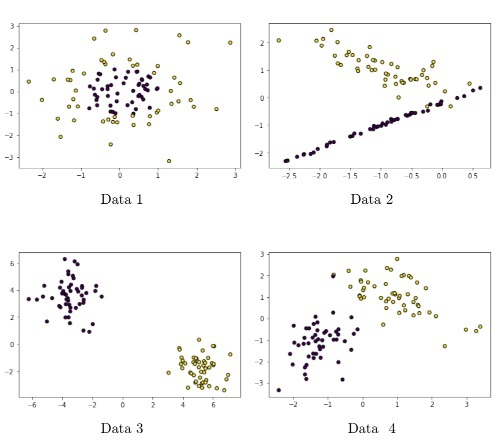 Consider the following scatter plots of four different input datasets: Which data will be classified better using gaussian rbf kernel?
- Data 1
- Data 3
- Data 4
- Data 2
What is the correct output of the following block of code? [Note: LinearSVC implements “one-vs-the-rest” multi-class strategy]
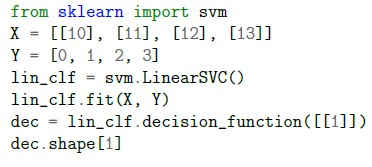 What is the correct output of the following block of code? [Note: LinearSVC implements “one-vs-the-rest” multi-class strategy]
 Putting loss=hinge in class sklearn.linear_model.SGDClassifier(loss=’hinge’) dictates which of the following loss functions in SGDClassifier?
- hinge but quadratically penalized
- logistic regression
- linear SVM
- None of these
l1 penalty in LinearSVC classifier leads to coef_vectors which are-
- dense.
- sparse.
- Unique class labels.
- l1 penalty can’t be set via a parameter in LinearSVC.
Comprehension passage for this question
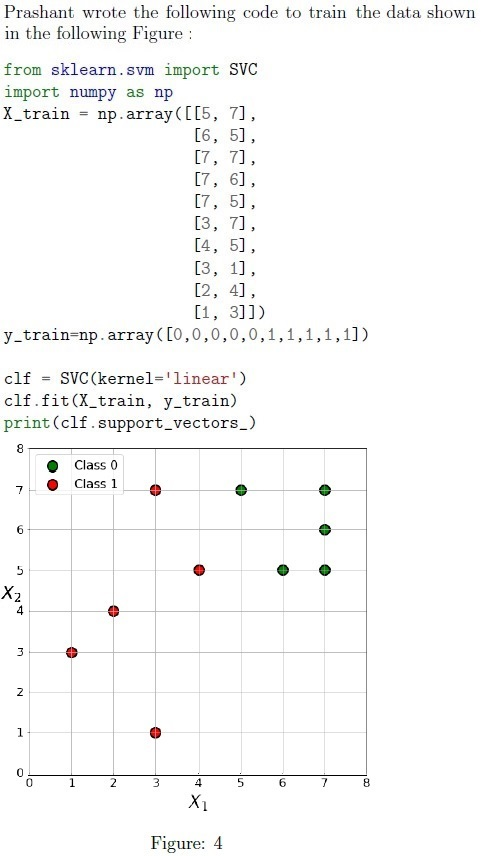
What is the output that Prashant will get?
- Indices of support vectors.
- Number of support vectors.
- Weights assigned to the features when kernel=”linear”
- ndarray of support vectors.