Home / MLT / Week 8 / Real questions
MLT week 8 - real exam questions
12 questions pulled from past papers whose wording matches this week's topics, newest first, duplicates removed. Pick your answers, then press Check answers. Figures and answer keys are the originals.
Elapsed 00:00
Suppose an email is represented by a binary feature vector  A generative classifier first chooses the class label
 according to the prior distribution
 . It then generates the feature vector
 conditioned on the chosen class. The classifier assumes that, given the class label, the features are conditionally independent. Which of the following expressions correctly represents

A generative classifier first chooses the class label according to the prior distribution . It then generates the feature vector conditioned on the chosen class. The classifier assumes that, given the class label, the features are conditionally independent. Which of the following expressions correctly represents 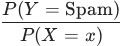
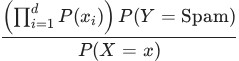
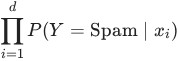

A generative classifier models the joint distribution of the feature vector and the class label . For a particular email represented by the feature vector  , suppose
 and
 Compute the posterior probability

and the class label . For a particular email represented by the feature vector , suppose and Compute the posterior probability Consider a dataset for a binary classification problem with five features, each of which is binary. If we go for a generative model that satisfies the class-conditional independence assumption, then how many free parameters do we need to learn?
Comprehension passage for this question
You are provided with a training set of 5 observations, each consisting of four binary features  and a binary target label
 .
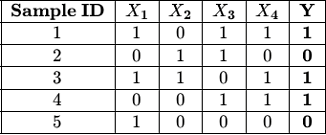 . Based on the above data, answer the given subquestions.
Using the Naive Bayes assumption and the data provided, calculate the joint probability 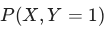 for a new test instance
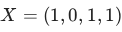 . Enter your answer correct to two decimal places.
for a new test instance . Enter your answer correct to two decimal places.Comprehension passage for this question
You are provided with a training set of 5 observations, each consisting of four binary features and a binary target label .
. Based on the above data, answer the given subquestions.To address zero-probability estimates using Laplace smoothing, the dataset is augmented with synthetic observations. Specifically, add the following two samples to the original table: 1. One sample in which all features ( (X1, X2, X3, X4) ) take the value 1 and the class label is Y = 1. 2. One sample in which all features ( (X1, X2, X3, X4) ) take the value 1 and the class label is Y = 0. Based on this new augmented dataset of 7 samples, calculate the updated conditional probability 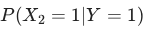 .
.Comprehension passage for this question
You are provided with a training set of 5 observations, each consisting of four binary features and a binary target label .
. Based on the above data, answer the given subquestions.For the Naive Bayes model described in the main data with  binary features and a binary class label, how many independent parameters are required to fully specify the model? Answer for the original dataset with 5 training examples.
- 5
- 8
- 9
- 10
Suppose you want to use a Naive Bayes classifier to predict whether a student will pass or fail an exam based on two features: the number of hours they studied and whether they attended review sessions. Assume that the features are conditionally independent given the exam outcome and that the variances of the study hours distributions are equal for both pass and fail categories.
How many parameters are required to classify a new student using this Naive Bayes classifier?
Comprehension passage for this question
Consider a multi-class classification problem with 3 classes and 4 features, all of which are binary. A generative model is used to model the joint distribution of the features and labels. Based on the above data, answer the given subquestions.Find the total number of independent (free) parameters in the model if the class conditional independence assumption is not enforced.
Comprehension passage for this question
Consider a multi-class classification problem with 3 classes and 4 features, all of which are binary. A generative model is used to model the joint distribution of the features and labels. Based on the above data, answer the given subquestions.Find the total number of independent (free) parameters in the model if the class conditional independence assumption is enforced.
Comprehension passage for this question
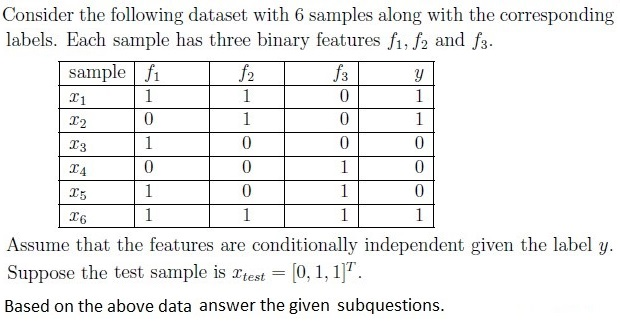
What will be the predicted label according to the Naive Bayes decision rule?
A Gaussian Naive Bayes model is trained for a multi-class classification problem that has 12 features and 5 classes. Find the total number of parameters that have to be estimated for this model. Consider each parameter to be a scalar value. In other words, if we decide to store all the parameters in a Python list, with each element of the list being a float value corresponding to a single parameter, what is the size of this list? Ignore the priors in the calculation. Only focus on the parameters of the class conditional densities.
A Gaussian Naive Bayes model is trained for a multi-class classification problem that has 10 features and 3 classes. Find the total number of parameters that have to be estimated for this model. Consider each parameter to be a scalar value. In other words, if we decide to store all the parameters in a Python list, with each element of the list being a float value corresponding to a single parameter, what is the size of this list? Ignore the priors in the calculation. Only focus on the parameters of the class conditional densities.