Home / Past papers / MLT Quiz 2 / this paper
IIT M DIPLOMA AN EXAM QDD3 01 Dec 2024 - 01 Dec 2024
Elapsed 00:00
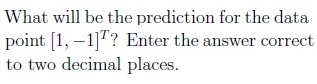
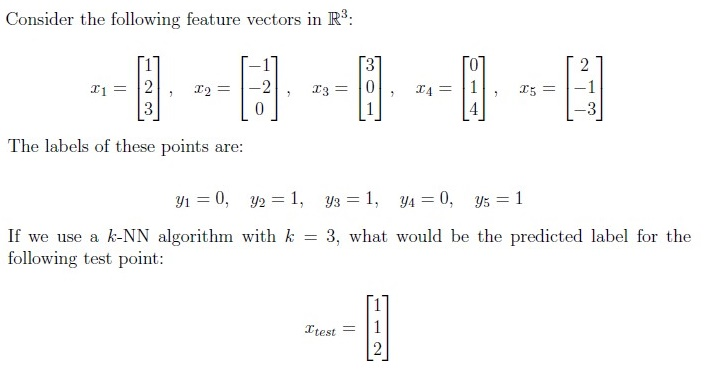
Comprehension passage - the questions below it refer to this
Based on the above data, answer the given subquestions.
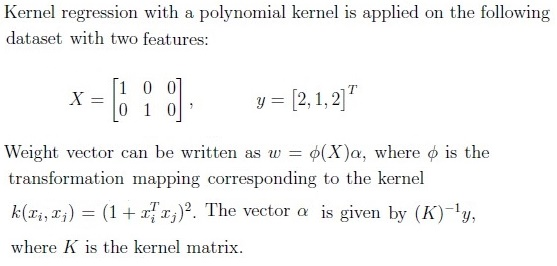
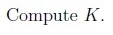
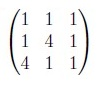

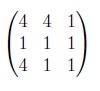

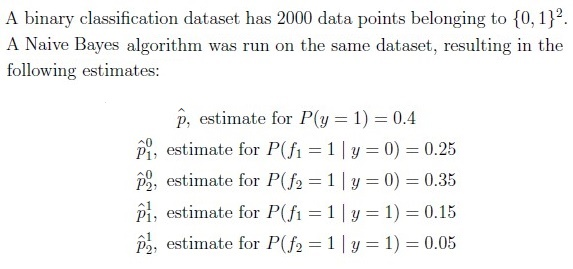
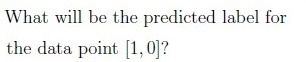
Comprehension passage - the questions below it refer to this
Based on the above data, answer the given subquestions.

Suppose you want to use a Naive Bayes classifier to predict whether a student will pass or fail an exam based on two features: the number of hours they studied and whether they attended review sessions. Assume that the features are conditionally independent given the exam outcome and that the variances of the study hours distributions are equal for both pass and fail categories.
How many parameters are required to classify a new student using this Naive Bayes classifier?
Select all true statements.





Comprehension passage - the questions below it refer to this
Consider a binary classification problem with a training dataset of 100 points, evenly distributed between two classes (50 points in each class). You decide to train a k-NN algorithm with k = 3. Each point is considered its own neighbor during classification.
Based on the above data, answer the given subquestions.What is the minimum number of misclassifications that can occur in the training dataset when using this k-NN algorithm?
Assuming there are outliers, the decision boundary becomes smoother with decreasing value of k
in a k-NN algorithm.
- TRUE
- FALSE
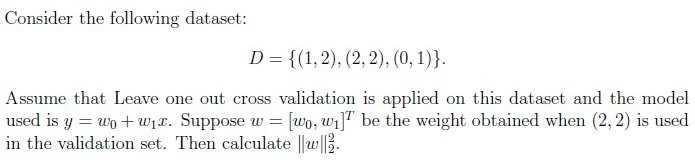
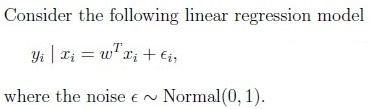
Comprehension passage - the questions below it refer to this
Based on the above data, answer the given subquestions.
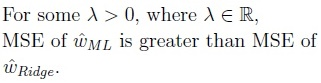
- TRUE
- FALSE
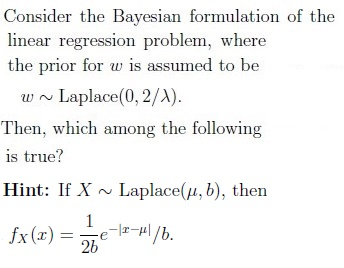




Comprehension passage - the questions below it refer to this
Consider a binary classification problem in which a decision tree is classifying data points into two classes, A and B. In a particular node of the tree, 60% of the data points belong to class A, while the remaining 40% belong to class B.
Based on the above data, answer the given subquestions.Do you have enough information to find the entropy of this node?
- Yes
- No
If the answer to the previous question is ”Yes,” calculate the entropy of this node to three decimal places. If the answer to the previous question is ”No,” enter -1 as your answer.





Answer key
- Q1 (MCQ, 3 marks): D
- Q2 (SA, 4 marks): 2.31 to 2.35
- Q3 (SA, 4 marks): 0.94 to 0.96
- Q4 (SA, 3 marks): 0
- Q5 (SA, 4 marks): 2
- Q6 (SA, 4 marks): 0
- Q7 (SA, 4 marks): 6
- Q8 (MSQ, 4 marks): A, D, E
- Q9 (SA, 3 marks): 0
- Q10 (MCQ, 2 marks): B
- Q11 (MCQ, 2 marks): A
- Q12 (MCQ, 4 marks): C
- Q13 (MCQ, 2 marks): A
- Q14 (SA, 4 marks): 0.94 to 1.01
- Q15 (MSQ, 3 marks): A, C
Concepts this paper tests
Auto-generated summary from the source site. Handy as a checklist; the lessons above explain each idea from scratch.
Summary of Core Topics, Concepts, Principles, and Equations
1. Kernel Regression and Polynomial Kernels
- Kernel Regression: A non-parametric method to estimate the conditional expectation of a random variable.
- Polynomial Kernel:
- Kernel Matrix (K): Computed using the kernel function.
- Weight Vector: , where
2. Naïve Bayes Algorithm
- Conditional Probability:
- Complement Rule:
- Prediction: Based on the maximum posterior probability.
3. k-Nearest Neighbors (k-NN)
- Distance Metric: Euclidean distance.
- Prediction: Majority vote among the k-nearest neighbors.
- Cross-Validation: Leave-one-out cross-validation for model evaluation.
4. Decision Trees
- Information Gain: Measure of the effectiveness of a question in partitioning the dataset.
- Entropy: Measure of impurity in a node.
- Hyperparameters: Depth of the tree, chosen using cross-validation.
5. Linear Regression
- Loss Function:
- Optimal Weight Vector:
- Ridge Regression: Regularized linear regression with L2 penalty.
- Bayesian Formulation: Prior distribution for weights, e.g., Laplace prior.
6. Model Evaluation
- Mean Squared Error (MSE): Measure of the quality of an estimator.
- Cross-Validation: Technique for assessing how the results of a statistical analysis will generalize to an independent dataset.
Equations
Kernel Regression
Naïve Bayes
Linear Regression
Entropy
Graph 1: Machine Learning Techniques Overview
Graph 2: Kernel Regression
Graph 3: Naïve Bayes
Graph 4: Decision Trees
Graph 5: Linear Regression
These graphs and summaries should help you understand the core topics and their relationships for your exam preparation.