Home / Past papers / MLT End Term / this paper
IIT M FOUNDATION FN EXAM QDF2 13 Apr - 13 Apr 2025
Elapsed 00:00
For a given dataset, a 1-Nearest Neighbor (1-NN) and a 3-Nearest Neighbor (3-NN) classifier are applied. Which classifier is likely to exhibit a higher Leave-One-Out Cross Validation (LOOCV) error? In case of tie-breaker, assign a positive class (+) to the data point.
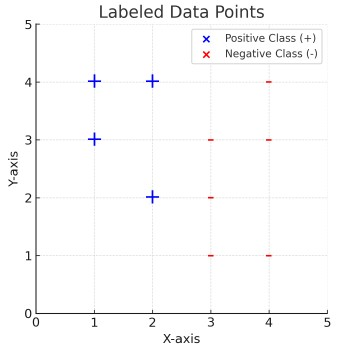 For a given dataset, a 1-Nearest Neighbor (1-NN) and a 3-Nearest Neighbor (3-NN) classifier are applied. Which classifier is likely to exhibit a higher Leave-One-Out Cross Validation (LOOCV) error? In case of tie-breaker, assign a positive class (+) to the data point.
- 1-NN
- 3-NN
- Both have the same error.





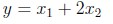
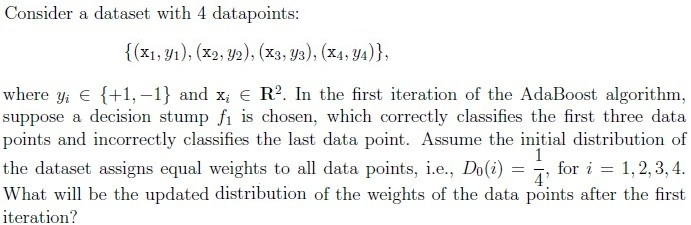
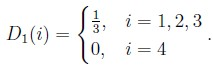
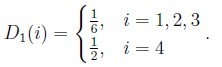
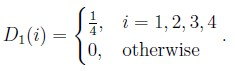
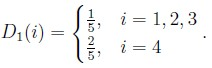
Which of the following statements correctly differentiates PCA and Kernel PCA?
- PCA maximizes variance in the original feature space, while Kernel PCAmaximizes variance in a higher-dimensional transformed space.
- PCA finds principal components using linear transformations in the originalspace, while Kernel PCA uses non-linear transformations to find principal components in a higher-dimensional space.
- Kernel PCA can capture non-linear patterns in data, making it useful when PCAfails to represent complex structures in a linear space.
- PCA and Kernel PCA always yield identical results regardless of the datasetstructure.
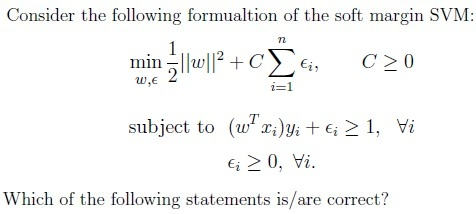





Which of the following statements are true for bagging?
- The final model has lesser variance than the individual learners.
- The final model has a higher variance than the individual learners.
- Estimators in bagging can be trained parallely.
- If the number of data points is large, typically two-third of the data pointsremain unselected in bags.

- It penalizes large coefficients to reduce overfitting.
- It shrinks the coefficients but does not set them to zero.
- It forces more coefficients to be exactly zero, performing feature selection.
- It has no effect on the regression model.
For a decision tree, each node has exactly two child nodes (balanced tree). If the tree has a depth of 3, how many leaf nodes are there?
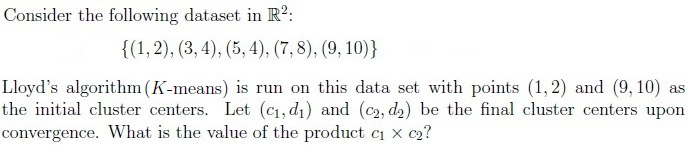
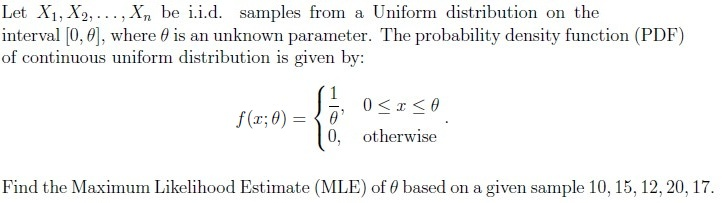
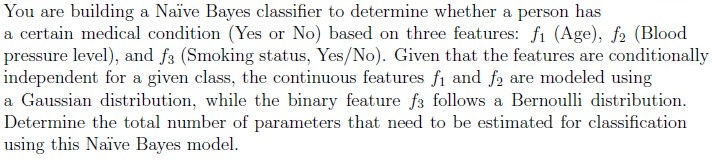
Comprehension passage - the questions below it refer to this
Based on the above data, answer the given subquestions.
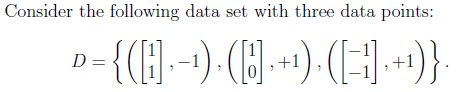
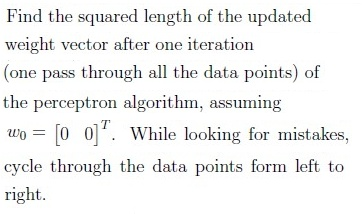
Will the algorithm converge after this update?
- YES
- NO
Comprehension passage - the questions below it refer to this
Based on the above data, answer the given subquestions.
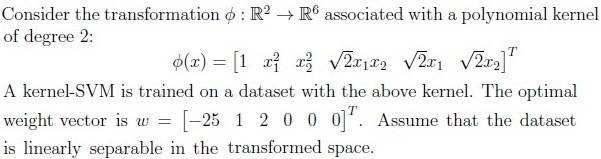

- It is a circle.
- It is a straight line.
- It is an ellipse.
- It is a parabola.
Which of the following training data points are certainly not support vectors?


Comprehension passage - the questions below it refer to this
Based on the above data, answer the given subquestions.
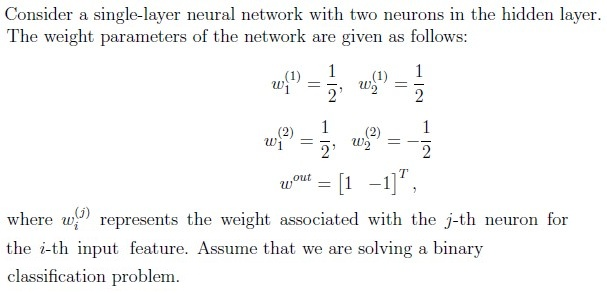
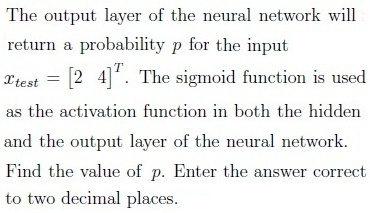
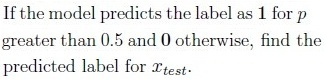
Answer key
- Q1 (MCQ, 3 marks): A
- Q2 (MCQ, 3 marks): C
- Q3 (MCQ, 4 marks): B
- Q4 (MCQ, 4 marks): B
- Q5 (MSQ, 3 marks): A, B, C
- Q6 (MSQ, 3 marks): B, D, E
- Q7 (MSQ, 2 marks): A, C
- Q8 (MSQ, 2 marks): A, C
- Q9 (SA, 2 marks): 8
- Q10 (SA, 3 marks): 24
- Q11 (SA, 3 marks): 20
- Q12 (SA, 3 marks): 11
- Q13 (SA, 3 marks): 1
- Q14 (MCQ, 2 marks): A
- Q15 (MCQ, 2 marks): C
- Q16 (MSQ, 3 marks): A, C
- Q17 (SA, 3 marks): 0.64 to 0.68
- Q18 (SA, 2 marks): 1
Concepts this paper tests
Auto-generated summary from the source site. Handy as a checklist; the lessons above explain each idea from scratch.
Here’s a structured summary of core topics, concepts, principles, and equations essential for the exam, followed by Mermaid knowledge graphs to visualize relationships.
1. Core Topics & Concepts
A. Supervised Learning
k-Nearest Neighbors (k-NN)
- LOOCV Error: 1-NN often has higher variance (overfits) than 3-NN, leading to higher LOOCV error.
- Tie-Breaker: Assign positive class (
+) in ties.
Linear Regression
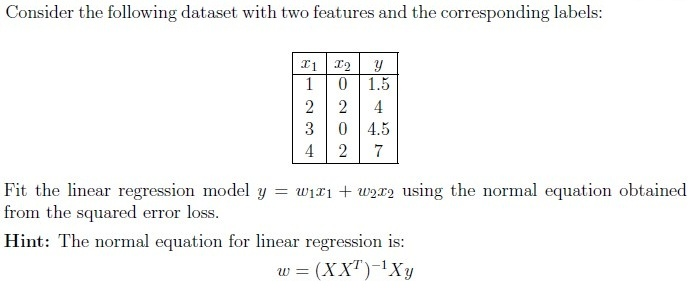
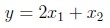
- Normal Equation:
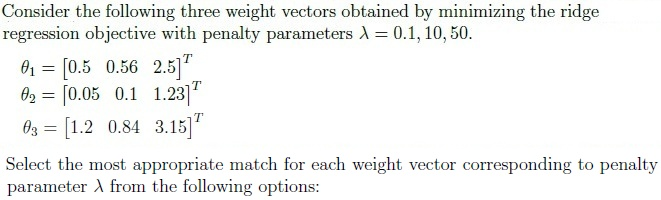
- Ridge Regression (L2 Regularization):
Effect of λ:
- Higher λ → shrinks coefficients (reduces overfitting).
- Lower λ → coefficients closer to OLS.
- Example: Match weight vectors (
θ) to λ values (Q3).
Logistic Regression & SVM
- Soft-Margin SVM:
C (Regularization):
- C → 0: Hard-margin SVM (no slack).
- C → ∞: Allows more slack (overfits).
- Decision Boundary: Linear in original space, non-linear in kernel space.
AdaBoost
Weight Update Rule:
- Misclassified points get higher weights.
- Correctly classified points get lower weights.
- Example: After 1st iteration (Q5), weights adjust to focus on errors.
Naïve Bayes
- Conditional Independence Assumption:
Parameter Count:
- Gaussian features: 2 params (μ, σ) per class per feature.
- Bernoulli features: 1 param (p) per class per feature.
- Class priors: 1 param per class (sums to 1).
- Total:
(2 * #Gaussian_features + 1 * #Bernoulli_features) * #classes + (#classes - 1).
B. Unsupervised Learning
K-Means (Lloyd’s Algorithm)
- Convergence: Stops when cluster assignments stabilize.
- Initialization Sensitivity: Final centers depend on initial seeds.
- Example: Final centers for given data (Q11).
PCA vs. Kernel PCA
- PCA: Linear transformation maximizing variance in original space.
- Kernel PCA: Non-linear transformation via kernel trick (e.g., polynomial/RBF), maximizes variance in higher-dimensional space.
- Use Case: Kernel PCA for non-linear patterns.
C. Model Evaluation & Ensemble Methods
Bagging (Bootstrap Aggregating)
- Variance Reduction: Averages multiple models (e.g., decision trees) trained on bootstrapped samples.
- Parallel Training: Estimators are independent.
- Out-of-Bag (OOB) Error: ~37% data points left out per tree (not "two-thirds").
Boosting (AdaBoost)
- Sequential Training: Each model corrects errors of the previous one.
- Weighted Voting: Final prediction combines weak learners weighted by accuracy.
D. Regularization & Feature Selection
Lasso (L1 Regularization)
Effect of λ:
- Increases λ: Penalizes large coefficients → sparsity (some coefficients = 0).
- Feature Selection: Automatically drops irrelevant features.
- Contrast with Ridge (L2): Ridge shrinks but rarely zeros coefficients.
Maximum Likelihood Estimation (MLE)
- Uniform Distribution MLE:
- Example: MLE for θ given samples (Q12).
E. Neural Networks
Single-Layer Perceptron
- Activation: Sigmoid (σ), ReLU, etc.
- Forward Pass:
- Convergence: Guaranteed if data is linearly separable (Q14–15).
Kernel SVM with Polynomial Kernel
- Degree-2 Kernel:
- Decision Boundary: Ellipse (Q16) if has non-zero quadratic terms.
F. Trees & Decision Boundaries
Decision Trees
- Balanced Binary Tree: Leaf nodes = (Q10: depth 3 → 8 leaves).
Support Vectors
- Non-Support Vectors: Points not on the margin (Q17).
2. Key Equations
| Topic | Equation |
|---|---|
| Linear Regression | |
| Ridge Regression | |
| Lasso Regression | |
| Soft-Margin SVM | |
| PCA | (eigenvectors of ) |
| Kernel PCA | (kernel matrix ) |
| AdaBoost Weight Update | |
| MLE (Uniform) | |
| Naïve Bayes | |
| Perceptron Update | (if misclassified) |
| Sigmoid Activation |
Graph 2: Unsupervised Learning & Dimensionality Reduction
Graph 3: Ensemble Methods
Graph 4: Regularization & Feature Selection
Graph 5: Neural Networks & Kernels
4. Exam Tips
- k-NN: Higher
k→ smoother decision boundaries (lower LOOCV error). - Ridge/Lasso: Match weight vectors to λ (smaller λ → larger weights).
- SVM:
C=0→ hard margin;C→∞→ overfits. - AdaBoost: Misclassified points get higher weights in next iteration.
- PCA vs. Kernel PCA: Kernel PCA for non-linear patterns.
- Bagging: Reduces variance; estimators are independent.
- Lasso: Increases λ → more coefficients zeroed out.
- K-Means: Final centers depend on initialization.
- MLE for Uniform: .
- Naïve Bayes: Count parameters carefully (Gaussian/Bernoulli).
- Perceptron: Converges if data is linearly separable.
- Kernel SVM: Degree-2 polynomial → elliptical boundary.