Home / Past papers / MLT Quiz 1 / this paper
IIT M FOUNDATION AN4 EXAM QPF4 16 JULY 2023 - 16 Jul 2023
Elapsed 00:00
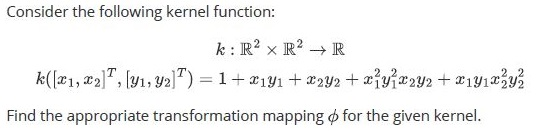







Select all true statements regarding standard PCA applied on a centered dataset.
- The variance of the dataset along the first principal component is maximum.
- The variance of the dataset along the first principal component is minimum.
- The first principal component is the unit norm eigenvector corresponding tothe largest eigenvalue of the covariance matrix.
- The first principal component is the unit norm eigenvector corresponding tothe smallest eigenvalue of the covariance matrix.

- The covariance matrix corresponding to this dataset has 30 non-zeroeigenvalues.
- The covariance matrix corresponding to this dataset has only four non-zeroeigenvalues.
- The residues will become zero after four rounds
- By utilizing four principal component vectors and their correspondingcoefficients, we have the ability to reconstruct the complete dataset using representatives.
Which of the following statements about kernel PCA is/are always true?





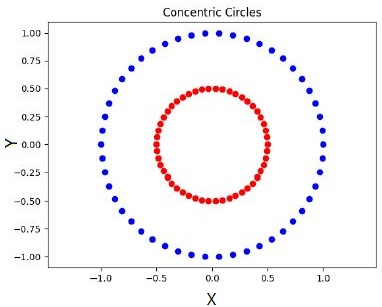
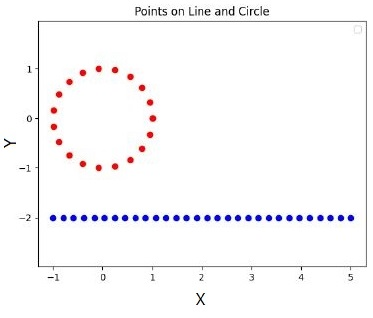
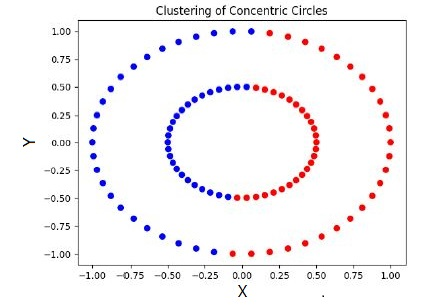
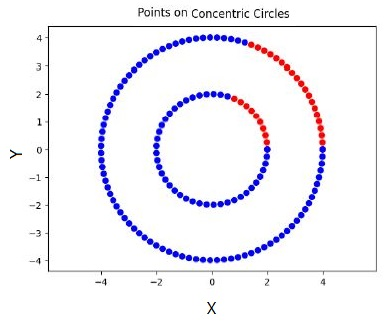
Which of the following statements is/are true?




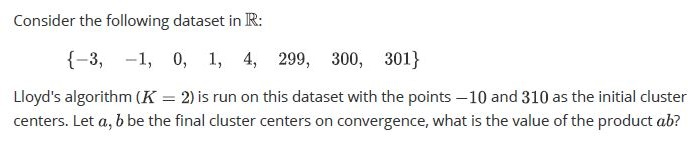


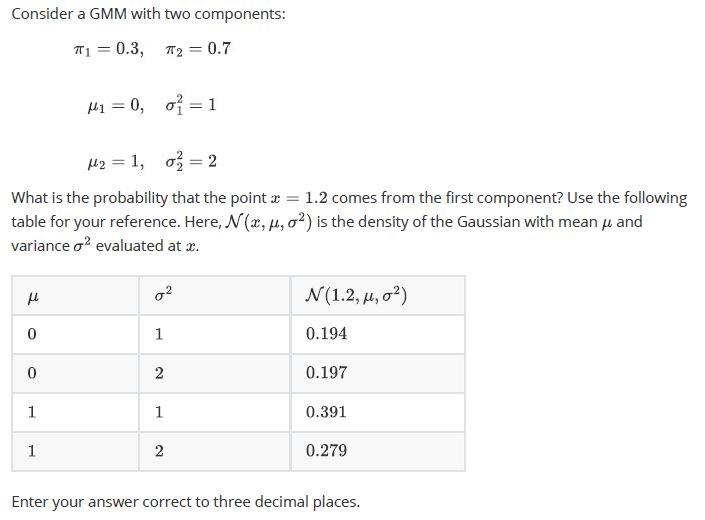
Comprehension passage - the questions below it refer to this
Based on the above data, answer the given subquestions.
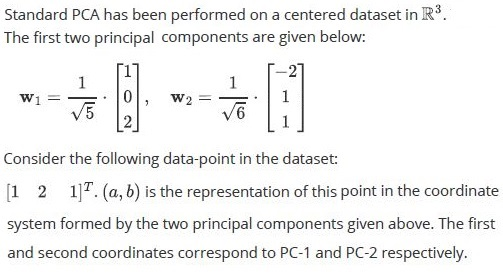
What is the value of a? Enter your answer correct to three decimal places.
What is the value of b? Enter your answer correct to two decimal places.
Answer key
- Q1 (MCQ, 4 marks): C
- Q2 (MCQ, 4 marks): C
- Q3 (MSQ, 4 marks): A, C
- Q4 (MSQ, 4 marks): B, C, D
- Q5 (MSQ, 5 marks): B, C
- Q6 (MSQ, 5 marks): A, B, D
- Q7 (MSQ, 3.5 marks): A, C
- Q8 (SA, 4 marks): 60
- Q9 (SA, 4 marks): 70
- Q10 (SA, 4 marks): 40
- Q11 (SA, 4.5 marks): 0.15 to 0.35
- Q12 (SA, 2 marks): 1.25 to 1.5
- Q13 (SA, 2 marks): 0.25 to 0.55
Concepts this paper tests
Auto-generated summary from the source site. Handy as a checklist; the lessons above explain each idea from scratch.
Summary of Core Topics, Concepts, Principles, and Equations
1. Kernel Functions and Transformation Mappings
- Kernel Functions: Functions that compute the dot product of the transformed input data in a higher-dimensional space.
- Transformation Mapping (): Maps input data to a higher-dimensional space.
- Example: For a given kernel , the appropriate transformation mapping is:
2. Principal Component Analysis (PCA)
- Standard PCA: Applied on a centered dataset to find the directions (principal components) of maximum variance.
- Variance: The variance of the dataset along the first principal component is maximum.
- Eigenvalues and Eigenvectors: The first principal component is the unit norm eigenvector corresponding to the largest eigenvalue of the covariance matrix.
- Low-Dimensional Subspace: If all points lie in a four-dimensional low subspace, the covariance matrix has only four non-zero eigenvalues.
3. Kernel PCA
- Kernel PCA: Extension of PCA using kernel functions to handle non-linear data.
- Valid Kernel Functions: For every transformation mapping , there exists a valid kernel function.
- Combination of Kernels: For two valid kernels , is a valid kernel function where and are positive real numbers.
4. Lloyd's Algorithm (K-Means Clustering)
- Lloyd's Algorithm: Iterative algorithm to partition data into clusters.
- Initialization: Initial cluster centers are chosen, and the algorithm iteratively updates the centers to minimize within-cluster variance.
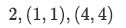
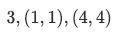
- Example: For a dataset with initial centers and , the final cluster centers and can be found, and their product can be computed.
5. Gaussian Mixture Models (GMM)
- GMM: Probabilistic model that assumes all the data points are generated from a mixture of a finite number of Gaussian distributions.
- Probability Calculation: The probability that a point comes from a specific component can be calculated using the Gaussian density function.
- Example: For a GMM with two components, the probability that the point comes from the first component can be calculated using the given table of Gaussian densities.
6. Beta Distribution and Bernoulli Distribution
- Beta Distribution: Used as a prior and posterior distribution for the parameter in a Bernoulli distribution.
- Example: For a dataset with 60 points, if the prior and posterior distributions for are and respectively, the number of data points with the value 0 can be determined.