Home / Past papers / MLT Quiz 2 / this paper
IIT M DIPLOMA AN4 EXAM QDD4 03 Dec 2023 - 03 Dec 2023
Elapsed 00:00
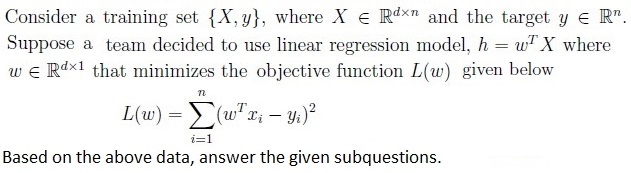
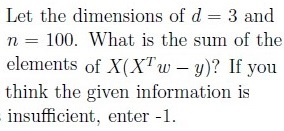
Comprehension passage - the questions below it refer to this
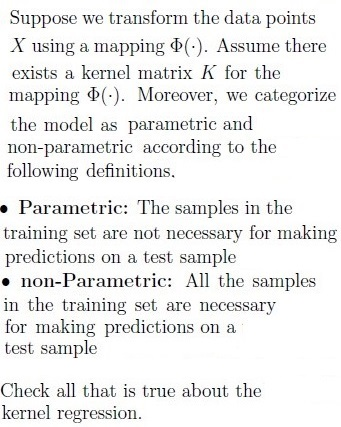
- The kernel regression is parametric
- The kernel regression is non-parametric
- The Kernel matrix K is positive semi-definite
- In general, Kernel regression is computationally expensive than a simple linearregression
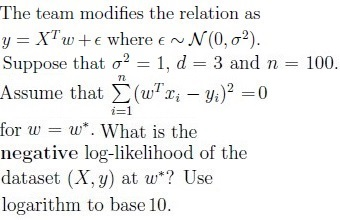
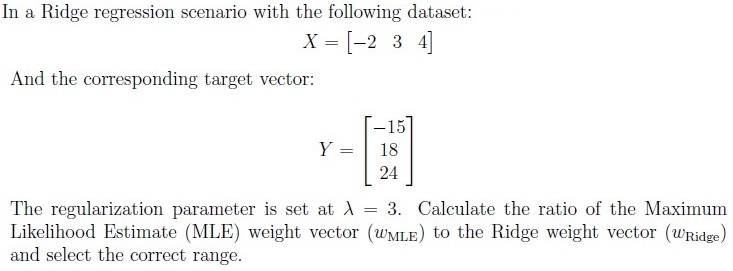
- (1.05, 1.20)
- (0.85, 0.95)
- (1,1)
- (3, 3.5)
Which of the following is/are the primary advantages of using L1 regularization
- L1 regularization reduces the risk of overfitting.
- L1 regularization tends to produce sparse models.
- L1 regularization always improves the model’s predictive accuracy on largedatasets.
- L1 regularization is primarily used to increase model complexity.
Select all the statements that are true about decision trees and k-Nearest Neighbors (k-NN) in machine learning:
- Decision trees are a supervised learning algorithm used for classifications.
- The k-NN algorithm is a lazy learner, which means it doesn’t build an explicitmodel during the training phase.
- In k-NN, the value of k represents the number of features used forclassification.
- k-Nearest Neighbors (k-NN) is a parametric model that requires estimatingprobability distributions.
- The depth of the tree is a hyperparameter and is typically chosen using cross-validation.
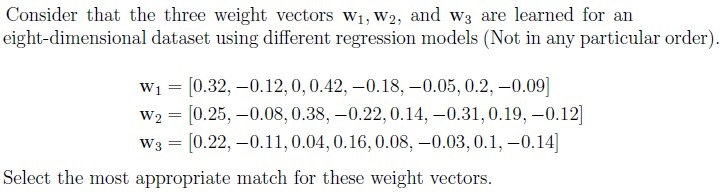
- w1 → Lasso regression, w2 → Linear regression, w3 → Ridge regression
- w1→ Ridge regression, w2 → Lasso regression, w3 → Linear regression
- w1 → Linear regression, w2 → Ridge regression, w3 → Lasso regression
- w1 → Ridge regression, w2 → Linear regression, w3 → Lasso regression
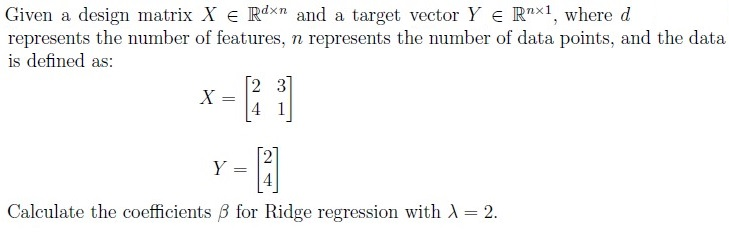
- β = [0.75, 0.75]
- β = [1, 0.5]
- β = [0.5, 1]
- β = [0.85, 0.12]
- None of these
You are working on a decision tree algorithm to classify whether a bank loan applicant will default on their loan based on several financial factors. The dataset includes Credit Score, Annual Income, Loan Amount, Loan Term as features. The target variable is binary: 1 for ”Default” and 0 for ”No Default.” You have a dataset of 500 loan applicants, and you want to construct a decision tree to predict loan default. To determine the first split (root node), you'll use the information gain as the criterion. Here’s the distribution of loan default in the dataset: Default: 150 applicants No Default: 350 applicants Calculate the Entropy for the initial dataset.
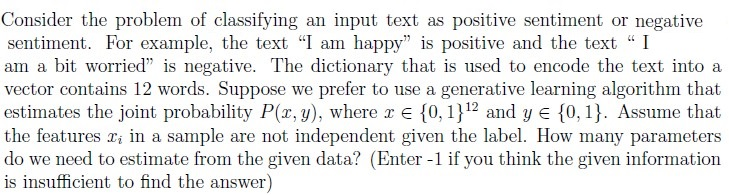
Given a training dataset with 100 data points, how many distances would we have to compute in the process of predicting the label of test-point in the k-NN algorithm with k = 5
If the proportion of points belonging to class 1 in a node is p, for what value of p is the node’s entropy maximum?
Comprehension passage - the questions below it refer to this
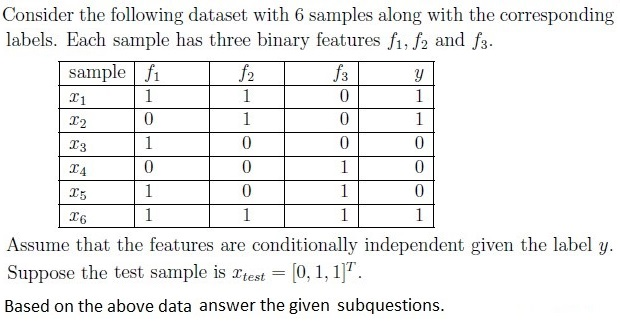
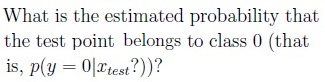
What will be the predicted label according to the Naive Bayes decision rule?
Answer key
- Q1 (SA, 4 marks): 0
- Q2 (MSQ, 4 marks): B, C, D
- Q3 (SA, 4 marks): 39 to 40
- Q4 (MCQ, 4 marks): A
- Q5 (MSQ, 4 marks): A, B
- Q6 (MSQ, 4 marks): A, B, E
- Q7 (MCQ, 4 marks): A
- Q8 (MCQ, 4 marks): D
- Q9 (SA, 4 marks): 0.83 to 0.92
- Q10 (SA, 4 marks): 8191
- Q11 (SA, 2 marks): 100
- Q12 (SA, 2 marks): 0.5
- Q13 (SA, 3 marks): 0
- Q14 (SA, 3 marks): 1