Home / Past papers / MLT Quiz 1 / this paper
IIT M DIPLOMA AN EXAM QDD3 26 Oct 2025 - 26 Oct 2025
- It always converges.
- It may fail to converge for an initialization while it may converge for otherinitialization.
- It is sensitive to outliers.
- The solution produced is always the optimal.

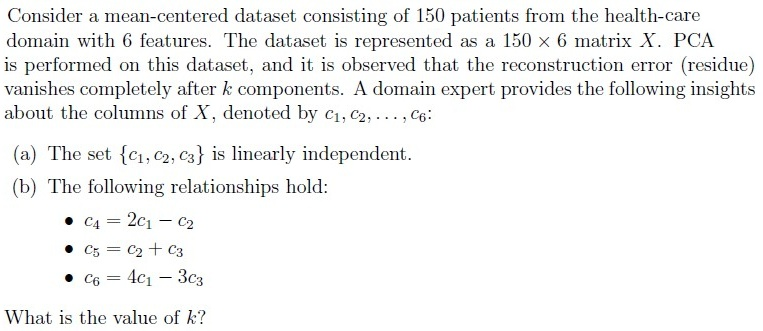
- There will be 50 non-zero eigenvalues of the covariance matrix.
- There will be 6 non-zero eigenvalues of the covariance matrix.
- Using the first 5 principal components, the dataset can be reconstructed withzero residue.
- The variance captured by the top 6 principal components equals the totalvariance of the dataset.
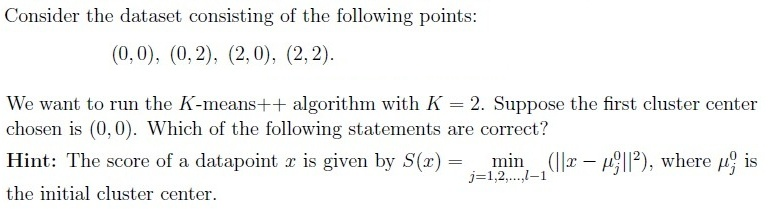
- The points (0, 2), (2, 0), and (2, 2) have the equal probability of being chosen asthe second cluster center.
- The probability of selecting (2, 2) as the second cluster center is twice that ofselecting (0, 2).
- If (2, 2) is chosen as the second cluster center, the algorithm will alwaysconverge in one iteration.
- The tie-breaking rule will affect the final cluster centers.
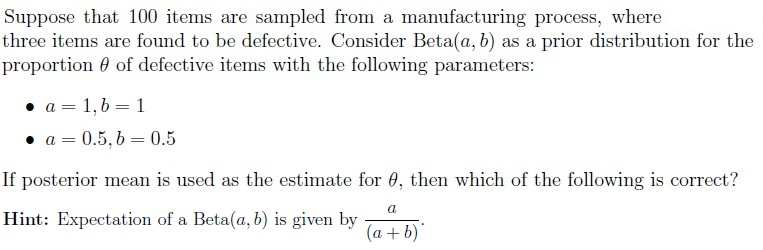
- Posterior mean for Beta(1, 1) is 0.039.
- Posterior mean for Beta(1, 1) is 0.03.
- Posterior mean for Beta(0.5, 0.5) is 0.025.
- Posterior mean for Beta(0.5, 0.5) is 0.034.




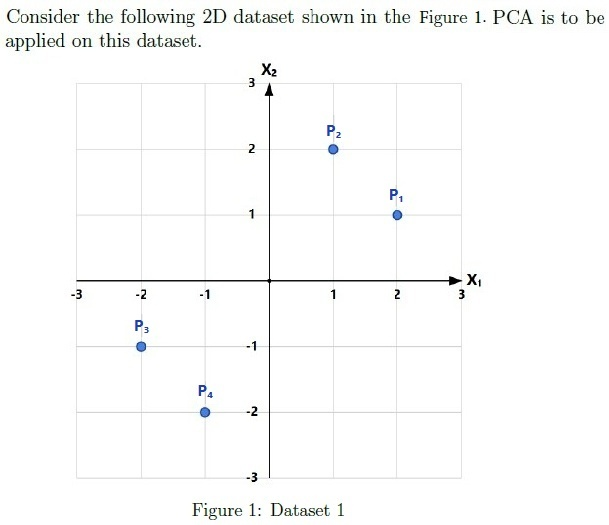



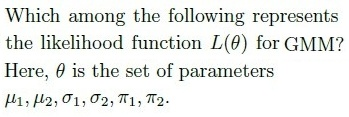




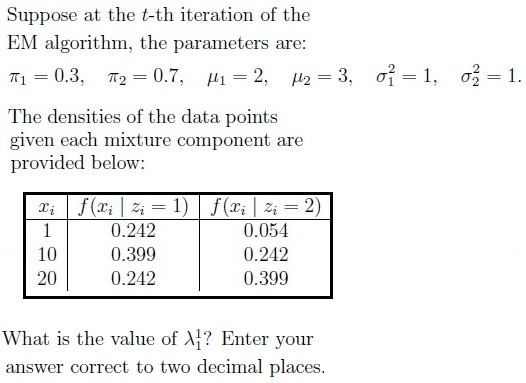
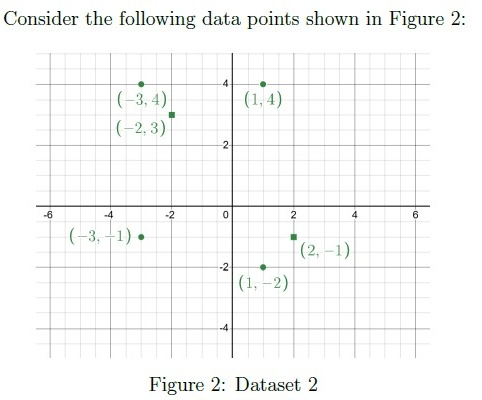




Answer key
- Q1 (MSQ, 2 marks): A, C
- Q2 (MSQ, 4 marks): B, D
- Q3 (MSQ, 4 marks): B, C, D
- Q4 (MSQ, 4 marks): A, D
- Q5 (MSQ, 3 marks): A, B, D
- Q6 (SA, 3 marks): 3
- Q7 (SA, 3 marks): 0.45 to 0.50
- Q8 (MCQ, 2 marks): B
- Q9 (SA, 2 marks): 4.5
- Q10 (SA, 2 marks): 0.5
- Q11 (MCQ, 3 marks): B
- Q12 (SA, 3 marks): 0.64 to 0.68
- Q13 (MCQ, 3 marks): A
- Q14 (SA, 2 marks): 1
Concepts this paper tests
Auto-generated summary from the source site. Handy as a checklist; the lessons above explain each idea from scratch.
Here’s a structured summary of core topics, concepts, principles, and equations essential for the Diploma-Level Machine Learning Techniques exam, based on the provided question paper. The exam focuses on clustering (K-means, Lloyd’s algorithm), PCA, Bayesian inference, kernel methods, and basic linear algebra.
1. Core Topics & Key Concepts
A. Clustering (K-means & Lloyd’s Algorithm)
Lloyd’s Algorithm (Standard K-means)
Steps:
- Initialize cluster centers (e.g., randomly or via k-means++).
- Assign points to the nearest center (Euclidean distance).
- Recompute centers as the mean of assigned points.
- Repeat until convergence (centers stabilize).
Convergence:
- Guaranteed to converge (monotonically decreases within-cluster sum of squares, WCSS).
- May converge to local optima (sensitive to initialization).
- Sensitivity to Outliers: Yes (outliers can skew cluster means).
- Optimality: Not guaranteed (depends on initialization).
K-means++ Initialization
- Probability of selecting a point as a center is proportional to its squared distance from existing centers.
- Reduces sensitivity to initialization.
Tie-Breaking in K-means
- Affects final clusters if points are equidistant to multiple centers.
Convergence in 1 Iteration
- Happens if initial centers are already the final means (e.g., symmetric data).
B. Principal Component Analysis (PCA)
Key Ideas:
- Linear dimensionality reduction via orthogonal projection.
- Maximizes variance along principal components (PCs).
- PCs are eigenvectors of the covariance matrix, ordered by eigenvalues (variance).
Covariance Matrix (Σ)
- For a dataset (centered):
Eigendecomposition: , where:
- : Matrix of eigenvectors (PCs).
- : Diagonal matrix of eigenvalues (variances).
Number of Non-Zero Eigenvalues:
- Equals the rank of the data matrix (≤ min(n, d)).
- If data is d-dimensional but lies in a k-dimensional subspace, only k eigenvalues are non-zero.
Variance Explained:
- Total variance = sum of all eigenvalues.
- Variance of the i-th PC = i-th eigenvalue ().
- Reconstruction Error: Zero if all PCs are used; otherwise, equals the sum of discarded eigenvalues.
Standard PCA Steps:
- Center the data (subtract mean).
- Compute covariance matrix .
- Eigendecomposition to get PCs and eigenvalues.
- Project data onto top-k PCs.
C. Bayesian Inference (Beta Distribution)
Beta Distribution:
- Prior for binomial/proportion data: .
- Posterior Mean: For s successes and f failures:
Special Cases:
- : Uniform prior.
- : U-shaped prior.
Example Calculation:
Given data with 1 success and 24 failures:
- For : Posterior mean = .
- For : Posterior mean = .
D. Kernel Methods
Kernel Trick:
- Maps data to a higher-dimensional space where linear separation is possible.
- Kernel function: .
Valid Kernels (must satisfy Mercer’s condition):
- Linear: .
- Polynomial: .
- Gaussian (RBF): .
- Sigmoid: .
E. Linear Algebra Basics
Covariance Matrix:
- For 2D data :
- Variance: .
- Covariance: .
Eigenvalues/Eigenvectors:
- For a 2x2 matrix , solve .
2. Key Equations
| Topic | Equation |
|---|---|
| K-means Objective | Minimize |
| Covariance Matrix | (centered data) |
| PCA Projection | (project onto top-k PCs) |
| Beta Posterior Mean | |
| Gaussian Kernel |
Graph 2: Bayesian Inference & Kernels
Graph 3: Linear Algebra Foundations
4. Exam Tips
K-means:
- Remember it always converges but may not find the global optimum.
- K-means++ reduces initialization bias.
PCA:
- Number of non-zero eigenvalues = rank of the data.
- Total variance = sum of all eigenvalues.
Bayesian Inference:
- Posterior mean for Beta prior: plug in successes/failures.
Kernels:
- Valid kernels must be positive semi-definite.
Covariance Matrix:
- Diagonal elements = variances; off-diagonal = covariances.