Home / Past papers / MLT End Term / this paper
IIT M FOUNDATION DIPLOMA AN EXAM - 22 Dec 2024

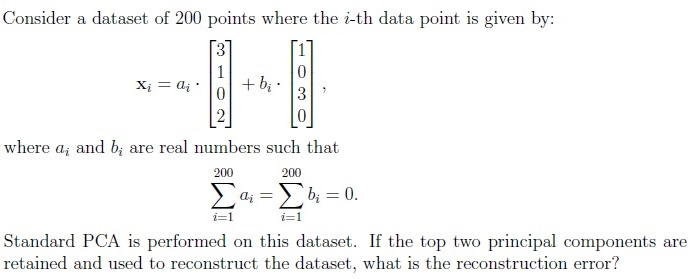
- In k-means algorithm, all cluster initializations lead to the same result.
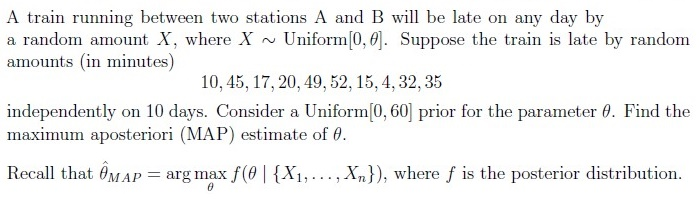
- k-means algorithm is sensitive to outliers.
- One initialization may converge while another may not.
- The initialization of cluster centres may affect the number of iterations k-means takes to converge.
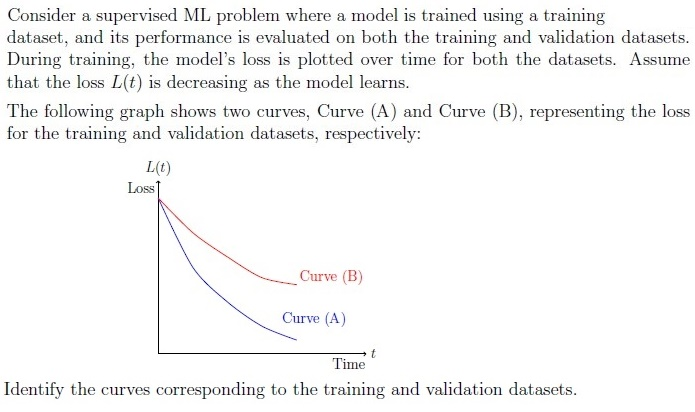
- Curve (A) represents the training loss.
- Curve (B) represents the training loss.
- Curve (A) represents the validation loss.
- Curve (B) represents the validation loss.







- Underfitted models generally have less bias and high variance.
- A decision tree with the maximum possible length may lead to overfitting.
- Weak learners are those whose performance is slightly better than therandom classifier.
- All the estimators in bagging can be trained parallelly.
- Model will overfit.
- The model will not be changed.
- Model will underfit.
- Accuracy of the model will increase.
- classified incorrectly by the weak learner trained in the round.
- classified correctly by the weak learner trained in the round.
- classified incorrectly by a majority of the weak learners trained up to theround.
- classified correctly by a majority of the weak learners trained up to the round.
- True
- False






Answer key
- Q1 (SA, 2 marks): 2.5
- Q2 (SA, 3 marks): 0
- Q3 (SA, 3 marks): 52
- Q4 (SA, 3 marks): 1
- Q5 (MSQ, 3 marks): B, D
- Q6 (MSQ, 3 marks): A, D
- Q7 (MCQ, 4 marks): B
- Q8 (MCQ, 4 marks): A
- Q9 (SA, 2 marks): 1
- Q10 (SA, 2 marks): 2
- Q11 (SA, 2 marks): 1
- Q12 (SA, 5 marks): 0.3 to 0.4
- Q13 (MCQ, 3 marks): A
- Q14 (MCQ, 3 marks): A
- Q15 (MCQ, 2 marks): B
- Q16 (MCQ, 2 marks): B
- Q17 (MCQ, 1 marks): B
- Q18 (SA, 0.5 marks): 1
- Q19 (SA, 0.5 marks): 0
- Q20 (SA, 0.5 marks): 0
- Q21 (SA, 0.5 marks): 2
- Q22 (MSQ, 1 marks): A, B
Concepts this paper tests
Auto-generated summary from the source site. Handy as a checklist; the lessons above explain each idea from scratch.
Here’s a structured summary of core topics, concepts, principles, and equations essential for the exam, followed by Mermaid knowledge graphs to visualize relationships.
Core Topics & Concepts
1. Principal Component Analysis (PCA)
- Key Idea: Dimensionality reduction by projecting data onto orthogonal axes (principal components) that maximize variance.
Steps:
- Center the data (subtract mean).
- Compute covariance matrix .
- Eigen-decomposition: , where contains eigenvectors (principal components) and contains eigenvalues (variances).
- Project data onto top eigenvectors: .
Variance along PC1: For a dataset , the variance along the first PC is the largest eigenvalue of .
- Equation: If all points lie on a line (e.g., ), the variance is .
- Example (Q2): For , variance along PC1 is .
- Reconstruction Error: If data lies in a -dimensional subspace, retaining top PCs gives zero reconstruction error (Q3).
2. Maximum A Posteriori (MAP) Estimation
Key Idea: Bayesian estimate of parameters by maximizing the posterior distribution.
- Posterior: .
- MAP Estimate: .
- Uniform Prior: For and , the posterior is:
- MAP Solution: (Q4: ).
3. Logistic Regression & Class Imbalance
- Key Idea: Binary classification using sigmoid function .
Threshold Adjustment:
- Low threshold: Prioritizes recall (reduces false negatives, e.g., spam detection in Q5).
- High threshold: Prioritizes precision (reduces false positives).
- Trade-off: Acceptable to have false positives (regular emails marked as spam) to minimize false negatives (missed phishing emails).
4. k-Means Clustering
Key Properties (Q6):
- Sensitive to outliers: Outliers can distort centroids.
- Initialization matters: Different initializations can lead to different results (local optima).
- Convergence: Always converges (but may not find global optimum).
- Iterations: Initialization affects the number of iterations.
- Correct Statements: B (sensitive to outliers), D (initialization affects iterations).
5. Training vs. Validation Loss Curves
Key Idea: Monitor overfitting/underfitting via loss curves (Q7).
- Training Loss (Curve A): Decreases monotonically.
- Validation Loss (Curve B): May increase if overfitting.
Interpretation:
- If validation loss > training loss → overfitting.
- If both losses plateau at high values → underfitting.
6. Gradient Descent for Linear Regression
- Objective: Minimize .
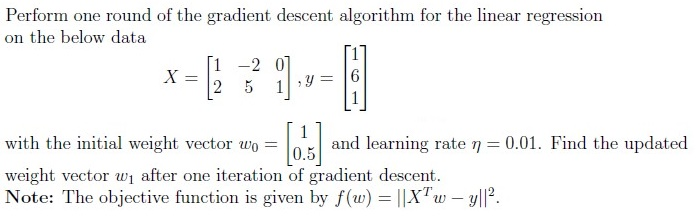
- Update Rule (Q8):
where .
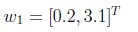
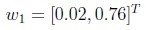
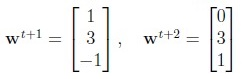
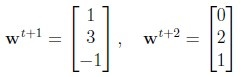
- Example: For , , and , the updated weights after one iteration are .
7. Perceptron Algorithm
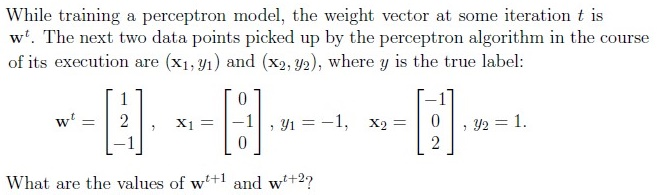
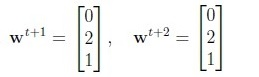
- Update Rule (Q9): For misclassified point :
Example:
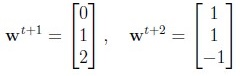
Given , , and :
- .
- .
8. Naïve Bayes Classifier
- Key Idea: Assume features are conditionally independent given the class.
Parameter Estimation (Q10–Q12):
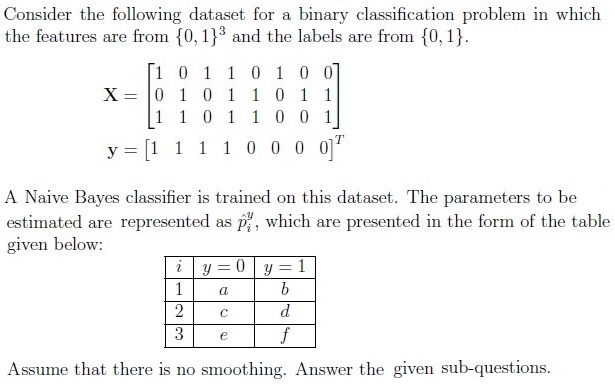
- For binary features , estimate .
- No Smoothing: .
- Prediction: Choose class with highest posterior .
Example:
For , :
- (Q10), (Q11).
- Predict as class (Q12).
9. Leave-One-Out Cross-Validation (LOOCV)
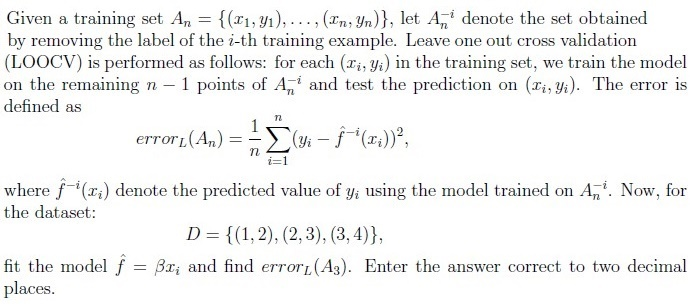
- Key Idea: Train on points, validate on the left-out point (Q13).
- Error Calculation:
- Example: For and model , .
10. Lagrangian & Constrained Optimization
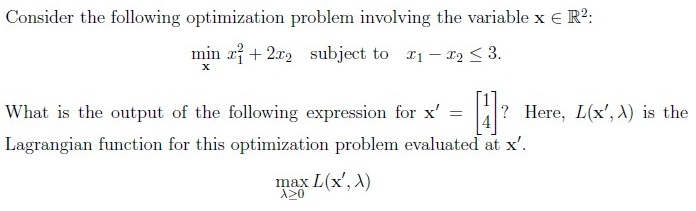
- Lagrangian (Q14): For problem s.t. :
Dual Problem: .
- If is feasible (), the max is .
- If infeasible, .
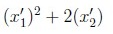
- Example: For , , so .
11. Model Complexity & Bias-Variance Trade-off
Key Concepts (Q15, Q18):
- Underfitting: High bias, low variance (simplistic model).
- Overfitting: Low bias, high variance (complex model).
- Bagging (e.g., Random Forest): Train estimators in parallel on bootstrapped data.
- Boosting (e.g., AdaBoost): Train sequentially, reweighting misclassified points.
- AdaBoost (Q17): Decrease weights for correctly classified observations in next round.
12. Support Vector Machines (SVM)
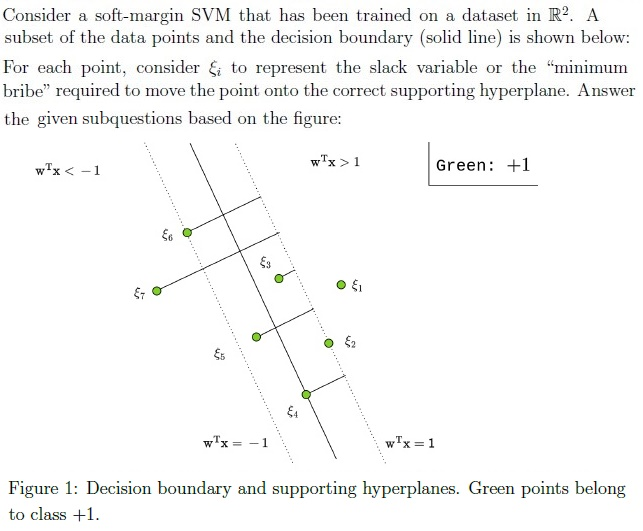
Soft-Margin SVM: Allows misclassification via slack variables .
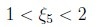
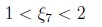
Slack Variable : Distance from correct margin boundary (Q19–Q22).
- if point is on correct side of margin.
- if point violates margin or is misclassified.
- Support Vectors: Points with or on the margin.
Key Properties (Q16):
- Removing non-support vectors does not change the model.
- Kernel trick: Map data to higher dimensions for linear separation.