Home / Past papers / MLT Quiz 2 / this paper
IIT M DIPLOMA AN EXAM QDD3 03 Aug - 03 Aug 2025
Elapsed 00:00






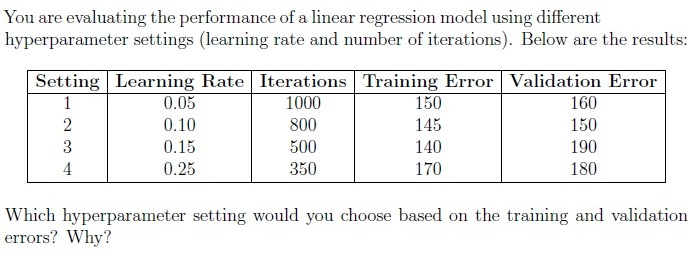
- Setting 3, because it has the lowest training error, indicating the best fit to thetraining data.
- Setting 2, because it has the lowest validation error and a relatively lowtraining error, indicating a good generalization.
- Setting 1, because it has the highest number of iterations and therefore likelyto be more stable.
- Setting 4, because it uses the highest learning rate and converges the fastest.
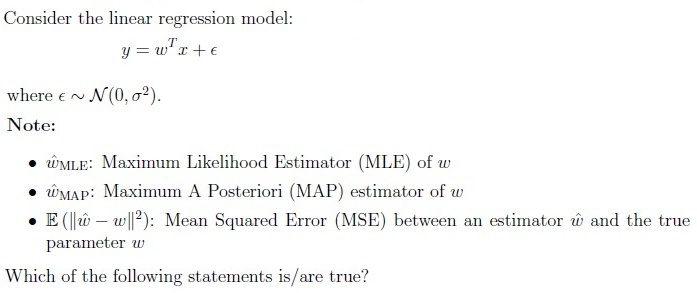





- TRUE
- FALSE

- TRUE
- FALSE





Which among the following are true?





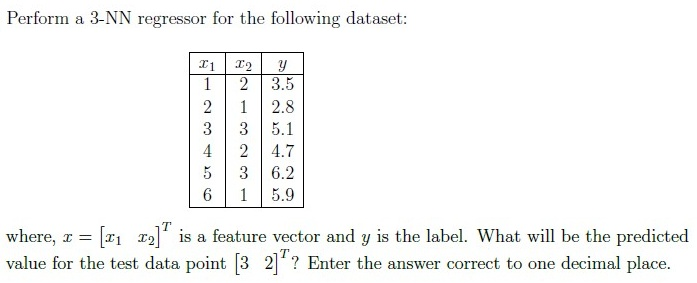
Comprehension passage - the questions below it refer to this
Based on the above data, answer the given subquestions.
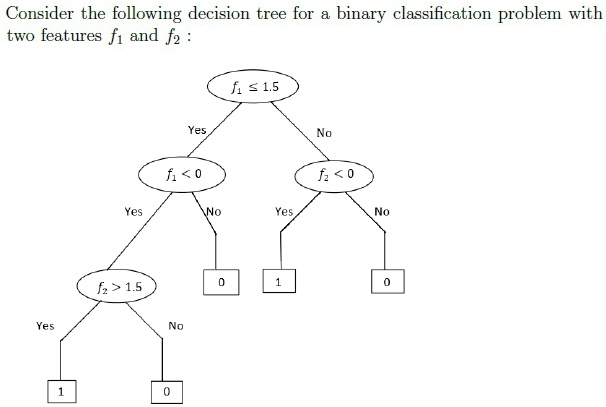
Which among the following represents the correct decision boundary for the decision tree?
Note: Here + represents the label 1 and − represents the label 0.
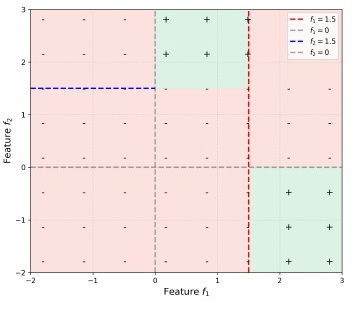
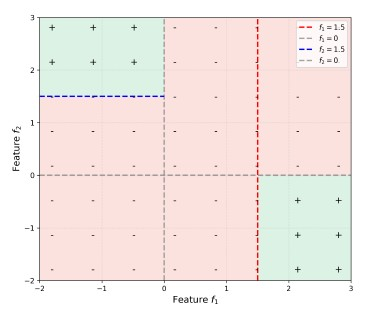
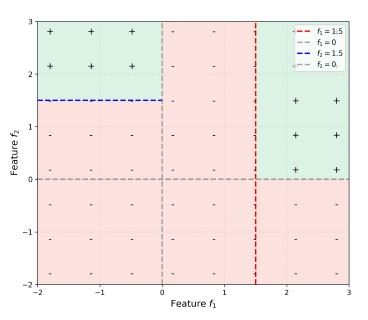
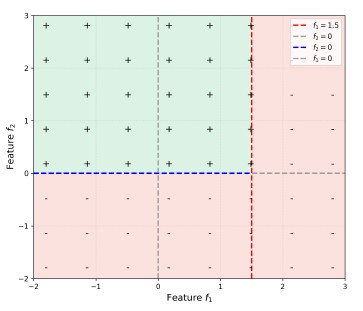
What will be the prediction for the new datapoint (2, 2)?
Comprehension passage - the questions below it refer to this
Based on the above data, answer the given subquestions.
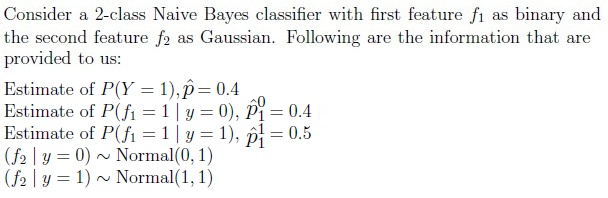
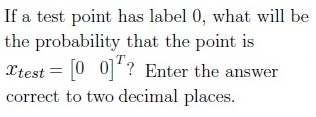
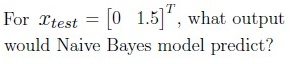
Comprehension passage - the questions below it refer to this
Suppose you want to build a decision tree to help diagnose a certain disease based on patient data. You have a dataset of 1000 patients labeled as either “positive” or “negative”. Here, positive represents patients with the disease and negative represents no disease. One of the feature used to diagnose is headache. Below is the breakdown of the patients reporting headache: Headache present: 300 positive, 50 negative Headache not present: 100 positive, 550 negative
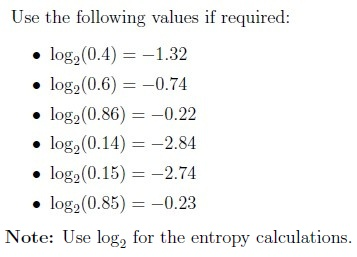 Suppose you want to build a decision tree to help diagnose a certain disease based on patient data. You have a dataset of 1000 patients labeled as either “positive” or “negative”. Here, positive represents patients with the disease and negative represents no disease. One of the feature used to diagnose is headache. Below is the breakdown of the patients reporting headache: Headache present: 300 positive, 50 negative Headache not present: 100 positive, 550 negative
Based on the above data, answer the given subquestions.
What is the entropy of the root node? Enter the answer correct to two decimal places.
What is the information gain for choosing the feature “headache” for splitting at the root node? Enter the answer correct to two decimal places.
Answer key
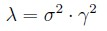
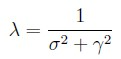
- Q1 (MCQ, 4 marks): A
- Q2 (MCQ, 3 marks): C
- Q3 (MCQ, 3 marks): B
- Q4 (MCQ, 3 marks): C
- Q5 (MCQ, 2 marks): A
- Q6 (MCQ, 1 marks): A
- Q7 (MSQ, 2 marks): A, C
- Q8 (MSQ, 2 marks): A, C
- Q9 (SA, 3 marks): 4.2
- Q10 (MCQ, 3 marks): B
- Q11 (SA, 2 marks): 0
- Q12 (SA, 2 marks): 0.22 to 0.26
- Q13 (SA, 3 marks): 1
- Q14 (SA, 3 marks): 0.95 to 0.99
- Q15 (SA, 4 marks): 0.34 to 0.38
Concepts this paper tests
Auto-generated summary from the source site. Handy as a checklist; the lessons above explain each idea from scratch.
Summary of Core Topics, Concepts, Principles, and Equations
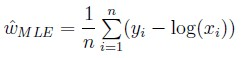
1. Maximum Likelihood Estimation (MLE)
- Concept: MLE is a method of estimating the parameters of a statistical model by maximizing the likelihood function.
- Equation:
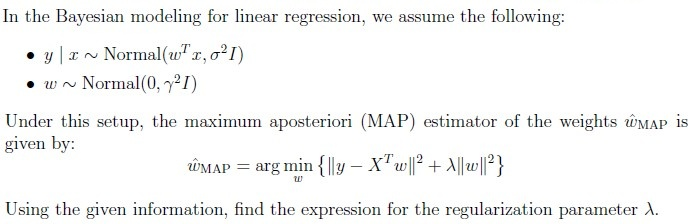
2. Maximum A Posteriori (MAP) Estimation
- Concept: MAP estimation is used in Bayesian statistics to estimate an unknown quantity by maximizing the posterior distribution.
- Equation:
3. Linear Regression
- Concept: Linear regression models the relationship between a dependent variable and one or more independent variables using a linear approach.
- Equation:
4. Model Evaluation and Hyperparameter Tuning
- Concept: Evaluating the performance of a model using training and validation errors to choose the best hyperparameters.
- Key Idea: Choose hyperparameters that minimize validation error while keeping training error relatively low.
5. Generative and Discriminative Models
Concept:
- Generative Models: Model how the features are generated, e.g., Gaussian Naive Bayes.
- Discriminative Models: Model the conditional probability , focusing on the boundary between classes.
6. Decision Trees
- Concept: A decision tree is a flowchart-like structure where each internal node represents a feature, each branch represents a decision rule, and each leaf node represents an outcome.
Entropy and Information Gain:
- Entropy: Measure of impurity or disorder in a dataset.
- Information Gain: Measure of the reduction in entropy achieved by partitioning the data based on a given feature.
7. Naive Bayes Classifier
- Concept: A probabilistic classifier based on applying Bayes' theorem with strong independence assumptions between the features.
- Equation: