Home / Past papers / MLT Quiz 1 / this paper
IIT M DIPLOMA AN4 EXAM QPD4 29 Oct 2023 - 29 Oct 2023
Elapsed 00:00
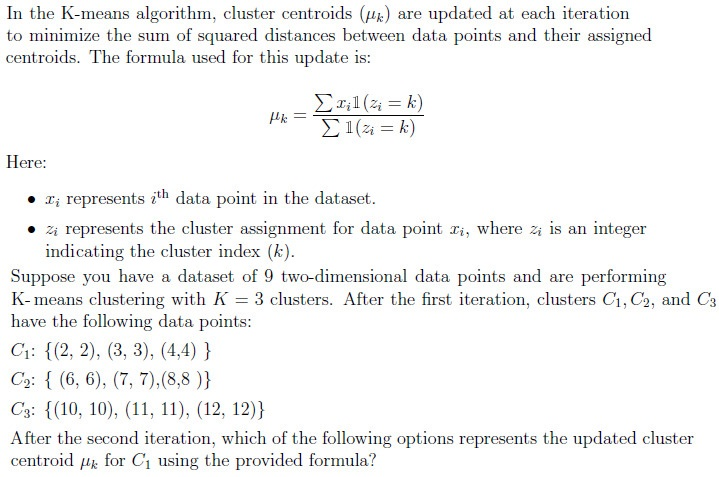
- μ1 = (2.5, 2.5)
- μ1 = (4.5, 4.5)
- μ1 = (3, 3)
- μ1 = (5.5, 5.5)
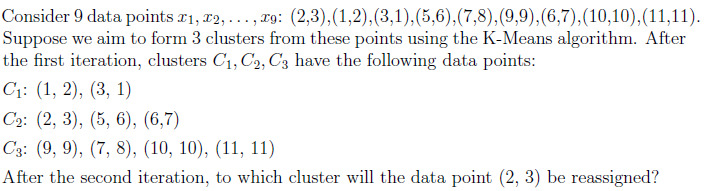
- C1
- C2
- C3
- It remains in the same cluster as in the first iteration
Which of the following statements are true regarding applying standard PCA on a centered dataset?
- The variance of the dataset along the first principal component is maximum.
- Eigenvectors are always orthogonal to each other in PCA.
- The first principal component is the eigenvector corresponding to the largesteigenvalue of the covariance matrix.
- The first principal component is the eigenvector corresponding to the smallesteigenvalue of the covariance matrix.
Consider a dataset that has 200 data-points, each of which is either a zero or one. The Bernoulli distribution is used to model this data. If the MLE estimate for the parameter p of the Bernoulli distribution is 0.3, how many zeros does the dataset have?
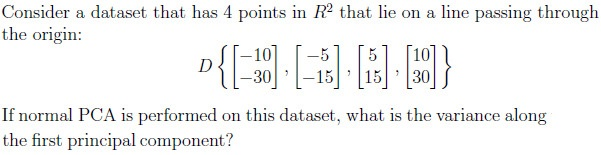
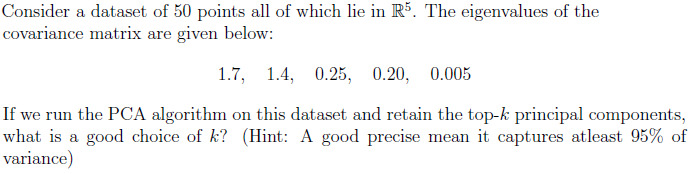
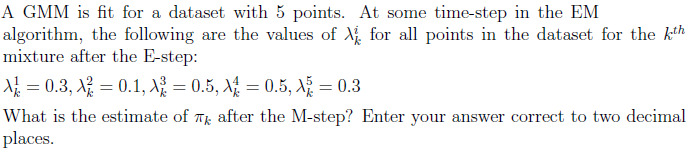
Enter your answer correctly up to two decimals
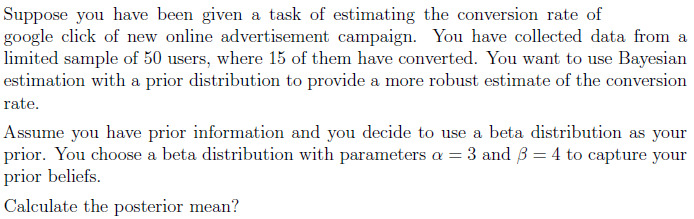
Comprehension passage - the questions below it refer to this
A k-means++ algorithm with k= 3 was applied to the following 2D points: (2, 2), (3, 3), (4, 4), (10, 10), (12, 12), (13, 13) (2, 2) is chosen as the first cluster mean. Based on the above data, answer the given subquestions.Which point has the highest probability of being chosen as the 2nd cluster mean? Use the Manhattan distance to compute the distances.
- (4, 4)
- (12, 12)
- (10, 10)
- (13, 13)
Let’s assume that (3, 3), (10, 10), and (12, 12) are the cluster means. You introduce a new data point, (−5, 10). Which cluster mean is the data point (−5, 10) closest to when using the Euclidean distance method?
- (3, 3)
- (10, 10)
- (12, 12)
- None of these
Comprehension passage - the questions below it refer to this
Based on the above data, answer the given subquestions.
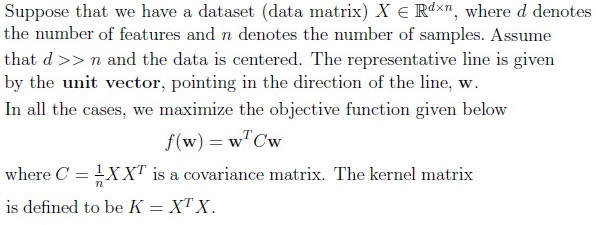
Which of the following statements are true?
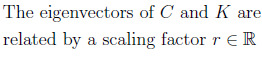
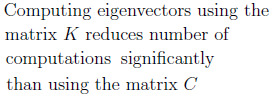
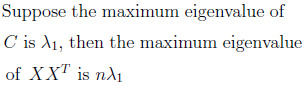
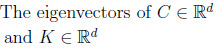
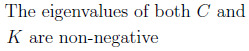
Which of the following matrices helps in transforming the eigenvectors of K to the eigenvectors of C?
- X
- XT
- C-1
- K-1
- X-1
Suppose that the 95% of the variance of the data is captured using d − 1 eigenvectors. This implies that

Answer key
Concepts this paper tests
Auto-generated summary from the source site. Handy as a checklist; the lessons above explain each idea from scratch.
Summary of Core Topics, Concepts, Principles, and Equations
1. K-Means Clustering
- Concepts: Cluster centroids, sum of squared distances, cluster assignment.
- Principles: Minimize the sum of squared distances between data points and their assigned centroids.
- Equations:
where is the data point and is the cluster assignment for .
2. Principal Component Analysis (PCA)
- Concepts: Eigenvectors, eigenvalues, covariance matrix, variance.
- Principles: Transform data to a new coordinate system where the greatest variance lies on the first axis (first principal component), the second greatest variance on the second axis, and so on.
- Equations:
where is the covariance matrix and is the data matrix.
3. Maximum Likelihood Estimation (MLE)
- Concepts: Bernoulli distribution, parameter estimation.
- Principles: Estimate the parameters of a statistical model by maximizing the likelihood function.
- Equations:
4. Gaussian Mixture Models (GMM) and Expectation-Maximization (EM) Algorithm
- Concepts: Mixture models, latent variables, responsibility.
- Principles: Iteratively estimate the parameters of a mixture model using the EM algorithm.
- Equations:
where is the responsibility of the mixture for the data point.
5. Bayesian Estimation
- Concepts: Prior distribution, posterior distribution, Beta distribution.
- Principles: Update the prior distribution with observed data to obtain the posterior distribution.
- Equations:
where and are the parameters of the Beta prior distribution.
6. K-Means++ Algorithm
- Concepts: Initialization, Manhattan distance, Euclidean distance.
- Principles: Improve the initialization of K-Means clustering to achieve better results.
- Equations: Distance metrics (Manhattan and Euclidean distances).
7. Eigenvalues and Eigenvectors
- Concepts: Covariance matrix, kernel matrix, eigenvalues, eigenvectors.
- Principles: Use eigenvalues and eigenvectors to understand the variance and structure of the data.
- Equations:
where is the covariance matrix and is the unit vector.