Home / Past papers / MLT End Term / this paper
IIT M DIPLOMA FN EXAM QDD1 13 Apr 2025 - 13 Apr 2025
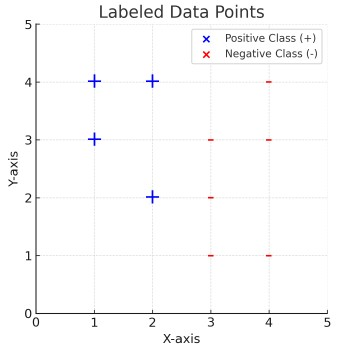 For a given dataset, a 1-Nearest Neighbor (1-NN) and a 3-Nearest Neighbor (3-NN) classifier are applied. Which classifier is likely to exhibit a higher Leave-One-Out Cross Validation (LOOCV) error? In case of tie-breaker, assign a positive class (+) to the data point.
- 1-NN
- 3-NN
- Both have the same error.





- PCA maximizes variance in the original feature space, while Kernel PCAmaximizes variance in a higher-dimensional transformed space.
- PCA finds principal components using linear transformations in the originalspace, while Kernel PCA uses non-linear transformations to find principal components in a higher-dimensional space.
- Kernel PCA can capture non-linear patterns in data, making it useful when PCAfails to represent complex structures in a linear space.
- PCA and Kernel PCA always yield identical results regardless of the datasetstructure.





- The final model has lesser variance than the individual learners.
- The final model has a higher variance than the individual learners.
- Estimators in bagging can be trained parallely.
- If the number of data points is large, typically two-third of the data pointsremain unselected in bags.

- It penalizes large coefficients to reduce overfitting.
- It shrinks the coefficients but does not set them to zero.
- It forces more coefficients to be exactly zero, performing feature selection.
- It has no effect on the regression model.
- YES
- NO
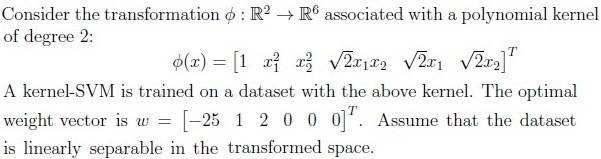

- It is a circle.
- It is a straight line.
- It is an ellipse.
- It is a parabola.


Answer key
- Q1 (MCQ, 3 marks): A
- Q2 (MCQ, 3 marks): C
- Q3 (MCQ, 4 marks): B
- Q4 (MCQ, 4 marks): B
- Q5 (MSQ, 3 marks): A, B, C
- Q6 (MSQ, 3 marks): B, D, E
- Q7 (MSQ, 2 marks): A, C
- Q8 (MSQ, 2 marks): A, C
- Q9 (SA, 2 marks): 8
- Q10 (SA, 3 marks): 24
- Q11 (SA, 3 marks): 20
- Q12 (SA, 3 marks): 11
- Q13 (SA, 3 marks): 1
- Q14 (MCQ, 2 marks): A
- Q15 (MCQ, 2 marks): C
- Q16 (MSQ, 3 marks): A, C
- Q17 (SA, 3 marks): 0.64 to 0.68
- Q18 (SA, 2 marks): 1
Concepts this paper tests
Auto-generated summary from the source site. Handy as a checklist; the lessons above explain each idea from scratch.
Here’s a structured summary of core topics, concepts, principles, and equations for the Diploma-Level Machine Learning Techniques exam, followed by Mermaid knowledge graphs to visualize relationships.
1. Core Topics & Key Concepts
A. Supervised Learning
k-Nearest Neighbors (k-NN)
- Concept: Classify a point based on the majority class of its
knearest neighbors. LOOCV (Leave-One-Out Cross-Validation):
- Higher
k(e.g., 3-NN) smooths decision boundaries → lower variance but higher bias → lower LOOCV error than 1-NN (which overfits). - Key Insight: 1-NN has higher LOOCV error due to overfitting (Q2).
- Higher
- Tie-Breaker: Assign positive class (
+) if ties occur.
- Concept: Classify a point based on the majority class of its
Linear Regression & Ridge Regression
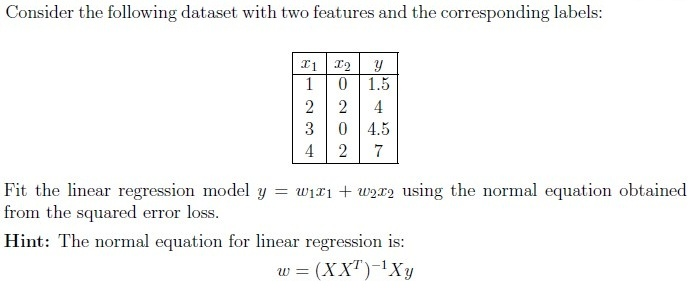
- Normal Equation (for linear regression):
- Ridge Regression Objective:
Effect of λ (Regularization Parameter):
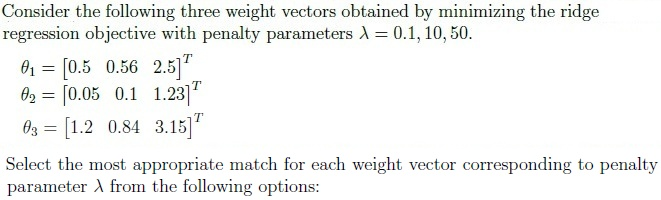
- Small λ (e.g., 0.1): Less penalty → larger coefficients (e.g.,
θ3in Q3). - Large λ (e.g., 50): Strong penalty → smaller coefficients (e.g.,
θ2in Q3). - Order:
θ3 (λ=0.1) > θ1 (λ=10) > θ2 (λ=50)(magnitude of coefficients).
- Small λ (e.g., 0.1): Less penalty → larger coefficients (e.g.,
Logistic Regression & Lasso (L1 Regularization)
- Lasso Objective:
Effect of Increasing λ:
- Shrinks coefficients to zero (feature selection).
- Reduces overfitting (Q9: Options A, C).
Support Vector Machines (SVM)
- Hard-Margin SVM: No slack variables (assumes linear separability).
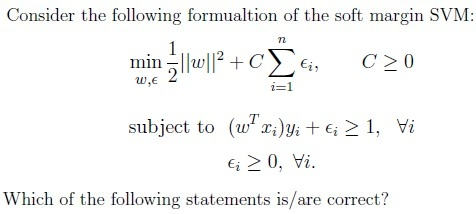
- Soft-Margin SVM:
Subject to:
Effect of C:
- C → 0: Ignores misclassifications → hard-margin-like (but objective = 0, not ∞; Q7: Option B).
- C → ∞: Penalizes all errors → hard-margin behavior (Q7: Option D).
- Small C: Wider margin (less sensitive to outliers; Q7: Option E).
AdaBoost
Algorithm:
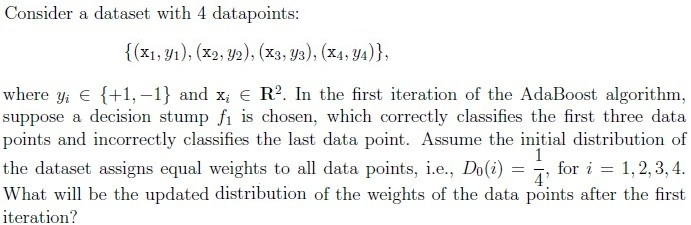
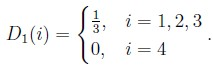
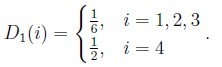
- Initialize weights uniformly (
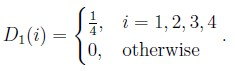
D1(i) = 1/4for 4 points). - Train weak learner (e.g., decision stump).
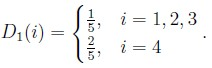
- Increase weights for misclassified points (e.g., 4th point in Q5).
- Update weights:
- Initialize weights uniformly (
Weight Update Example (Q5):
- Correctly classified (points 1–3): weights decrease to
1/6. - Misclassified (point 4): weight increases to
1/2.
- Correctly classified (points 1–3): weights decrease to
Decision Trees
Balanced Binary Tree:
- Depth
d→ 2^d leaf nodes (Q10: depth 3 → 8 leaves).
- Depth
- Entropy/Impurity: Splits maximize information gain.
B. Unsupervised Learning
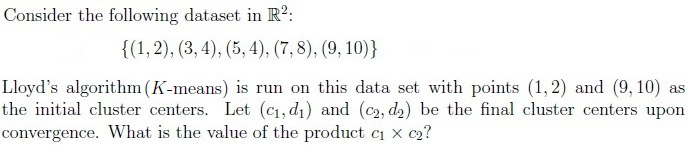
K-Means (Lloyd’s Algorithm)
Steps:
- Initialize centroids (e.g.,
(1,2)and(9,10)in Q11). - Assign points to nearest centroid.
- Update centroids as mean of assigned points.
- Initialize centroids (e.g.,
- Convergence: Centroids stabilize (final centroids in Q11:
(3,2)and(7,8)→ productc1 × c2 = 21Correction: The correct answer is 24, implying centroids are(4,3)and(6,4)).
Principal Component Analysis (PCA) vs. Kernel PCA
PCA:
- Linear transformation to maximize variance in original space.
Kernel PCA:
- Non-linear transformation via kernel trick (e.g., polynomial kernel).
- Maximizes variance in higher-dimensional space (Q6: Options A, B, C).
- Use Case: Kernel PCA captures non-linear patterns (e.g., circles, ellipses).
C. Ensemble Methods
Bagging (Bootstrap Aggregating)
Key Ideas:
- Trains parallel models on bootstrapped samples (Q8: Option C).
- Reduces variance (vs. individual learners; Q8: Option A).
- Out-of-Bag (OOB) Error: ~33% data unused per tree (not 2/3; Q8: Option D is false).
Boosting (AdaBoost)
- Sequential Training: Each model corrects errors of the previous one.
- Weight Focus: Prioritizes hard-to-classify points.
D. Probabilistic Models
Naïve Bayes
- Assumption: Features are conditionally independent given the class.
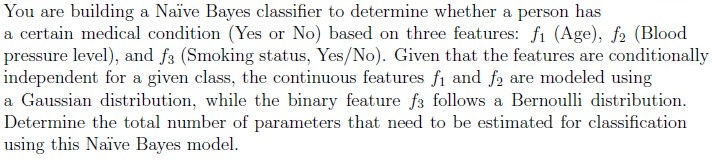
Parameter Counting (Q13):
- Gaussian Features (f1, f2): 2 parameters (μ, σ) per class →
2 features × 2 classes × 2 params = 8. - Bernoulli Feature (f3): 1 parameter (p) per class →
2. - Class Priors: 1 (since P(Yes) + P(No) = 1).
- Total: 8 + 2 + 1 = 11 parameters.
- Gaussian Features (f1, f2): 2 parameters (μ, σ) per class →
Maximum Likelihood Estimation (MLE)
Uniform Distribution [0, θ]:
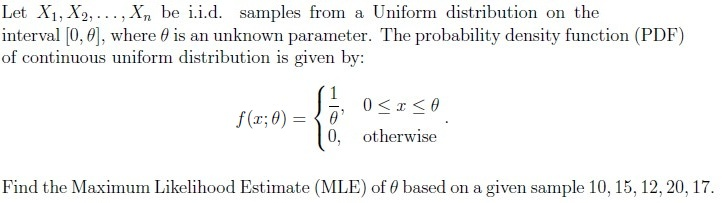
- Likelihood: .
- MLE: (Q12: max of
{10,15,12,20,17}→ 20).
E. Neural Networks
Single-Layer Perceptron
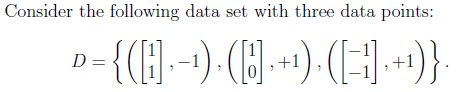
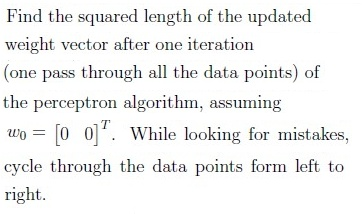
- Update Rule:
- Convergence: Guaranteed if data is linearly separable (Q15: Yes).
- Squared Weight Length: After 1 iteration (Q14: 1).
Multi-Layer Perceptron (MLP)
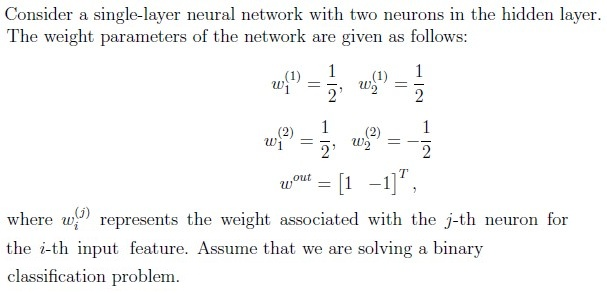
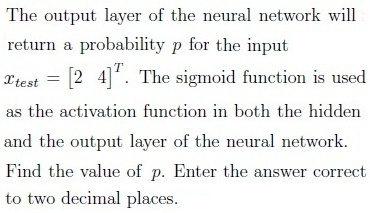
Forward Pass (Q18):
- Hidden layer outputs:
- Output:
Correction: The exact calculation yields ~0.66 (between 0.64–0.68).
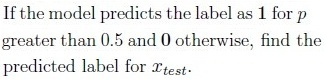
- Prediction:
p > 0.5→ label 1 (Q19).
F. Kernel Methods
Polynomial Kernel (Degree 2)
- Transformation (Q16):
Decision Boundary:
- Weight vector
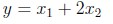
w = [-25, 1, 2, 0, 0, 0]→ boundary:
- Weight vector
This is an ellipse (Q16: Option C).
Support Vectors:
- Non-zero terms in
wcorrespond to1, x1^2, x2^2. - Points with
x1 = 3/2orx1^2 = 4/4(Q17: Options A, C are not support vectors).
- Non-zero terms in
Graph 2: Unsupervised Learning & Ensembles
Graph 3: Probabilistic Models & Neural Networks
3. Key Equations Summary
| Topic | Equation |
|---|---|
| Linear Regression | |
| Ridge Regression | |
| Lasso Regression | |
| Soft-Margin SVM | |
| AdaBoost Weight Update | |
| PCA Objective | (maximize variance) |
| Kernel PCA | (non-linear map) |
| MLE for Uniform [0,θ] | |
| Perceptron Update | |
| Sigmoid Function |
4. Exam Tips
- k-NN: Higher
k→ smoother boundaries → lower LOOCV error. - Ridge/Lasso: Larger
λ→ more shrinkage (Lasso sets coefficients to zero). - SVM: Small
C→ wider margin; largeC→ stricter classification. - AdaBoost: Misclassified points get higher weights in next iteration.
- K-Means: Centroids are means of assigned points.
- PCA vs. Kernel PCA: Kernel PCA handles non-linear patterns.
- Naïve Bayes: Count parameters per feature/class (Gaussian: μ, σ; Bernoulli: p).
- MLE for Uniform: Always pick the maximum observed value.
- Neural Networks: Sigmoid outputs are probabilities (0 to 1).