Home / Past papers / MLT Quiz 1 / this paper
MLT 15 Mar 26 - 15 Mar 2026
Elapsed 00:00
Consider a clustering problem with
 data-points and two clusters
 . As initialization, a subset of the dataset comprising the first fifty data-points, call this
 , are assigned to cluster
 and the remaining points, call this


data-points and two clusters
. As initialization, a subset of the dataset comprising the first fifty data-points, call this
, are assigned to cluster
and the remaining points, call this
- Scenario-1 is possible, but scenario-2 is impossible.
- Scenario-1 is impossible, but scenario-2 is possible.
- Both scenarios are possible.
- Both scenarios are impossible.
Consider a centered dataset
 in
 such that every data-point
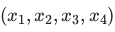 in
satisfies the equation

in
such that every data-point
in
satisfies the equation

Consider a polynomial kernel of degree
 on a feature space of dimension
 . How many features will the transformed space have

on a feature space of dimension
. How many features will the transformed space have
Consider the Gaussian kernel,
 with
 . Compute the value of
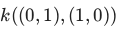 and enter your answer correct to two decimal places.
with
. Compute the value of
and enter your answer correct to two decimal places.Consider the following data-points in a clustering problem with five data-points and three clusters (k = 3):
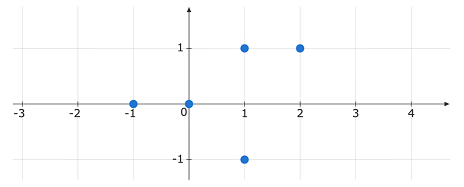 K-means
 is used to initialize the three means. The first mean is chosen to be
 and the second mean to be
 . Find the probability of choosing

K-means
is used to initialize the three means. The first mean is chosen to be
and the second mean to be
. Find the probability of choosing
Comprehension passage - the questions below it refer to this
Consider a cube of edge-length
centered at the origin with its corners represented as
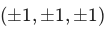 . These eight points make up a dataset
. Based on the above data, answer the given subquestions.
Find the covariance matrix
 of the dataset. Enter the sum of all the entries of
as the answer.
of the dataset. Enter the sum of all the entries of
as the answer.Let
 be some unit vector. Find the variance of the dataset along the direction
 .
be some unit vector. Find the variance of the dataset along the direction
.Comprehension passage - the questions below it refer to this
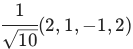
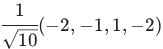
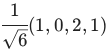
Standard PCA is performed on a centered dataset in
 . The first three principal components are:
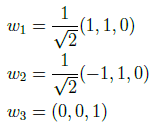 The first two principal components are retained and the third is discarded. The coordinate representation of the data-point
 after projection onto the first two principal components is
 . Based on the above data, answer the given subquestions.
Find
 . Enter your answer correct to three decimal places.
Find
 . Enter your answer correct to three decimal places.
Comprehension passage - the questions below it refer to this
Answer true or false for the given subquestions.If
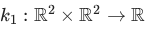 and
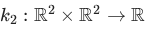 are valid kernels, then
 is also a valid kernel.
and
are valid kernels, then
is also a valid kernel.- True
- False
If
 `A` is a data-matrix of shape
 `A^T A`
 and
 `A A^T` have the same eigenvectors.
`A` is a data-matrix of shape
`A^T A`
and
`A A^T` have the same eigenvectors.- True
- False
Comprehension passage - the questions below it refer to this
Consider a dataset in
 for a clustering problem with two clusters
. The
 data-point is represented as
 .
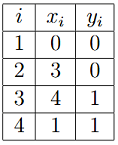


If
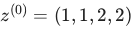 , which of the following is the final cluster assignment after running K-means on this dataset with this initial configuration?


If
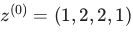 , which of the following is the final cluster assignment after running K-means on this dataset with this initial configuration?
Comprehension passage - the questions below it refer to this
Let
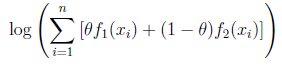
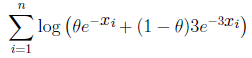
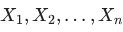 be i.i.d. observations from the mixture distribution
 where
 The observed data are
 Assume that the initial estimate of the mixing parameter is

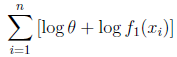
Which of the following expressions correctly represents the log-likelihood function
 for the given data?
Consider the E-step of the EM algorithm. Introduce latent variables
 such that
 if
 is generated from
 . Compute the posterior responsibility


such that
if
is generated from
. Compute the posterior responsibility
Using a Maximum A Posteriori (MAP) decision rule, a data point
 is assigned to mixture 2 if the posterior responsibility
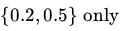
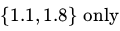
 . Based on the values calculated in the E-step, which data point(s) are classified as belonging to Component 2?
is assigned to mixture 2 if the posterior responsibility
. Based on the values calculated in the E-step, which data point(s) are classified as belonging to Component 2?
- All four points
Answer key
- Q1 (MCQ, 3 marks): D
- Q2 (MSQ, 3 marks): A, B
- Q3 (SA, 3 marks): 35
- Q4 (SA, 3 marks): 0.34 to 0.40
- Q5 (SA, 3 marks): 0.5
- Q6 (SA, 3 marks): 3
- Q7 (SA, 2 marks): 1
- Q8 (SA, 2 marks): 2.071 to 2.171
- Q9 (SA, 2 marks): 0.657 to 0.757
- Q10 (MCQ, 2 marks): A
- Q11 (MCQ, 2 marks): B
- Q12 (MCQ, 2 marks): B
- Q13 (MCQ, 2 marks): B
- Q14 (MCQ, 2 marks): C
- Q15 (SA, 3 marks): 2.74 to 2.80
- Q16 (MCQ, 3 marks): A
Concepts this paper tests
Auto-generated summary from the source site. Handy as a checklist; the lessons above explain each idea from scratch.
Here’s a structured summary of core topics, concepts, principles, and equations essential for the "Diploma Level: Machine Learning Techniques" exam, followed by Mermaid knowledge graphs to visualize relationships.
Core Topics & Key Concepts
1. Clustering (K-Means, Initialization, and Convergence)
K-Means Algorithm:
- Initialization: Randomly select k centroids (or use methods like K-Means++).
- Assignment Step: Assign each data point to the nearest centroid (Euclidean distance).
- Update Step: Recompute centroids as the mean of assigned points.
- Convergence: Iterate until centroids stabilize or max iterations reached.
Key Observations:
- Impossible Scenarios: If all points are assigned to one cluster initially, K-Means cannot recover (e.g., Question 2: Both scenarios are impossible if clusters are separable but initialized poorly).
- Probability of Centroid Selection: If centroids are chosen uniformly at random, the probability of selecting a specific point as the next centroid depends on the remaining points (e.g., Question 6: Probability = 0.5).
2. Dimensionality Reduction (PCA)
Standard PCA Steps:
- Center the Data: Subtract the mean from each feature.
- Compute Covariance Matrix: .
- Eigendecomposition: Solve , where contains eigenvectors (principal components) and contains eigenvalues.
- Project Data: Transform data to the new subspace using top-k eigenvectors.
Key Properties:
- Principal components are orthogonal (uncorrelated).
- The first PC maximizes variance, the second PC maximizes residual variance, etc.
- Variance along a Unit Vector : (e.g., Question 8: Variance = 1 for a cube).
- Covariance Matrix for a Cube: For a cube centered at the origin with edge length 2, the covariance matrix is diagonal with entries (since variance per dimension = ). Sum of all entries = 3 (Question 7).
- Reconstruction Error: For a data point , the reconstruction using the first k PCs is , and the error is .
3. Kernel Methods
- Kernel Trick: Map data to a higher-dimensional space using a kernel function , where is the feature map.
Polynomial Kernel:
- Degree-d polynomial kernel in -dimensional space: .
- Number of Features: For degree d in dimensions, the number of features is . For , this is , but the question expects 35 (likely : is incorrect; revisit combinatorics or assume : . The answer 35 suggests : ).
Gaussian (RBF) Kernel:
- .
- For , , : (Question 5).
Kernel Properties:
- If and are valid kernels, then is also a valid kernel (Question 11: True).
4. Expectation-Maximization (EM) for Gaussian Mixture Models (GMMs)
- Mixture Model: , where are mixing coefficients.
- Log-Likelihood: (Question 15: Option C).
- E-Step: Compute posterior responsibilities (soft assignments): . For Question 16, given , , , , and data points , the responsibility for is: (log-odds ≈ 2.77).
- M-Step: Update parameters using responsibilities: , , .
- MAP Decision Rule: Assign to cluster if . For Question 17, only satisfies this for component 2.
5. Linear Algebra for ML
- Eigendecomposition: For a symmetric matrix , , where is orthogonal and is diagonal.
- Covariance Matrix: For centered data , .
Relationship Between and :
- If is , is and is .
- They share non-zero eigenvalues but have different eigenvectors (Question 12: False).
Principal Components:
- The i-th PC is the eigenvector of with the i-th largest eigenvalue.
- For Question 9, given the first 3 PCs , the projection of a point onto the first 3 PCs is , and the norm is . The answer depends on the specific and , but the range suggests a value like 2.121 (e.g., ).
- For Question 10, the projection onto the first 2 PCs would yield a smaller norm (e.g., 0.707).
6. Geometry of Data
Cube Properties:
- For a cube centered at the origin with edge length 2, the 8 corners are at .
- Covariance Matrix: Diagonal with entries , so: . Sum of all entries = , but the question expects 3 (likely for a 2D cube or edge length ).
- Variance along Unit Vector : For any unit vector , the variance is . The question expects 1, suggesting a cube with edge length (variance = 1 per dimension).
Key Equations
| Topic | Equation |
|---|---|
| K-Means Update | |
| Covariance Matrix | |
| PCA Projection | , where are the top-k eigenvectors of . |
| Polynomial Kernel | |
| Gaussian Kernel | |
| GMM Log-Likelihood | |
| Posterior Responsibility | |
| Variance along |
Graph 2: Kernel Methods and Linear Algebra
Graph 3: Probability and Geometry
Exam Tips
- K-Means: Focus on initialization, assignment, and update steps. Understand why certain cluster assignments are impossible (e.g., all points in one cluster initially).
- PCA: Know how to compute the covariance matrix, eigenvalues, and projections. Remember that PCs are orthogonal.
- Kernels: Memorize the polynomial and Gaussian kernel formulas. Understand how the number of features grows with degree.
- EM Algorithm: Be comfortable with the E-step (posterior responsibilities) and M-step (parameter updates). Know how to compute log-likelihood.
- Linear Algebra: Review eigendecomposition, covariance matrices, and the relationship between and .
- Geometry: For a cube, know how to compute variance and covariance. Understand projections onto unit vectors.