Home / Past papers / MLT Quiz 1 / this paper
IIT M IMPROVEMENT AN EXAM QIM3 26 Oct - 26 Oct 2025
Elapsed 00:00
Which among the following is true with respect to the Lloyds’ algorithm?
- It always converges.
- It may fail to converge for an initialization while it may converge for otherinitialization.
- It is sensitive to outliers.
- The solution produced is always the optimal.

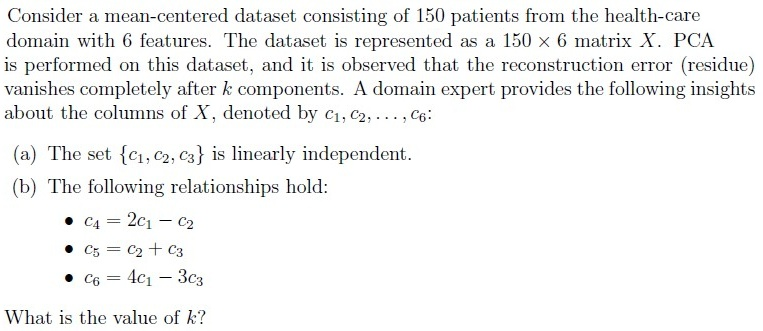
- There will be 50 non-zero eigenvalues of the covariance matrix.
- There will be 6 non-zero eigenvalues of the covariance matrix.
- Using the first 5 principal components, the dataset can be reconstructed withzero residue.
- The variance captured by the top 6 principal components equals the totalvariance of the dataset.
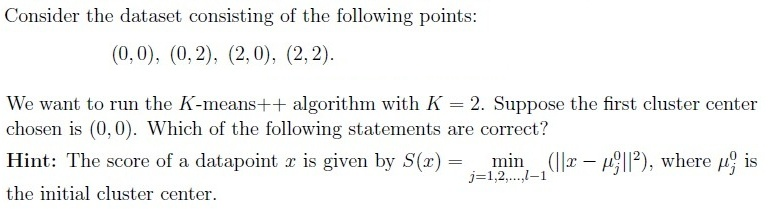
- The points (0, 2), (2, 0), and (2, 2) have the equal probability of being chosen asthe second cluster center.
- The probability of selecting (2, 2) as the second cluster center is twice that ofselecting (0, 2).
- If (2, 2) is chosen as the second cluster center, the algorithm will alwaysconverge in one iteration.
- The tie-breaking rule will affect the final cluster centers.
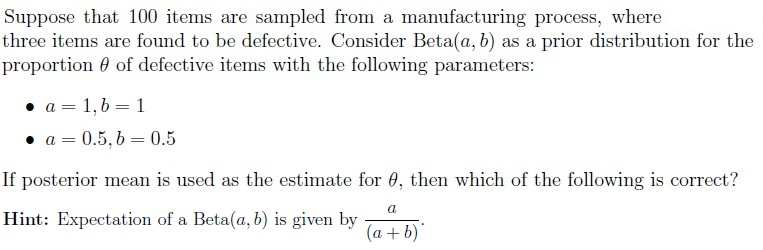
- Posterior mean for Beta(1, 1) is 0.039.
- Posterior mean for Beta(1, 1) is 0.03.
- Posterior mean for Beta(0.5, 0.5) is 0.025.
- Posterior mean for Beta(0.5, 0.5) is 0.034.
Which of the following are valid kernel functions? Select all that apply.




Comprehension passage - the questions below it refer to this
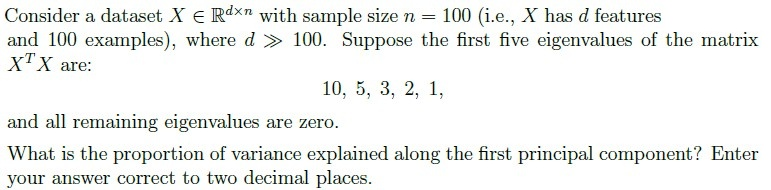
Based on the above data, answer the given subquestions.
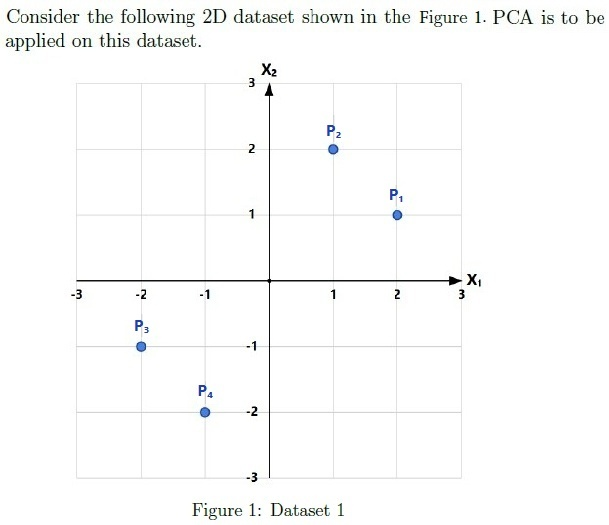
What is the covariance matrix of the dataset?


If standard PCA is performed on this dataset, what is the variance along the first principal component? Enter the answer correct to one decimal place.
If standard PCA is performed on this dataset, what is the variance along the second principal component? Enter the answer correct to one decimal place.
Comprehension passage - the questions below it refer to this
Based on the above data, answer the given subquestions.

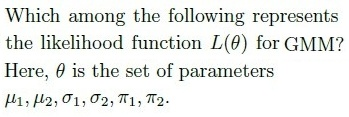




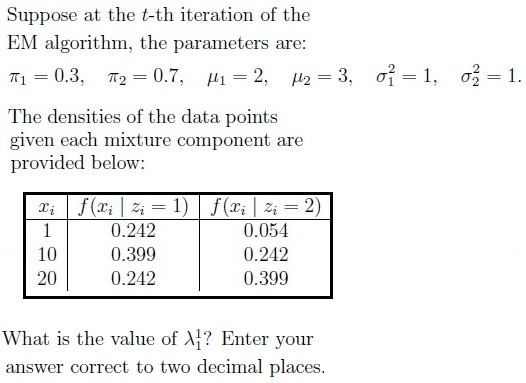
Comprehension passage - the questions below it refer to this
Based on the above data, answer the given subquestions.
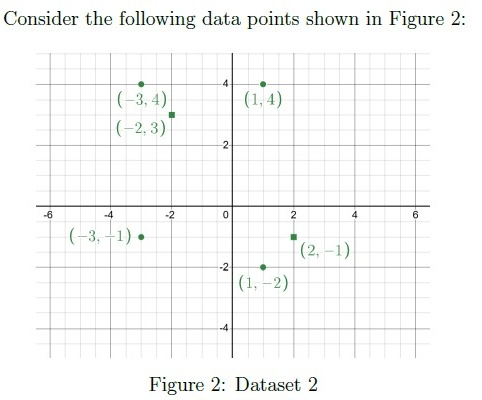
Perform K-means clustering with K = 2 and initial cluster centers at (−2, 3) and (2,−1). What are the final means of clusters after convergence?




Suppose we introduce a new data point (0, 0) to the existing dataset and perform K means with the same initial cluster centers. How many iterations would it require now for convergence?
Answer key
- Q1 (MSQ, 2 marks): A, C
- Q2 (MSQ, 4 marks): B, D
- Q3 (MSQ, 4 marks): B, C, D
- Q4 (MSQ, 4 marks): A, D
- Q5 (MSQ, 3 marks): A, B, D
- Q6 (SA, 3 marks): 3
- Q7 (SA, 3 marks): 0.45 to 0.50
- Q8 (MCQ, 2 marks): B
- Q9 (SA, 2 marks): 4.5
- Q10 (SA, 2 marks): 0.5
- Q11 (MCQ, 3 marks): B
- Q12 (SA, 3 marks): 0.64 to 0.68
- Q13 (MCQ, 3 marks): A
- Q14 (SA, 2 marks): 1
Concepts this paper tests
Auto-generated summary from the source site. Handy as a checklist; the lessons above explain each idea from scratch.
Here’s a structured summary of core topics, concepts, principles, and equations for the Diploma-Level Machine Learning Techniques exam, along with Mermaid knowledge graphs to visualize relationships.
1. Core Topics & Concepts
A. Clustering (K-Means & K-Means++)
Key Concepts:
Lloyd’s Algorithm (Standard K-Means):
- Iterative algorithm to minimize within-cluster sum of squares (WCSS).
- Convergence: Always converges (monotonically decreases WCSS), but may converge to local optima.
- Sensitive to outliers (centroids can be pulled toward outliers).
- Not guaranteed to find the global optimum (depends on initialization).
K-Means++ Initialization:
- Improves initialization by spreading out initial centroids.
- Probability of selection for next centroid:
- Tie-breaking affects final clusters if points are equidistant.
Convergence in One Iteration:
- If centroids are already at the mean of their clusters, the algorithm terminates in one step.
Equations:
- Within-Cluster Sum of Squares (WCSS):
- Centroid Update:
B. Principal Component Analysis (PCA)
Key Concepts:
Dimensionality Reduction:
- Projects data into a lower-dimensional subspace while maximizing variance.
- If data lies in a k-dimensional subspace, the first k principal components capture all variance.
Eigenvalues & Variance:
- Non-zero eigenvalues of the covariance matrix correspond to dimensions with variance.
- Proportion of variance explained by the -th PC:
- Reconstruction error = 0 if .
Covariance Matrix:
- For centered data , covariance is:
- Eigendecomposition:
where .
Linear Dependencies:
- If columns of are linearly dependent, some eigenvalues will be zero.
Equations:
- Principal Components:
- Reconstruction:
- Residue (Reconstruction Error):
C. Bayesian Statistics (Beta Distribution)
Key Concepts:
Beta Distribution as Prior:
- Used for modeling proportions ().
- Prior:
- Posterior:
- Posterior Mean (Estimate for ):
- For Beta(1,1) (uniform prior), posterior mean = empirical proportion.
- For Beta(0.5,0.5), posterior mean is adjusted toward 0.5.
Equations:
- Beta Mean:
- Posterior Update:
D. Kernel Methods
Key Concepts:
Valid Kernel Functions:
- Must satisfy Mercer’s condition (positive semi-definite Gram matrix).
Examples:
- Gaussian (RBF) Kernel:
- Polynomial Kernel:
- Laplacian Kernel:
- Invalid Kernel: (not PSD).
E. Gaussian Mixture Models (GMM) & EM Algorithm
Key Concepts:
- Likelihood Function:
- : Mixing coefficient ().
- : Gaussian PDF.
EM Algorithm Steps:
- E-Step: Compute responsibilities ():
- M-Step: Update parameters:
Convergence:
- Monotonically increases log-likelihood.
Equations:
- Responsibility ():
- Log-Likelihood:
Graph 2: PCA Concepts
Graph 3: Bayesian & GMM Concepts
Graph 4: Kernel Methods
3. Key Equations Summary
| Topic | Equation | Description |
|---|---|---|
| K-Means | Within-cluster sum of squares. | |
| PCA Variance | Proportion of variance explained by PC . | |
| Beta Posterior Mean | Posterior mean for proportion . | |
| Gaussian Kernel | RBF kernel. | |
| GMM Likelihood | Likelihood for Gaussian Mixture Model. | |
| EM Responsibility | Soft assignment in E-step. |
4. Exam Tips
PCA:
- If data lies in a k-dimensional subspace, the first k PCs capture all variance.
- Reconstruction error = 0 if .
- Eigenvalues of give variance along PCs.
K-Means:
- Converges always, but may not find the global optimum.
- K-Means++ improves initialization by weighting points by .
Bayesian Estimation:
- Beta(1,1) = Uniform prior.
- Posterior mean = .
GMM/EM:
- Likelihood involves a sum over components (mixture).
- Responsibilities () are soft assignments.
Kernels:
- RBF, Polynomial, Laplacian are valid.
- is invalid (not a kernel).