Home / Past papers / MLT Quiz 1 / this paper
IIT M FOUNDATION AN EXAM QDF3 23 Feb - 23 Feb 2025
Elapsed 00:00
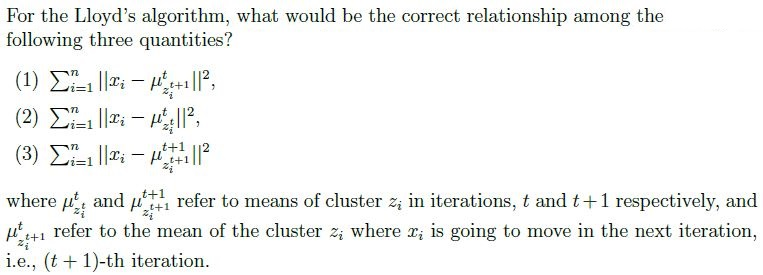
- (1) > (2) > (3)
- (1) < (2) < (3)
- (3) < (1) < (2)
- (2) < (3) < (1)







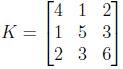
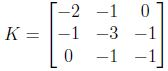
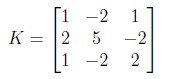
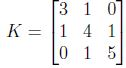
Which of the following statements is/are true?





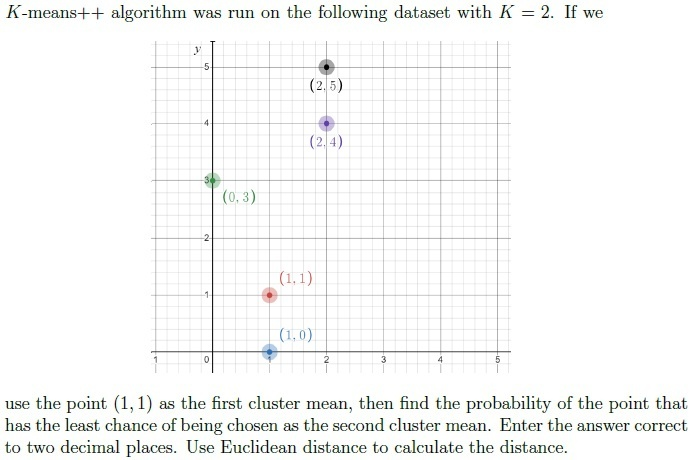
Suppose you toss a coin four times and observe no heads. You then give the coin to your friend, who tosses it until the first head occurs. Your friend tosses the coin a total of five times. Let p
denote the probability that the coin comes up heads. Find the maximum likelihood estimate of p.
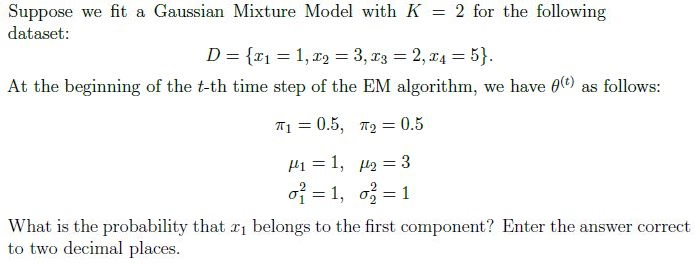
Comprehension passage - the questions below it refer to this
Based on the above data, answer the given subquestions.

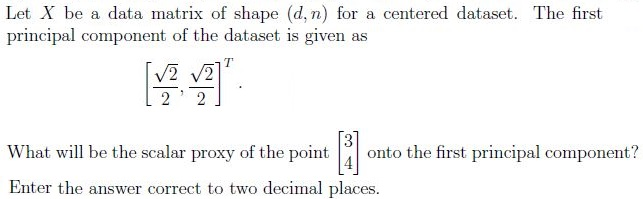
Among the vectors given below, choose a representative that has unit length.


If standard PCA is performed on this dataset, what is the variance along the first principal component? Enter the answer correct to two decimal places.
Comprehension passage - the questions below it refer to this
Suppose that 100 items are sampled from a manufacturing process and 10 are found to be defective. Let p denote the proportion of defective items. Assume that the prior distribution for p
is Beta(1, 1).
Based on the above data, answer the given subquestions.Select the correct options from the following:
- Posterior distribution for p is Beta(91, 11).
- Posterior distribution for p is Beta(11, 91).
- Posterior distribution for p is Bernoulli(0.1).
- Posterior distribution for p is Bernoulli(0.9).
Find the posterior mean. Enter the answer correct to two decimal places.
Answer key
- Q1 (MCQ, 2 marks): C
- Q2 (MCQ, 3 marks): C
- Q3 (MCQ, 3 marks): C
- Q4 (MSQ, 4 marks): A, D
- Q5 (MSQ, 3 marks): A, B, C
- Q6 (SA, 3 marks): 4.92 to 4.98
- Q7 (SA, 3 marks): 74 to 75
- Q8 (SA, 3 marks): 0.07 to 0.11
- Q9 (SA, 3 marks): 0.10 to 0.12
- Q10 (SA, 4 marks): 0.86 to 0.90
- Q11 (MCQ, 2 marks): B
- Q12 (SA, 3 marks): 43 to 44
- Q13 (MCQ, 2 marks): B
- Q14 (SA, 2 marks): 0.10 to 0.11
Concepts this paper tests
Auto-generated summary from the source site. Handy as a checklist; the lessons above explain each idea from scratch.
Summary of Core Topics, Concepts, Principles, and Equations
Core Topics and Concepts:
K-means Clustering and Lloyd's Algorithm
- Understanding the iterative process of K-means.
- Sum of squared distances minimization.
- Cluster assignment and mean updates.
Principal Component Analysis (PCA)
- Eigenvalues and eigenvectors.
- Projection of data points onto principal components.
- Variance along principal components.
- Data compression and storage reduction.
Kernel Methods and Valid Kernels
- Kernel functions and their properties.
- Examples of valid kernels.
Matrix Properties
- Trace of matrices.
- Eigenvectors and eigenvalues of matrices and .
Probability and Statistics
- Maximum Likelihood Estimation (MLE).
- Beta distribution and posterior mean.
- Gaussian Mixture Models (GMM) and Expectation-Maximization (EM) algorithm.
Data Representation and Storage
- Data matrices and their shapes.
- Storage space calculation and reduction.
Important Equations:
- Sum of Squared Distances in K-means:
- Projection of Data Points onto Principal Components:
- Percentage Decrease in Storage Space:
- Euclidean Distance:
- Posterior Mean for Beta Distribution:
- Probability in Gaussian Mixture Models: