Home / Past papers / MLT End Term / this paper
IIT M FOUNDATION AN EXAM QDF3 13 Apr - 13 Apr 2025
Elapsed 00:00
What is the role of the regularization term in ridge regression?
- It ensures that the dataset is normally distributed.
- It penalizes large coefficients to reduce overfitting.
- It forces more coefficients to be exactly zero, performing feature selection.
- It increases the variance of the model.
Which of the following conditions must be satisfied for a decision tree to be pure at a given node?
- The entropy of the node is maximum.
- The information gain at the node is negative.
- All samples at a node belong to the same class.
- The entropy of the node is 0.






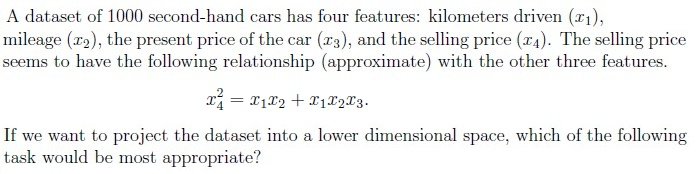
- Kernel PCA with a polynomial kernel of degree 2.
- Kernel PCA with a polynomial kernel of degree 3.
- Kernel PCA with a polynomial kernel of degree 4.
- Standard PCA
Weak learners used in the ensemble method typically perform slightly better than random guessing.
- TRUE
- FALSE
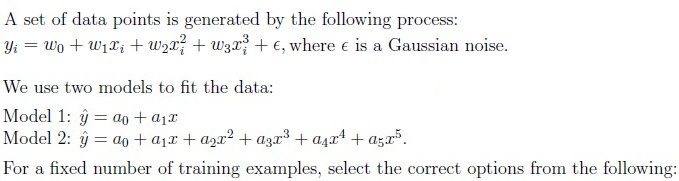
- Model 1 will have a higher bias than Model 2.
- Model 2 will have a lower variance than Model 1.
- Model 1 is more likely to underfit.
- Model 1 is more likely to overfit.






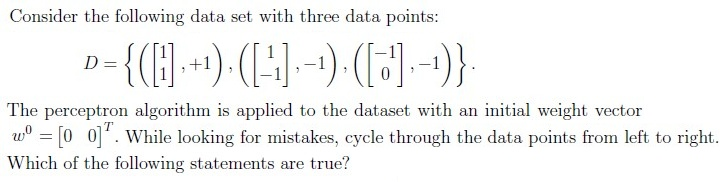






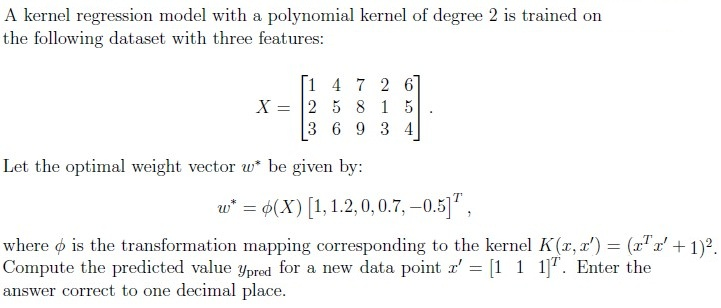
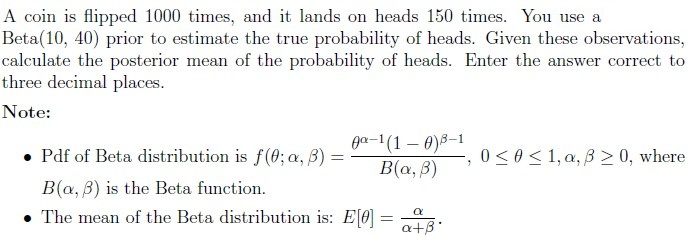
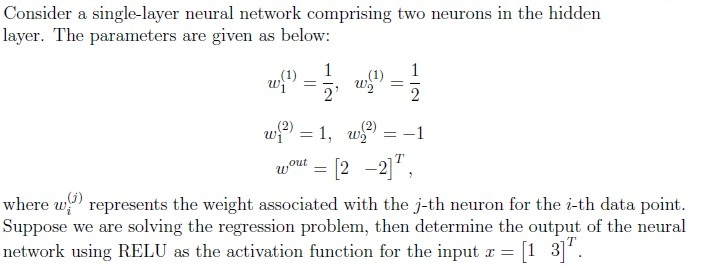
The following dataset represents different weather conditions and the corresponding decision on whether a person chooses to play tennis:
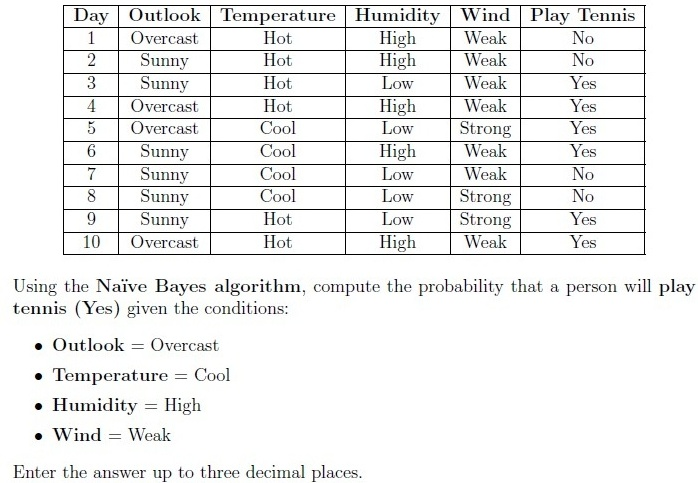 The following dataset represents different weather conditions and the corresponding decision on whether a person chooses to play tennis:

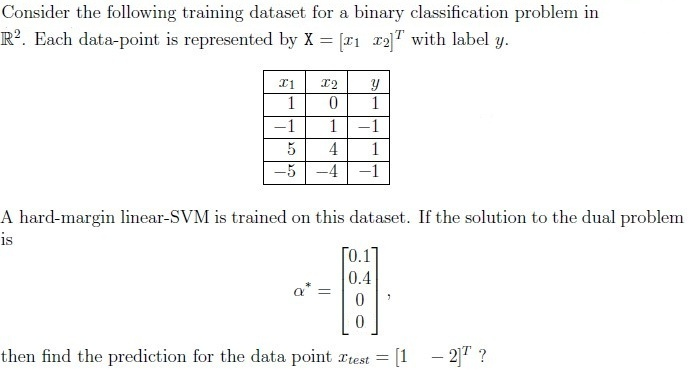
Comprehension passage - the questions below it refer to this
Based on the above data, answer the given subquestions.
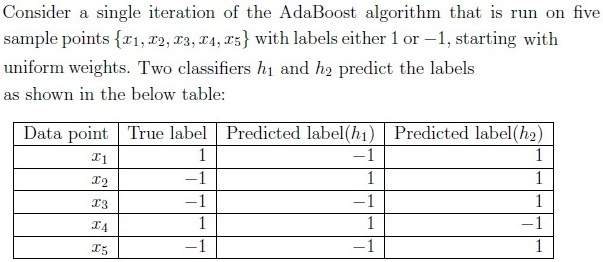
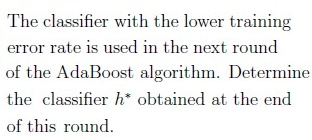
Which classifier has the lower training error?






Answer key
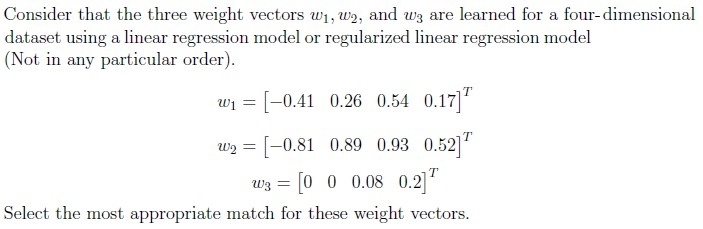
- Q1 (MSQ, 2 marks): B
- Q2 (MSQ, 2 marks): C, D
- Q3 (MCQ, 3 marks): B
- Q4 (MCQ, 3 marks): A
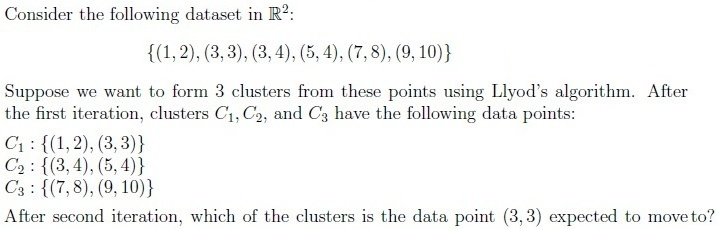
- Q5 (MCQ, 2 marks): B
- Q6 (MCQ, 1 marks): A
- Q7 (MSQ, 3 marks): A, C
- Q8 (MSQ, 3 marks): B, D, E
- Q9 (MSQ, 4 marks): B, E
- Q10 (SA, 4 marks): 262.2 to 262.8
- Q11 (SA, 4 marks): 0.148 to 0.154
- Q12 (SA, 4 marks): 4
- Q13 (SA, 4 marks): 0.61 to 0.67
- Q14 (SA, 3 marks): 1
- Q15 (SA, 3 marks): 1
- Q16 (MCQ, 2 marks): A
- Q17 (MCQ, 3 marks): B
Concepts this paper tests
Auto-generated summary from the source site. Handy as a checklist; the lessons above explain each idea from scratch.
Here’s a structured summary of core topics, concepts, principles, and equations for the exam, followed by Mermaid knowledge graphs to visualize relationships.
Core Topics & Concepts
1. Linear & Regularized Regression
Linear Regression:
- Model:
- Loss: Mean Squared Error (MSE) =
Ridge Regression (L2 Regularization):
- Loss:
- Penalizes large coefficients to reduce overfitting.
Lasso Regression (L1 Regularization):
- Loss:
- Forces sparse solutions (some coefficients = 0).
Key Insight:
- Ridge shrinks coefficients, Lasso performs feature selection.
- Example (Q4): (sparse) → Lasso, (large) → Ridge.
2. Decision Trees & Entropy
- Pure Node: All samples belong to the same class.
Entropy:
- → Pure node.
Information Gain:
- Higher IG → Better split.
Key Insight:
- Pure node: Entropy = 0 or all samples same class (Q3).
3. Clustering (Lloyd’s Algorithm / K-Means)
Steps:
- Initialize centroids.
- Assign points to nearest centroid.
- Recompute centroids.
- Convergence: When assignments stop changing.
Example (Q5):
- After 1st iteration, recompute centroids and reassign points.
4. Dimensionality Reduction (PCA & Kernel PCA)
Standard PCA:
- Maximizes variance in orthogonal directions.
Kernel PCA:
- Uses kernel trick for nonlinear projections.
- Polynomial kernel:
Example (Q6):
- → Degree 3 polynomial kernel.
5. Ensemble Methods (AdaBoost)
- Weak Learners: Slightly better than random guessing (Q7).
AdaBoost:
- Train weak learner .
- Compute error .
- Update weights:
- Combine:
Example (Q17-18):
- has lower error → Used in next round.
6. Support Vector Machines (SVM)
Soft-Margin SVM:
- Minimize:
- Dual problem: are Lagrange multipliers.
KKT Conditions:
- If : Correctly classified.
- If : Misclassified or margin violator.
- If : Lies on margin.
Example (Q9):
- → Correctly classified.
- Point between margins → (pays "bribe").
7. Perceptron Algorithm
Update Rule:
- If , update:
- Convergence: Guaranteed if data is linearly separable.
Example (Q10):
- Converges to .
8. Kernel Methods (Kernel Regression)
- Polynomial Kernel:
- Prediction:
Example (Q11):
- Compute using kernel expansion.
9. Bayesian Inference (Beta-Binomial)
- Prior:
- Posterior:
- Mean:
Example (Q12):
- Posterior mean = .
10. Neural Networks (Single-Layer)
- ReLU Activation:
Forward Pass:
- Hidden layer:
- Output:
Example (Q13):
- Input , weights , , .
- Output = 4.
11. Naïve Bayes
- Assumption: Features are conditionally independent given class.
- Prediction:
Example (Q14):
- Compute .
12. Logistic Regression
- Sigmoid:
Decision Rule:
- Predict 1 if , else 0.
Example (Q15):
- , .
- .
13. SVM Prediction
- Dual Form:
Example (Q16):
- , .
- Predict sign of .
Graph 2: Unsupervised Learning
Graph 3: Ensemble & Bayesian Methods
Graph 4: Neural Networks
Graph 5: Probabilistic Models
Key Equations Summary
| Topic | Equation |
|---|---|
| Linear Regression | , Loss = |
| Ridge Regression | Loss = MSE + |
| Lasso Regression | Loss = MSE + |
| Entropy | |
| Information Gain | |
| SVM Dual Problem | (Lagrange multipliers), |
| Kernel PCA | (Polynomial) |
| AdaBoost Weight Update | |
| Bayesian Posterior | |
| Logistic Regression | , |
| Naïve Bayes |