Home / Past papers / MLT End Term / this paper
IIT M IMPROVEMENT FN EXAM QDD2 22 Dec - 22 Dec 2024
Elapsed 00:00
NOTE: Enter the answer correct to one decimal place

Consider a logistic regression model trained to detect spam emails. Emails containing harmful phishing links are labeled as spam (1), while regular emails are labeled as not spam (0).
A good spam detector should correctly identify almost all emails with phishing links. Even a single phishing email incorrectly classified as not spam could expose users to significant risks. However, the detector may classify some regular emails as spam. This trade-off is acceptable to ensure safety.
To ensure user safety, if the threshold is set to a low value to prioritize the detection of phishing emails, type 1. If the threshold is set to a high value to minimize false positives (misclassifying regular emails as spam), type 0.
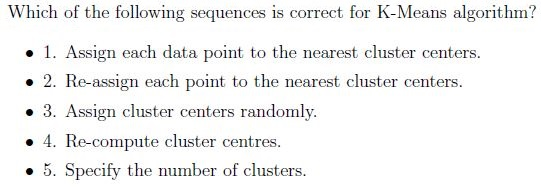
- 3, 5, 1, 4, 2
- 5, 3, 1, 2, 4
- 3, 5, 2, 4, 1
- 5, 3, 1, 4, 2
- None of these
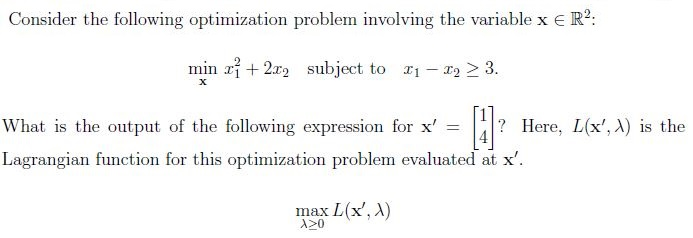
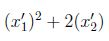


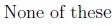
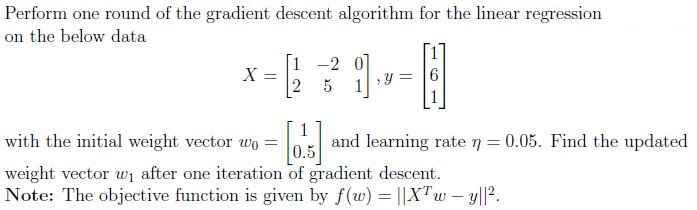
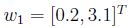
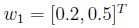
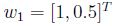

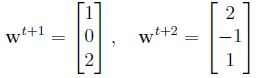
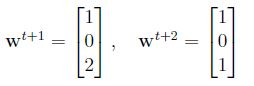
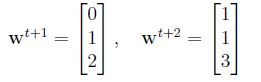
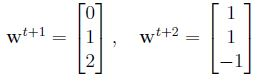
If we remove all the non-support vectors from the dataset, what will be the impact on the model using SVM algorithm?
- Model will overfit.
- The model will not be changed.
- Model will underfit.
- Accuracy of the model will increase.
In each round of AdaBoost, the weight for a particular training observation is decreased from round t to round t + 1 if the observation was:
- classified incorrectly by the weak learner trained in the round.
- classified correctly by the weak learner trained in the round.
- classified incorrectly by a majority of the weak learners trained up to theround.
- classified correctly by a majority of the weak learners trained up to the round.
Is the following statement true or false? For a fixed size of the training and the test set, increasing the complexity of the model always leads to an increment in the test error.
- TRUE
- FALSE
Consider a supervised ML problem where a model is trained using a training dataset, and its performance is evaluated on both the training and validation datasets. During training, the model’s loss is plotted over time for both the datasets. Assume that the loss L(t) is decreasing as the model learns.
The following graph shows two curves, Curve (A) and Curve (B), representing the loss for the training and validation datasets, respectively:
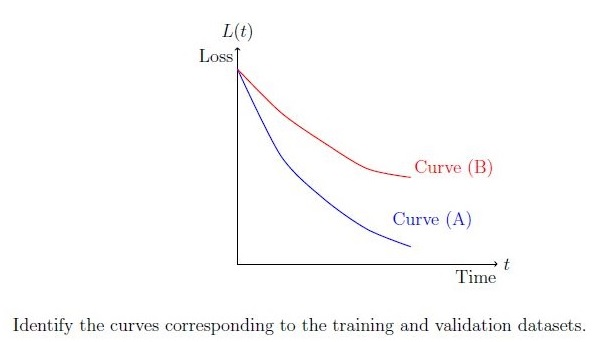 Consider a supervised ML problem where a model is trained using a training dataset, and its performance is evaluated on both the training and validation datasets. During training, the model’s loss is plotted over time for both the datasets. Assume that the loss L(t) is decreasing as the model learns.
The following graph shows two curves, Curve (A) and Curve (B), representing the loss for the training and validation datasets, respectively:
Consider a supervised ML problem where a model is trained using a training dataset, and its performance is evaluated on both the training and validation datasets. During training, the model’s loss is plotted over time for both the datasets. Assume that the loss L(t) is decreasing as the model learns.
The following graph shows two curves, Curve (A) and Curve (B), representing the loss for the training and validation datasets, respectively:
- Curve (A) represents the training loss.
- Curve (B) represents the training loss.
- Curve (A) represents the validation loss.
- Curve (B) represents the validation loss.
Which of the following options are correct? Select all that apply.
- Underfitted models generally have less bias and high variance.
- A decision tree with the maximum possible length may lead to overfitting.
- Weak learners are those whose performance is slightly better than therandom classifier.
- All the estimators in bagging can be trained parallelly.
Comprehension passage - the questions below it refer to this
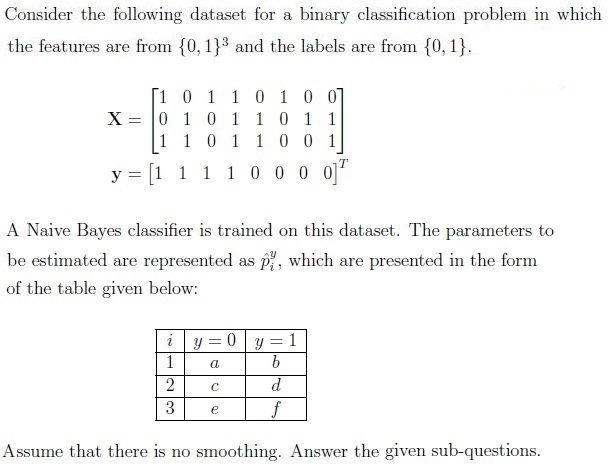


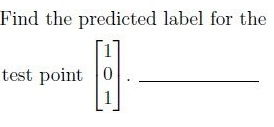
Comprehension passage - the questions below it refer to this
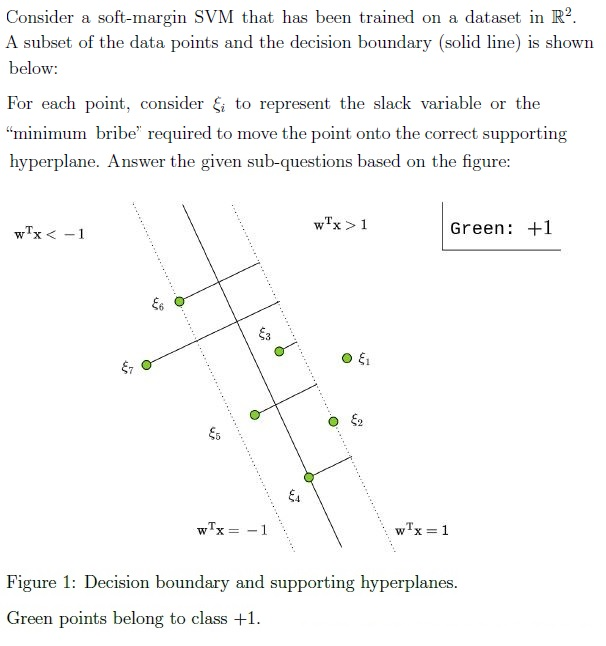




Which of the following is correct ?

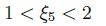

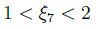
Answer key
- Q1 (SA, 2 marks): 2.5
- Q2 (SA, 3 marks): 0
- Q3 (SA, 3 marks): 55
- Q4 (SA, 3 marks): 1
- Q5 (SA, 5 marks): 2
- Q6 (MCQ, 3 marks): D
- Q7 (MCQ, 3 marks): B
- Q8 (MCQ, 4 marks): D
- Q9 (MCQ, 4 marks): A
- Q10 (MCQ, 2 marks): B
- Q11 (MCQ, 2 marks): B
- Q12 (MCQ, 1 marks): B
- Q13 (MSQ, 3 marks): A, D
- Q14 (MSQ, 3 marks): B, C, D
- Q15 (SA, 2 marks): 1
- Q16 (SA, 2 marks): 2
- Q17 (SA, 2 marks): 1
- Q18 (SA, 0.5 marks): 1
- Q19 (SA, 0.5 marks): 0
- Q20 (SA, 0.5 marks): 0
- Q21 (SA, 0.5 marks): 2
- Q22 (MSQ, 1 marks): A, B
Concepts this paper tests
Auto-generated summary from the source site. Handy as a checklist; the lessons above explain each idea from scratch.
Here’s a structured summary of the core topics, concepts, principles, and equations essential for the exam, followed by Mermaid knowledge graphs to visualize relationships.
Core Topics & Concepts
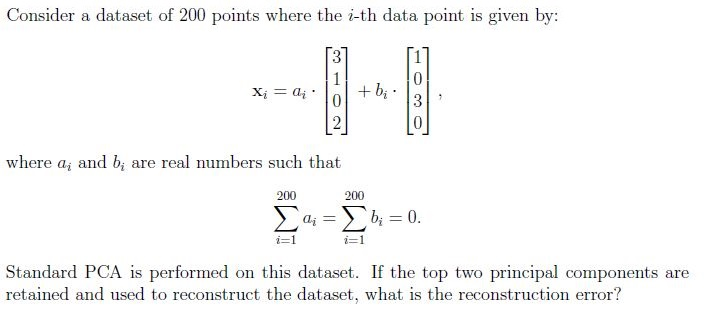
1. Principal Component Analysis (PCA)
- Purpose: Dimensionality reduction while preserving variance.
Steps:
- Center the data (subtract mean).
- Compute covariance matrix .
- Eigen-decomposition: .
- Project data onto top eigenvectors (principal components).
Variance along PC1:
- For a dataset , variance along PC1 is the largest eigenvalue .
- Equation:
Reconstruction Error:
- If top PCs are retained, error = sum of discarded eigenvalues.
- Equation:
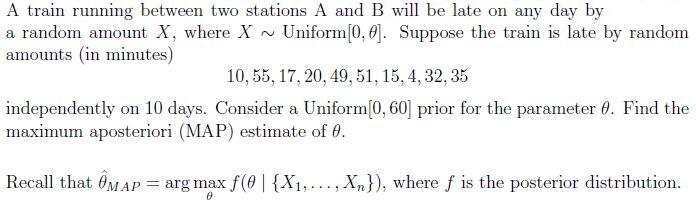
2. Maximum A Posteriori (MAP) Estimation
- Prior + Likelihood → Posterior:
Uniform Prior:
- For , MAP estimate is the maximum observed data point (if is upper-bound of uniform distribution).
- Equation:
3. Logistic Regression & Class Imbalance
- Decision Boundary:
Threshold Adjustment:
- Low threshold → High recall (catches most positives, more false positives).
- High threshold → High precision (fewer false positives, misses some positives).
Trade-off:
- Safety-critical applications (e.g., spam/phishing detection) prioritize recall (low threshold).
4. Cross-Validation (LOOCV)
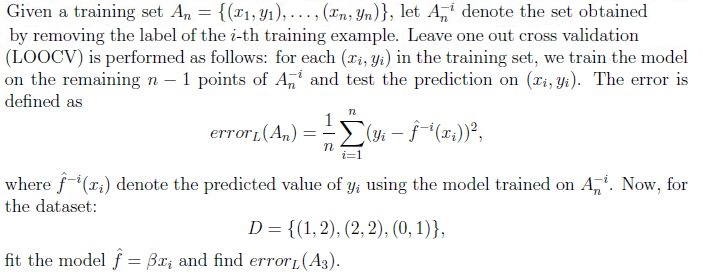
- Leave-One-Out Error:
Steps:
- For each , train on points (excluding ).
- Predict and compute squared error.
- Average errors.
5. K-Means Clustering
Algorithm Steps:
- Initialize centroids randomly.
- Assign points to nearest centroid.
- Recompute centroids as mean of assigned points.
- Repeat until convergence.
- Correct Sequence:
Initialize → Assign → Recompute → Reassign(Option D: 5→3→1→4→2 is incorrect; correct is 1→2→3→4→5).
6. Optimization & Lagrangian
- Lagrangian for Constrained Optimization:
For s.t. , .
- Dual Problem:
Example:
- For , ,
- .
- if .
7. Gradient Descent
- Update Rule:
For Linear Regression:
- ,
- .
Example:
- Given , compute .
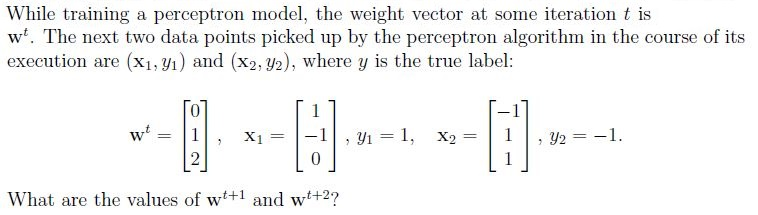
8. Perceptron Algorithm
- Update Rule:
.
- Example:
For , :
- .
- .
9. Support Vector Machines (SVM)
Key Concepts:
- Support Vectors: Points lying on margin boundaries.
- Slack Variables (): Measure margin violation.
- Kernel Trick: Non-linear decision boundaries.
Soft-Margin SVM:
- Minimize s.t. .
Impact of Removing Non-Support Vectors:
- No change to the model (only support vectors define the boundary).
10. AdaBoost
Weight Update:
- Increase weights for misclassified points.
- Decrease weights for correctly classified points.
Weak Learners:
- Slightly better than random guessing (e.g., decision stumps).
11. Bias-Variance Tradeoff
| Model Type | Bias | Variance | Error Behavior |
|---|---|---|---|
| Underfitted | High | Low | Poor train/test performance |
| Overfitted | Low | High | Good train, poor test |
| Well-generalized | Balanced | Balanced | Good train/test |
12. Naive Bayes
- Assumption: Features are conditionally independent given the class.
- Probability Estimation:
- Prediction:
Example:
- For binary features, .
13. Training vs. Validation Loss
- Training Loss: Decreases monotonically with training.
Validation Loss:
- Decreases initially, then may increase (overfitting).
- Early Stopping: Stop training when validation loss starts rising.
14. Bagging & Boosting
| Technique | Parallel? | Base Learners | Focus |
|---|---|---|---|
| Bagging | Yes | High variance (e.g., deep trees) | Reduce variance |
| Boosting | No | Weak learners | Reduce bias |
Key Equations Summary
| Topic | Equation |
|---|---|
| PCA Variance | |
| MAP Estimation | |
| Logistic Regression | , |
| LOOCV Error | |
| Gradient Descent | |
| Perceptron Update | |
| SVM Slack Variable | |
| Naive Bayes |
Graph 2: Unsupervised Learning & Optimization
Graph 3: Model Evaluation
Graph 4: Probabilistic Models
Exam Strategy
- PCA: Focus on eigenvalues, variance, and reconstruction error.
- MAP Estimation: Remember the prior’s role in Bayesian inference.
- Logistic Regression: Understand threshold adjustment for imbalanced data.
- SVM: Know slack variables, support vectors, and kernel tricks.
- Optimization: Lagrangian, gradient descent, and perceptron updates.
- Cross-Validation: LOOCV error calculation.
- Ensemble Methods: Bagging vs. boosting, weak learners.
- Naive Bayes: Conditional independence assumption.