Home / Past papers / MLP End Term / this paper
IIT M FOUNDATION DIPLOMA FN EXAM QDF2 28 Apr 2024 - 28 Apr 2024
- Instruction has been mentioned above.
- This Instruction is just for a reference & not for an evaluation.
- There is a collection of photographs. Each photograph can have multipleanimals, e.g., cats, dogs and birds. Your model should indicate all the animals which are present.
- From appropriate weather data, your model must predict, averagetemperature and average humidity for next seven days.
- Predicting expected price of a second hand car with appropriate features.
- None of these.




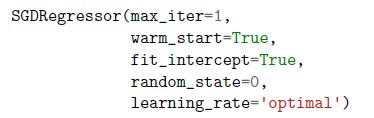
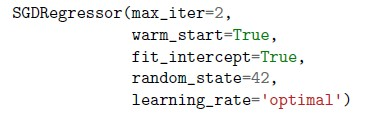
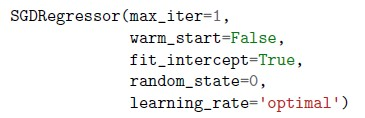
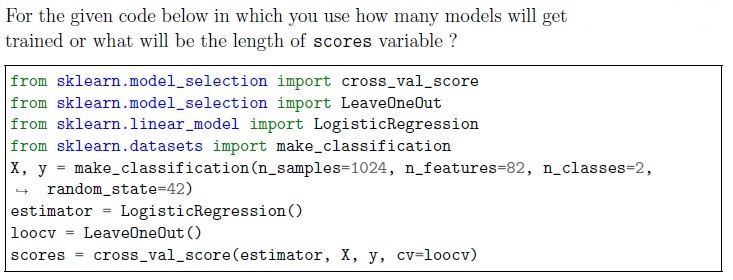
- 1106
- 82
- 1024
- 5
- None of these
- To split data into training and testing sets.
- To tune hyperparameters.
- To evaluate model performance on multiple subsets.
- To preprocess data.

- Statement 1 is True and Statement 2 is False
- Statement 2 is True and Statement 1 is False
- Both the statements are True
- Both the statements are False
- They are independent of each other.
- They are always a numerical representation of the text data.
- They are linearly related.
- They are categorical.
- None of these.
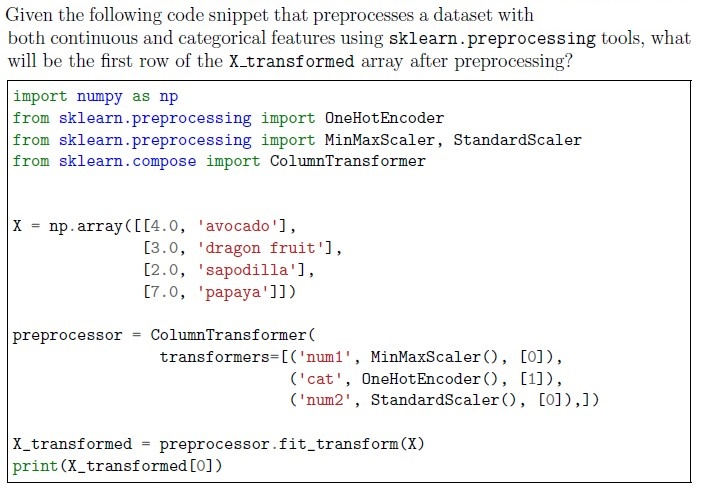
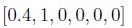
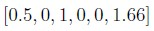


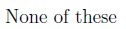
- Linear Regression
- Decision Tree
- K-means Clustering
- Support Vector Machine
- None of these

- Increasing the number of neurons in hidden layers will always lead to bettermodel performance.
- Decreasing the number of neurons in hidden layers reduces the model’scapacity to capture complex patterns.
- The number of neurons in hidden layers does not significantly affect themodel’s performance.
- Finding the optimal number of neurons is a trial-and-error process and mayrequire experimentation.
- It ignores outliers during the clustering process.
- It assigns outliers to the nearest cluster.
- It creates separate clusters for outliers.
- It removes outliers from the dataset before clustering.
- A hierarchical clustering technique that starts with each data point as itscluster and merges the closest clusters iteratively.
- A method for partitioning data into a predefined number of clusters.
- A clustering algorithm that uses centroids to iteratively assign data points toclusters.
- A dimensionality reduction technique that projects data onto a lower-dimensional space.
- Random initialization
- K-means++ initialization
- Hierarchical agglomerative initialization
- Weighted initialization

- The distance between cluster centroids
- The number of clusters formed
- Sum of squared distances of samples to their closest cluster center.
- The silhouette coefficient





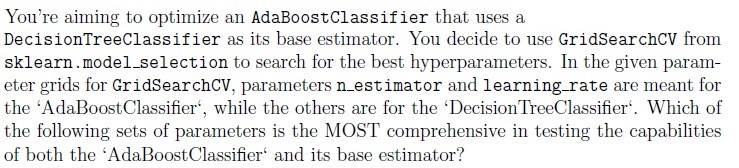

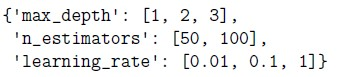

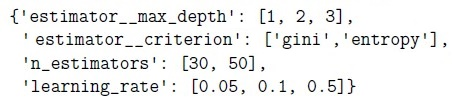
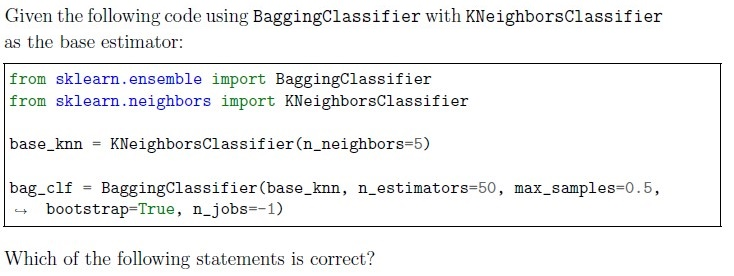




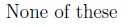





- To have less constraints/regularization
- To have more constraints/regularization
- Delete a significant portion of data
- Increase the dataset size.
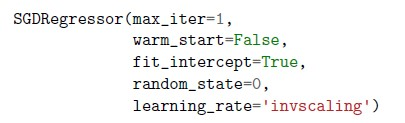
- None of these.
- The more the SGD iterations, the lesser the fluctuations in training error.
- More iterations require more computation time.
- The tol (error tolerance) parameter restricts the number of iterationsperformed.
- Training error might not consistently decrease while performing SGDiterations.
- None of these
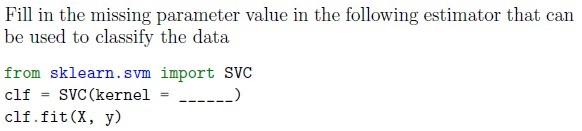





- It is a technique used to minimize the adjusted loss function and avoidunderfitting.
- It helps in increasing the bias of the training model.
- It determines the rows to be selected as a training dataset.
- Elastic net regularization is a combination of L1 and L2 regularization both.
- Entropy
- RoC Curve
- Cross Entropy
- Gini Impurity
- Plotting an Elbow curve.
- Using classifiers before making clusters.
- Plotting Silhouette coefficient for various values of k.
- Using k-fold cross validation
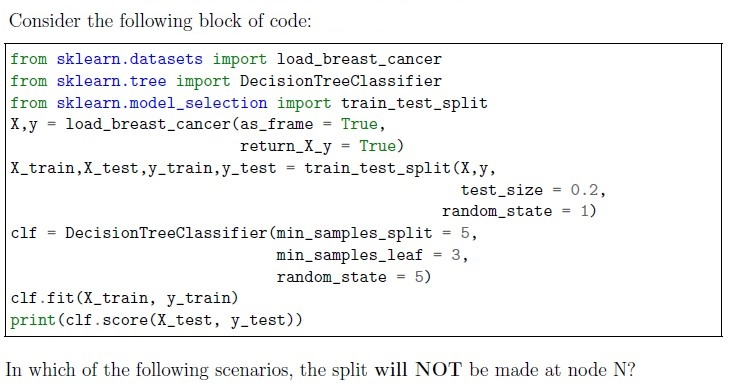
- 10 number of samples at node N. If it is split, it can split such that 2 samples inthe left child and 8 samples in the right child.
- 6 number of samples at node N. If it is split, it can split such that 3 samples inthe left child and 3 samples in the right child.
- 12 number of samples at node N. If it is split, it can split such that 5 samples inthe left child and 7 samples in the right child.
- 4 number of samples at node N. If it is split, it can split such that 3 samples inthe left child and 1 samples in the right child.
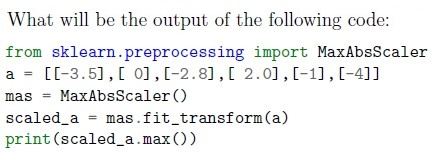
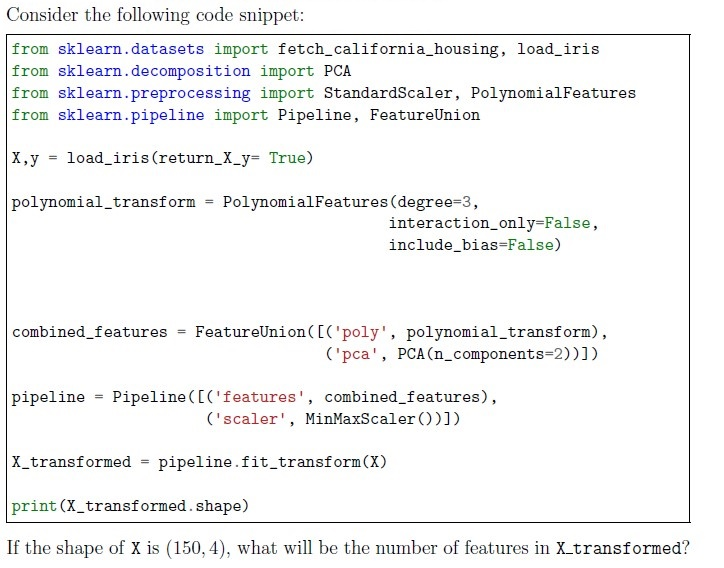
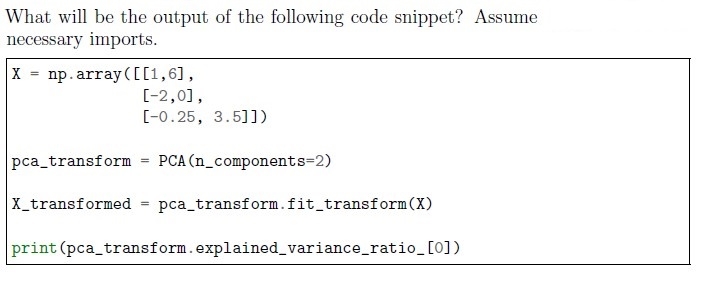
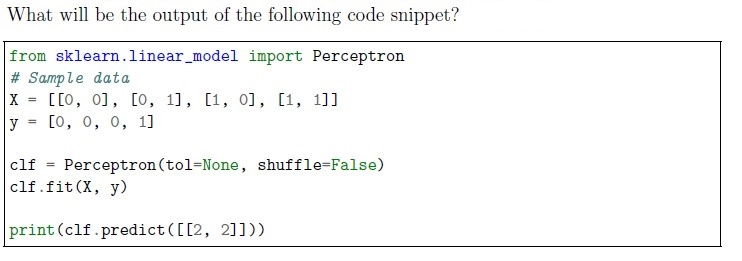
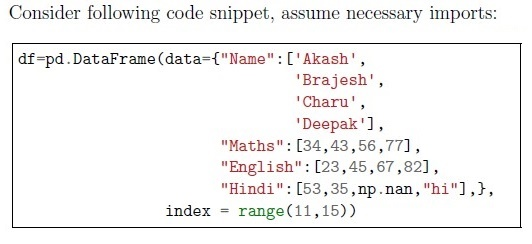
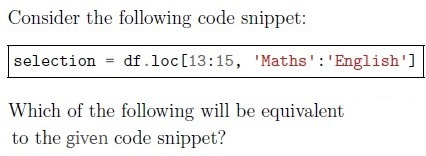




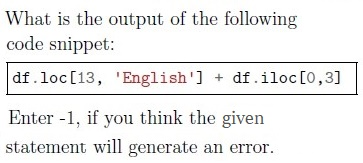
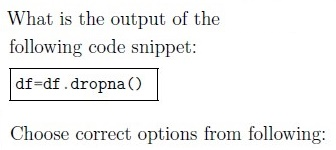
- The number of rows will decrease in the dataset.
- The number of columns will decrease in the dataset.
- The number of columns and number of rows, both, will decrease in thedataset.
- There will be no change.
- Insufficient information.
Answer key
- Q1 (MCQ, 0 marks): A
- Q2 (MCQ, 2 marks): A
- Q3 (MCQ, 2 marks): A
- Q4 (MCQ, 2 marks): A
- Q5 (MCQ, 2 marks): C
- Q6 (MCQ, 2 marks): C
- Q7 (MCQ, 2 marks): A
- Q8 (MCQ, 2 marks): A
- Q9 (MCQ, 3 marks): A
- Q10 (MCQ, 3 marks): C
- Q11 (MCQ, 3 marks): D
- Q12 (MCQ, 3 marks): B
- Q13 (MCQ, 3 marks): A
- Q14 (MCQ, 3 marks): B
- Q15 (MCQ, 3 marks): C
- Q16 (MCQ, 4 marks): A
- Q17 (MCQ, 4 marks): D
- Q18 (MCQ, 4 marks): C
- Q19 (MCQ, 4 marks): C
- Q20 (MSQ, 2 marks): B, D
- Q21 (MSQ, 2 marks): A, B, C, D
- Q22 (MSQ, 2 marks): B, C
- Q23 (MSQ, 2 marks): A, C
- Q24 (MSQ, 2 marks): B, D
- Q25 (MSQ, 3 marks): A, D
- Q26 (MSQ, 3 marks): A, C
- Q27 (MSQ, 4 marks): A, D
- Q28 (SA, 2 marks): 0.5
- Q29 (SA, 2 marks): 0.8
- Q30 (SA, 2 marks): 0.37 to 0.38
- Q31 (SA, 2 marks): 0.32 to 0.35
- Q32 (SA, 2 marks): 1
- Q33 (SA, 3 marks): 36
- Q34 (SA, 3 marks): 1.00
- Q35 (SA, 3 marks): 1
- Q36 (MSQ, 2 marks): A, C
- Q37 (SA, 2 marks): 120
- Q38 (SA, 2 marks): 3
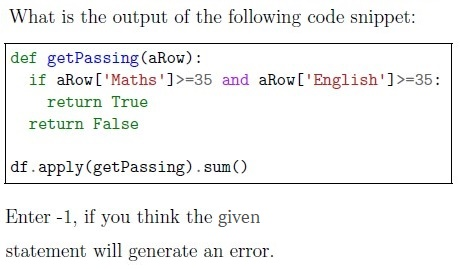
- Q39 (SA, 2 marks): -1
- Q40 (MCQ, 2 marks): A
Concepts this paper tests
Auto-generated summary from the source site. Handy as a checklist; the lessons above explain each idea from scratch.
Here’s a structured summary of core topics, concepts, principles, and equations essential for the Diploma Level: Machine Learning Practices (Computer-Based Exam). The summary is organized by themes (e.g., Supervised Learning, Unsupervised Learning, Model Evaluation, etc.), followed by a knowledge graph in Mermaid syntax to visualize relationships.
1. Core Topics & Concepts
A. Supervised Learning
1. Classification
Algorithms:
- Logistic Regression: Binary/multi-class classification using sigmoid/log-softmax.
Decision Trees:
- Splitting criteria: Gini Impurity, Entropy (Information Gain).
- Hyperparameters:
max_depth,min_samples_split,min_samples_leaf,class_weight. - Pruning to avoid overfitting.
Support Vector Machines (SVM):
- Kernels:
linear,rbf,poly. - Margin maximization (support vectors).
- Kernels:
k-Nearest Neighbors (k-NN):
- Distance metrics: Euclidean, Manhattan.
- Curse of dimensionality: Feature scaling (e.g.,
StandardScaler) is critical. n_neighbors: Low → complex boundaries; High → smooth boundaries.
Naive Bayes:
- Assumption: Features are conditionally independent given the class.
- Variants: Gaussian (continuous features), Multinomial (discrete counts).
Perceptron:
- Linear classifier; updates weights via gradient descent.
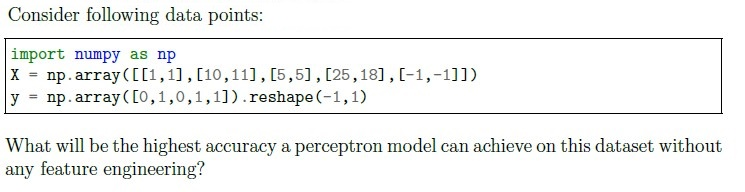
- Limited to linearly separable data (accuracy ≤ 80% in Q30).
AdaBoost:
- Ensemble of weak learners (e.g., decision stumps).
- Hyperparameters:
n_estimators,learning_rate.
Random Forest:
- Ensemble of decision trees; reduces variance via bagging.
- Hyperparameters:
max_features(default:sqrt(n_features)),bootstrap. - Feature importance via
feature_importances_.
Evaluation Metrics:
- Confusion Matrix: TP, TN, FP, FN.
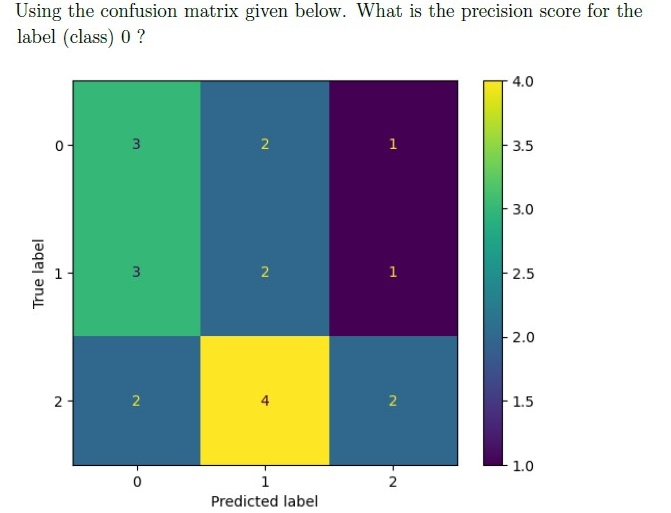
- Precision = TP / (TP + FP) (Q31: 0.375).
- Recall, F1-Score, Accuracy.
- Class Imbalance: Use
class_weight='balanced'or resampling.
2. Regression
Algorithms:
- Linear Regression: Minimizes MSE (Mean Squared Error).
SGDRegressor:
- Stochastic Gradient Descent; supports
shuffle=True(Q4). - Hyperparameters:
learning_rate(constant,invscaling,optimal),max_iter,warm_start(Q5). - Training Error: May fluctuate; not guaranteed to decrease monotonically (Q22).
- Stochastic Gradient Descent; supports
- Polynomial Regression: Use
PolynomialFeatures(Q34: 36 features after degree=3).
Regularization (Avoid Overfitting):
- L1 (Lasso): Sparse weights (feature selection).
- L2 (Ridge): Smooth weights.
- Elastic Net: Combines L1 + L2 (Q25).
- Hyperparameter:
alpha(strength),l1_ratio(mix).
3. Neural Networks
MLPClassifier (Multi-Layer Perceptron):
- Hyperparameters:
hidden_layer_sizes,activation(relu,tanh). - Trial-and-error for optimal architecture (Q12).
- Overfitting: Use dropout, early stopping, or reduce layers/neurons.
- Hyperparameters:
B. Unsupervised Learning
1. Clustering
k-Means:
- Initialization:
k-means++(better than random; Q15). - Inertia: Sum of squared distances to centroids (Q16).
- Optimal k: Elbow method (Q27), Silhouette Score.
- Limitations: Sensitive to outliers, assumes spherical clusters.
- Initialization:
Agglomerative Clustering:
- Hierarchical; merges closest clusters (Q14).
- Handles outliers: Assigns to nearest cluster (Q13).
- DBSCAN: Density-based; robust to noise.
2. Dimensionality Reduction
PCA (Principal Component Analysis):
- Transforms features to orthogonal components (Q35: explained variance ratio = 1.0).
n_components: Number of principal components.- Standardization required (use
StandardScaler).
- FeatureUnion: Combines multiple transformations (e.g., PCA + PolynomialFeatures; Q34).
C. Model Evaluation & Selection
1. Cross-Validation
- k-Fold CV: Evaluates model on multiple subsets (Q7).
- Leave-One-Out (LOO):
n_models = n_samples(Q6: 1024 scores for 1024 samples). - Stratified k-Fold: Preserves class distribution.
2. Hyperparameter Tuning
- GridSearchCV: Exhaustive search over parameter grid (Q18:
Dis most comprehensive). - RandomizedSearchCV: Faster; samples random combinations.
3. Overfitting & Underfitting
Solutions for Overfitting (Q21):
- Regularization (L1/L2), pruning (decision trees), dropout (NNs).
- More data, feature selection, simpler models.
Bias-Variance Tradeoff:
- High bias → underfitting; high variance → overfitting.
D. Data Preprocessing
1. Feature Scaling
- StandardScaler: Mean=0, std=1 (Q10: first row =
[0.1768, 1, 0, 0, 0]). - MinMaxScaler: Scales to [0, 1].
- MaxAbsScaler: Scales by max absolute value (Q29: max = 0.5).
2. Encoding
- One-Hot Encoding: For categorical features (Q10).
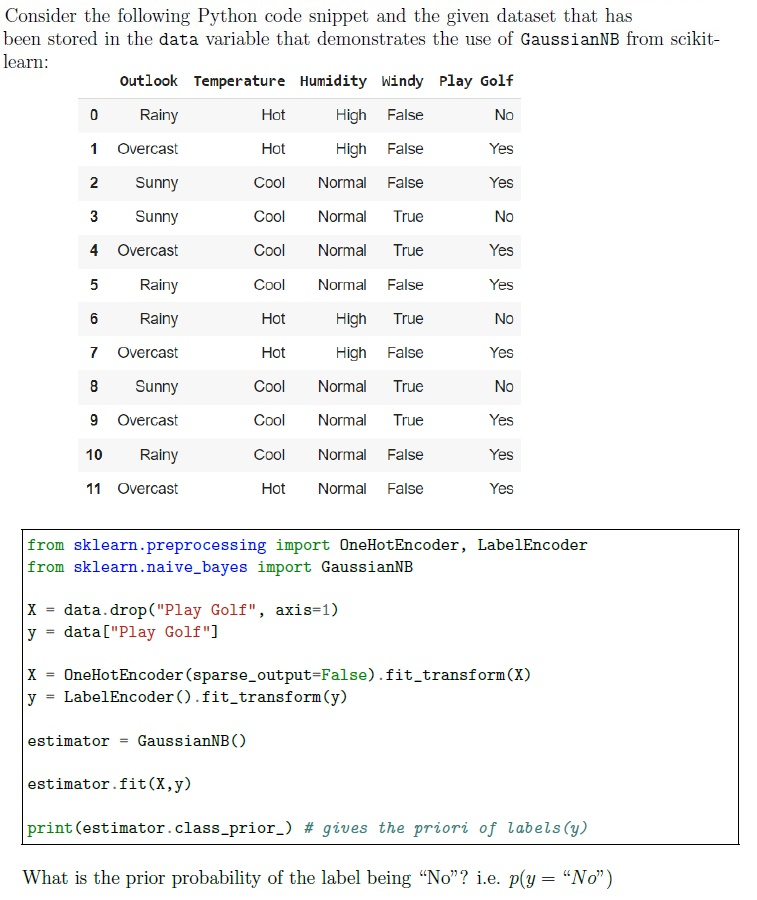
- Label Encoding: For target variables (Q32:
p(y="No") ≈ 0.33).
3. Handling Missing Data
dropna(): Removes rows/columns with NaN (Q41: reduces rows).- Imputation:
SimpleImputer(mean/median/mode).
4. Feature Engineering
- PolynomialFeatures: Generates interaction terms (Q34: 35 features for degree=3).
- ColumnTransformer: Applies different transformers to columns (Q10).
E. Ensemble Methods
1. Bagging
- Random Forest: Trains trees on bootstrapped samples (Q20:
max_features < n_features). - BaggingClassifier: Can use any base estimator (e.g., k-NN; Q19:
max_samples=0.5).
2. Boosting
- AdaBoost: Sequentially corrects errors of weak learners (Q18).
- Gradient Boosting: Optimizes loss function (e.g., XGBoost).
F. Practical ML with scikit-learn
1. Key Methods
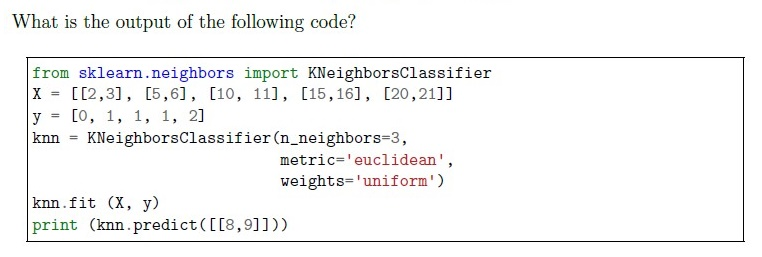
fit(): Trains the model (Q8: Statement 1 is True).transform(): Applies preprocessing (e.g., scaling, encoding).predict(): Generates predictions (Q33: k-NN predicts1for[8,9]).score(): Returns accuracy (or R² for regression).
2. Pipelines
Pipeline: Chains transformers and estimators (Q34).FeatureUnion: Combines multiple feature transformations.
3. Common Errors
- Data Leakage: Preprocessing before train-test split.
- Shape Mismatch: Ensure
Xandydimensions align. - Non-Numeric Data: Use encoders (Q39:
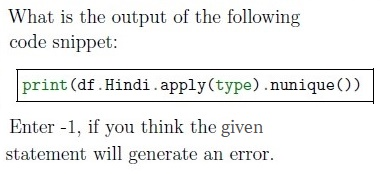
df.Hindi.apply(type).nunique() = 3).
2. Key Equations
A. Supervised Learning
- Linear Regression (MSE Loss):
- Logistic Regression (Log Loss):
where .
- Decision Tree Splitting (Gini/Entropy):
- SVM Margin:
- k-NN Prediction:
- Perceptron Update Rule:
B. Unsupervised Learning
- k-Means Objective (Inertia):
where if is assigned to cluster .
- PCA Variance Maximization:
C. Model Evaluation
- Precision/Recall:
- Silhouette Score (for clustering):
where = intra-cluster distance, = inter-cluster distance.
D. Regularization
- L1 (Lasso) Penalty:
- L2 (Ridge) Penalty:
- Elastic Net:
Graph 2: Unsupervised Learning Relationships
Graph 3: Model Evaluation & Preprocessing
Graph 4: Ensemble Methods
Graph 5: Neural Networks
4. Exam Tips
Focus Areas:
- Algorithms: Know when to use each (e.g., k-means for clustering, decision trees for interpretability).
- Hyperparameters: Understand their impact (e.g.,
n_neighborsin k-NN,max_depthin trees). - Preprocessing: Scaling/encoding is critical for distance-based models (k-NN, SVM, PCA).
- Evaluation: Metrics for classification (precision/recall) vs. regression (MSE/R²).
- Ensembles: Bagging (Random Forest) vs. Boosting (AdaBoost).
Common Pitfalls:
- Data Leakage: Always split data before preprocessing.
- Overfitting: Regularization, pruning, or more data.
- Class Imbalance: Use
class_weightor resampling. - Categorical Features: One-hot encode (not label encode) for non-tree models.
Code Snippets:
- Memorize key scikit-learn syntax (e.g.,
SGDRegressor(shuffle=True),PCA(n_components=2)). - Understand
PipelineandColumnTransformerfor workflows.
- Memorize key scikit-learn syntax (e.g.,
Math Equations:
- Prioritize loss functions (MSE, log loss), regularization, and evaluation metrics.
- For clustering, focus on inertia and silhouette score.
Practical Questions:
- Q10 (Preprocessing): Output after
MinMaxScaler+StandardScaler+OneHotEncoder. - Q30 (Perceptron): Maximum accuracy for non-linearly separable data (80%).
- Q34 (FeatureUnion): Count features after polynomial + PCA transformations (36).
- Q37 (Pandas): Equivalent
ilocfordf.loc[13:15, 'Maths':'English'].
- Q10 (Preprocessing): Output after