Home / Past papers / MLP Quiz 1 / this paper
2024 July07: IIT M AN EXAM QDD2 - 07 Jul 2024
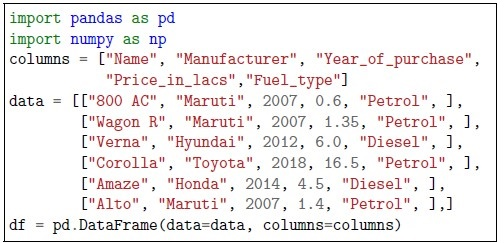 Consider following common data and answer the given subquestions:
 What will be the output of the following code snippet? Enter -1, if you think the above code snippet will generate an error.
 What will be the output of the following code snippet? Enter -1, if you think the above code snippet will generate an error.
 What will be the output of the following code snippet? Enter -1, if you think the above code snippet will generate an error.
 What will be the output of the following code snippet? Enter -1, if you think the above code snippet will generate an error.











- Null values cannot be interpreted by the model hence we need to handle themaccordingly.
- Null values cannot be replaced because we can not manipulate the dataset.
- We should let the sklearn or software automatically decide how to handledifferent kinds of missing values.
- Different types of representation of missing values could be seen in thedataset.










- Due to errors in data capture, data may contain outliers or missing values.
- Different features may be at different scales.
- Data contains non numerical features.
- All of these
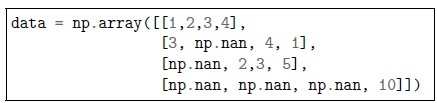 Consider following data and answer the given subquestions: Each row represents a data point. There are exactly 4 points. The index of points starts from 0 and ends at 3 (included).
- 1 and 2
- 0 and 2
- 1 and 3
- 2 and 3
- 0 and 1
- There is a tie between two or more options.
- None of these.
- 1 and 2
- 0 and 2
- 1 and 3
- 2 and 3
- 0 and 1
- There is a tie between two or more options.
- None of these.
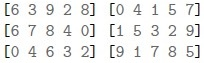
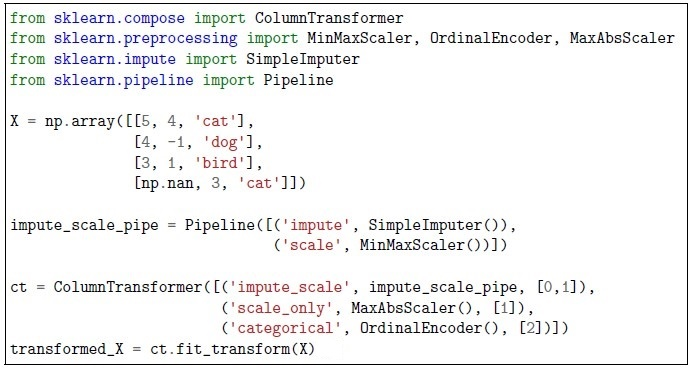 Consider following data and code snippet: Based on the above data, answer the given subquestions.
 What will be the output of the following code snippet: Enter -1, if you think the above code snippet will generate an error.
 What will be the output of the following code snippet: Enter -1, if you think the above code snippet will generate an error.
 What will be the output of the following code snippet: Enter -1, if you think the above code snippet will generate an error.
 What will be the output of the following code snippet: Enter -1, if you think the above code snippet will generate an error.







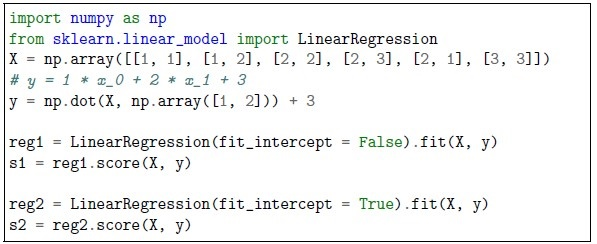
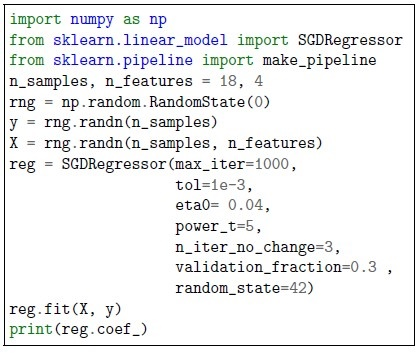 Go through the code snippet given below and answer the given subquestions.





- -0.528
- 1
- 0.528
- Given code will return an error
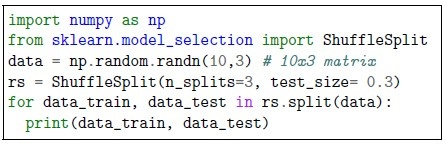 Consider the following code: Which of the following may be the correct output of the above code?:
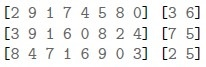
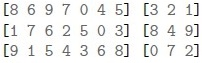
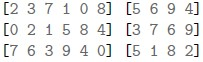

 Consider the following code: Which of the following is more likely to be true?


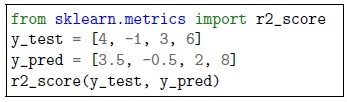 What will be the output of the following code ?
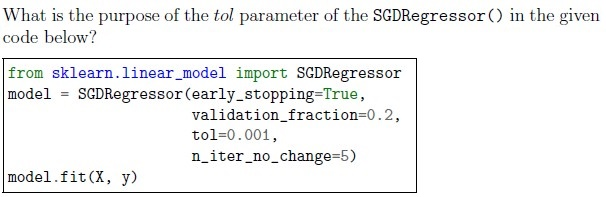
- It controls the learning rate of the stochastic regressor during training.
- It determines the maximum number of iterations for the training process.
- It defines the fraction of the validation set used for early stopping.
- It specifies the tolerance level for early stopping based on the change in thevalidation error.
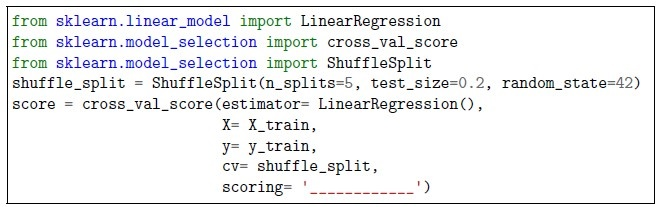 Consider the following code block and if needed make appropriate assumptions: Which of the following may be appropriate to be filled in the blank space value for scoring parameter?





Answer key
- Q1 (SA, 1 marks): 11
- Q2 (SA, 1 marks): 3
- Q3 (SA, 2 marks): 2
- Q4 (SA, 2 marks): 2
- Q5 (MSQ, 2 marks): A, B, C, D, E
- Q6 (MSQ, 2 marks): A, B
- Q7 (MSQ, 2 marks): A, D
- Q8 (MSQ, 2 marks): A, C
- Q9 (MSQ, 3 marks): B, D
- Q10 (MCQ, 2 marks): D
- Q11 (MCQ, 3 marks): C
- Q12 (MCQ, 2 marks): B
- Q13 (SA, 2 marks): 4
- Q14 (SA, 2 marks): 0.5
- Q15 (SA, 2 marks): 1.0
- Q16 (SA, 2 marks): 0.4
- Q17 (MSQ, 2 marks): B, C
- Q18 (MCQ, 2 marks): A
- Q19 (MCQ, 2 marks): D
- Q20 (MCQ, 3 marks): B
- Q21 (MCQ, 3 marks): B
- Q22 (SA, 2 marks): 0.76 to 0.80
- Q23 (MCQ, 2 marks): D
- Q24 (MSQ, 2 marks): B, C
Concepts this paper tests
Auto-generated summary from the source site. Handy as a checklist; the lessons above explain each idea from scratch.
Summary of Core Topics, Concepts, Principles, and Equations
1. Pandas and NumPy
DataFrame Operations: Creating, manipulating, and querying DataFrames.
df.shape,df.describe(),df.value_counts(),df.query()df.iloc[],df.loc[]
- Handling Missing Values: Using
SimpleImputerfromsklearn.impute. - Data Transformation: Using
MinMaxScaler,MaxAbsScaler, andOrdinalEncoderfromsklearn.preprocessing.
2. Scikit-Learn
Pipelines: Creating and using
PipelineandColumnTransformerfor data preprocessing.Pipeline([('impute', SimpleImputer()), ('scale', MinMaxScaler())])ColumnTransformer([('impute_scale', impute_scale_pipe, [0, 1]), ('categorical', OrdinalEncoder(), [2])])
Model Training and Evaluation: Using
SGDRegressor,LinearRegression, andcross_val_score.SGDRegressor(max_iter=1000, tol=1e-3, eta0=0.04, power_t=5, n_iter_no_change=3, validation_fraction=0.3, random_state=42)LinearRegression(fit_intercept=False)cross_val_score(estimator=LinearRegression(), X=X_train, y=y_train, cv=shuffle_split, scoring='neg_mean_squared_error')
Model Evaluation Metrics: Using
r2_scorefromsklearn.metrics.r2_score(y_test, y_pred)
3. Data Splitting
ShuffleSplit: Using
ShuffleSplitfor splitting data into training and test sets.ShuffleSplit(n_splits=5, test_size=0.2, random_state=42)
4. Mathematical Concepts
Euclidean Distance: Calculating the distance between data points.
Correlation Matrix: Understanding Pearson correlation coefficients and their range.
R² Score: Evaluating the performance of a regression model.
5. Handling Missing Data
- Imputation: Techniques for handling missing data, such as mean, median, or mode imputation.
- Data Cleaning: Importance of preprocessing data to handle errors, outliers, and missing values.
6. Model Parameters
- Tolerance (
tol): Understanding the role of tolerance in optimization algorithms. - Learning Rate (
eta0): Understanding the learning rate in stochastic gradient descent. - Early Stopping: Using
n_iter_no_changeandvalidation_fractionfor early stopping in model training.