Home / Past papers / MLP Quiz 1 / this paper
IIT M DIPLOMA AN4 EXAM QDD4 25 Feb 2024 - 25 Feb 2024
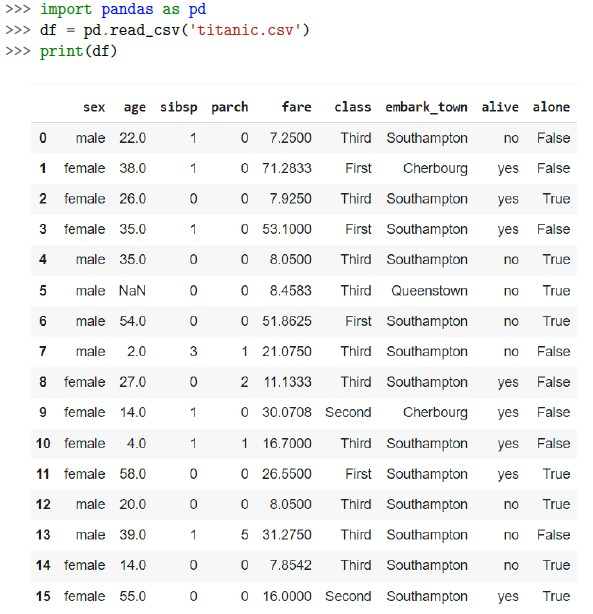








- number
- bool
- str
- object




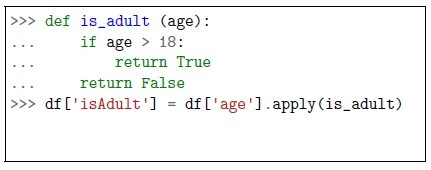 What is the given code below trying to accomplish for the given titanic dataset ?


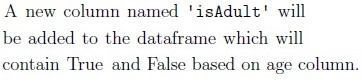



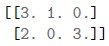
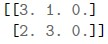
- Plotting a heatmap of the correlation matrix to understand the linearrelationship between the numeric features.
- Using a scatter plot to visualize the relationship between the square footage ofa house and its price.
- Visualizing the distribution of housing prices using a pie chart.
- Creating box plots for housing prices, grouped by the number of bedrooms, todetect outliers and understand the distribution across different categories.




- Statement 1 is True and statement 2 is False
- Statement 1 is False and statement 2 is True
- Both the statements are False
- Both the statements are True
- Data has missing values and categorical string data.
- Data consists a lot of outliers based on values in target(y) column
- The data consists solely of numerical values and are on a similar scale.
- None of the choices


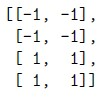
- RMSE
- R2
- Mean absolute error
- Mean squared error
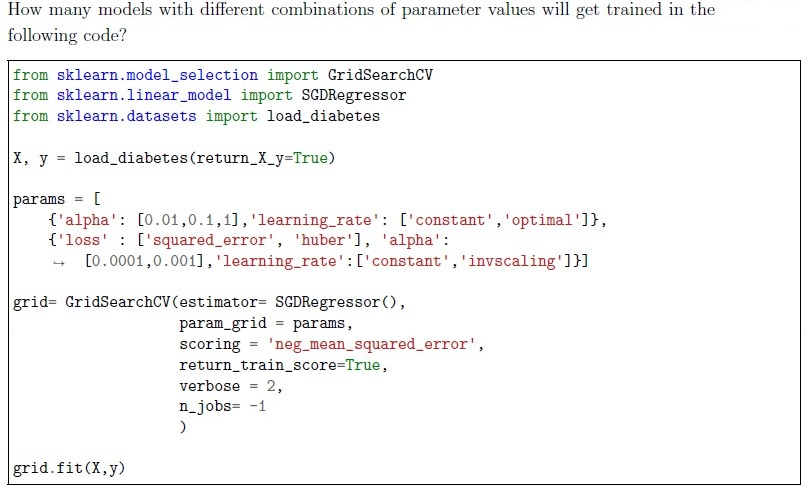
- 10
- 12
- 14
- 16
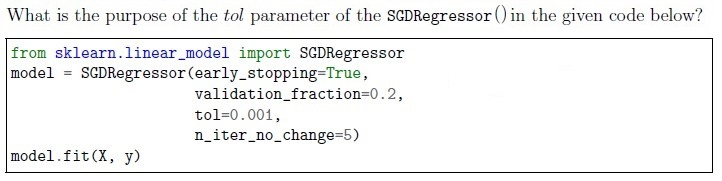
- It controls the learning rate of the stochastic regressor during training.
- It determines the maximum number of iterations for the training process.
- It defines the fraction of the validation set used for early stopping.
- It specifies the tolerance level for early stopping based on the change in thevalidation error.
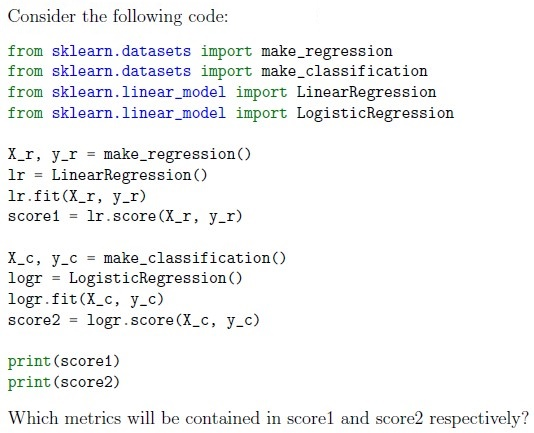
- Accuracy, Accuracy
- R2 score, R2 score
- Accuracy, R2 score
- R2 score, Accuracy
- F1 score, Precision
- Precision, Recall
- MAE, MSE
- The code will result in an error.
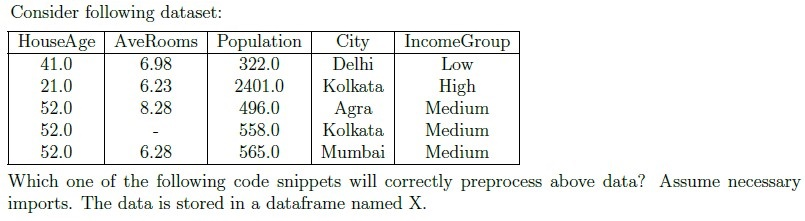
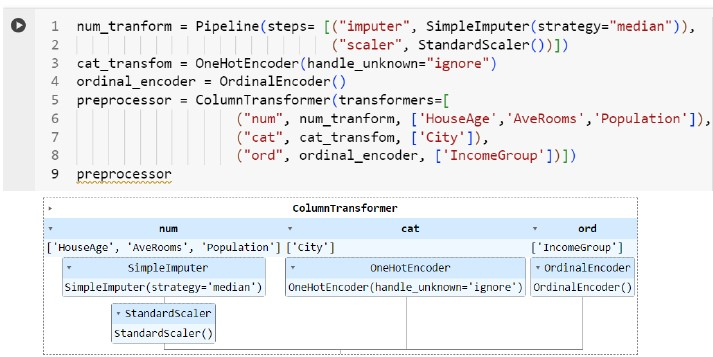
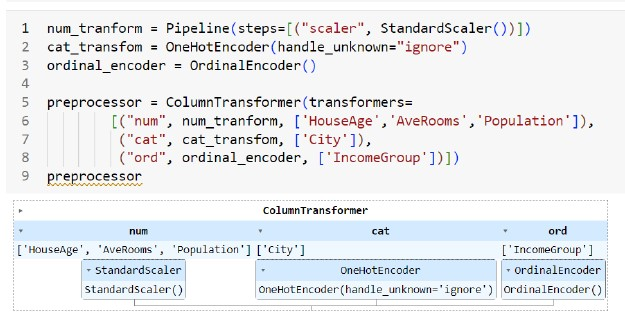
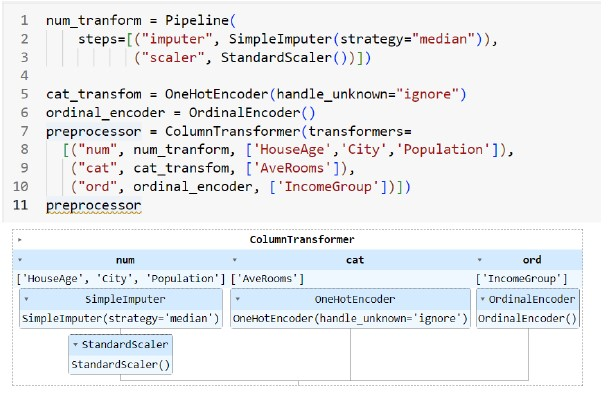
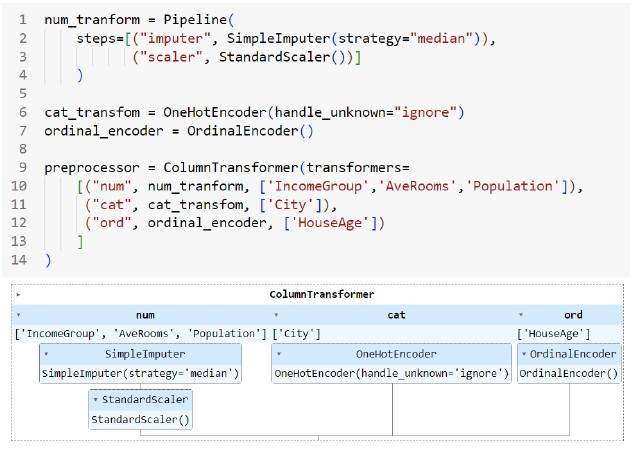
- Scale of the features
- (left or right) Skew of the distribution
- Modes in the distribution
- Missing values
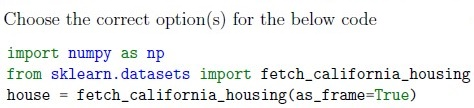
- house.data.shape will give the count of number of rows and columns forfeatures and labels(target) both
- house.target_names will give the name of the target column
- house.data.head() will show last 5 rows of the data
- house.feature_names will give a list of names of the columns of the featurematrix
- Squared Loss
- Hinge Loss
- Log Loss
- Mean Absolute Error
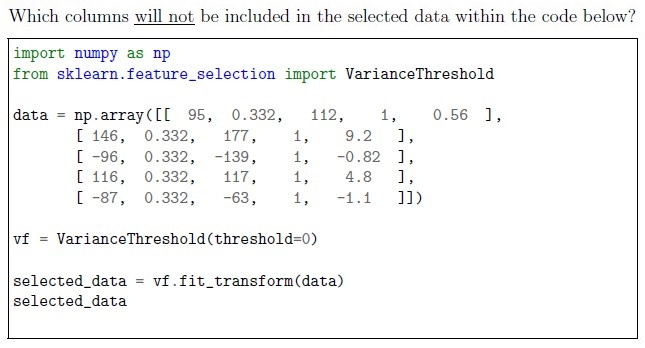
- Column indexed at 0
- Column indexed at 1
- Column indexed at 2
- Column indexed at 3
- Column indexed at 4
- No columns
- Mean Squared Error
- Accuracy
- F1-Score
- Mean Absolute Error
- credit score
- CGPA
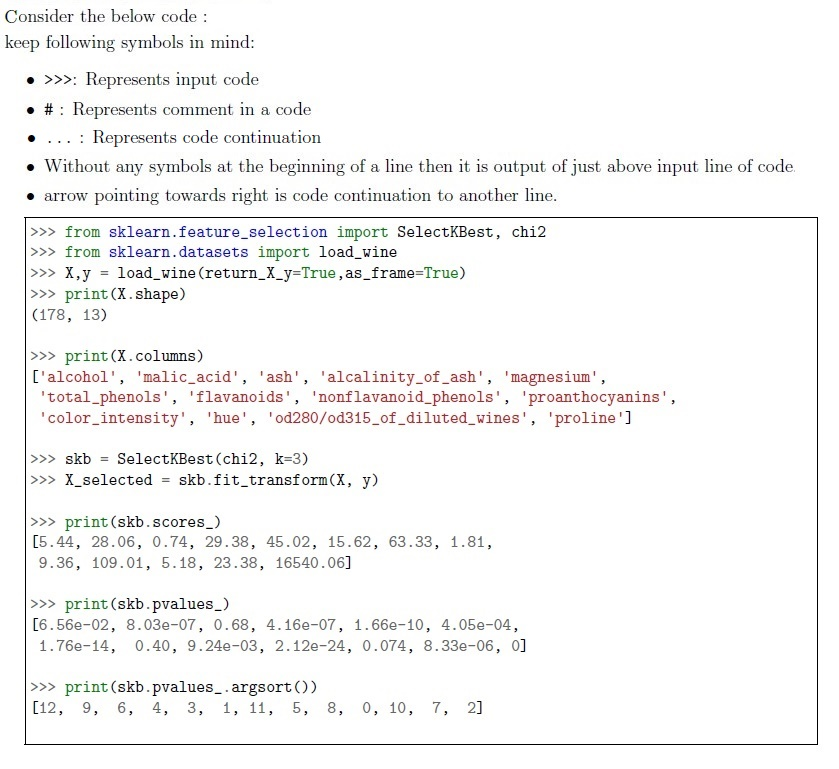
- malic_acid
- magnesium
- flavanoids
- proanthocyanins
- color_intensity
- proline
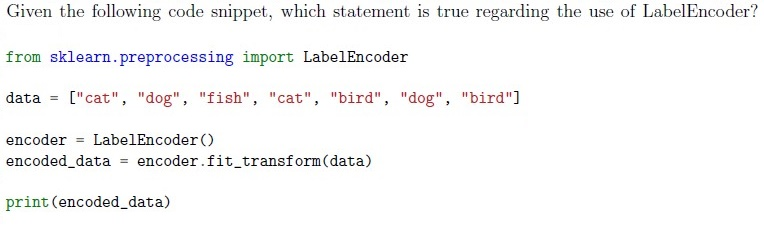




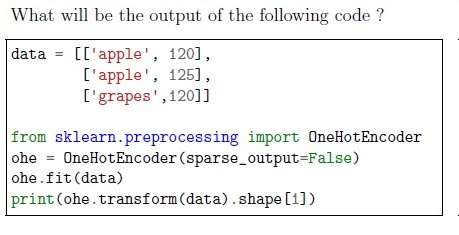
Answer key
- Q1 (MCQ, 2 marks): A
- Q2 (MCQ, 2 marks): B
- Q3 (MCQ, 2 marks): D
- Q4 (MCQ, 2 marks): A
- Q5 (MCQ, 2 marks): C
- Q6 (MCQ, 1 marks): C
- Q7 (MCQ, 2 marks): C
- Q8 (MCQ, 2 marks): C
- Q9 (MCQ, 2 marks): D
- Q10 (MCQ, 2 marks): A
- Q11 (MCQ, 2 marks): D
- Q12 (MCQ, 2 marks): B
- Q13 (MCQ, 2 marks): C
- Q14 (MCQ, 2 marks): D
- Q15 (MCQ, 2 marks): D
- Q16 (MCQ, 3 marks): A
- Q17 (MSQ, 2 marks): A, B, C
- Q18 (MSQ, 2 marks): B, D
- Q19 (MSQ, 2 marks): B, C
- Q20 (MSQ, 2 marks): B, D
- Q21 (MSQ, 2 marks): A, D
- Q22 (MSQ, 3 marks): C, E, F
- Q23 (MSQ, 3 marks): A, D
- Q24 (SA, 2 marks): 4
Concepts this paper tests
Auto-generated summary from the source site. Handy as a checklist; the lessons above explain each idea from scratch.
Summary of Core Topics, Concepts, Principles, and Equations
1. Pandas and Data Handling
DataFrame Operations: Handling DataFrames, checking for NULL values, selecting columns, and filtering data.
df.isnull().sum(): Counts NULL values in each column.df.iloc[:, 1:2]: Selects odd-indexed columns.df[(df['sex'] == 'female') & (df['alive'] == 'yes')]: Filters data based on conditions.
Data Types: Understanding data types in DataFrames.
df['sex'].dtype: Determines the data type of a column.
2. Data Visualization
Visualization Techniques: Using visualizations to understand data structure and relationships.
- Heatmaps, scatter plots, box plots, and histograms.
- Histograms: Reveal scale, skew, and modes in the distribution of numerical features.
3. Data Preprocessing
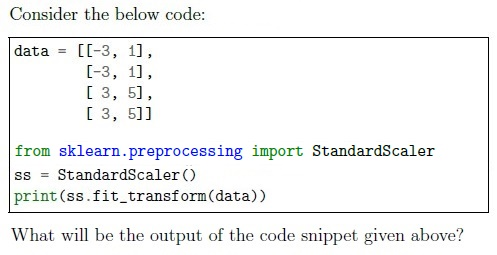
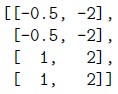
StandardScaler: Standardizes features by removing the mean and scaling to unit variance.
StandardScaler().fit_transform(data): Standardizes the data.
Label Encoding and One-Hot Encoding: Converting categorical data into numerical format.
LabelEncoder().fit_transform(data): Encodes categorical data.OneHotEncoder().fit_transform(data): One-hot encodes categorical data.
Handling Missing Values: Using imputers to handle missing data.
SimpleImputer(strategy="median"): Imputes missing values with the median.
4. Machine Learning Concepts
Train-Test Split: Splitting data into training and testing sets.
train_test_split(data, test_size=0.3, random_state=42): Splits data into training and testing sets.
Model Evaluation Metrics: Metrics for evaluating regression models.
- R² (R-squared): Higher values indicate better performance.
- RMSE (Root Mean Squared Error): Lower values indicate better performance.
- MAE (Mean Absolute Error): Lower values indicate better performance.
Grid Search and Hyperparameter Tuning: Using
GridSearchCVto find the best hyperparameters.GridSearchCV(estimator, param_grid, scoring='neg_mean_squared_error'): Performs grid search for hyperparameter tuning.
5. Feature Selection
Variance Threshold: Selecting features based on variance.
VarianceThreshold(threshold=0).fit_transform(data): Selects features with variance above a threshold.
SelectKBest: Selecting the best features based on statistical tests.
SelectKBest(chi2, k=3).fit_transform(X, y): Selects the top k features.
6. Mathematical Equations
- R² (R-squared):
- RMSE (Root Mean Squared Error):
- MAE (Mean Absolute Error):