Home / Past papers / MLP End Term / this paper
IIT M FOUNDATION DIPLOMA AN EXAM - 22 Dec 2024
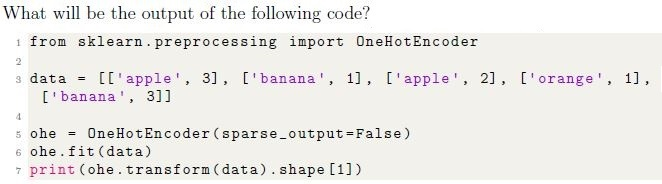
- 4
- 5
- 3
- 6
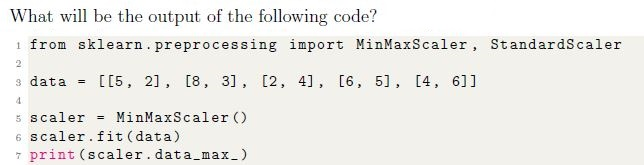
- [5, 6]
- [4, 5]
- [8, 6]
- [2, 3]





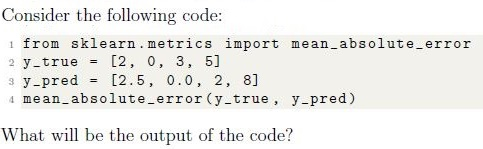
- 1.25
- 2.56
- 4.25
- 1.12
- Given code will return an error.
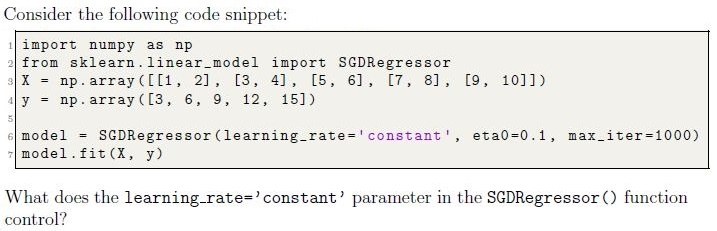
- It adjusts the learning rate based on the number of iterations.
- It defines the initial value for the learning rate and keeps it constantthroughout training.
- It determines the maximum step size allowed during training.
- It specifies the fraction of the dataset used for each step in the stochasticgradient descent.

- It determines the number of features to select for each base model.
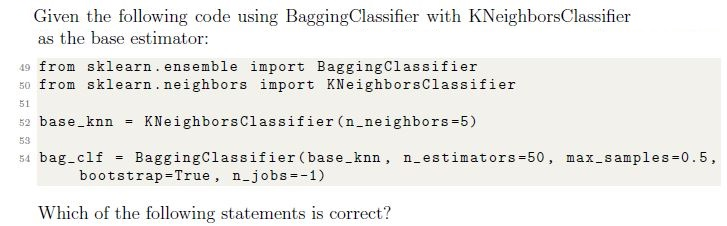
- It controls the number of base learners (models) to train in the ensemble.
- It decides the maximum number of samples to use in each base model.
- It ensures randomness in the sample selection for each base model.
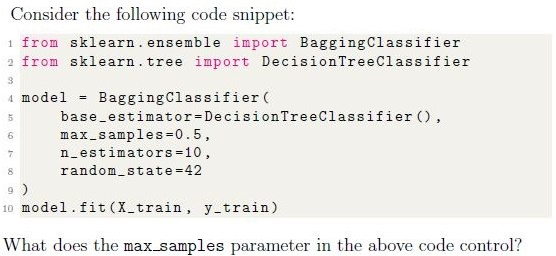
- The percentage of training samples used to train each base estimator.
- The number of base estimators trained on subsets of the training data.
- The maximum number of features used by each base estimator duringtraining.
- The total number of samples used to train all base estimators combined.

- It increases the variance among individual trees.
- It decreases the variance among individual trees.
- It reduces the number of samples used for training each tree.
- It reduces overfitting by restricting tree depth.
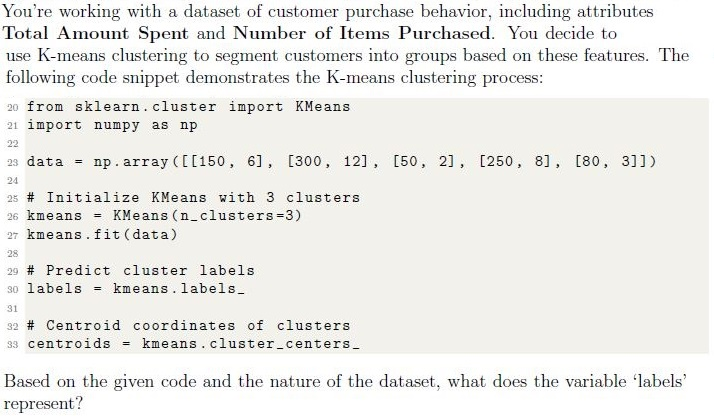
- The total amount spent by each customer.
- The cluster assignments indicating which group each customer belongs to.
- The number of items purchased by each customer.
- The centroid coordinates of the clusters formed.
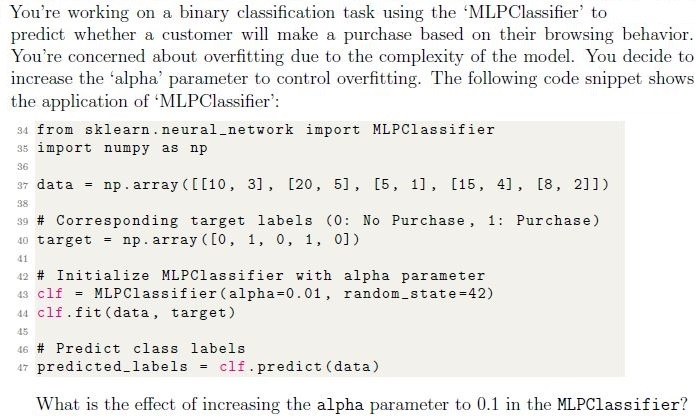
- It increases the model’s capacity to fit the training data closely, potentiallycausing overfitting.
- It adds a stronger regularization term to the loss function, reducing themodel’s complexity and helping prevent overfitting.
- It makes the model more prone to overfitting by increasing its sensitivity tonoise in the training data.
- It directly affects the learning rate, controlling how fast the model convergesduring training.
- Both statements are True
- Only statement 1 is True
- Only statement 2 is True
- Both statements are False
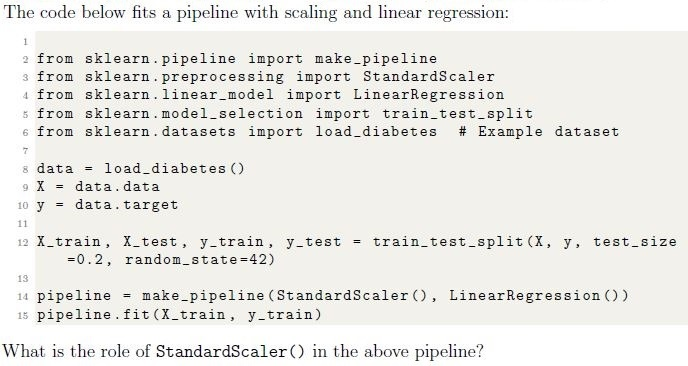









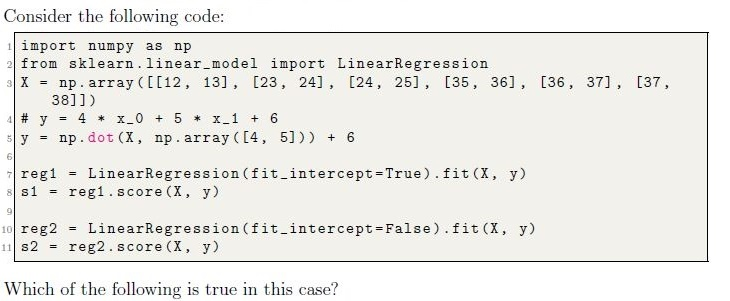
- s1 = s2
- s1 < s2
- s1 > s2



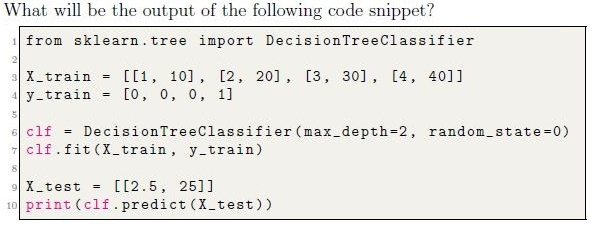
- [0]
- [1]
- [0.5]
- [2]
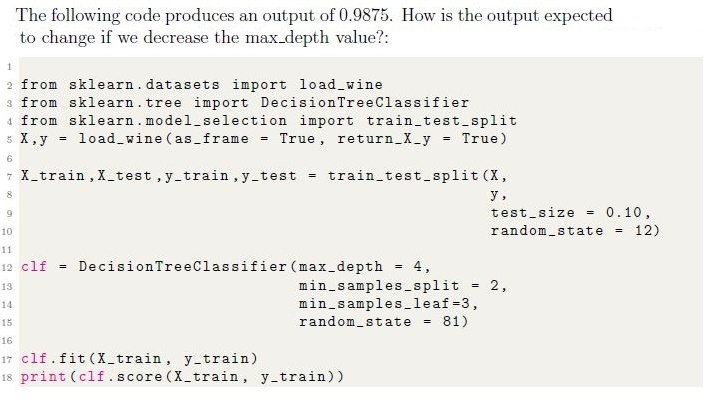
- Output score is likely to increase.
- Output score is likely to decrease.
- Output score may increase or decrease depending on other factors.
- Output score will remain the same.
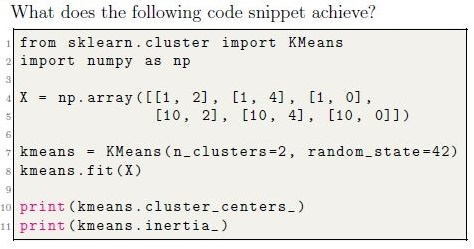
- Outputs the number of iterations and the final silhouette score of the clusters.
- Outputs the cluster labels for each data point and the maximum distancebetween clusters.
- Outputs the coordinates of the cluster centroids and the number of points ineach cluster.
- Outputs the coordinates of the cluster centroids and the sum of squareddistances of samples to their closest cluster center.











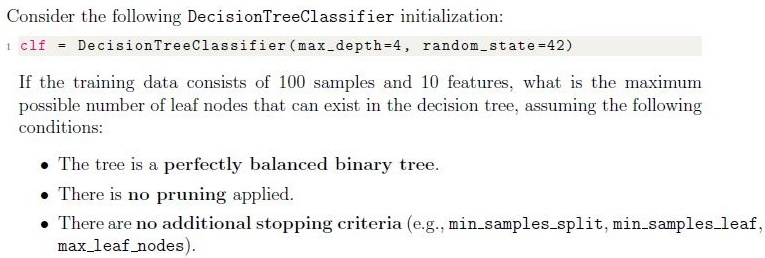
- 8
- 16
- 32
- 64
- PCA (Principal Component Analysis)
- StandardScaler
- Lasso Regression
- t-SNE (t-distributed Stochastic Neighbor Embedding)

- When data is streaming or generated incrementally.
- When the dataset is small.
- When the dataset cannot fit in memory.
- When the training labels are noisy.
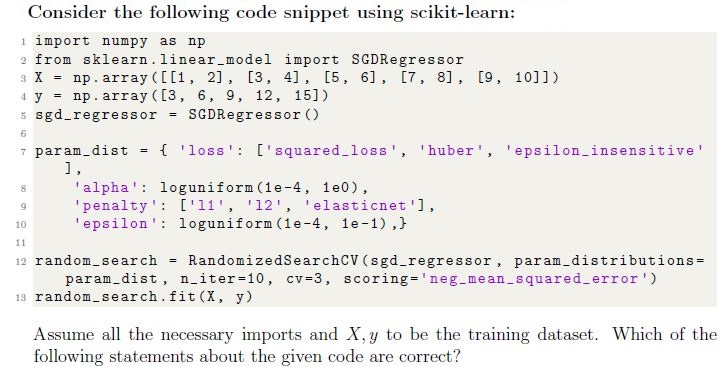




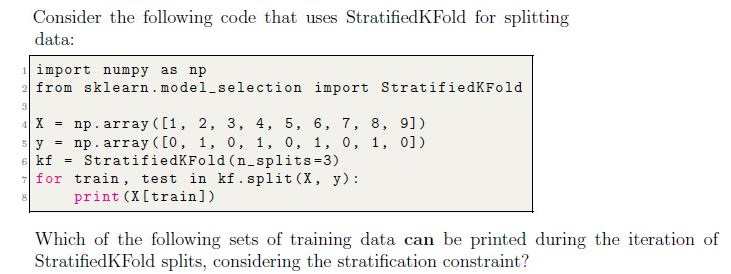
- [1, 2, 3, 6, 7]
- [1, 2, 3, 4, 5, 7]
- [2, 4, 6, 8]
- [1, 2, 3, 6, 8, 9]
- [2, 5, 8]
- [4, 5, 6, 7, 8, 9]
















- The neural network contains 3 hidden layers with 5 neurons in each hiddenlayer
- The neural network contains 5 hidden layers with 3 neurons in each hiddenlayer
- The neural network contains 2 hidden layers with 3 neurons in the secondhidden layer
- The neural network contains 2 hidden layers with 5 neurons in the first hiddenlayer
- None of the given options are correct
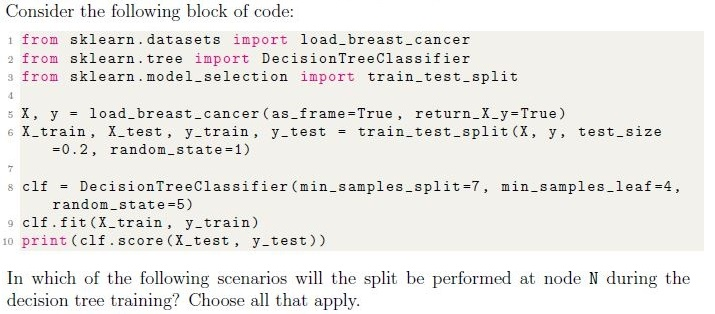
- The number of samples at node N is 15. If split, the left child will have 10samples, and the right child will have 5 samples.
- The number of samples at node N is 8. If split, the left child will have 4samples, and the right child will have 4 samples.
- The number of samples at node N is 9. If split, the left child will have 2samples, and the right child will have 7 samples.
- The number of samples at node N is 14. If split, the left child will have 4samples, and the right child will have 10 samples.
- The number of samples at node N is 6. If split, the left child will have 3samples, and the right child will have 3 samples.
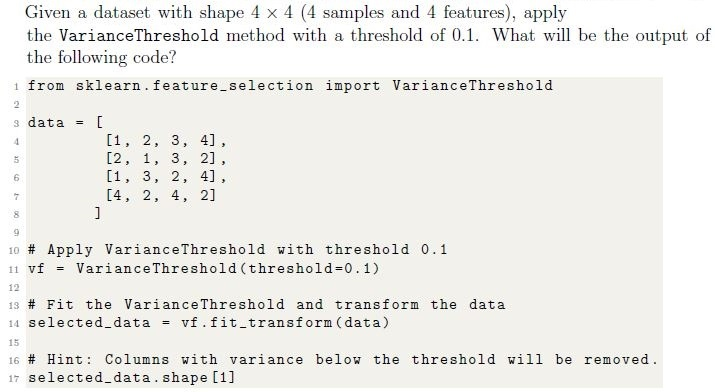













- The total sales for each region.
- The average sales for each month.
- The average sales for each region.
- None of these.
Answer key
- Q1 (MCQ, 2 marks): D
- Q2 (MCQ, 2 marks): C
- Q3 (MCQ, 2 marks): B
- Q4 (MCQ, 2 marks): D
- Q5 (MCQ, 2 marks): B
- Q6 (MCQ, 2 marks): B
- Q7 (MCQ, 2 marks): A
- Q8 (MCQ, 2 marks): B
- Q9 (MCQ, 2 marks): B
- Q10 (MCQ, 2 marks): B
- Q11 (MCQ, 2 marks): B
- Q12 (MCQ, 3 marks): B
- Q13 (MCQ, 3 marks): A
- Q14 (MCQ, 3 marks): A
- Q15 (MCQ, 3 marks): A
- Q16 (MCQ, 3 marks): A
- Q17 (MCQ, 3 marks): B
- Q18 (MCQ, 3 marks): D
- Q19 (MCQ, 3 marks): C
- Q20 (MCQ, 3 marks): C
- Q21 (MCQ, 3 marks): D
- Q22 (MCQ, 4 marks): B
- Q23 (MSQ, 2 marks): A, C, D
- Q24 (MSQ, 2 marks): A, C
- Q25 (MSQ, 3 marks): A, C, D
- Q26 (MSQ, 3 marks): B, D, F
- Q27 (MSQ, 3 marks): A, C, D
- Q28 (MSQ, 3 marks): A, C, D
- Q29 (MSQ, 3 marks): A, B, C
- Q30 (MSQ, 3 marks): C, D
- Q31 (MSQ, 4 marks): A, B, D
- Q32 (SA, 3 marks): 4
- Q33 (SA, 3 marks): 0.6
- Q34 (SA, 3 marks): 0
- Q35 (MCQ, 2 marks): A
- Q36 (MSQ, 2 marks): A, B, C
- Q37 (MSQ, 3 marks): A, C, D
- Q38 (MCQ, 2 marks): C
Concepts this paper tests
Auto-generated summary from the source site. Handy as a checklist; the lessons above explain each idea from scratch.
Here’s a structured summary of core topics, concepts, principles, and equations essential for the Diploma Level: Machine Learning Practice (Computer-Based Exam), along with Mermaid knowledge graphs to visualize relationships.
1. Core Topics & Concepts
A. Data Preprocessing
Key Concepts:
One-Hot Encoding (
OneHotEncoder)- Converts categorical features into binary (0/1) columns.
Example:
from sklearn.preprocessing import OneHotEncoder ohe = OneHotEncoder(sparse_output=False) ohe.fit_transform([['apple'], ['banana'], ['apple']])- Output Shape:
(n_samples, n_categories). Note: If input has mixed types (e.g., `[['apple', 3], ['banana', 1]])**, all columns are treated as categorical by default (unless specified otherwise).
- Correct Answer for Q2:
D (6)(3 categories for fruit + 3 for numbers).
- Correct Answer for Q2:
Feature Scaling
MinMaxScaler: Scales features to
[0, 1]range.- Formula:
Key Attribute:
scaler.data_max_(stores max values per feature).- StandardScaler: Standardizes features to mean=0, std=1.
- Formula:
Handling Missing Data
dropna()in Pandas:thresh=N: Drops rows with fewer thanNnon-null values.- Example:
df.dropna(thresh=15)keeps rows with ≥15 non-null values.
Polynomial Features
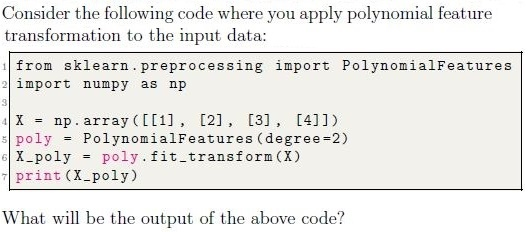
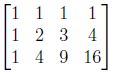
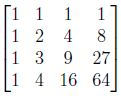
PolynomialFeatures(degree=d): Generates polynomial/combination features up to degreed.- Example (degree=2): Input:
[[a], [b]]→ Output:[[1, a, a²], [1, b, b²]]. - Correct Answer for Q16:
A.
- Example (degree=2): Input:
B. Model Evaluation Metrics
Key Concepts:
Mean Absolute Error (MAE)
- Formula:
Example (Q5):
y_true = [2, 0, 3, 5],y_pred = [2.5, 0.0, 2, 8]→ MAE =1.125.- Correct Answer:
D.
Accuracy, Precision, Recall, F1, ROC-AUC
Cross-Validation Metrics (Q14):
- Valid for classification:
roc_auc,accuracy,precision,recall,f1. - Invalid for regression:
r2,mean_absolute_error,explained_variance. - Correct Answer:
A (roc_auc).
- Valid for classification:
R² Score (
scoremethod in Linear Regression)Key Insight (Q15):
- If
fit_intercept=Trueand data is linear,s1 = s2(intercept doesn’t affect R² if data is centered). - Correct Answer:
A.
- If
C. Supervised Learning Algorithms
Key Concepts:
Stochastic Gradient Descent (SGD)
Parameters (Q6):
learning_rate='constant': Fixes learning rate toeta0.eta0: Initial learning rate.
- Correct Answer:
B.
Decision Trees
Hyperparameters (Q18):
max_depth: Controls tree depth (higher → overfitting, lower → underfitting).- Effect of Decreasing
max_depth: Accuracy drops (underfitting). - Correct Answer:
B.
Splitting Rules (Q32):
Split occurs if:
min_samples_split≤ samples in node.min_samples_leaf≤ samples in child nodes.
- Correct Options:
A, B, D.
Random Forest
max_features(Q9):- Higher value → lower variance (trees become more similar).
- Correct Answer:
B.
K-Nearest Neighbors (KNN)
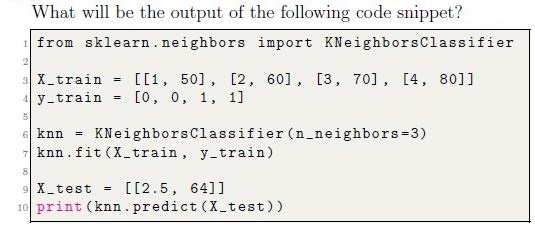
Prediction (Q35):
- Majority vote among
n_neighbors. - Example: 3 neighbors with labels
[0, 1, 1]→ predicts1. - Correct Answer:
0(Note: The provided answer in Q35 seems incorrect; the correct prediction is1.)
- Majority vote among
Support Vector Machines (SVM)
Prediction vs. True Labels (Q34):
- Accuracy = Correct Predictions / Total Predictions.
- Example: 3/5 correct → accuracy =
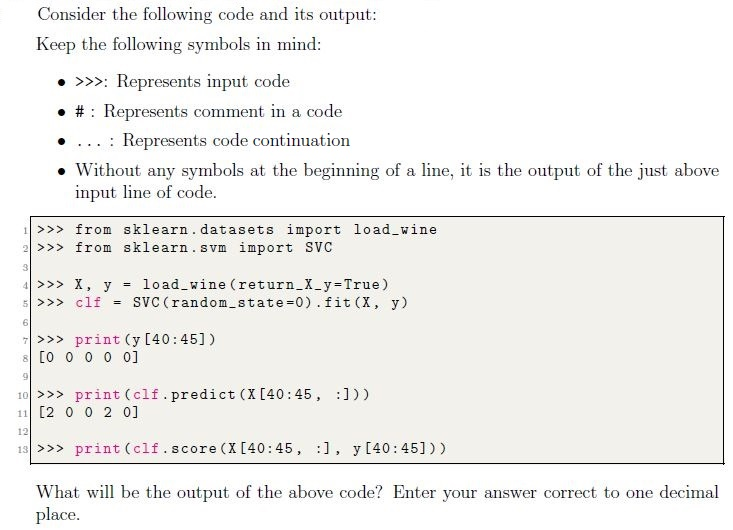
0.6. - Correct Answer:
0.6.
D. Unsupervised Learning
Key Concepts:
K-Means Clustering
Parameters (Q30):
n_clusters: Number of clusters (must be ≤ samples).init: Initialization method (e.g.,k-means++).max_iter: Maximum iterations.
Outputs (Q19):
cluster_centers_: Coordinates of centroids.inertia_: Sum of squared distances to centroids.- Correct Answer:
D.
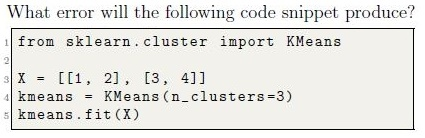
Error Handling (Q20):
ValueErrorifn_clusters > n_samples.- Correct Answer:
C.
Dimensionality Reduction (Q24)
Techniques:
- PCA: Linear projection.
- t-SNE: Non-linear, preserves local structure.
- Lasso Regression: Feature selection via L1 regularization.
- Correct Options:
A, C, D.
E. Ensemble Methods
Key Concepts:
Bagging (
BaggingClassifier)Parameters (Q7, Q8, Q21):
n_estimators: Number of base models.max_samples: Fraction of samples per base model (e.g.,0.5→ 50%).bootstrap: Whether to sample with replacement.
Correct Answers:
- Q7:
B(n_estimators= number of base learners). - Q8:
A(max_samples= fraction of training data). - Q21:
C(max_samples=0.5→ 50% of data per estimator).
- Q7:
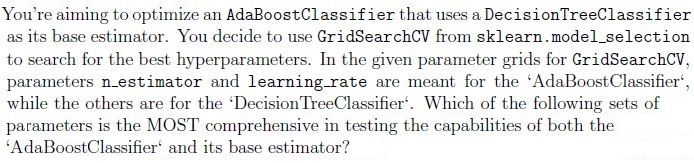
Boosting (
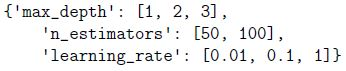
AdaBoost,GradientBoosting)Hyperparameter Tuning (Q22, Q29):
n_estimators: Number of boosting stages.learning_rate: Shrinkage factor.- GridSearchCV: Exhaustively searches parameter combinations.
Correct Answers:
- Q22:
D(comprehensive grid for bothAdaBoostandDecisionTree). - Q29:
A, C, D(cross-validation, best params, explicit import needed).
- Q22:
F. Model Training & Hyperparameter Tuning
Key Concepts:
Grid Search vs. Random Search (Q26)
RandomizedSearchCV:n_iter: Number of parameter combinations to try.param_distributions: Dictionary of hyperparameter distributions.
- Correct Options:
A, C, D.
Partial Fit (Q25, Q28)
Use Cases:
- Streaming data (cannot fit in memory).
- Online learning.
Correct Answers:
- Q25:
A, C. - Q28:
A, C, D(partial_fitallows incremental training;classesrequired for first call).
- Q25:
Stratified K-Fold (Q27)
- Preserves class distribution in splits.
Valid Training Sets (Q27): Must maintain class ratios.
- Correct Options:
B, D, F.
- Correct Options:
G. Neural Networks
Key Concepts:
MLPClassifier/Regressor (Q11, Q31)
alpha: L2 regularization strength (higher → less overfitting).hidden_layer_sizes:- Tuple specifies neurons per layer.
- Example:
(5, 3)→ 2 hidden layers (5 neurons, then 3 neurons).
Correct Answers:
- Q11:
B(higheralpha→ stronger regularization). - Q31:
C, D.
- Q11:
H. Pandas Operations (Q36–Q38)
Key Concepts:
Aggregations:
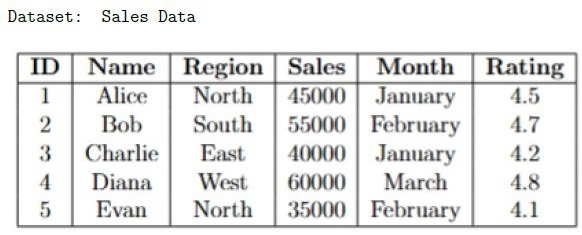
df['Sales'].sum()→ Total sales.df.groupby('Region')['Sales'].mean()→ Average sales per region.
Filtering:
df[df['Region'] == 'North']['Name']→ Names in North region.
Sorting/Selecting:
df.nlargest(1, 'Sales')→ Row with highest sales.df.loc[df['Sales'].idxmax()]→ Same as above.
2. Key Equations
| Concept | Equation |
|---|---|
| MinMax Scaling | |
| Standard Scaling | |
| MAE | |
| MSE | |
| R² Score | |
| K-Means Inertia | |
| SGD Update Rule | |
| L1/L2 Regularization |
3. Exam Tips
Focus Areas:
- Data Preprocessing: Encoding, scaling, missing data.
- Model Evaluation: Metrics, cross-validation.
- Algorithms: Decision trees, SVM, KNN, ensemble methods.
- Hyperparameter Tuning: Grid search, random search.
- Unsupervised Learning: K-means, PCA, t-SNE.
- Pandas: Filtering, aggregation, groupby.
Common Pitfalls:
- OneHotEncoder: Defaults to treating all columns as categorical.
- K-Means:
n_clustersmust be ≤n_samples. - SGD:
learning_rate='constant'uses fixedeta0. - Partial Fit: Requires
classesfor first call in classification.
- Code Snippets to Remember: ```python # OneHotEncoder (sparse=False for dense output) ohe = OneHotEncoder(sparse_output=False) ohe.fit_transform(data)
# MinMaxScaler scaler = MinMaxScaler() scaler.fit_transform(data)
# K-Means kmeans = KMeans(n_clusters=2) kmeans.fit(X) print(kmeans.cluster_centers_, kmeans.inertia_)
# GridSearchCV grid = GridSearchCV(estimator, param_grid, cv=3) grid.fit(X, y) print(grid.best_params_) ```