Home / Past papers / MLP End Term / this paper
IIT M FOUNDATION FN EXAM FDF2 24 Dec 2023 - 24 Dec 2023
 Consider the following Python code using Pandas: What does the groupby operation in the code achieve?
- It calculates the total price for each category.
- It calculates the average price for each category.
- It groups the data by the ’Category’ column.
- It filters out rows where the ’Price’ column is zero.
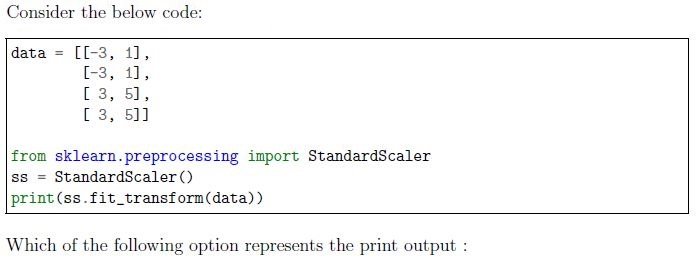

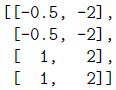

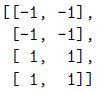
- RMSE
- R2
- Mean absolute error
- Mean squared error
- stochastic gradient descent
- mini gradient descent
- full batch gradient descent
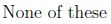
- None of these
- Ridge regression is designed to handle class imbalance of the dataset.
- The regularization term in Ridge regression is added to the sum of absoluteresiduals.
- Increasing the value of the regularization parameter (alpha) in Ridgeregression makes the model less sensitive to high-magnitude coefficients.
- Ridge regression is equivalent to Lasso regression when the regularizationparameter (alpha) is set to zero.
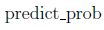

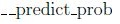

- Faster to compute the list of neighbors on scaled data.
- k-nearest neighbors is based on computing some distances. Features need tobe normalized to contribute approximately equally to the distance computation.
- Scaling the data has a negligible effect on k-nearest neighbor’s performance,but it enhances the interpretability of the model.
- This is irrelevant. One could use k-nearest neighbors without normalizing thedataset and get a very similar cross-validation score.
- The maximum number of documents considered during vectorization.
- The maximum number of features (words) to be extracted based on termfrequency.
- The maximum number of randomly selected features (words).
- The maximum number of characters allowed in each document.
- Increasing the value of min_samples_split
- Increasing the value of the pruning parameter
- Increasing the value of min_samples_leaf
- Increasing the depth of the tree
- Connectivity-based Clustering
- Centroids-based Clustering
- Density-based Clustering
- All of them
- Supervised learning
- Unsupervised learning
- Reinforcement learning
- None of these
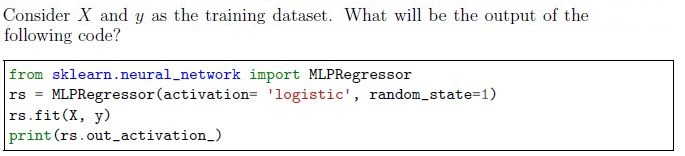
- logistic
- relu
- identity
- tanh
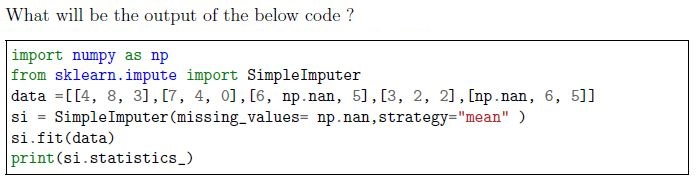
- [5, 5, 3.75]
- [5, 5, 3]
- [4, 4, 3]
- [4, 4, 3.75]
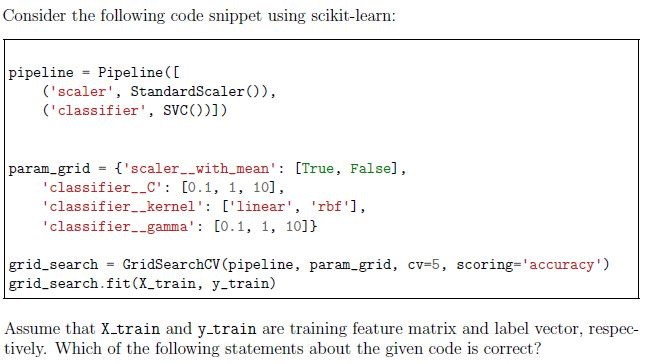




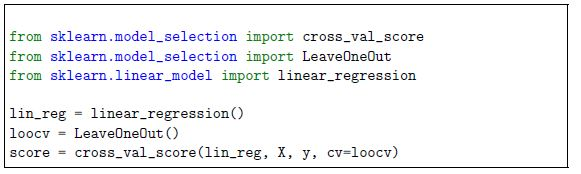
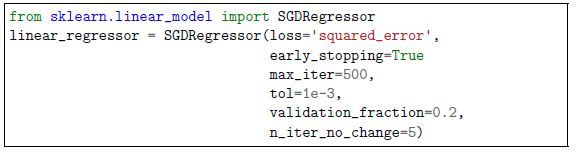
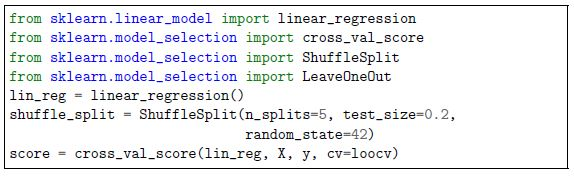
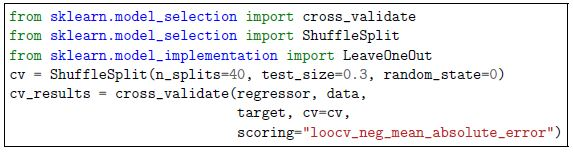

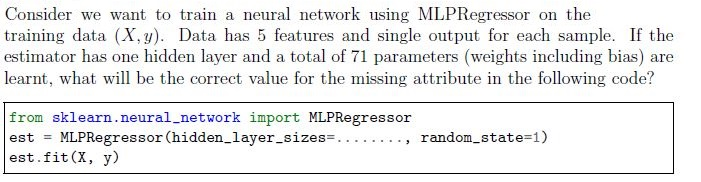
- (71)
- (71, 1)
- (10)
- (10, 2)
- Increasing the number of neurons in hidden layers will always lead to bettermodel performance.
- Decreasing the number of neurons in hidden layers reduces the model’scapacity to capture complex patterns.
- The number of neurons in hidden layers does not significantly affect themodel’s performance.
- Finding the optimal number of neurons is a trial-and-error process and mayrequire experimentation.
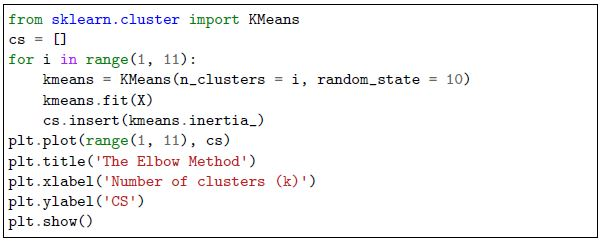
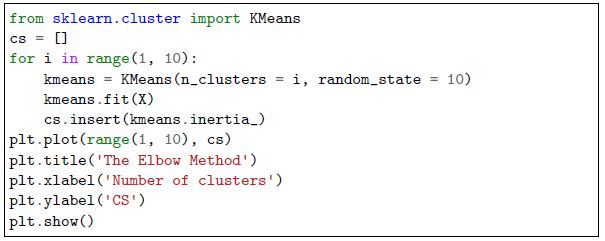
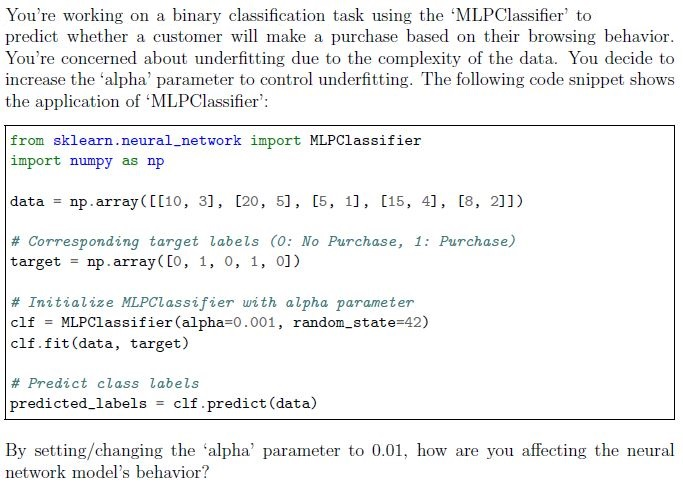
- Increasing the model’s complexity to fit the training data more closely.
- Adding a stronger regularization term to the loss function, discouragingcomplex models.
- Making the model more capable to learn more complex behaviour.
- Adjusting the learning rate to control convergence speed.
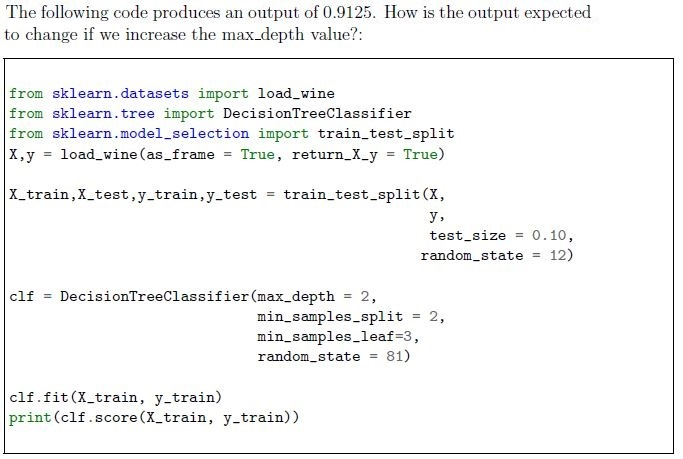
- Output score is likely to increase.
- Output score is likely to decrease.
- Output score may increase or decrease.
- Output score will remain the same.
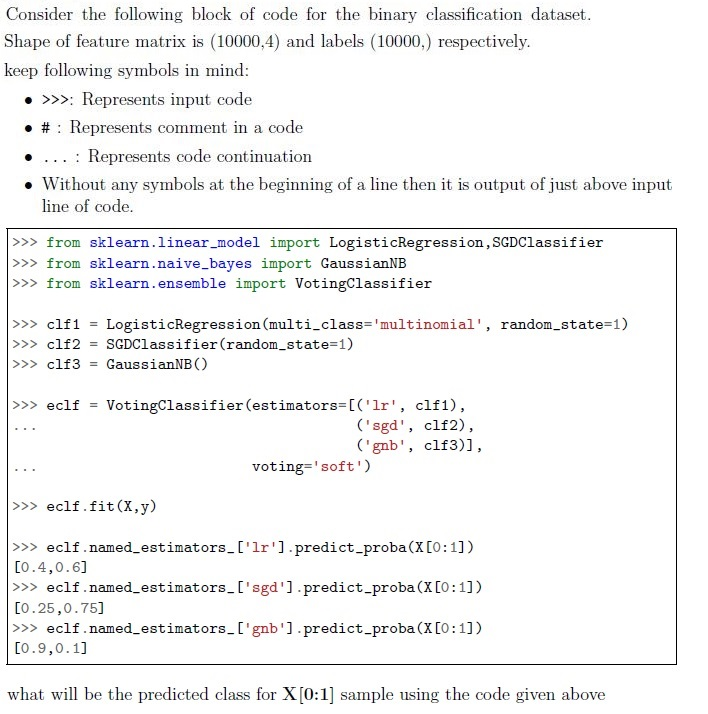
- 0
- 1
- 2
- 3
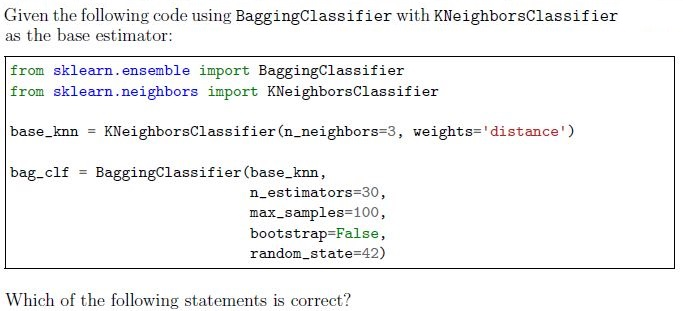
- Above code uses bootstrapping to generate samples for each base classifier.
- model will be tested on out of the bags samples.
- Due to weights=’distance’, each base KNN classifier will treat all neighborsequally in terms of voting power.
- The ensemble will consist of 3 base KNN classifiers.
- None of these
 Consider a dataset representing various attributes of red wine, loaded into a Pandas DataFrame named data using the following code: Suppose we are interested in extracting the value of the chlorides attribute for the third sample in the dataset (2nd by index). Which of the following expressions correctly achieves this? chlorides is at the 4th index of columns.
- data.chlorides[2]
- data[’chlorides’][2]
- data[2][4]
- data.iloc[2, 4]
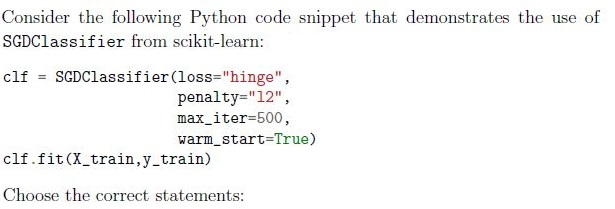
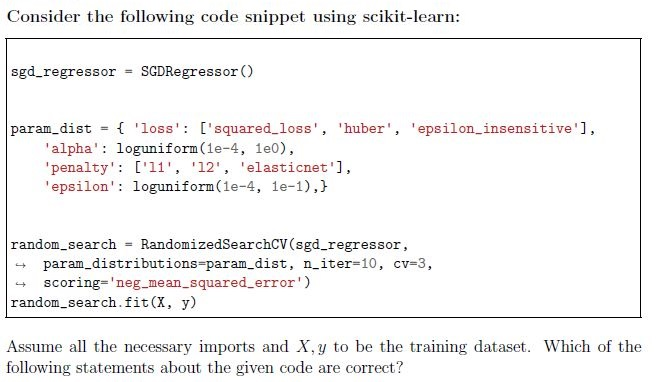
- It applies lasso penalty.
- The training may terminate after 499 iterations or lesser
- the classifier represents a perceptron model
- The classifier’s model parameters will initialized with parameters learnt fromprevious call to fit() function, if the same object is trained/fitted multiple times on new data.
- The data set size is 1000 GB.
- The model has to be trained in non-iterative manner.
- The model must be a decision tree.
- The model must be a logistic regressor.
- None of these





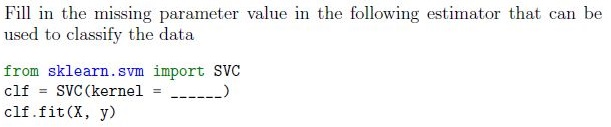
- ‘poly’,
- ‘lasso’
- ‘rbf’,
- ‘scale’
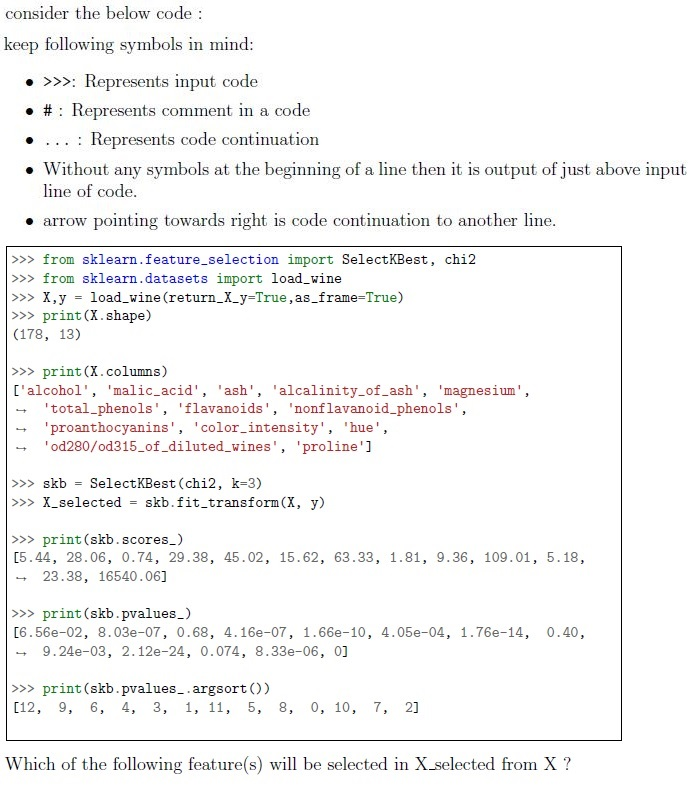
- malic_acid
- magnesium
- flavanoids
- proanthocyanins
- color_intensity
- proline




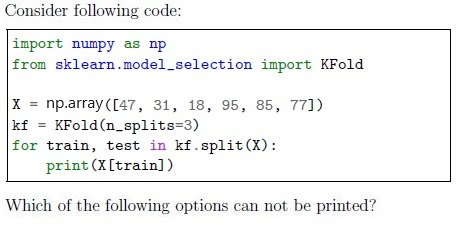
- [47, 31, 18, 95, 77]
- [47, 31, 18 ]
- [31, 41, 18, 95, 85, 77]
- [31, 41, 85, 31]
- [18, 95, 85, 77]
- [47, 31, 18, 85]
- None of these
- Smaller values of C result in a more complex decision boundary.
- Larger values of C result in a more complex decision boundary.
- The decision boundary becomes simpler with increasing values of C.
- Very large values of C may lead to overfitting.
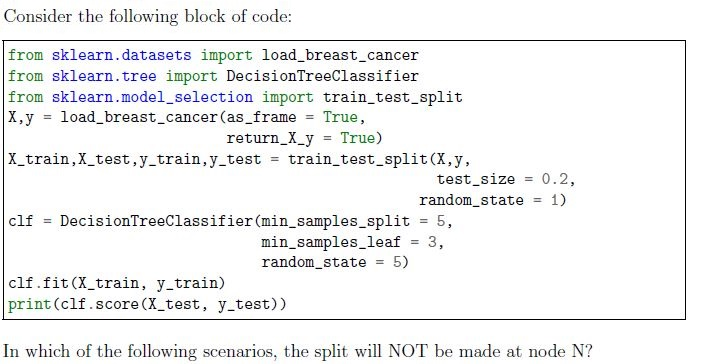
- Number of samples at node N = 10. If it is split, it will result in 2 nodes in theleft child and 8 nodes in the right child.
- Number of samples at node N = 6. If it is split, it will result in 3 nodes in the leftchild and 3 nodes in the right child.
- Number of samples at node N = 12. If it is split, it will result in 5 nodes in theleft child and 7 nodes in the right child.
- Number of samples at node N = 4. If it is split, it will result in 3 nodes in the leftchild and 1 node in the right child.
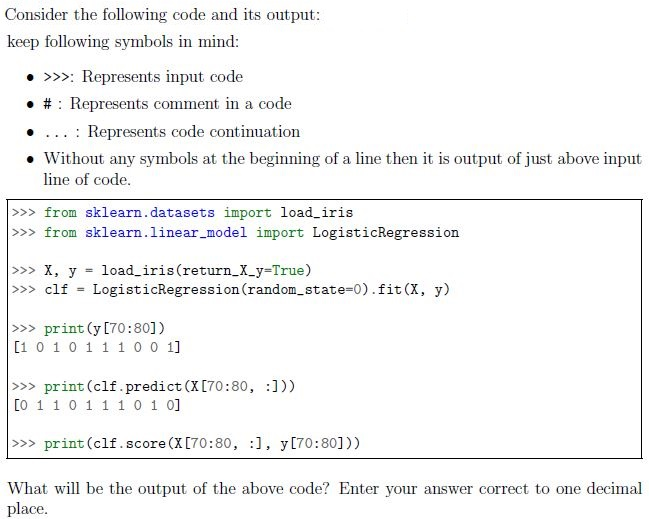
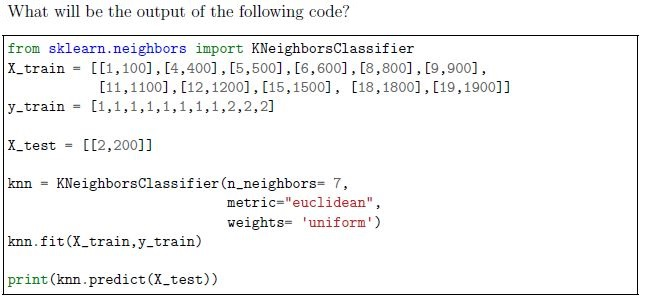
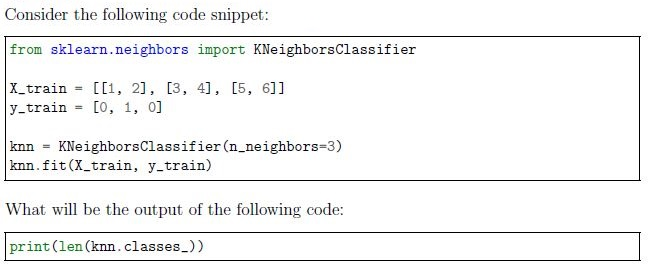
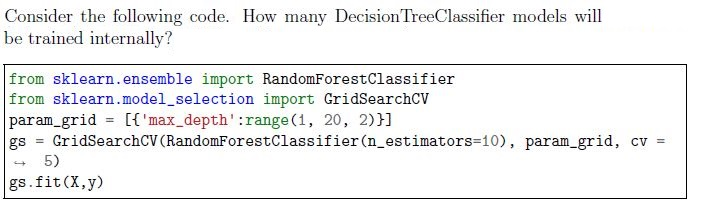
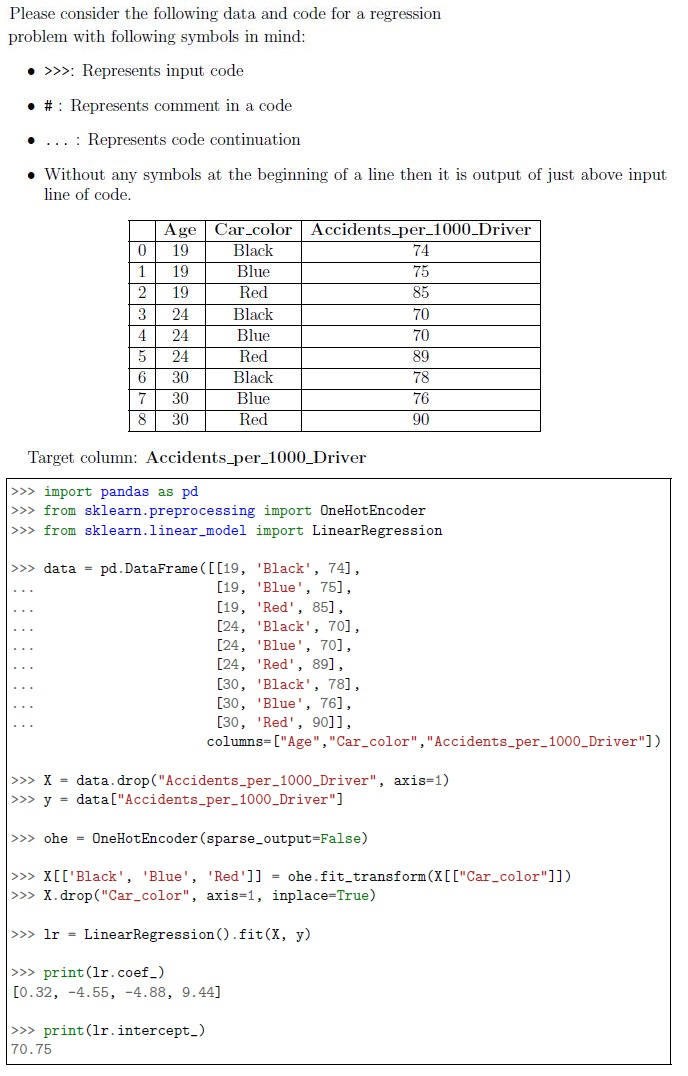
- StandardScaler()
- OrdinalEncoder()
- MinMaxScaler()
- LabelEncoder()
Answer key
- Q1 (MCQ, 2 marks): B
- Q2 (MCQ, 2 marks): D
- Q3 (MCQ, 2 marks): B
- Q4 (MCQ, 2 marks): A
- Q5 (MCQ, 2 marks): C
- Q6 (MCQ, 2 marks): A
- Q7 (MCQ, 2 marks): B
- Q8 (MCQ, 2 marks): B
- Q9 (MCQ, 2 marks): D
- Q10 (MCQ, 2 marks): D
- Q11 (MCQ, 2 marks): B
- Q12 (MCQ, 2 marks): C
- Q13 (MCQ, 3 marks): B
- Q14 (MCQ, 3 marks): B
- Q15 (MCQ, 3 marks): A
- Q16 (MCQ, 3 marks): C
- Q17 (MCQ, 3 marks): D
- Q18 (MCQ, 3 marks): C
- Q19 (MCQ, 3 marks): C
- Q20 (MCQ, 4 marks): A
- Q21 (MCQ, 4 marks): B
- Q22 (MCQ, 4 marks): E
- Q23 (MSQ, 2 marks): A, B, D
- Q24 (MSQ, 2 marks): B, D
- Q25 (MSQ, 2 marks): A, D
- Q26 (MSQ, 2 marks): A, C
- Q27 (MSQ, 2 marks): A, C
- Q28 (MSQ, 3 marks): C, E, F
- Q29 (MSQ, 3 marks): A, C, D
- Q30 (MSQ, 3 marks): A, B, C, D
- Q31 (MSQ, 3 marks): B, D
- Q32 (MSQ, 4 marks): A, D
- Q33 (SA, 3 marks): 0.6
- Q34 (SA, 3 marks): 1
- Q35 (SA, 2 marks): 2
- Q36 (SA, 4 marks): 500
- Q37 (SA, 3 marks): 73 to 75
- Q38 (MSQ, 2 marks): A, C
Concepts this paper tests
Auto-generated summary from the source site. Handy as a checklist; the lessons above explain each idea from scratch.
Here’s a structured summary of core topics, concepts, principles, and equations essential for the Diploma Level: Machine Learning Practice (Computer-Based Exam). The summary is organized by themes (e.g., preprocessing, model evaluation, algorithms) with key equations, Python snippets, and conceptual notes. --- ---
1. Data Preprocessing
Key Concepts
Standardization/Normalization:
- Required for distance-based algorithms (e.g., KNN, SVM, neural networks).
- StandardScaler: Transforms data to have mean = 0 and std = 1. Formula:
- MinMaxScaler: Scales data to a range (e.g., [0, 1]). Formula:
Handling Missing Data:
SimpleImputer: Replaces missing values with mean/median/mode.
from sklearn.impute import SimpleImputer si = SimpleImputer(strategy="mean") si.fit_transform(data)- Output:
si.statistics_gives the computed means/medians.
Categorical Encoding:
OneHotEncoder: Converts categorical features to binary columns.
from sklearn.preprocessing import OneHotEncoder ohe = OneHotEncoder(sparse_output=False) encoded = ohe.fit_transform(data[['category']])LabelEncoder: Converts categories to integers (not recommended for features).
from sklearn.preprocessing import LabelEncoder
le = LabelEncoder()
y_encoded = le.fit_transform(y)
Feature Selection:
SelectKBest: Selects top-k features based on statistical tests (e.g., chi-squared, ANOVA).
from sklearn.feature_selection import SelectKBest, chi2 skb = SelectKBest(chi2, k=3) X_selected = skb.fit_transform(X, y)skb.scores_: Scores for each feature.skb.pvalues_: p-values for hypothesis testing.
2. Model Evaluation
Key Metrics
Regression Metrics:
- R² (R-squared): Higher = better (max = 1).
- RMSE (Root Mean Squared Error): Lower = better.
- MAE (Mean Absolute Error): Lower = better.
Classification Metrics:
- Accuracy: .
- Precision: .
- Recall: .
- F1-Score: Harmonic mean of precision/recall.
Cross-Validation:
GridSearchCV: Exhaustive search over hyperparameters.
from sklearn.model_selection import GridSearchCV param_grid = {'C': [0.1, 1, 10], 'kernel': ['linear', 'rbf']} grid_search = GridSearchCV(SVC(), param_grid, cv=5) grid_search.fit(X, y)RandomizedSearchCV: Random sampling of hyperparameters.
from sklearn.model_selection import RandomizedSearchCV
param_dist = {'C': loguniform(1e-4, 1e0), 'kernel': ['linear', 'rbf']}
random_search = RandomizedSearchCV(SVC(), param_dist, n_iter=10, cv=3)
LeaveOneOut (LOO): Uses n-1 samples for training, 1 for testing.
from sklearn.model_selection import LeaveOneOut, cross_val_score
loo = LeaveOneOut()
scores = cross_val_score(model, X, y, cv=loo)
3. Supervised Learning Algorithms
Linear Models
Linear Regression:
- Predicts continuous output: .
- Ridge (L2 Regularization):
Higher → more regularization (prevents overfitting).
- Lasso (L1 Regularization):
- Can shrink coefficients to 0 (feature selection).
Logistic Regression:
- Predicts probabilities: , where is the sigmoid.
- Loss: Log loss (cross-entropy).
SGDClassifier/Regressor:
- Supports hinge loss (SVM), log loss (logistic), squared loss (linear regression).
Key Parameters:
loss:'hinge','log','squared_error'.penalty:'l1','l2','elasticnet'.alpha: Regularization strength.warm_start: Reuses previous solution for faster training.
Example:
from sklearn.linear_model import SGDClassifier
clf = SGDClassifier(loss="hinge", penalty="l2", alpha=0.001)
Support Vector Machines (SVM)
SVC/SVR:
Kernel Trick: Maps data to higher dimensions for linear separation.
- Kernels:
'linear','poly','rbf','sigmoid'.
- Kernels:
Regularization (C):
- Low C → simpler boundary (underfitting).
- High C → complex boundary (overfitting risk).
Example:
from sklearn.svm import SVC
clf = SVC(kernel='rbf', C=1.0)
Decision Trees
Hyperparameters:
max_depth: Maximum tree depth.min_samples_split: Minimum samples to split a node.min_samples_leaf: Minimum samples in a leaf.- Overfitting Risk: Deeper trees → higher variance.
- Pruning: Reduces tree complexity to avoid overfitting.
Example:
from sklearn.tree import DecisionTreeClassifier
clf = DecisionTreeClassifier(max_depth=3, min_samples_leaf=5)
Neural Networks (MLP)
MLPClassifier/Regressor:
- Architecture: Input layer → hidden layers → output layer.
Key Parameters:
hidden_layer_sizes: Tuple specifying neurons per layer (e.g.,(10, 5)).activation:'logistic','tanh','relu'.alpha: L2 regularization strength.solver:'adam','sgd','lbfgs'.
- Total Parameters: For 1 hidden layer with h neurons, n features, o outputs:
Example:
from sklearn.neural_network import MLPClassifier
clf = MLPClassifier(hidden_layer_sizes=(10,), alpha=0.01)
Ensemble Methods
Bagging (e.g., Random Forest):
- Trains multiple models on bootstrapped samples.
RandomForestClassifier:
from sklearn.ensemble import RandomForestClassifier clf = RandomForestClassifier(n_estimators=100, max_depth=5)BaggingClassifier:
from sklearn.ensemble import BaggingClassifier
bag_clf = BaggingClassifier(KNeighborsClassifier(), n_estimators=30)
Boosting (e.g., AdaBoost, Gradient Boosting):
- Sequentially corrects errors of previous models.
Voting Classifier:
- Combines predictions from multiple models (hard/soft voting).
Example:
from sklearn.ensemble import VotingClassifier
eclf = VotingClassifier(
    estimators=[('lr', LogisticRegression()), ('svm', SVC())],
    voting='soft'
)
4. Unsupervised Learning
Clustering
K-Means:
- Partitions data into k clusters by minimizing inertia (within-cluster sum of squares).
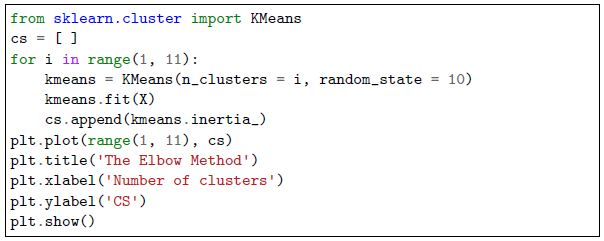
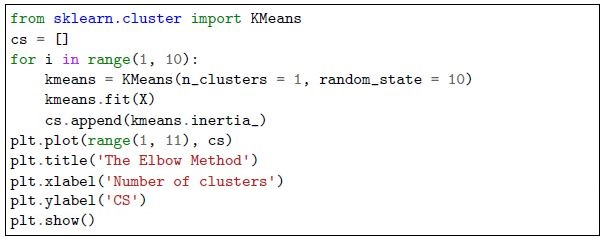
Elbow Method: Plot inertia vs. k to find optimal k.
from sklearn.cluster import KMeans
inertias = []
for k in range(1, 11):
    kmeans = KMeans(n_clusters=k)
    kmeans.fit(X)
    inertias.append(kmeans.inertia_)
plt.plot(range(1, 11), inertias)
Types of Clustering:
- Centroid-based: K-Means.
- Density-based: DBSCAN.
- Connectivity-based: Hierarchical clustering.
Dimensionality Reduction
PCA (Principal Component Analysis):
- Projects data to lower dimensions while preserving variance.
t-SNE:
- Non-linear technique for visualization.
5. Model-Specific Notes
K-Nearest Neighbors (KNN)
- Distance Metrics: Euclidean, Manhattan, Minkowski.
Hyperparameters:
n_neighbors: Number of neighbors to consider.weights:'uniform'or'distance'(closer neighbors have more influence).
- Scaling: Critical (features should be standardized).
Naive Bayes
- GaussianNB: Assumes features follow a normal distribution.
- MultinomialNB: For discrete counts (e.g., text classification).
Text Vectorization
CountVectorizer:
- Converts text to a matrix of token counts.
max_features: Limits vocabulary size.Example:
from sklearn.feature_extraction.text import CountVectorizer
vectorizer = CountVectorizer(max_features=1000)
X = vectorizer.fit_transform(texts)
6. Practical Tips
Overfitting/Underfitting:
Overfitting: High training score, low test score.
- Solutions: Regularization, pruning, cross-validation.
Underfitting: Low training/test scores.
- Solutions: Increase model complexity, add features.
Hyperparameter Tuning:
- Use
GridSearchCVorRandomizedSearchCV. - Log-uniform distributions (e.g.,
loguniform(1e-4, 1e0)) for parameters likealpha.
- Use
Neural Networks:
- Hidden Layer Sizes: Start with a single layer (e.g., 10 neurons), then experiment.
Activation Functions:
- Output layer:
'identity'(regression),'logistic'(binary classification).
- Output layer:
Imbalanced Data:
- Use class weights (
class_weight='balanced') or resampling (SMOTE).
- Use class weights (
7. Python Snippets Cheat Sheet
| Task | Code Snippet |
|---|---|
| Standardize data | StandardScaler().fit_transform(X) |
| Impute missing values | SimpleImputer(strategy='mean').fit_transform(X) |
| Train-test split | train_test_split(X, y, test_size=0.2, random_state=42) |
| Grid search | GridSearchCV(estimator, param_grid, cv=5).fit(X, y) |
| K-Means clustering | KMeans(n_clusters=3).fit(X) |
| Feature selection | SelectKBest(chi2, k=5).fit_transform(X, y) |
| Neural network | MLPClassifier(hidden_layer_sizes=(10,), solver='adam').fit(X, y) |
| Cross-validation | cross_val_score(model, X, y, cv=LeaveOneOut()) |
| One-hot encoding | OneHotEncoder().fit_transform(X[['category']]) |
| Voting classifier | VotingClassifier([('lr', LogisticRegression()), ('svm', SVC())]).fit(X, y) |
8. Common Pitfalls
- Forgetting to scale data for KNN/SVM/neural networks.
- Ignoring class imbalance in classification tasks.
- Using
LabelEncoderfor features (useOneHotEncoderinstead). - Not setting
random_statefor reproducibility. - Overlooking feature importance in tree-based models.
Misinterpreting
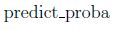
predictvs.predict_proba:predict: Returns class labels.predict_proba: Returns class probabilities.
Graph 2: Supervised Learning Algorithms
Graph 3: Model Evaluation
Graph 4: Unsupervised Learning
Graph 5: Neural Networks
Key Equations Summary
| Concept | Equation |
|---|---|
| Standardization | |
| MinMax Scaling | |
| R² Score | |
| RMSE | |
| Ridge Loss | |
| Lasso Loss | |
| Logistic Regression | , where |
| Neural Network Parameters | |
| K-Means Inertia | |
| Decision Tree Entropy |