Home / Past papers / MLP End Term / this paper
IIT M FOUNDATION ET1 EXAM QPF1 S1 03 Sep - 03 Sep 2023
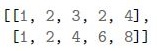
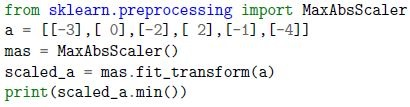 What will be the output of the following code:
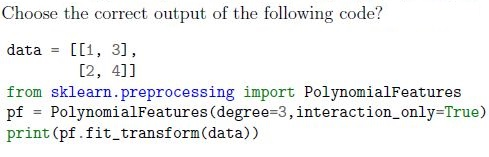
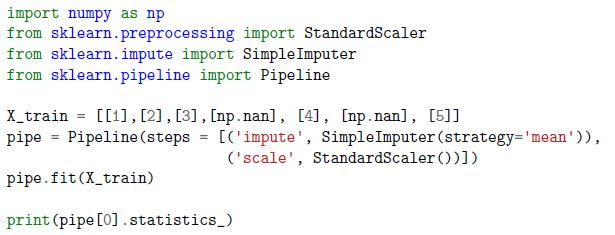 What will be the numerical value in the output array of the following code:
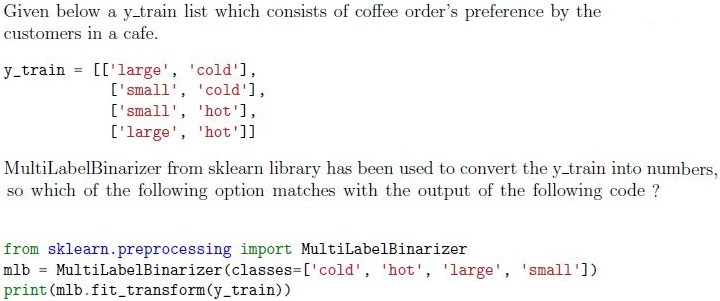




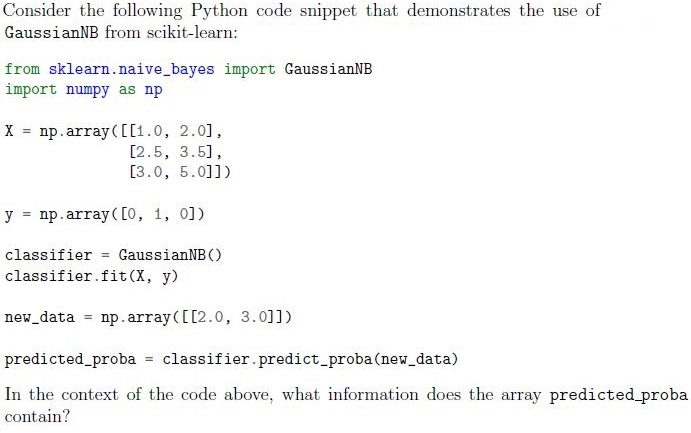
- The predicted classes for the new data points.
- The decision boundary values for the classes.
- The posterior probabilities of the classes for the new data points.
- The likelihood estimates for the new data points.
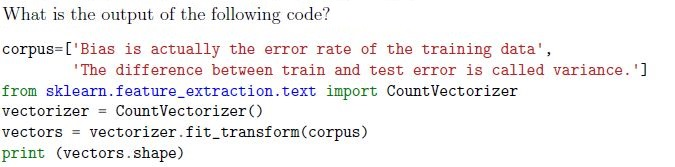
- (15,2)
- (2,3)
- (2,15)
- (15,3)
- Linear Regression
- Decision Tree
- K-means Clustering
- Support Vector Machine
- Complete Linkage
- Ward’s Linkage
- Single Linkage
- Average Linkage
- Distribution-based Clustering
- Density-based Clustering
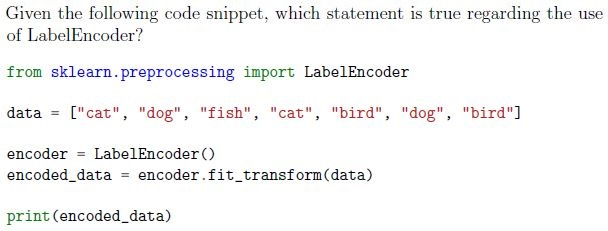





- MultinomialNB
- RandomForestRegressor
- LogisticRegressor
- SGDRegressor
- It is a technique used to minimize the adjusted loss function and avoidunderfitting.
- It helps in increasing the bias of the training model.
- It determines the rows to be selected as a training dataset.
- Elastic net regularization is a combination of L1 and L2 regularization both.
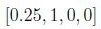
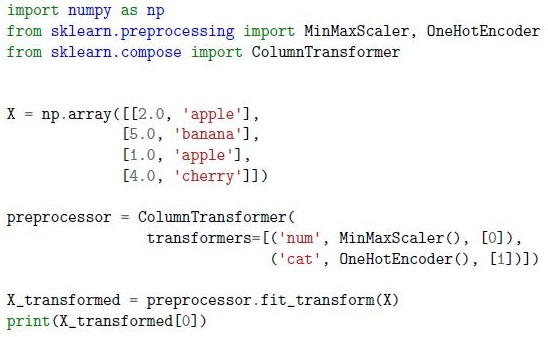 Given the following code snippet that preprocesses a dataset with both continuous and categorical features using sklearn.preprocessing tools, what will be the first row of the X transformed array after preprocessing?


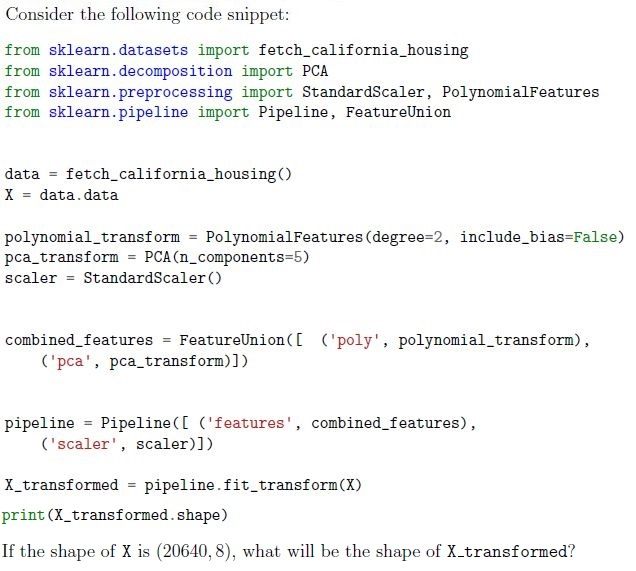
- (20640, 8)
- (20640, 5)
- (20640, 44)
- (20640, 49)
- Predict the mean or median of the target variable for all instances.
- Fit a complex mathematical function to the data.
- Randomly shuffle the target variable values to make predictions.
- Predict the sum of the input features for each instance.
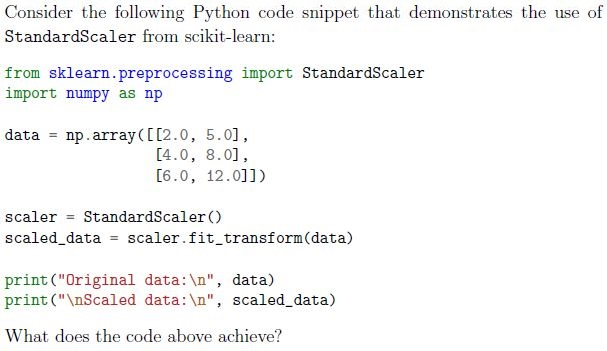
- It converts the numerical values in the data array to categorical labels.
- It standardizes the features in the data array to have zero mean and unitvariance.
- It applies a logarithmic transformation to the values in the data array.
- It removes the mean and scales the features in the data array to a specificrange.
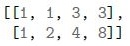


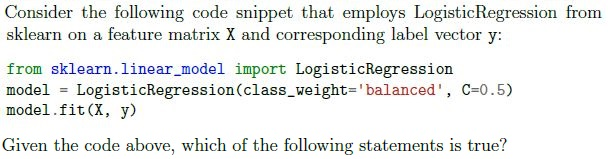





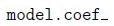



- Newton-CG
- SGD
- LBFGS
- Liblinear

- Increasing the number of neurons in hidden layers will always lead to bettermodel performance.
- Decreasing the number of neurons in hidden layers reduces the model’scapacity to capture complex patterns.
- The number of neurons in hidden layers does not significantly affect themodel’s performance.
- Finding the optimal number of neurons is a trial-and-error process and mayrequire experimentation.
- Number of hidden layers
- Number of neurons in input layer
- Learning rate
- Activation function
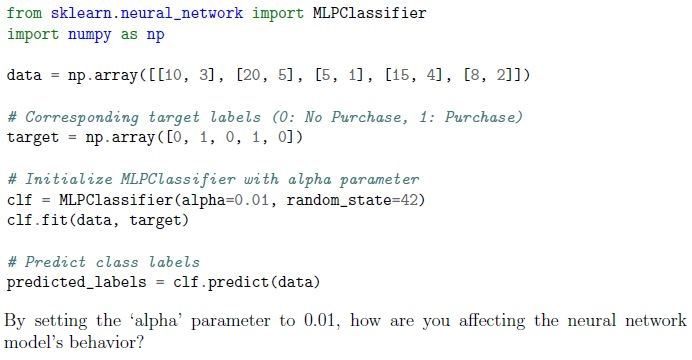 You’re working on a binary classification task using the ‘MLPClassifier’ to predict whether a customer will make a purchase based on their browsing behavior.You’re concerned about overfitting due to the complexity of the model. You decide to increase the ‘alpha’ parameter to control overfitting. The following code snippet shows the application of ‘MLPClassifier’:
- Increasing the model’s complexity to fit the training data more closely.
- Adding a stronger regularization term to the loss function, discouragingcomplex models.
- Making the model more sensitive to outliers and noise in the data.
- Adjusting the learning rate to control convergence speed.
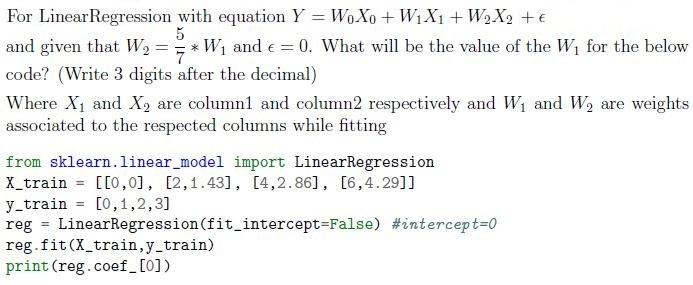
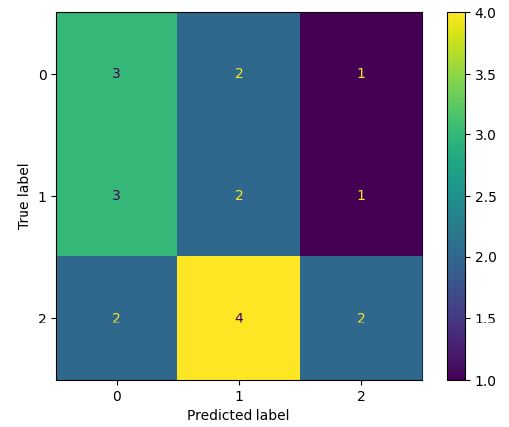 Using the confusion matrix given below. What is the precision score for the label (class) 1 ?
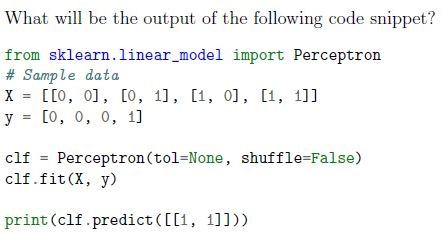
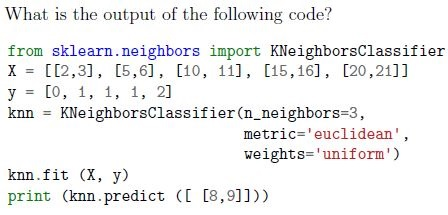
- KNeighborsClassifier with low values of n_neighbors produces complexdecision boundaries.
- KNeighborsClassifier with low values of n_neighbors produces smoothdecision boundaries.
- In KNeighborsClassifier the scale of the features(columns) can impact thedecision boundaries.
- None of these
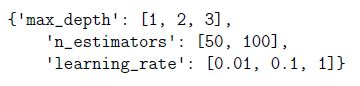
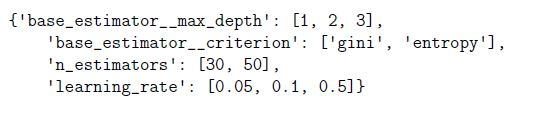
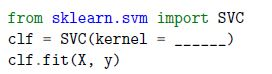 Fill in the missing parameter value in the following estimator that can be used to classify the data
- ‘lasso’
- ‘linear’,
- ‘rbf’,
- ‘scale’
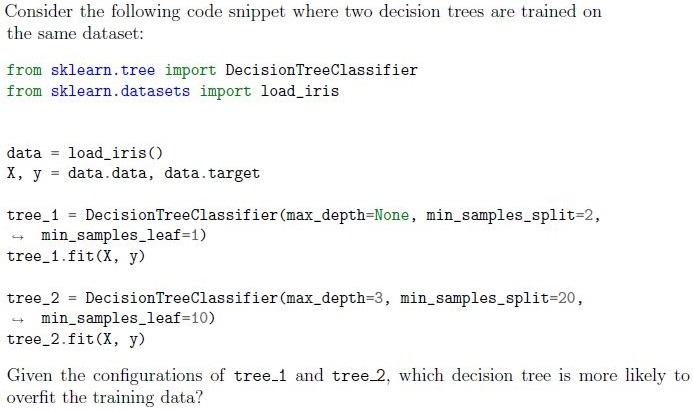


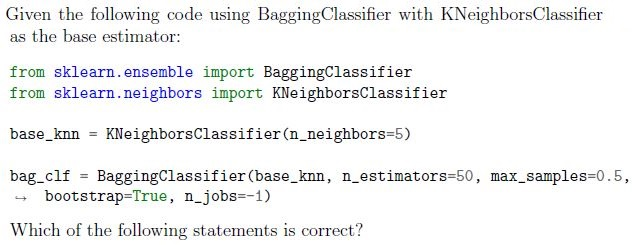














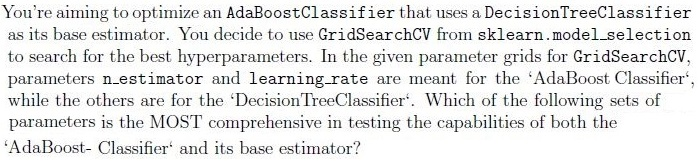


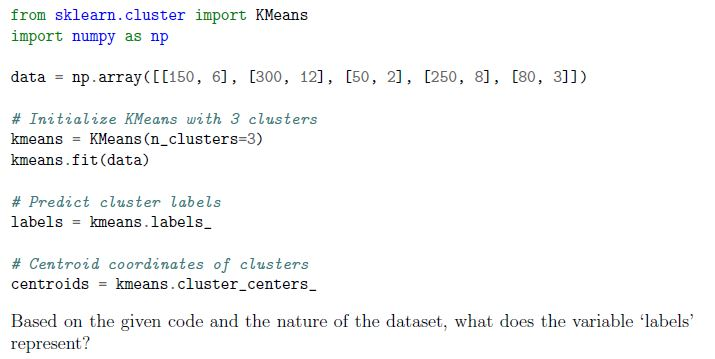 You’re working with a dataset of customer purchase behavior, including attributes “Total Amount Spent” and “Number of Items Purchased.” You decide to use K-means clustering to segment customers into groups based on these features. The following code snippet demonstrates the K-means clustering process:
- The total amount spent by each customer.
- The cluster assignments indicating which group each customer belongs to.
- The number of items purchased by each customer.
- The centroid coordinates of the clusters formed.
Answer key
- Q1 (SA, 2 marks): -1
- Q2 (SA, 2 marks): 3
- Q3 (MCQ, 2 marks): A
- Q4 (MCQ, 2 marks): C
- Q5 (MCQ, 2 marks): C
- Q6 (MCQ, 2 marks): C
- Q7 (MCQ, 2 marks): A
- Q8 (MCQ, 2 marks): A
- Q9 (MSQ, 3 marks): A, D
- Q10 (MSQ, 3 marks): A, D
- Q11 (MSQ, 3 marks): B, D
- Q12 (MCQ, 3 marks): A
- Q13 (MCQ, 3 marks): D
- Q14 (MCQ, 3 marks): A
- Q15 (MCQ, 3 marks): B
- Q16 (MCQ, 3 marks): B
- Q17 (MCQ, 3 marks): D
- Q18 (MCQ, 3 marks): A
- Q19 (MCQ, 3 marks): D
- Q20 (MCQ, 3 marks): D
- Q21 (MCQ, 3 marks): D
- Q22 (MCQ, 3 marks): B
- Q23 (SA, 3 marks): 0.327 to 0.333
- Q24 (SA, 3 marks): 0.25
- Q25 (SA, 3 marks): 1
- Q26 (SA, 3 marks): 1
- Q27 (MSQ, 4 marks): A, C
- Q28 (MSQ, 2 marks): B, C
- Q29 (MCQ, 4 marks): A
- Q30 (MCQ, 4 marks): C
- Q31 (MCQ, 4 marks): C
- Q32 (MCQ, 4 marks): A
- Q33 (MCQ, 4 marks): D
- Q34 (MCQ, 4 marks): B
Concepts this paper tests
Auto-generated summary from the source site. Handy as a checklist; the lessons above explain each idea from scratch.
Here’s a structured summary of the core topics, concepts, principles, and equations essential for the Diploma Level: Machine Learning Practice (Computer-Based Exam). The summary is organized by topic domains and includes key equations where applicable.
1. Data Preprocessing
Key Concepts
Scaling/Normalization:
StandardScaler: Standardizes features to have mean = 0 and variance = 1.
- Formula:
where = mean, = standard deviation.
MaxAbsScaler: Scales features by their maximum absolute value (range: ).
- Formula:
MinMaxScaler: Scales features to a specified range (default: ).
- Formula:
Encoding Categorical Data:
- LabelEncoder: Converts categorical labels to numerical values (e.g.,
["cat", "dog"]→[0, 1]). - OneHotEncoder: Converts categorical features into a binary matrix (one-hot encoding).
- MultiLabelBinarizer: Converts multi-label categorical data into a binary matrix (e.g.,
["large", "cold"]→[1, 0, 1, 0]).
- LabelEncoder: Converts categorical labels to numerical values (e.g.,
Handling Missing Data:
SimpleImputer: Replaces missing values with mean, median, or mode.
- Example:
strategy='mean'replacesNaNwith the column mean.
- Example:
Polynomial Features:
PolynomialFeatures: Generates polynomial/interaction features (e.g., ).
- Parameter:
degree=n(max polynomial degree). - Parameter:
interaction_only=True(only interaction terms, no higher-order polynomials).
- Parameter:
Feature Union & Pipelines:
- FeatureUnion: Combines multiple feature transformations (e.g., scaling + polynomial features).
- Pipeline: Sequentially applies transformations and estimators (e.g., impute → scale → model).
2. Dimensionality Reduction
Key Concepts
PCA (Principal Component Analysis):
- Reduces dimensionality by projecting data onto principal components (orthogonal axes of max variance).
- Parameter:
n_components=k(number of principal components to keep). - Explained variance ratio: Indicates how much variance each PC captures.
3. Supervised Learning
Key Algorithms & Concepts
A. Linear Models
Linear Regression:
- Equation:
- Ordinary Least Squares (OLS): Minimizes sum of squared residuals.
Ridge (L2) & Lasso (L1) Regularization:
- Ridge: Penalizes large coefficients ( norm).
- Lasso: Penalizes coefficients to sparsity ( norm).
- Elastic Net: Combines and .
Logistic Regression:
- Sigmoid function:
- Regularization:
C(inverse of ) controls strength. Solvers:
liblinear: Good for small datasets, supports .lbfgs: Default, fast for large datasets (only ).sgd: Stochastic Gradient Descent (supports partial_fit).
B. Naive Bayes
GaussianNB: Assumes features follow a normal distribution.
- Predicts posterior probabilities .
- Uses Bayes' Theorem:
C. Support Vector Machines (SVM)
SVC (Support Vector Classifier):
Kernel Trick: Maps data to higher dimensions for linear separation.
- Kernels:
linear,rbf(Gaussian),poly,sigmoid.
- Kernels:
- Regularization:
Ccontrols margin hardness.
D. Decision Trees & Ensembles
DecisionTreeClassifier:
Splitting Criteria:
- Gini Impurity:
- Entropy:
Hyperparameters:
max_depth: Limits tree depth.min_samples_split: Min samples required to split a node.min_samples_leaf: Min samples required in a leaf.
Random Forest:
- Bagging (Bootstrap Aggregating): Trains multiple trees on random subsets of data/features.
Hyperparameters:
n_estimators: Number of trees.max_features: Features considered for splitting (default:sqrt(n_features)).bootstrap: Whether to use bootstrapping.
AdaBoost:
- Boosting: Sequentially trains weak learners (e.g., shallow trees), weighting misclassified samples higher.
Hyperparameters:
n_estimators: Number of weak learners.learning_rate: Shrinks contribution of each tree.
Gradient Boosting (GBM, XGBoost, LightGBM):
- Boosting: Builds trees to correct errors of previous trees.
Hyperparameters:
learning_rate: Step size shrinkage.n_estimators: Number of boosting stages.
E. Neural Networks (MLP)
MLPClassifier (Multi-Layer Perceptron):
Architecture:
- Input layer → Hidden layers (with activation functions) → Output layer.
Activation Functions:
- ReLU:
- Sigmoid:
- Tanh:
Hyperparameters:
hidden_layer_sizes: Number of neurons per layer (e.g.,(100, 50)).alpha: regularization strength.activation:relu,tanh,logistic.
Overfitting Control:
- Increase
alpha(regularization). - Reduce
hidden_layer_sizes.
- Increase
F. k-Nearest Neighbors (k-NN)
KNeighborsClassifier:
- Distance Metrics:
euclidean,manhattan,minkowski. Hyperparameters:
n_neighbors: Number of neighbors to consider.weights:uniform(all neighbors equal) ordistance(weight by inverse distance).
Decision Boundary:
- Low
n_neighbors→ complex boundaries (prone to overfitting). - High
n_neighbors→ smooth boundaries (prone to underfitting).
- Low
- Distance Metrics:
G. Perceptron
- Linear classifier for binary classification.
- Update Rule:
where = learning rate.
4. Unsupervised Learning
Key Algorithms
A. Clustering
K-Means:
- Objective: Minimize within-cluster sum of squares (WCSS).
Steps:
- Initialize centroids randomly.
- Assign points to nearest centroid.
- Update centroids as mean of assigned points.
- Repeat until convergence.
Hyperparameters:
n_clusters: Number of clusters ().- Elbow Method: Plot WCSS vs. to find optimal .
Hierarchical Clustering:
Linkage Methods:
- Single Linkage: Min distance between clusters.
- Complete Linkage: Max distance between clusters.
- Average Linkage: Average distance between clusters.
- Ward’s Linkage: Minimizes variance when merging clusters.
DBSCAN (Density-Based):
- Groups points based on density.
Hyperparameters:
eps: Max distance between points to be considered neighbors.min_samples: Min points to form a dense region.
B. Dimensionality Reduction
PCA (Principal Component Analysis):
- Transforms data into orthogonal components ordered by variance.
- Explained Variance Ratio: Proportion of variance explained by each PC.
5. Model Evaluation & Metrics
Key Concepts
- Confusion Matrix: | | Predicted Positive | Predicted Negative | |---------------|--------------------|--------------------| | Actual Positive | True Positive (TP) | False Negative (FN) | | Actual Negative | False Positive (FP) | True Negative (TN) |
Classification Metrics:
- Accuracy:
- Precision (for class 1):
- Recall (Sensitivity):
- F1-Score:
Regression Metrics:
- Mean Squared Error (MSE):
- R² Score:
where , .
Bias-Variance Tradeoff:
- Underfitting (High Bias): Model is too simple.
- Overfitting (High Variance): Model is too complex.
- Regularization: Reduces variance by penalizing complexity.
6. Hyperparameter Tuning
Key Methods
GridSearchCV:
- Exhaustively searches over a parameter grid.
- Uses cross-validation to evaluate performance.
RandomizedSearchCV:
- Samples random combinations from a parameter distribution.
- More efficient than
GridSearchCVfor large spaces.
7. Incremental Learning
Key Concepts
Partial Fit:
- Allows models to be trained incrementally (useful for large datasets).
Supported by:
SGDClassifier/SGDRegressorPassiveAggressiveClassifierPerceptronMultinomialNB/BernoulliNB
8. Ensemble Methods
Key Concepts
Bagging (Bootstrap Aggregating):
- Trains multiple models on random subsets of data.
- Reduces variance (e.g.,
RandomForest,BaggingClassifier).
Boosting:
- Sequentially trains models to correct errors of previous models.
- Reduces bias (e.g.,
AdaBoost,GradientBoosting).
Stacking:
- Combines multiple models using another model (meta-learner).
9. Text Feature Extraction
Key Methods
CountVectorizer:
- Converts text into a matrix of token counts.
TF-IDF (Term Frequency-Inverse Document Frequency):
- Weights terms by importance in a document relative to a corpus.
- Formula:
where:
- = Term frequency in document .
- = Total number of documents.
- = Number of documents containing term .
10. Model Interpretation
Key Concepts
Feature Importance:
- Decision Trees/Random Forest: Based on Gini/entropy reduction.
- Linear Models: Coefficients indicate feature impact.
- SHAP Values: Explain individual predictions by approximating Shapley values from game theory.