Home / Past papers / MLP Quiz 2 / this paper
IIT M DIPLOMA AN EXAM QDD4 01 Dec 2024 - 01 Dec 2024
Elapsed 00:00



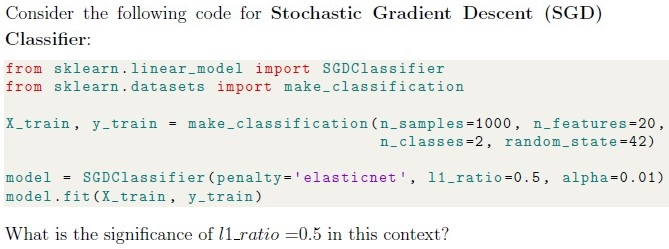
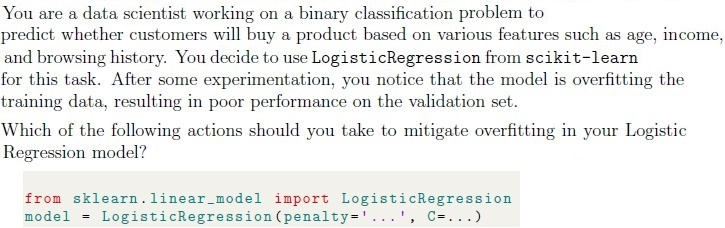
- It assigns equal weightage to L1 and L2 regularizations.
- It applies only L2 regularization.
- It applies only L1 regularization.
- It disables regularization completely.




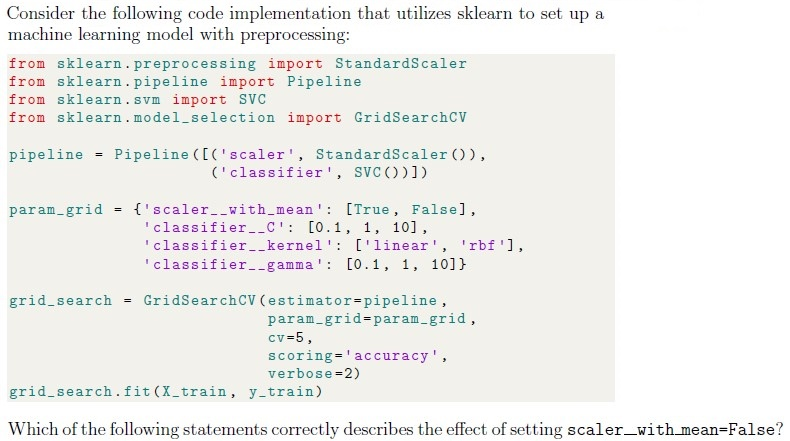
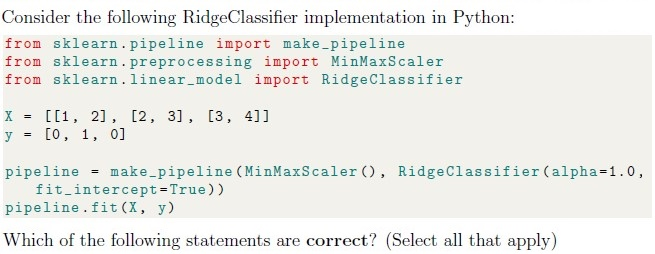
- The data will be standardized without centering, preserving the mean of thedataset.
- The data will be centered but not scaled, leading to variance issues.
- The parameter has no effect; the data will always be centered regardless ofthis setting.
- The scaling operation will be disabled entirely, leaving the data unchanged.








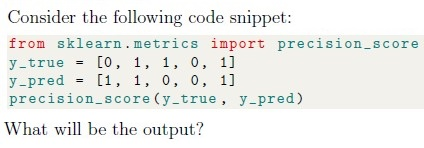
- 0.75
- 0.80
- 0.50
- 0.67

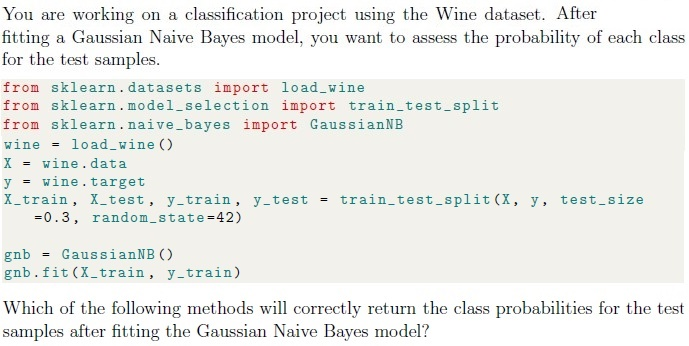
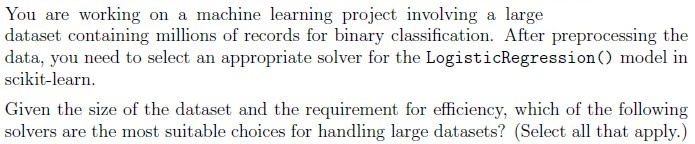
- LogisticRegression
- Perceptron
- RidgeClassifier
- Support Vector Machine (SVM)
- LassoClassifer





- The boundaries become more complex and tightly fitted to the training data.
- The boundaries become more regular and smooth.
- Decision boundaries are unaffected by C.
- The number of support vectors decreases.
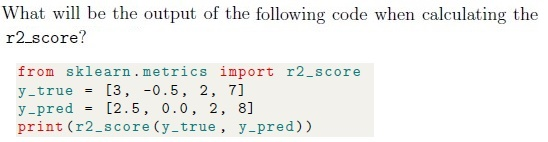
- 0.99
- 0.87
- 0.95
- 0.80



- It defines the tolerance for stopping criteria.
- It defines the learning rate schedule.
- It controls regularization strength.
- It controls the number of iterations.

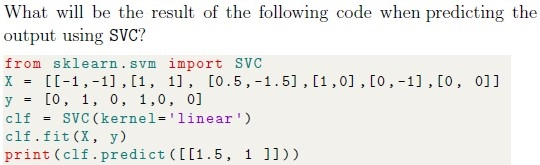
- ’linear’
- ’quadratic’
- ’rbf’
- ’sigmoid’











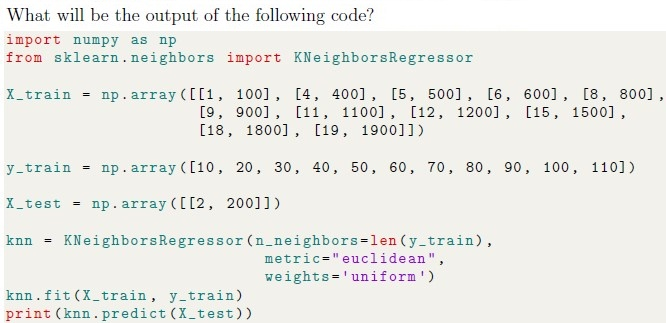
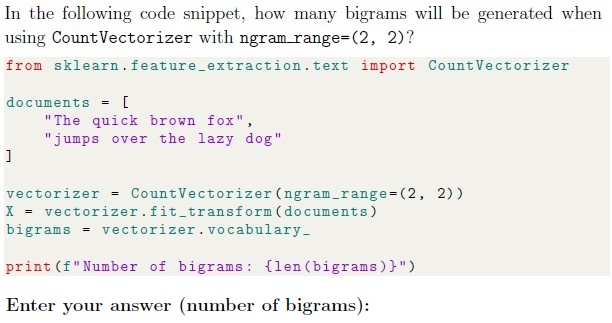
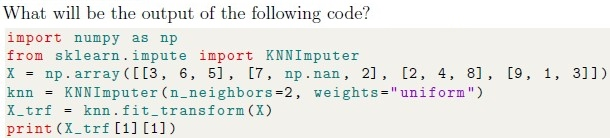
Answer key
- Q1 (MCQ, 3 marks): E
- Q2 (MCQ, 3 marks): A
- Q3 (MCQ, 3 marks): A
- Q4 (MCQ, 3 marks): A
- Q5 (MCQ, 2 marks): B
- Q6 (MCQ, 2 marks): B
- Q7 (MCQ, 2 marks): D
- Q8 (MCQ, 2 marks): C
- Q9 (MCQ, 2 marks): B
- Q10 (MCQ, 2 marks): A
- Q11 (MCQ, 2 marks): C
- Q12 (MCQ, 2 marks): A
- Q13 (MCQ, 2 marks): A
- Q14 (MSQ, 2 marks): A, C, D
- Q15 (MSQ, 2 marks): B, C, D
- Q16 (MSQ, 2 marks): A, C, D
- Q17 (MSQ, 3 marks): A, B
- Q18 (SA, 3 marks): 0.012 to 0.022
- Q19 (SA, 3 marks): 60
- Q20 (SA, 3 marks): 7
- Q21 (SA, 2 marks): 3.5
Concepts this paper tests
Auto-generated summary from the source site. Handy as a checklist; the lessons above explain each idea from scratch.
Summary of Core Topics, Concepts, Principles, and Equations
Core Topics and Concepts
Machine Learning Models and Algorithms
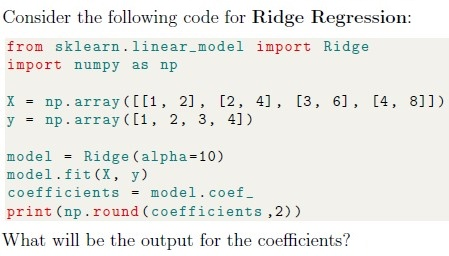
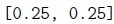
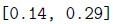
- Ridge Regression: A linear regression technique with L2 regularization.
- Stochastic Gradient Descent (SGD): An optimization algorithm for training linear models.
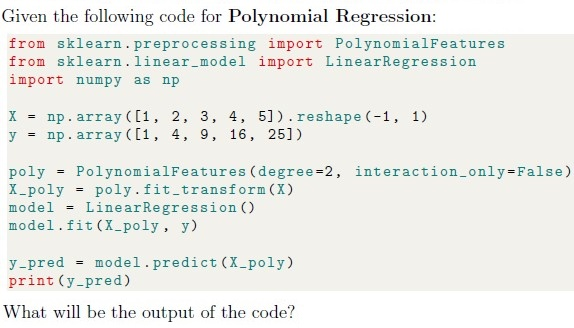
- Polynomial Regression: Extending linear regression by adding polynomial terms.
- Support Vector Machines (SVM): Supervised learning models for classification and regression.
- Logistic Regression: A classification algorithm for binary and multiclass problems.
- K-Nearest Neighbors (KNN): A non-parametric method used for classification and regression.
- Gaussian Naive Bayes: A probabilistic classifier based on Bayes' theorem.
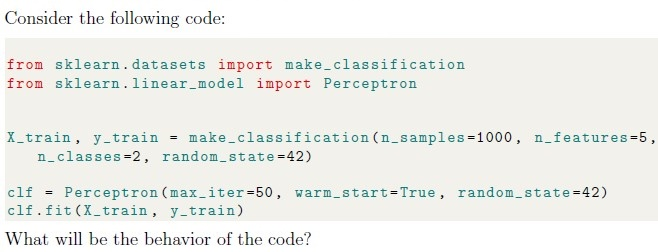
- Perceptron: A linear classifier for binary classification.
- KNN Imputation: A method to handle missing values using KNN.
Model Evaluation and Metrics
- Mean Squared Error (MSE): A common metric for regression models.
- R² Score: A statistical measure of how well the regression predictions approximate the real data points.
- Precision Score: A metric for classification models, indicating the ratio of correctly predicted positive observations to the total predicted positives.
Data Preprocessing and Feature Engineering
- StandardScaler: Standardizes features by removing the mean and scaling to unit variance.
- Polynomial Features: Generates polynomial and interaction features.
- CountVectorizer: Converts a collection of text documents to a matrix of token counts.
- KNN Imputation: Imputes missing values using the K-Nearest Neighbors algorithm.
Hyperparameter Tuning and Model Selection
- GridSearchCV: Exhaustive search over specified parameter values for a model.
- Regularization Parameters: Parameters like
alphain Ridge Regression andCin SVM that control the strength of regularization.
Model Interpretation and Analysis
- Coefficients in Linear Models: Interpretation of model coefficients in linear regression and classification models.
- Decision Boundaries: Understanding how decision boundaries change with different parameters in SVM.
Important Equations
- Ridge Regression Cost Function:
where is the regularization parameter.
- Mean Squared Error (MSE):
- R² Score:
where SSR is the sum of squares of residuals and SST is the total sum of squares.
- Precision Score:
- Polynomial Features:
generates features of degree up to .
- KNN Imputation:
imputes missing values based on the nearest neighbors.