Home / Past papers / MLP Quiz 1 / this paper
IIT M QUIZ 1 FOUNDATION DAD DIPLOMA QPD1 16 Oct 2022 - 16 Oct 2022
Elapsed 00:00
- YES
- NO
The violin plot shown in Figure 2 demonstrates the age of passengers on the Titanic ship. Mark the approximate age range of most of the passengers.
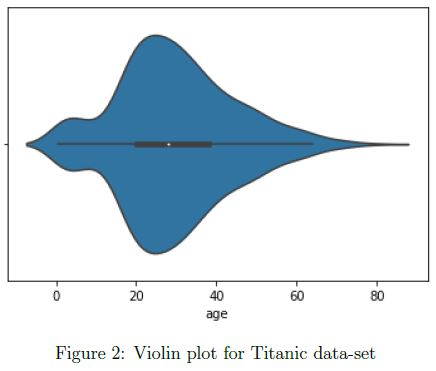 The violin plot shown in Figure 2 demonstrates the age of passengers on the Titanic ship. Mark the approximate age range of most of the passengers.
 - 20 - 40
- 80 above
- Less than 20
- 40-60
Which of the following Sklearn objects can help you to reduce, expand or generate feature representations?
- Estimator
- Predictor
- Transformer
- None of these
What will be the output of the following code?
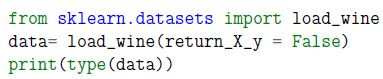 What will be the output of the following code?



Go through the code snippet given below:
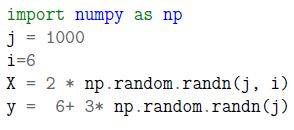 Go through the code snippet given below: What will be the shape of the feature matrix (X.shape) and the label vector (y.shape)?
- (2000, 12) and (1000, 6)
- (1, 1000) and (1,1000)
- (599, 1) and (699, 1)
- (1000, 6) and (1000,)
Which of the following options is likely to be the correct output of the code snippet given below?
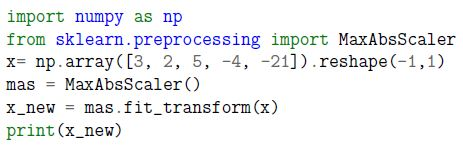 Which of the following options is likely to be the correct output of the code snippet given below?



In the figure 1, what are the names of classes arranged in the increasing order of the median values?
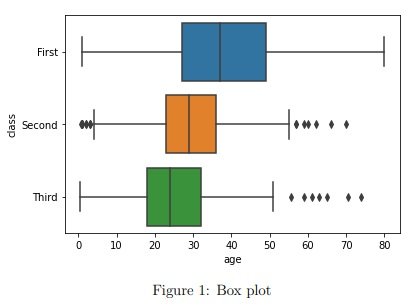 In the figure 1, what are the names of classes arranged in the increasing order of the median values?
 - First < Second < Third
- Third < Second < First
- Second < Third < First
- Third < First < Second
Go through the code snippet given below and mark the correct output.
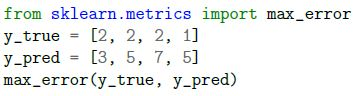 Go through the code snippet given below and mark the correct output.
 - 1
- 3
- 9
- 25
- 4
- 5
Which of the following is likely to be the correct output of the code given below?
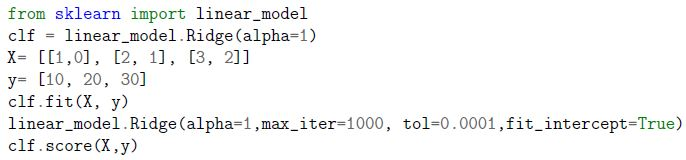 Which of the following is likely to be the correct output of the code given below?
 - 12
- 29
- No evaluation metrics are mentioned, hence it will produce an error
- 0.96
Which of the following is likely to be the correct output of the code given below?
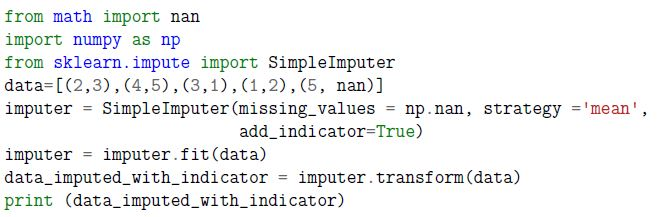 Which of the following is likely to be the correct output of the code given below?



Consider the following code snippet:
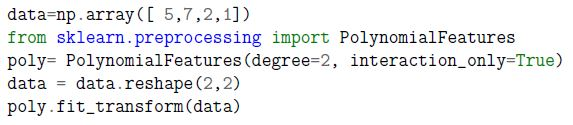 Consider the following code snippet: Which of the following could be the correct output?



Which of the following options will be the correct output of print(clf.coef_)?
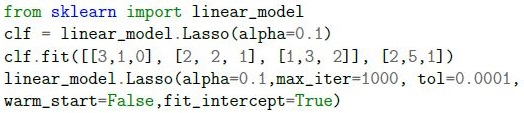 Which of the following options will be the correct output of print(clf.coef_)?
 - [ 0.35 -0. -0. ]
- [-0.85,0]
- [3,2,1,2]
- Given code block will return an error.
Go through the code snippet given below and mark the correct output.
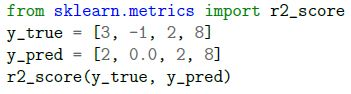 Go through the code snippet given below and mark the correct output.
 - 0.61
- 0.83
- 0.95
- 1
- -0.6
- 5
Which of the following is likely to be the correct output of the code given below?
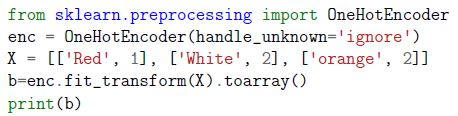 Which of the following is likely to be the correct output of the code given below?



Which of the following code blocks will correctly take the learning rate as‘optimal’ ?



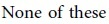
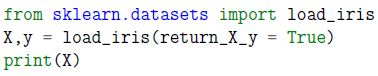
Which of the following code blocks will correctly return an array of feature variables?



Scikit-Learn’s API is remarkably well designed. The main design principles are:-
- Nonproliferation of classes
- Sensible defaults
- Consistency
- Proportion
Go through the code block given below:
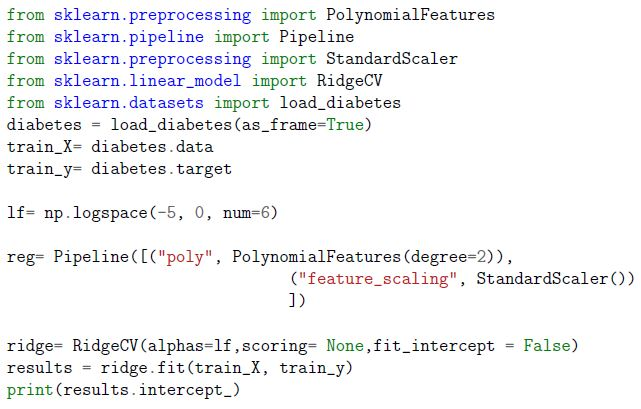 Go through the code block given below: Which of the following can’t be the correct output of the given code block?
- 0.0
- 0.01
- 0.1
- 1
Enter the correct output of the following code block.
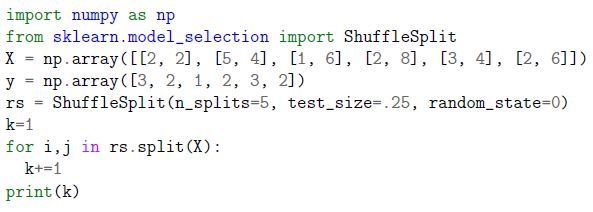 Enter the correct output of the following code block.
 Comprehension passage - the questions below it refer to this
Go through the code snippet given below and answer the given subquestions.
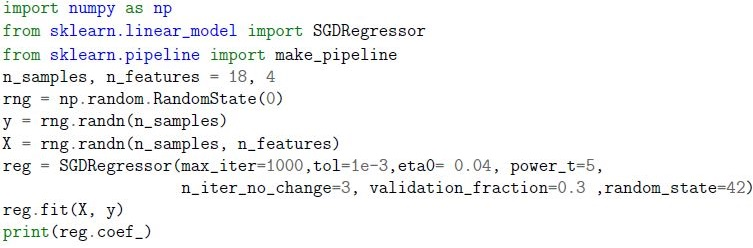 Go through the code snippet given below and answer the given subquestions.
Which of the following options will be the output of the given code?
- [-0.02634908 0.01189399 0.0917284 0.08966849]
- array([-0.22622766, -0.00582008, -0.1820344 , 0.03518086, -0.14490955])
- array([-0.22622766, -0.00582008, -0.1820344 ])
- Given code will return an error because the data set is not given
Which of the following could be the possible output of print(reg.score())?
- -0.528
- 1
- 0.528
- Given code will return an error
Answer key
- Q1 (MCQ, 0 marks): A
- Q2 (MCQ, 1 marks): A
- Q3 (MCQ, 2 marks): C
- Q4 (MCQ, 2 marks): A
- Q5 (MCQ, 2 marks): D
- Q6 (MCQ, 2 marks): A
- Q7 (MCQ, 2 marks): B
- Q8 (MCQ, 2 marks): F
- Q9 (MCQ, 2 marks): D
- Q10 (MCQ, 3 marks): B
- Q11 (MCQ, 3 marks): A
- Q12 (MCQ, 3 marks): A
- Q13 (MCQ, 3 marks): C
- Q14 (MCQ, 3 marks): D
- Q15 (MCQ, 3 marks): A
- Q16 (MSQ, 2 marks): B, D
- Q17 (MSQ, 3 marks): A, B, C
- Q18 (MSQ, 3 marks): B, C, D
- Q19 (SA, 3 marks): 6
- Q20 (MCQ, 3 marks): A
- Q21 (MCQ, 3 marks): D
Concepts this paper tests
Auto-generated summary from the source site. Handy as a checklist; the lessons above explain each idea from scratch.
Summary of Core Topics, Concepts, Principles, and Equations
1. Machine Learning Algorithms
- Clustering Algorithms: K-means clustering
- Regression Algorithms: Linear regression, Logistic regression, Ridge regression, Lasso regression
- Classification Algorithms: SGDRegressor, LassoCV
2. Data Preprocessing
- Scaling: MaxAbsScaler, MinMaxScaler
- Imputation: SimpleImputer
- Encoding: OneHotEncoder
- Polynomial Features: PolynomialFeatures
3. Model Evaluation
- Metrics: Mean Squared Error (MSE), R² Score
- Cross-Validation: LassoCV
4. Data Splitting
- Train-Test Split: train_test_split
- Shuffle Split: ShuffleSplit
5. Data Generation
- Datasets: make_classification, load_iris, load_wine, load_diabetes
6. Scikit-Learn API Design Principles
- Nonproliferation of classes
- Consistency
7. Equations
- Mean Squared Error (MSE):
- R² Score:
- Ridge Regression:
- Lasso Regression:
Graph 1: Machine Learning Algorithms
Graph 2: Data Preprocessing
Graph 3: Model Evaluation
Graph 4: Data Splitting
Graph 5: Data Generation
Graph 6: Scikit-Learn API Design Principles
These graphs and summaries should help you understand the core topics and their relationships, which are essential for the exam.