Home / Past papers / MLF End Term / this paper
IIT M DIPLOMA AN EXAM QDD4 31 Aug - 31 Aug 2025
Elapsed 00:00





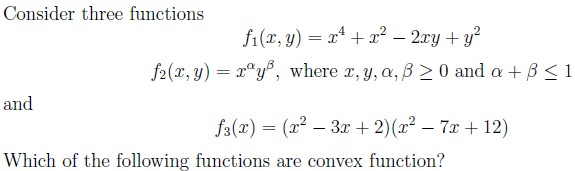









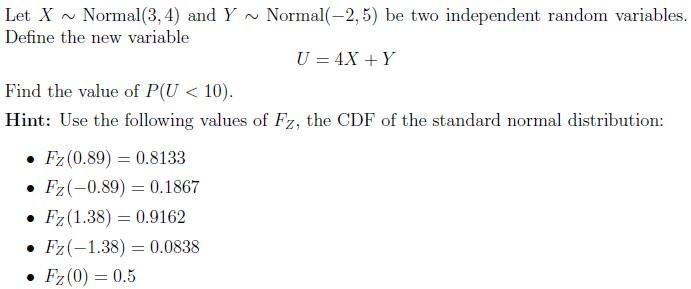
Comprehension passage - the questions below it refer to this

Let A = (x, y) be a point in the set S which is closest to the origin. Choose the correct Primal optimization problem from the following.




Which of the following options is/are true?





If A = (x, y) is the closest point to the origin, then find the value of 3x − y.
Which of the following options is/are true ?
- S is a convex set.
- The objective function of the Primal optimization problem from the previousquestion number no 9 is a convex function.
- The objective function of the Primal optimization problem from the previousquestion number no 9 is a concave function.
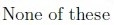
- None of these
Comprehension passage - the questions below it refer to this
Based on the above data, answer the given subquestions.
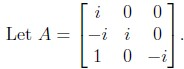

Which of the following options is /are true?
- A is not a Hermitian matrix.
- A is not a unitary matrix.
- A is diagonalizable.
- None of these
Answer key
- Q1 (MCQ, 3 marks): A
- Q2 (MSQ, 4 marks): A, C
- Q3 (MSQ, 3 marks): A, D
- Q4 (SA, 4 marks): 24
- Q5 (SA, 4 marks): 0.31 to 0.37
- Q6 (SA, 4 marks): 0.02 to 0.06
- Q7 (SA, 3 marks): 0.5
- Q8 (MCQ, 2 marks): B
- Q9 (MSQ, 2 marks): B, C
- Q10 (SA, 3 marks): 7.8
- Q11 (MSQ, 2 marks): A, B
- Q12 (SA, 3 marks): -125
- Q13 (MSQ, 3 marks): A, B
Concepts this paper tests
Auto-generated summary from the source site. Handy as a checklist; the lessons above explain each idea from scratch.
Here’s a structured summary of core topics, concepts, principles, and equations essential for the exam, followed by Mermaid knowledge graphs to visualize relationships.
Core Topics & Key Concepts
1. Probability & Statistics
Markov’s Inequality: For a non-negative random variable , .
- Applied to : .
Chebyshev’s Inequality: For any random variable with mean and variance , .
- For : (from variance ).
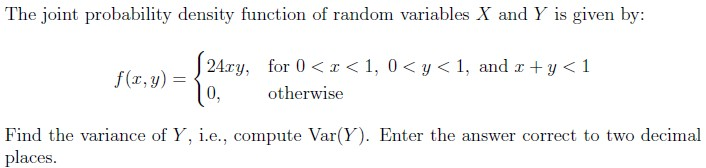
Joint Probability Density Function (PDF):
- Compute marginal/conditional PDFs, expectations, and variances.
- Example: for over , .
Normal Distribution:
- Linear combinations of independent normals: where , . .
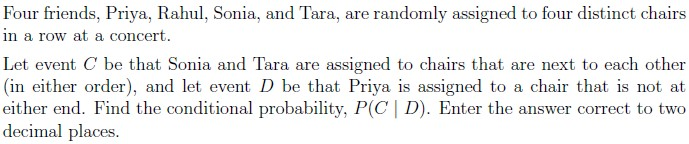
Conditional Probability:
- .
- Example: 4 friends seated randomly; compute .
2. Linear Algebra
Vector Spaces & Span:
- Projection of onto : .
- Orthogonality: if .
Eigenvalues & Matrices:
- Eigenvalues of : If has eigenvalues , then has eigenvalues .
- Hermitian Matrix: (conjugate transpose).
- Unitary Matrix: .
- Diagonalizable: has linearly independent eigenvectors.
3. Optimization & Convexity
Convex Functions:
- is convex if (1D) or Hessian (multivariate).
Examples:
- (convex; Hessian positive semidefinite).
- (convex in ).
Constrained Optimization:
- Primal Problem: Minimize subject to linear constraints.
- Lagrangian: .
- KKT Conditions: , , (complementary slackness).
Convex Sets:
- is convex (intersection of half-spaces).
4. Calculus & Algebra
Quadratic Forms:
- Cost function .
- Minimize under constraint : Use substitution or Lagrange multipliers.
Polynomial Factorization:
- . Convexity analyzed via second derivative.
Key Equations
| Topic | Equation |
|---|---|
| Markov’s Inequality | |
| Chebyshev’s Inequality | |
| Projection | |
| Normal Linear Combo | |
| Lagrangian | |
| KKT Conditions | , |
| Variance of Joint PDF | |
| Conditional Probability |
2. Linear Algebra
3. Optimization & Convexity
4. Calculus & Algebra
Exam Tips
- Probability: Focus on inequalities (Markov/Chebyshev) and normal distributions.
- Linear Algebra: Master projections, orthogonality, and eigenvalue problems.
- Optimization: Understand convexity, Lagrangians, and KKT conditions.
- Calculus: Practice constrained optimization and polynomial analysis.
- Mermaid Graphs: Use them to visualize relationships between concepts.