Home / Past papers / MLF End Term / this paper
IIT M FOUNDATION DIPLOMA FN EXAM - 01 Sep 2024





- A circular park with one side boundary is a circle of radius of 200 meters andanother side boundary is a circle of radius of 300 meters, both centered at the origin.
- City district defined by the region above the x-axis within a radius of 10 milesfrom the origin, forming a semicircle.
- A triangular region with vertices at (0, 0), (1, 0), and (0, 1).
- A path consisting of two connected line segments (forming the boundaries ofthe path on either sides) formed a “V” shape with vertices at (0, 0), (2, 2), and (2, 0)




- Matrix A is symmetric matrix.
- Matrix A is Hermitian matrix.
- 1 + i is an eigenvalue of A.
- 2 − i is an eigenvalue of A.
- Matrix A is diagonalizable.


- PCA will transform the original data set onto a lower dimension subspace suchthat the variance of the project is maximized.
- PCA calculates the mean of each data set to determine its significance.
- PCA can be used to reduce the dimensionality of the dataset.
- PCA will transform the original data set onto a lower dimension subspace suchthat the reconstruction error is maximized.







Answer key
- Q1 (MCQ, 2 marks): B
- Q2 (SA, 3 marks): 80
- Q3 (MSQ, 3 marks): B, C
- Q4 (MSQ, 3 marks): B, C, D
- Q5 (SA, 3 marks): 1800
- Q6 (SA, 3 marks): 0.25
- Q7 (SA, 3 marks): 4.2
- Q8 (SA, 3 marks): 0.262 to 0.268
- Q9 (MSQ, 4 marks): C, E
- Q10 (MSQ, 4 marks): B, C
- Q11 (MSQ, 2 marks): A, C
- Q12 (MCQ, 3 marks): B
- Q13 (SA, 2 marks): 1
- Q14 (MCQ, 2 marks): A
Concepts this paper tests
Auto-generated summary from the source site. Handy as a checklist; the lessons above explain each idea from scratch.
Here’s a structured summary of core topics, concepts, principles, and equations essential for the exam, followed by Mermaid knowledge graphs to visualize relationships.
1. Core Topics & Key Concepts
A. Linear Programming (Optimization)
Primal Problem Formulation:
- Objective: Minimize/maximize a linear function (e.g., cost/profit).
- Constraints: Linear inequalities (resource limits).
- Non-negativity: Variables ≥ 0.
Example (Q2, Q3):
Minimize: 2x + 3y Subject to: 2x + y ≤ 90 (labor hours), x + 3y ≤ 80 (machine hours), x, y ≥ 0.- Solution Method: Graphical (for 2D) or Simplex algorithm.
- Dual Problem: Not directly tested here, but useful for sensitivity analysis.
B. Convex Sets & Functions
Convex Set (Q4):
- A set where the line segment joining any two points lies entirely within the set.
Examples:
- Semicircle (Q4B), Triangle (Q4C).
- Non-examples: "V" shape (Q4D), disjoint circles (Q4A).
Convex Function (Q5):
- A function where the line segment between any two points on the graph lies above the graph.
Tests:
- Quadratic Forms: is convex if matrix is positive semidefinite (e.g., Q5B, Q5D).
- Hessian Matrix: For , the Hessian is (positive definite → convex).
- Product of Convex Functions: Not necessarily convex (e.g., Q5A is not convex).
C. Probability & Statistics
Chebyshev’s Inequality (Q7):
- Bounds the probability of a random variable deviating from its mean.
Formula:
P(|X - μ| ≥ kσ) ≤ 1/k²Example: For , , :
P(|X - 70| ≥ 16) ≤ 1/4 = 0.25.
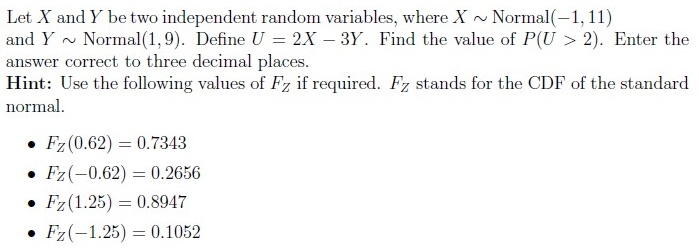
Normal Distribution (Q9):
- Linear combinations of independent normals are normal.
Example: where , .
, where:
μ_U = 2μ_X - 3μ_Y = 2(-1) - 3(1) = -5, σ_U² = 4Var(X) + 9Var(Y) = 4(11) + 9(9) = 127.- Standardize to : .
Joint & Conditional Distributions (Q13, Q14):
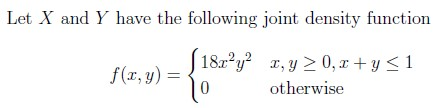
- Joint PDF: for , .
Conditional PDF (Q13):
f_{X|Y}(x|y) = f(x, y)/f_Y(y),where .
- Result: for .
Conditional Probability (Q14):
P(X < 0.5 | Y = 0.5) = \int_0^{0.5} f_{X|Y}(x|0.5) dx = 1.
D. Linear Algebra
Eigenvalues & Diagonalizability (Q10):
- Trace = Sum of eigenvalues = 3.
- Determinant = Product of eigenvalues = 2.
Given eigenvalue , let , .
- Then: → .
- → → .
- Possible eigenvalues: (Q10C).
- Diagonalizable: Yes, if eigenvalues are distinct or matrix is symmetric (not necessarily symmetric/Hermitian here, but diagonalizable due to distinct eigenvalues).
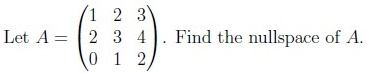
Nullspace (Q15):
- For matrix , solve .
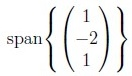
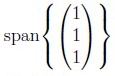
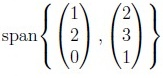
- Example: in Q15 has nullspace spanned by .
E. Optimization in Geometry
Maximizing Area with Constraints (Q6):
- Problem: Fence 3 sides of a rectangle with 120m (river on 4th side).
Solution:
- Let sides be (parallel to river) and (perpendicular).
- Constraint: .
- Area: .
Maximize by setting derivative :
120 - 4y = 0 → y = 30, x = 60.- Max Area: m².
F. Machine Learning Basics
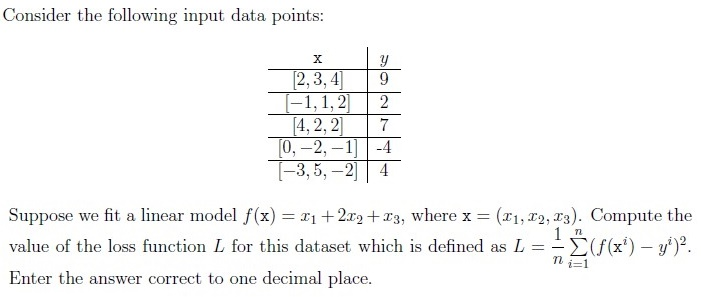
Linear Regression Loss (Q8):
Loss Function: Mean Squared Error (MSE):
L = \frac{1}{n} \sum_{i=1}^n (f(\mathbf{x}^i) - y^i)².- Example: For , compute predictions and compare to .
Principal Component Analysis (PCA) (Q12):
- Goal: Project data onto lower-dimensional subspace to maximize variance (or minimize reconstruction error).
Steps:
- Center the data.
- Compute covariance matrix.
- Eigen decomposition to find principal components.
Key Points:
- Reduces dimensionality (Q12C).
- Maximizes variance of projection (Q12A).
- Does not maximize reconstruction error (Q12D is false).
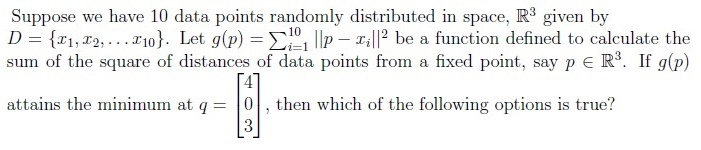
Least Squares Minimization (Q11):
- Problem: Minimize .
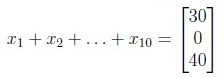
Solution: The minimizer is the mean of the data points.
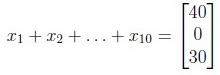
- For , the sum .
- Distance from origin: (Q11C).
2. Key Equations
| Topic | Equation |
|---|---|
| Linear Programming | Minimize s.t. , . |
| Chebyshev’s Inequality | . |
| Normal Distribution | . |
| Conditional PDF | . |
| MSE Loss | . |
| PCA Objective | Maximize s.t. . |
| Least Squares | Minimizer (mean). |