Home / Past papers / MLF Quiz 2 / this paper
IIT M DIPLOMA AN2 EXAM QDD2 03 Dec 2023 - 03 Dec 2023
Elapsed 00:00
Let U andV be two unitary matrices. Consider the following statements: Statement 1: U + V is unitary. Statement 2: UV is unitary. Select the correct options from the following:
- Only statement 2 is correct.
- Both statement 1 and statement 2 are incorrect.
- Both statement 1 and statement 2 are correct.
- Only statement 1 is correct.
Consider a function f(x, y) = x2 + y2 − 4x − 2y + 5. Using gradient descent algorithm, with an initial guess of (3, 2) and learning rate of 0.1, what will be the value of (x, y) after one iteration?
- x = 3.2, y = 2.2
- x = 3, y = 2
- x = 1.8,y = 0.8
- x = 2.8, y = 1.8

- x = 40, y = 20
- x = 20, y = 40
- x = 30, y = 30
- x = 0, y = 60
- None of these




- A is Hermitian matrix.
- A is not Hermitian matrix.
- A is unitarily diagonalizable.
- A is not unitarily diagonalizable.
Comprehension passage - the questions below it refer to this
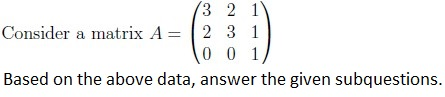
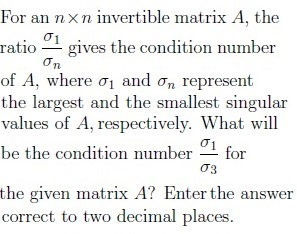
Is the matrix A positive definite?
- Yes
- No
Comprehension passage - the questions below it refer to this
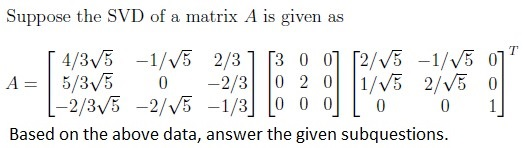
What is the rank of A?
Which of the following options are true?
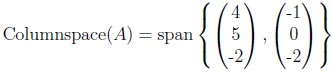
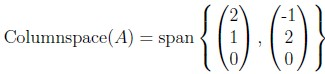
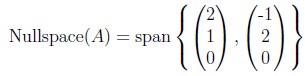
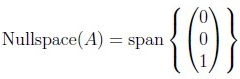
Which among the following statements are true about principal component analysis (PCA)?
- PCA is a supervised learning algorithm.
- Principal components are the eigenvectors of the sample covariance matrix.
- Principal components are eigenvectors of the centered data matrix.
- If p1 and p2 are the principal component vectors, then p1 is orthogonal to p2.
Comprehension passage - the questions below it refer to this
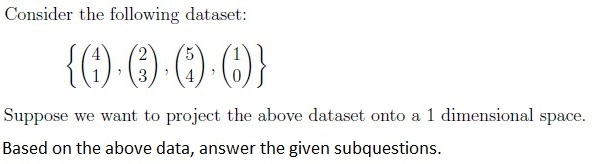
Compute the sample covariance matrix C for the given dataset.
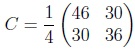
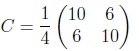
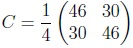
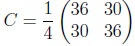
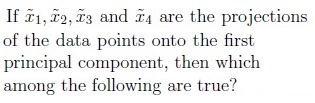
Which is the principal direction that is chosen for performing PCA?







Answer key
- Q1 (MCQ, 3 marks): A
- Q2 (MCQ, 3 marks): D
- Q3 (MCQ, 3 marks): A
- Q4 (MCQ, 4 marks): C
- Q5 (MSQ, 3 marks): B, C
- Q6 (SA, 3 marks): 2.20 to 2.26
- Q7 (MCQ, 2 marks): A
- Q8 (SA, 2 marks): 2
- Q9 (MSQ, 3 marks): A, D
- Q10 (MSQ, 2 marks): B, D
- Q11 (MCQ, 3 marks): B
- Q12 (MCQ, 3 marks): B
- Q13 (MCQ, 3 marks): D
- Q14 (SA, 3 marks): 2