Home / Past papers / MLF Quiz 2 / this paper
IIT M FOUNDATION AN EXAM QDF2 16 Mar - 16 Mar 2025
Elapsed 00:00








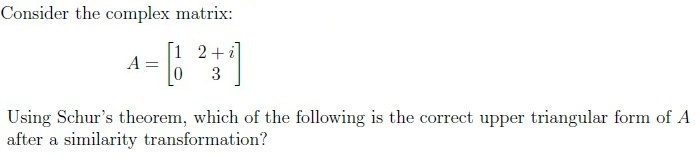


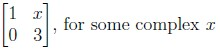









Which of the following statements is/are True regarding Schur’s Theorem?
- Every square matrix is unitarily similar to an upper triangular matrix.
- The diagonal entries of the Schur form of a matrix are its eigenvalues.
- A square matrix with repeated eigenvalues cannot always be unitarily similarto an upper triangular matrix.
- Schur’s Theorem holds only for square matrices, as it requires unitarysimilarity and the presence of eigenvalues.




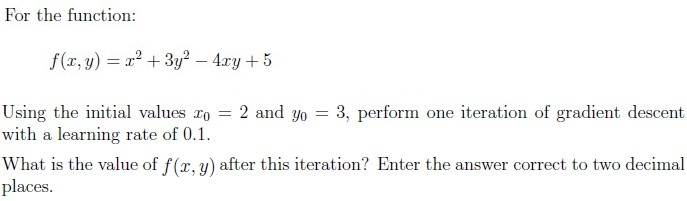

Comprehension passage - the questions below it refer to this
Based on the above data, answer the given subquestions.
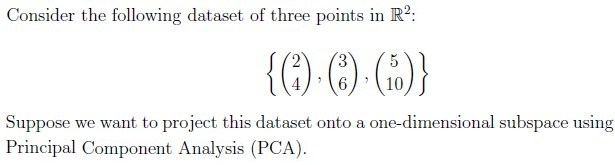
Compute the sample covariance matrix C for the given dataset.
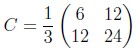

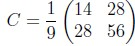
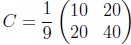
What is the principal direction chosen for PCA?


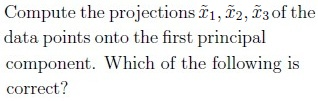




Comprehension passage - the questions below it refer to this
Based on the above data, answer the given subquestions.
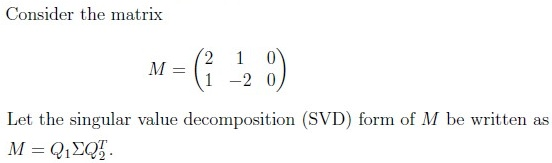
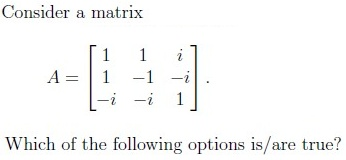
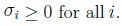
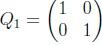
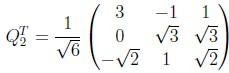
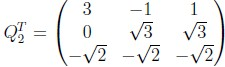
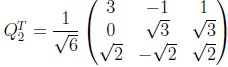
Which of the following options is/are true for Q1?
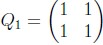
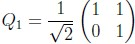
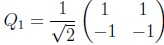

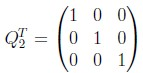
Answer key
- Q1 (MCQ, 3 marks): C
- Q2 (MCQ, 3 marks): B
- Q3 (MCQ, 3 marks): D
- Q4 (MCQ, 2 marks): A
- Q5 (MSQ, 3 marks): C, D
- Q6 (MSQ, 3 marks): A, B, D
- Q7 (MSQ, 3 marks): A, D
- Q8 (SA, 3 marks): 2.41 to 2.47
- Q9 (SA, 3 marks): -1
- Q10 (MCQ, 2 marks): C
- Q11 (MCQ, 3 marks): B
- Q12 (MCQ, 3 marks): A
- Q13 (MCQ, 3 marks): D
- Q14 (MCQ, 3 marks): D
Concepts this paper tests
Auto-generated summary from the source site. Handy as a checklist; the lessons above explain each idea from scratch.
Summary of Core Topics, Concepts, Principles, and Equations
1. Taylor Series Expansion
- Concept: Approximating a function using an infinite sum of terms calculated from the values of its derivatives at a single point.
- Equation: For around :
2. Eigenvalues and Eigenvectors
- Concept: Eigenvalues are scalars associated with a linear transformation of a vector space, and eigenvectors are the corresponding vectors.
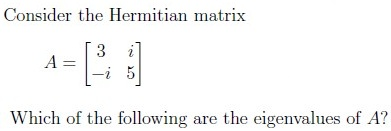
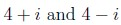
- Equation: For a Hermitian matrix , the eigenvalues satisfy .
3. Schur's Theorem
- Concept: Every square matrix is unitarily similar to an upper triangular matrix.
- Principle: The diagonal entries of the Schur form of a matrix are its eigenvalues.
4. Singular Value Decomposition (SVD)
- Concept: Factorizing a matrix into three matrices , , and .
- Equation:
5. Gradient Descent
- Concept: An optimization algorithm used to minimize some function by iteratively moving in the direction of steepest descent.
- Equation: Update rule for gradient descent:
where is the learning rate.
6. Principal Component Analysis (PCA)
- Concept: A technique used to emphasize variation and bring out strong patterns in a dataset.
- Equation: Covariance matrix for a dataset :
7. Positive Definite Matrices
- Concept: A matrix is positive definite if it satisfies for all non-zero vectors .
- Principle: All singular values of a positive definite matrix are positive.
8. Unitary Matrices
- Concept: A matrix is unitary if .
- Principle: The inverse of a unitary matrix is its conjugate transpose.