ML Study Hub

Home / Past papers / MLF Quiz 1 / this paper

IIT M IMPROVEMENT AN EXAM QIB3 26 Oct - 26 Oct 2025

MLF Quiz 118 questions40 marks12 MCQ · 4 SA · 2 MSQImprovement / afternoon / QIB3
Elapsed 00:00
Q1MCQ1 mark
A bank wants to decide whether a loan applicant should be given a loan or not, based on features like income, credit score and past records. Which of the following machine learning techniques is applicable for this scenario?
  1. Regression
  2. Classification
  3. Clustering
  4. Dimensionality Reduction
Q2MCQ3 marks
question figure
  1. question figure
  2. question figure
  3. question figure
  4. question figure
Q3MSQ2 marksselect all that apply
question figure
  1. question figure
  2. question figure
  3. question figure
  4. question figure
Q4SA3 marks
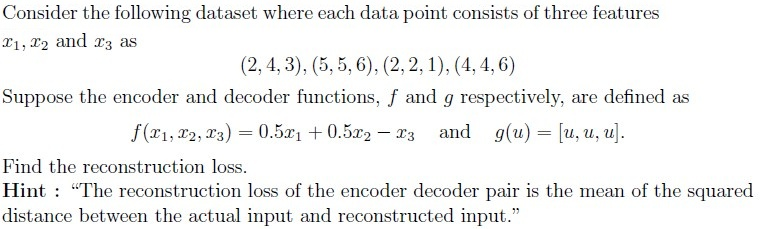
question figure
Q5SA3 marks
question figure
Q6SA2 marks
question figure
Comprehension passage - the questions below it refer to this
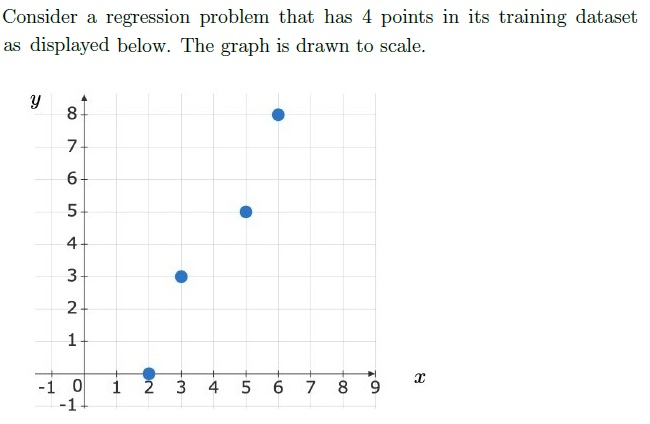
Based on the above data, answer the given subquestions. question figure
Q7MCQ3 marks
Which of these models has the smallest squared loss on this training dataset?
  1. question figure
  2. question figure
  3. question figure
  4. question figure
Q8MCQ2 marks
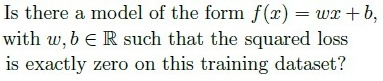
question figure
  1. No
  2. Yes
  3. Insufficient information to answer the question
Comprehension passage - the questions below it refer to this
Based on the above data, answer the given subquestions. question figure
Q9MCQ3 marks
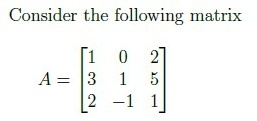
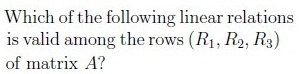
Which of the following sets forms a basis for the row space of A?
  1. {(1, 0, 2), (0, 1,−1)}
  2. {(1, 0, 2), (0, 1,−1), (0, 0,−1)}
  3. {(1, 0, 2), (0,−1, 1), (0,−1,−4)}
  4. {(0, 1,−1), (0, 0,−4)}
Q10MCQ2 marks
question figure
  1. question figure
  2. question figure
  3. question figure
  4. question figure
Comprehension passage - the questions below it refer to this
Based on the above data, answer the given subquestions. question figure
Q11MSQ2 marksselect all that apply
Which of the following is/are true?
  1. A is an orthogonal matrix
  2. A is invertible
  3. A is symmetric
Q12MCQ3 marks
Which of the following is true?
  1. A does not have real eigenvalues
  2. A has two distinct real eigenvalues
  3. A has two real eigenvalues, not necessarily distinct
Comprehension passage - the questions below it refer to this
There is no common data for this question. There are three independent sub-questions for which you have to answer True/False.
Q13MCQ2 marks
If a square matrix A is diagonalizable, then A is invertible.
  1. True
  2. False
Q14MCQ1 mark
The eigenvalues of a real symmetric matrix are real.
  1. True
  2. False
Q15MCQ2 marks
A square matrix A of shape n x n is diagonalizable if and only if it has n distinct eigenvalues.
  1. True
  2. False
Comprehension passage - the questions below it refer to this
Based on the above data, answer the given subquestions. question figure
Q16MCQ2 marks
question figure
  1. question figure
  2. question figure
  3. question figure
  4. question figure
Q17SA2 marks
question figure
Q18MCQ2 marks
question figure
  1. (A)
  2. (B)

Answer key

  1. Q1 (MCQ, 1 marks): B
  2. Q2 (MCQ, 3 marks): A
  3. Q3 (MSQ, 2 marks): B, C, D
  4. Q4 (SA, 3 marks): 72
  5. Q5 (SA, 3 marks): 1024
  6. Q6 (SA, 2 marks): 0
  7. Q7 (MCQ, 3 marks): A
  8. Q8 (MCQ, 2 marks): A
  9. Q9 (MCQ, 3 marks): B
  10. Q10 (MCQ, 2 marks): C
  11. Q11 (MSQ, 2 marks): A, B
  12. Q12 (MCQ, 3 marks): A
  13. Q13 (MCQ, 2 marks): B
  14. Q14 (MCQ, 1 marks): A
  15. Q15 (MCQ, 2 marks): B
  16. Q16 (MCQ, 2 marks): A
  17. Q17 (SA, 2 marks): 1
  18. Q18 (MCQ, 2 marks): A

Concepts this paper tests

Auto-generated summary from the source site. Handy as a checklist; the lessons above explain each idea from scratch.

Here’s a structured summary of core topics, concepts, principles, and equations essential for the exam, followed by Mermaid knowledge graphs to visualize relationships.


1. Core Topics & Concepts

A. Machine Learning Foundations

  1. Supervised Learning:

    • Classification (e.g., loan approval: B in Q2).

      • Binary/multi-class classification.
      • Algorithms: Logistic Regression, Decision Trees, SVM.
    • Regression (e.g., polynomial regression: Q3, Q8, Q9).

      • Linear/non-linear regression (e.g., quadratic model: y=θ0+θ1x+θ2x2y = \theta_0 + \theta_1 x + \theta_2 x^2).
      • Loss Functions:

        • Squared loss (MSE): L=1n∑i=1n(yi−y^i)2L = \frac{1}{n}\sum_{i=1}^n (y_i - \hat{y}_i)^2 (Q5, Q8).
        • Reconstruction loss (autoencoders): Mean squared distance between input and reconstructed input (Q5).
    • Model Evaluation:

      • Overfitting/underfitting.
      • Zero loss implies perfect fit (only possible if data is linearly separable; Q9).
  1. Unsupervised Learning:

    • Clustering (e.g., K-means, hierarchical).
    • Dimensionality Reduction (e.g., PCA, autoencoders; Q5).
  1. Key Algorithms:

    • Least Squares Method (for regression; Q3):

      • Solve θ=(XTX)−1XTy\theta = (X^T X)^{-1} X^T y for linear regression.
      • For polynomial regression, transform XX into a matrix of powers (e.g., [1,x,x2][1, x, x^2] for quadratic).
    • Autoencoders (Q5):

      • Encoder ff, decoder gg, reconstruction loss.

B. Linear Algebra

  1. Vectors:

    • Orthogonality: v1⋅v2=0v_1 \cdot v_2 = 0 (Q4).
    • Projection: Projection of v1v_1 onto v2v_2: projv2v1=(v1⋅v2v2⋅v2)v2\text{proj}_{v_2} v_1 = \left( \frac{v_1 \cdot v_2}{v_2 \cdot v_2} \right) v_2.

      • Zero projection implies orthogonality (Q4: options B, C, D).
  1. Matrices:

    • Eigenvalues/Eigenvectors (Q6, Q7, Q13–Q16):

      • Av=λvA v = \lambda v.
      • Properties:

        • Sum of columns = zero vector ⇒ λ=0\lambda = 0 is an eigenvalue (Q7).
        • Real symmetric matrices have real eigenvalues (Q15).
        • Diagonalizable ≠ invertible (Q14).
        • Diagonalizable iff nn linearly independent eigenvectors (not necessarily distinct eigenvalues; Q16).
    • Special Matrices:

      • Orthogonal Matrix: ATA=IA^T A = I (Q12, Q13).

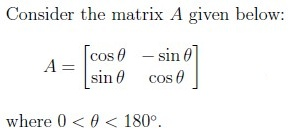
        • Rotation matrix: A=[cos⁡θ−sin⁡θsin⁡θcos⁡θ]A = \begin{bmatrix} \cos \theta & -\sin \theta \\ \sin \theta & \cos \theta \end{bmatrix} has no real eigenvalues for 0<θ<180∘0 < \theta < 180^\circ (Q13).
      • Determinant: det⁡(A)\det(A) for scalar matrices (Q6: A=2IA = 2I ⇒ det⁡(A)=210=1024\det(A) = 2^{10} = 1024).
    • Row Space/Basis (Q10, Q11):

      • Row space: Span of rows of AA.
      • Basis: Linearly independent rows that span the row space.
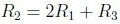
      • Linear relations among rows (Q11: R2=2R1+R3R_2 = 2R_1 + R_3).
  1. Systems of Equations:

    • Collinearity check for linear models (Q9: slopes must be equal for all points).

C. Calculus & Optimization

  1. Linear Approximation (Q17, Q18):

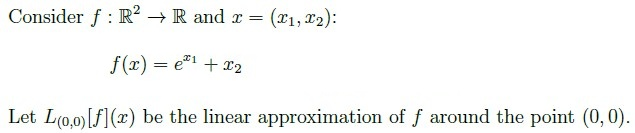
    • For f(x1,x2)=ex1+x2f(x_1, x_2) = e^{x_1} + x_2, the linear approximation at (0,0)(0,0):

      • L(0,0)[f](x)=f(0,0)+∇f(0,0)⋅x=1+x1+x2L_{(0,0)}[f](x) = f(0,0) + \nabla f(0,0) \cdot x = 1 + x_1 + x_2 (Q17).
    • Plane Equation: wTx+b=0w^T x + b = 0, where w=∇fw = \nabla f, b=−f(0,0)b = -f(0,0) (Q18: b=1b = 1).
  1. Contour Plots (Q19):

    • Contours of f(x1,x2)=ex1+x2f(x_1, x_2) = e^{x_1} + x_2 are horizontal curves (since ff increases monotonically with x1x_1 and x2x_2).

D. Probability & Statistics (Not directly tested here, but often paired with ML)


2. Key Equations

TopicEquation
Linear Regressiony=θ0+θ1x+θ2x2y = \theta_0 + \theta_1 x + \theta_2 x^2, θ=(XTX)−1XTy\theta = (X^T X)^{-1} X^T y
Squared LossL=1n∑i=1n(yi−y^i)2L = \frac{1}{n}\sum_{i=1}^n (y_i - \hat{y}_i)^2
Reconstruction Loss1n∑i=1n∥xi−g(f(xi))∥2\frac{1}{n}\sum_{i=1}^n \|x_i - g(f(x_i))\|^2
Projectionprojv2v1=(v1⋅v2v2⋅v2)v2\text{proj}_{v_2} v_1 = \left( \frac{v_1 \cdot v_2}{v_2 \cdot v_2} \right) v_2
Eigenvalue DefinitionAv=λvA v = \lambda v
Orthogonal MatrixATA=IA^T A = I
Linear ApproximationL(a,b)[f](x)=f(a,b)+∂f∂x1(a,b)(x1−a)+∂f∂x2(a,b)(x2−b)L_{(a,b)}[f](x) = f(a,b) + \frac{\partial f}{\partial x_1}(a,b)(x_1 - a) + \frac{\partial f}{\partial x_2}(a,b)(x_2 - b)
Plane EquationwTx+b=0w^T x + b = 0, where w=∇fw = \nabla f, b=−f(0,0)b = -f(0,0)

Graph 2: Linear Algebra Concepts

Graph 3: Calculus & Optimization

Graph 4: Relationships Between Topics