Home / Past papers / MLF End Term / this paper
IIT M FOUNDATION DIPLOMA AN EXAM - 01 Sep 2024













- Matrix A can be a symmetric matrix.
- All eigenvalues of A are distinct.
- 2 − i is an eigenvalue of A.
- Matrix A is not diagonalizable.


- PCA will transform the original data set onto a lower dimension subspace suchthat the variance of the project is maximized.
- PCA calculates the mean of each data set to determine its significance.
- PCA can be used to reduce the dimensionality of the dataset.
- PCA will transform the original data set onto a lower dimension subspace suchthat the reconstruction error is maximized.








Answer key
- Q1 (MCQ, 2 marks): A
- Q2 (SA, 3 marks): 90
- Q3 (MSQ, 3 marks): A, D
- Q4 (MSQ, 3 marks): B, C
- Q5 (SA, 3 marks): 5000
- Q6 (SA, 3 marks): 0.09 to 0.13
- Q7 (SA, 3 marks): 1.6
- Q8 (SA, 3 marks): 0.731 to 0.737
- Q9 (MSQ, 4 marks): A, B
- Q10 (MSQ, 4 marks): A, D
- Q11 (MSQ, 2 marks): A, C
- Q12 (MCQ, 3 marks): B
- Q13 (SA, 2 marks): 1
- Q14 (MCQ, 2 marks): D
Concepts this paper tests
Auto-generated summary from the source site. Handy as a checklist; the lessons above explain each idea from scratch.
Here’s a structured summary of core topics, concepts, principles, and equations for the exam, followed by Mermaid knowledge graphs to visualize relationships.
1. Core Topics & Key Concepts
A. Linear Programming & Optimization
Primal Problem Formulation:
- Objective: Minimize/maximize a linear function (e.g., cost/profit).
- Constraints: Linear inequalities (resource limits).
- Non-negativity: Variables ≥ 0.
Example (Q2, Q3):
\text{Minimize } 4x + 3y \text{Subject to: } 2x + y \leq 80, \quad x + 3y \leq 90, \quad x, y \geq 0- Solution Method: Graphical (for 2D) or Simplex algorithm.
- Dual Problem: Not directly tested here but related to constraints.
B. Convex Sets & Functions
Convex Set (Q4):
- A set is convex if for any , the line segment joining and lies entirely in .
Examples:
- Triangular region with vertices (convex).
- Region between and (non-convex unless specified otherwise).
- Epipgraph: Set of points above a function’s graph. Convex if the function is convex.
Convex Function (Q5):
A function is convex if:
f(\lambda x + (1-\lambda)y) \leq \lambda f(x) + (1-\lambda)f(y) \quad \forall \lambda \in [0,1]Tests:
Hessian Matrix: For , is convex if is positive semidefinite.
- Example (Q5B): is not convex (eigenvalues: ).
- Example (Q5C): is convex (Hessian is ).
- Quadratic Forms: Check eigenvalues of .
C. Calculus-Based Optimization
Unconstrained Optimization (Q6):
- Problem: Maximize area given perimeter constraint (fencing problem).
Steps:
- Express in terms of : .
- Substitute into : .
- Find critical point: .
- Evaluate .
Chebyshev’s Inequality (Q7):
Bounds probability of deviation from the mean:
P(|X - \mu| \geq k\sigma) \leq \frac{1}{k^2}Example: For , , :
P(|X - 70| \geq 24) \leq \frac{1}{9} \approx 0.11
D. Probability & Statistics
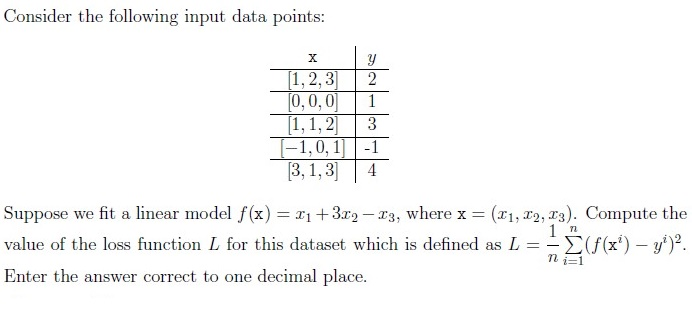
Linear Regression Loss (Q8):
Loss Function (MSE):
L = \frac{1}{n} \sum_{i=1}^n (f(x_i) - y_i)^2- Example: For , compute for given data points.
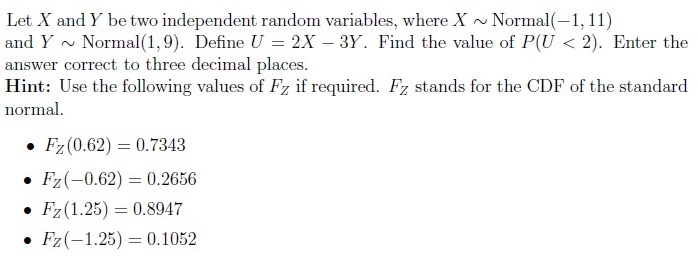
Normal Distribution & Linear Combinations (Q9):
If and , then:
U = aX + bY \sim N(a\mu_X + b\mu_Y, a^2\sigma_X^2 + b^2\sigma_Y^2)Example: where , :
U \sim N(2(-1) - 3(1), 4(11) + 9(9)) = N(-5, 127)Standardize to find :
P\left(Z < \frac{2 - (-5)}{\sqrt{127}}\right) \approx P(Z < 0.62) = 0.7343
Joint & Conditional Distributions (Q13, Q14):
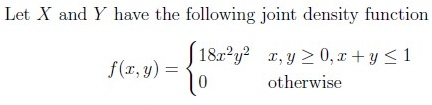
- Joint PDF: for .
Conditional PDF:
f_{X|Y}(x|y) = \frac{f(x,y)}{f_Y(y)} = \frac{18x^2y^2}{\int_0^{1-y} 18x^2y^2 dx} = \frac{3x^2}{(1-y)^3}Conditional Probability:
P(X < 0.5 | Y = 0.5) = \int_0^{0.5} f_{X|Y}(x|0.5) dx = 1
E. Linear Algebra
Eigenvalues & Diagonalization (Q10):
- Trace: Sum of eigenvalues = 3.
- Determinant: Product of eigenvalues = 2.
Given eigenvalue , let satisfy:
\lambda_1 + \lambda_2 + \lambda_3 = 3, \quad \lambda_1 \lambda_2 \lambda_3 = 2- Possible eigenvalues: (but is not necessarily an eigenvalue).
- Symmetric Matrix: Always diagonalizable.
- Distinct Eigenvalues: Implies diagonalizable.
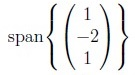
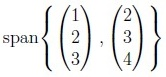
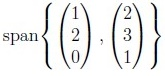
Column Space (Q15):
- Column space of = span of linearly independent columns.
For , the column space is:
\text{span}\left\{ \begin{pmatrix} 1 \\ 2 \\ 0 \end{pmatrix}, \begin{pmatrix} 2 \\ 3 \\ 1 \end{pmatrix} \right\}(Equivalent to option D after simplification.)
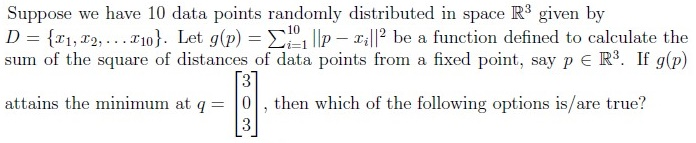
Least Squares & Mean of Data (Q11):
- The point minimizing is the mean of the data.
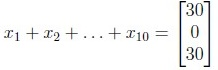
Implication:
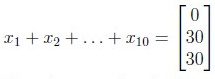
q = \frac{1}{10} \sum_{i=1}^{10} x_i \Rightarrow \sum_{i=1}^{10} x_i = 10q = \begin{pmatrix} 30 \\ 0 \\ 30 \end{pmatrix}Distance from origin:
\left\| \sum x_i \right\| = \sqrt{30^2 + 0^2 + 30^2} = 30\sqrt{2}
F. Dimensionality Reduction (PCA)
Principal Component Analysis (PCA) (Q12):
- Goal: Project data onto a lower-dimensional subspace to maximize variance (not reconstruction error).
Steps:
- Center the data (subtract mean).
- Compute covariance matrix.
- Eigen decomposition to find principal components.
Key Points:
- Reduces dimensionality while preserving variance.
- Does not maximize reconstruction error (that’s the opposite goal).
Graph 2: Probability & Statistics
Graph 3: Linear Algebra & PCA
Graph 4: Calculus-Based Optimization
3. Key Equations Summary
| Topic | Equation |
|---|---|
| Linear Programming | Minimize s.t. |
| Convex Function | |
| Chebyshev’s Inequality | |
| Normal Distribution | |
| Conditional PDF | |
| PCA Objective | Maximize s.t. |
| Least Squares | |
| Eigenvalues | , |