Home / Past papers / MLF Quiz 1 / this paper
IIT M IMPROVEMENT AN EXAM QIA2 26 Oct - 26 Oct 2025
- Regression
- Classification
- Clustering
- Dimensionality Reduction








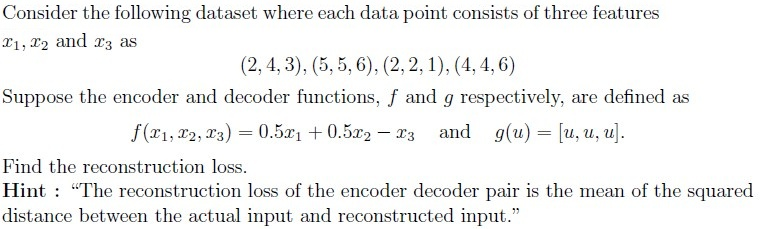


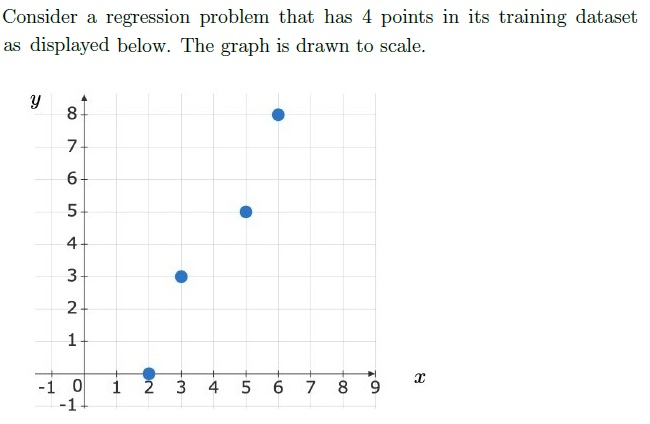
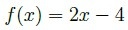



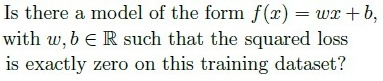
- No
- Yes
- Insufficient information to answer the question
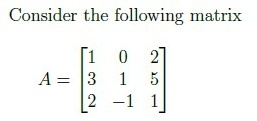
- {(1, 0, 2), (0, 1,−1)}
- {(1, 0, 2), (0, 1,−1), (0, 0,−1)}
- {(1, 0, 2), (0,−1, 1), (0,−1,−4)}
- {(0, 1,−1), (0, 0,−4)}
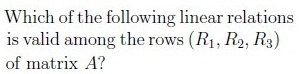



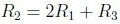
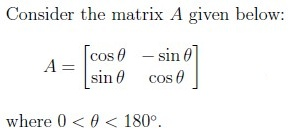
- A is an orthogonal matrix
- A is invertible
- A is symmetric
- A does not have real eigenvalues
- A has two distinct real eigenvalues
- A has two real eigenvalues, not necessarily distinct
- True
- False
- True
- False
- True
- False


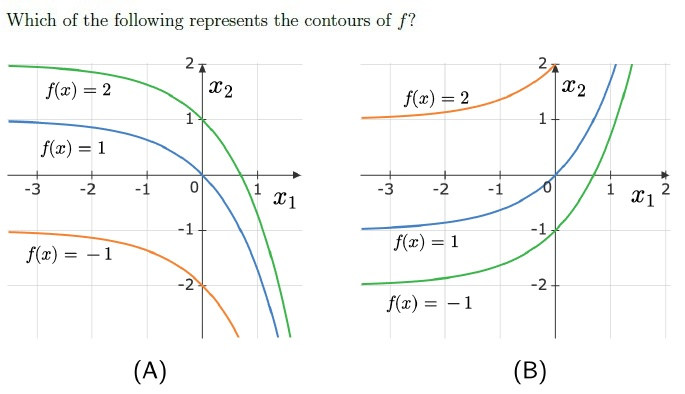
- (A)
- (B)
Answer key
- Q1 (MCQ, 1 marks): B
- Q2 (MCQ, 3 marks): A
- Q3 (MSQ, 2 marks): B, C, D
- Q4 (SA, 3 marks): 72
- Q5 (SA, 3 marks): 1024
- Q6 (SA, 2 marks): 0
- Q7 (MCQ, 3 marks): A
- Q8 (MCQ, 2 marks): A
- Q9 (MCQ, 3 marks): B
- Q10 (MCQ, 2 marks): C
- Q11 (MSQ, 2 marks): A, B
- Q12 (MCQ, 3 marks): A
- Q13 (MCQ, 2 marks): B
- Q14 (MCQ, 1 marks): A
- Q15 (MCQ, 2 marks): B
- Q16 (MCQ, 2 marks): A
- Q17 (SA, 2 marks): 1
- Q18 (MCQ, 2 marks): A
Concepts this paper tests
Auto-generated summary from the source site. Handy as a checklist; the lessons above explain each idea from scratch.
Here’s a structured summary of core topics, concepts, principles, and equations for the "Diploma Level: Machine Learning Foundations" exam, along with Mermaid knowledge graphs to visualize relationships.
1. Core Topics & Concepts
A. Machine Learning Fundamentals
Supervised Learning
Classification (Binary/Multi-class):
- Used for discrete outputs (e.g., loan approval: "Yes/No").
- Algorithms: Logistic Regression, Decision Trees, SVM, k-NN.
Regression:
- Used for continuous outputs (e.g., predicting house prices).
- Algorithms: Linear Regression, Polynomial Regression.
Loss Functions:
- Squared Loss (MSE) for regression:
- Log Loss (Cross-Entropy) for classification:
Unsupervised Learning
- Clustering (e.g., k-Means, Hierarchical Clustering).
- Dimensionality Reduction (e.g., PCA, t-SNE).
Model Evaluation
Overfitting/Underfitting:
- High training accuracy but low test accuracy → Overfitting.
- Low accuracy on both → Underfitting.
Bias-Variance Tradeoff:
- High bias → Underfitting.
- High variance → Overfitting.
B. Linear Algebra (Critical for ML)
Matrix Properties
- Row Space: Spanned by rows of matrix .
- Basis: Linearly independent vectors spanning a space.
- Rank: Max number of linearly independent rows/columns.
- Orthogonal Matrix: (columns are orthonormal).
- Invertible Matrix: , .
- Symmetric Matrix: .
Eigenvalues & Eigenvectors
- For matrix , .
- Real Symmetric Matrices: Always have real eigenvalues.
Diagonalizable Matrix:
- (if linearly independent eigenvectors exist).
- Not all diagonalizable matrices are invertible (e.g., singular matrices).
Special Matrices
- Positive Definite: All eigenvalues > 0.
- Singular Matrix: (non-invertible).
C. Probability & Statistics (Implied in Questions)
Basic Combinatorics
- Factorials: .
- Permutations: .
- Combinations: .
Exponents & Logarithms
- .
- .
2. Key Equations
| Topic | Equation |
|---|---|
| Squared Loss | |
| Log Loss | |
| Matrix Inverse | |
| Eigenvalue Equation | |
| Determinant | |
| Orthogonal Matrix | |
| Diagonalization |
Graph 2: Linear Algebra Concepts
Graph 3: Model Evaluation
Graph 4: Probability & Combinatorics
4. Exam Tips
Classification vs. Regression:
- Classification → Discrete output (e.g., loan approval).
- Regression → Continuous output (e.g., house price).
Matrix Properties:
- Basis must be linearly independent and span the space.
- Orthogonal matrices have .
- Symmetric matrices have real eigenvalues.
Diagonalizable Matrices:
- Not all diagonalizable matrices are invertible (e.g., singular matrices with repeated eigenvalues).
Loss Functions:
- Squared Loss → Regression.
- Log Loss → Classification.
Eigenvalues:
- Real symmetric matrices always have real eigenvalues.
This summary covers all key concepts from the question paper. Focus on Linear Algebra, ML basics, and loss functions for the exam.