Home / Past papers / MLF Quiz 1 / this paper
IIT M FOUNDATION AN2 EXAM QPF2 16 JULY 2023 - 16 Jul 2023




- Row space of a matrix is orthogonal to the null space of the matrix.
- Row space of a matrix is orthogonal to the null space of transpose of thematrix.
- Dimension of row space of a matrix is always equal to the dimension ofcolumn space of the matrix.
- Dimension of row space of a matrix need not be equal to the dimension ofcolumn space of the matrix.




















- (1, 3)
- (1/2, 1/6)
- (0, 0)
- The algorithm does not converge

- Yes
- No
Answer key
- Q1 (MSQ, 3 marks): A, D
- Q2 (MSQ, 3 marks): A, C
- Q3 (MSQ, 3 marks): A, B
- Q4 (MSQ, 3 marks): B, D
- Q5 (MSQ, 4 marks): A, B, C
- Q6 (MSQ, 4 marks): A, C
- Q7 (MCQ, 4 marks): A
- Q8 (MCQ, 4 marks): C
- Q9 (SA, 4 marks): 5
- Q10 (SA, 4 marks): 37 to 38
- Q11 (SA, 4 marks): 1
- Q12 (SA, 3 marks): -1.16 to -1.12
- Q13 (SA, 2 marks): 3.5
- Q14 (MCQ, 2 marks): B
- Q15 (SA, 3 marks): 3.12 to 3.16
Concepts this paper tests
Auto-generated summary from the source site. Handy as a checklist; the lessons above explain each idea from scratch.
The examination covers fundamental concepts in Machine Learning, Linear Algebra, Multivariable Calculus, and Optimization. A strong understanding of these mathematical and algorithmic foundations is crucial.
Summary of Core Topics, Concepts, Principles, and Equations
1. Machine Learning Fundamentals
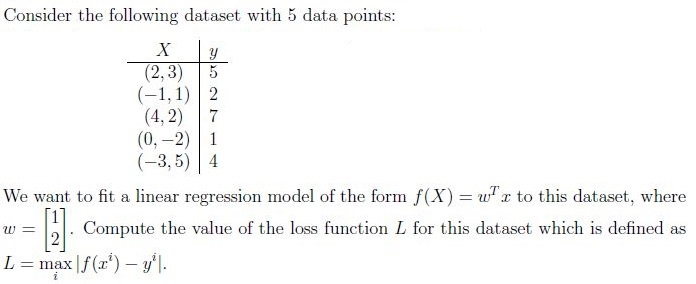
Loss Functions: Quantify the error between predicted and actual values.
Mean Squared Error (MSE): Primarily used for regression problems, penalizes larger errors more heavily.
Max Absolute Error ( Loss): Determines the largest absolute difference between any single prediction and its true value.
- Classification vs. Regression: Distinguish between problems predicting discrete categories (classification) and continuous values (regression). MSE is not suitable for classification.
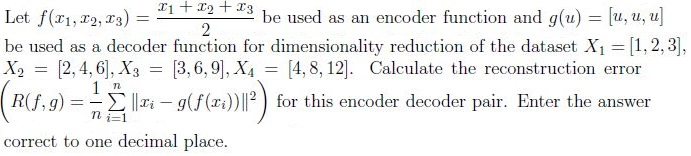
Autoencoders and Dimensionality Reduction:
- Encoder: Maps input data to a lower-dimensional representation.
- Decoder: Maps the lower-dimensional representation back to the original data space.
Reconstruction Error: Measures how well the decoder can reconstruct the original input from the encoded representation. Often uses squared Euclidean norm.
where is the encoder, is the decoder, and is the Euclidean norm.
- Gaussian Mixture Models (GMM): A probabilistic model used for representing sub-populations within an overall population, often for modeling multimodal data.
Indicator Function: A function that returns 1 if a given condition is true, and 0 otherwise.
2. Linear Algebra
Vector Spaces and Subspaces:
- Row Space, Column Space, Null Space (Kernel): Understand their definitions and properties.
- Orthogonality: The row space of a matrix is orthogonal to its null space. The column space of a matrix is orthogonal to the null space of its transpose.
Rank-Nullity Theorem: For a matrix , the dimension of its column space (rank) plus the dimension of its null space (nullity) equals the number of columns .
- Rank: The dimension of the column space (or row space) of a matrix. The column rank is always equal to the row rank.
Eigenvalues and Eigenvectors:
- Definition: For a matrix , a non-zero vector is an eigenvector if for some scalar , called the eigenvalue.
- Symmetric Matrices: Have real eigenvalues and an orthogonal basis of eigenvectors. They are always diagonalizable.
- Diagonalization: A square matrix is diagonalizable if and only if there exists a basis of eigenvectors for the entire space . This means the algebraic multiplicity of each eigenvalue equals its geometric multiplicity.
Matrix Operations and Properties:
- Matrix multiplication, transpose.
- Determinant: A scalar value that can be computed from the elements of a square matrix.
Projection Matrices: Project vectors onto a subspace.
Projection matrix onto the line spanned by vector :
Projection matrix onto the orthogonal complement of the span of :
Systems of Linear Equations ():
- Consistency: A system is consistent if a solution exists (i.e., lies in the column space of ). This can be checked by comparing the rank of with the rank of the augmented matrix .
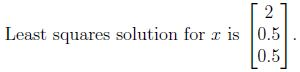
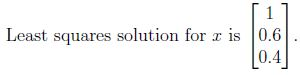
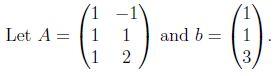
Least Squares Approximation: If is inconsistent, the least squares method finds that minimizes . The solution is found by solving the normal equations:
- Projection Vector: The vector is the projection of onto the column space of .
Euclidean Norm (Vector Length):
3. Multivariable Calculus
- Partial Derivatives: Derivatives of a multivariable function with respect to one variable, holding others constant.
Gradient Vector (): A vector containing all the partial derivatives of a multivariable function. Points in the direction of the greatest rate of increase of the function.
Directional Derivative (): The rate of change of a function in a specific direction defined by a unit vector .
Linear Approximation (First-Order Taylor Series): Approximating a function near a point with a linear function.
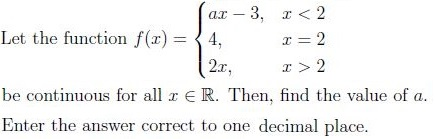
Continuity of Functions: For a function to be continuous at a point , the limit of the function as approaches from both sides must exist and be equal to the function's value at .
4. Optimization
Gradient Descent: An iterative optimization algorithm used to find the local minimum of a function. It moves in the direction opposite to the gradient.
where is the learning rate (step size).
- Convergence: Understanding how the choice of step size and function properties (e.g., convexity) affect the convergence of optimization algorithms. Convex functions guarantee convergence to a global minimum under appropriate conditions.