Home / Past papers / MLF Quiz 2 / this paper
IIT M FOUNDATION AN EXAM QDF3 01 Dec - 01 Dec 2024
Elapsed 00:00
Note:
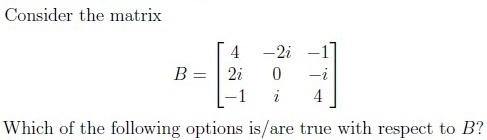
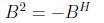
BH is a conjugate transpose of B.








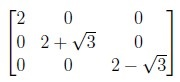
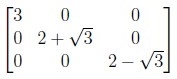




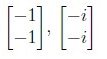



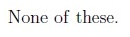

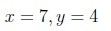

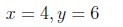
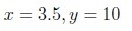

- (3,7)
- (0.4, 1.8)
- (0,0)
- (-1,0)
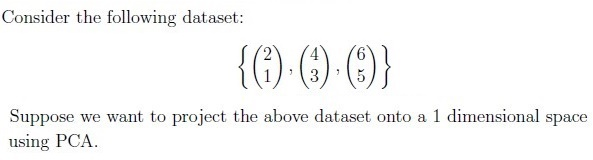
Comprehension passage - the questions below it refer to this
Based on the above data answer the given subquestions.

Which of the following options is/are true?
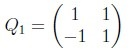
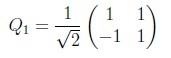
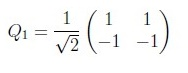
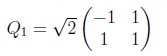
Which of the following options is/are true ?
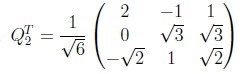
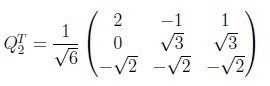
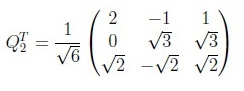
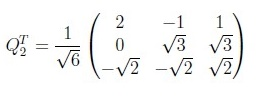
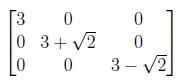
Which of the following options is true?
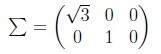
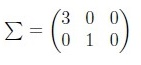
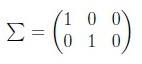
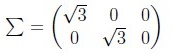
Comprehension passage - the questions below it refer to this
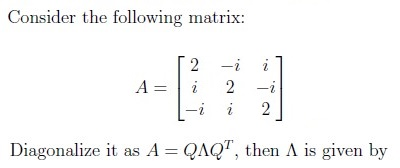
Based on the above data answer the given subquestions.

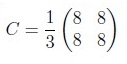
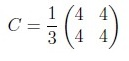
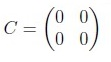
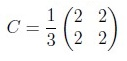

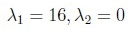
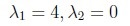
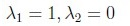
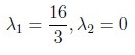

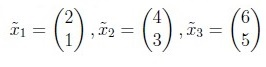
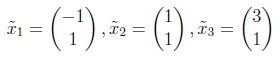
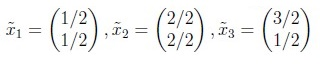
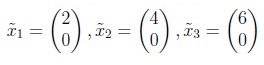

- M is an invertible matrix.
- M is a singular matrix.
- The determinant of M is 4.
- M is diagonalizable.

- A is positive definite.
- A is positive semi-definite.
- A is negative definite.
- A is negative semi-definite.
Answer key
- Q1 (MSQ, 3 marks): B, C
- Q2 (MSQ, 3 marks): A, B, C
- Q3 (MCQ, 3 marks): B
- Q4 (MCQ, 3 marks): A
- Q5 (MCQ, 3 marks): A
- Q6 (MCQ, 3 marks): B
- Q7 (MCQ, 3 marks): B
- Q8 (MCQ, 2 marks): B
- Q9 (MCQ, 2 marks): D
- Q10 (MCQ, 2 marks): A
- Q11 (MCQ, 3 marks): A
- Q12 (MCQ, 3 marks): D
- Q13 (MCQ, 3 marks): A
- Q14 (MSQ, 2 marks): B, D
- Q15 (MCQ, 2 marks): B
Concepts this paper tests
Auto-generated summary from the source site. Handy as a checklist; the lessons above explain each idea from scratch.
Summary of Core Topics, Concepts, Principles, and Equations
Linear Algebra
Matrices and Their Properties
- Hermitian Matrix: A matrix is Hermitian if , where is the conjugate transpose of .
- Unitary Matrix: A matrix is unitary if , where is the conjugate transpose of and is the identity matrix.
- Determinant and Trace: The determinant of a matrix is zero if the matrix is singular. The trace of a matrix is the sum of its diagonal elements.
- Eigenvalues and Eigenvectors: For a unitary matrix, the magnitude of the eigenvalues is 1, and the eigenvectors corresponding to different eigenvalues are orthogonal.
- Diagonalization: A matrix can be diagonalized as , where is a matrix of eigenvectors and is a diagonal matrix of eigenvalues.
Quadratic Forms
- Matrix Representation: A quadratic form can be represented in matrix form as , where is a symmetric matrix.
Gradient Descent
- Update Rule: For each iteration , the update rule is:
- Learning Rate: The learning rate can be defined as .
Singular Value Decomposition (SVD)
- SVD Form: A matrix can be written in SVD form as , where and are unitary matrices, and is a diagonal matrix of singular values.
Principal Component Analysis (PCA)
- Covariance Matrix: The sample covariance matrix for a dataset is calculated as:
- Eigenvalues and Eigenvectors: The eigenvalues of the covariance matrix are used to determine the principal components.
Equations
- Eigenvalue Equation:
where is a matrix, is an eigenvector, and is an eigenvalue.
- Gradient Descent Update:
where is the learning rate and is the gradient of the function at .
- SVD Equation:
where and are unitary matrices, and is a diagonal matrix of singular values.
- Covariance Matrix:
where is the number of data points, are the data points, and is the mean of the data points.