Home / Past papers / MLF End Term / this paper
IIT M FOUNDATION FN EXAM FDF1 24 Dec 2023 - 24 Dec 2023
Elapsed 00:00
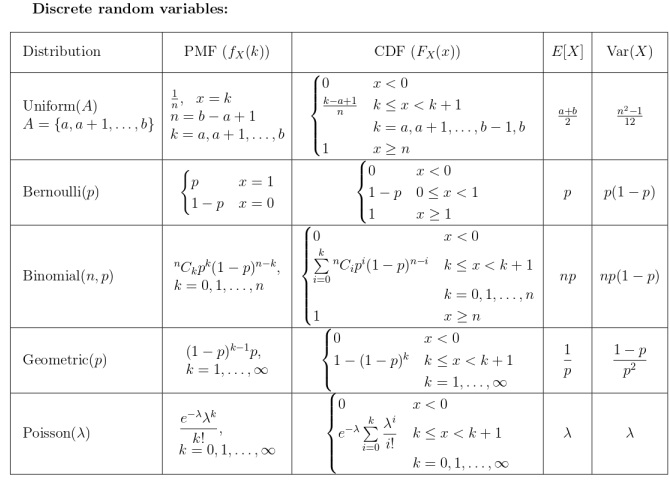
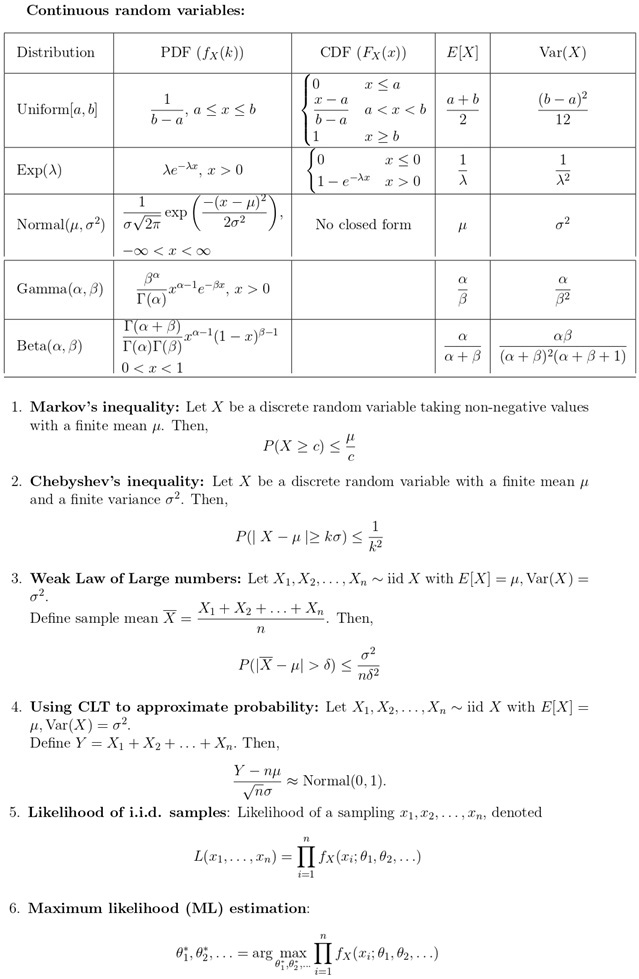
- Useful Data has been mentioned above.
- This data attachment is just for a reference & not for an evaluation.
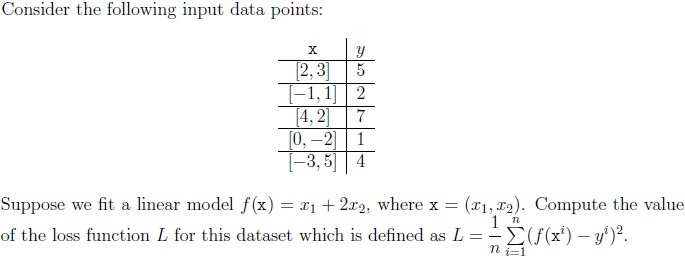
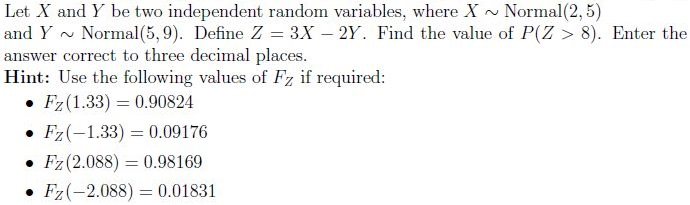


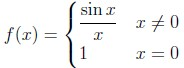
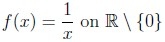
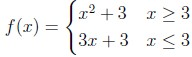
Which of the following functions is/are continuous?

Let A be a n × n positive definite matrix. Then, which among the following are correct?















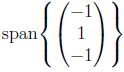
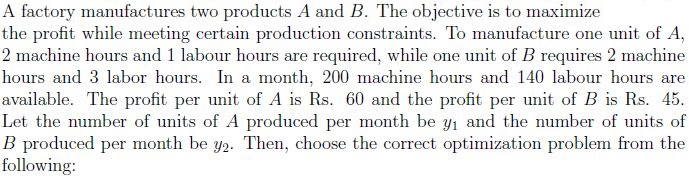




Comprehension passage - the questions below it refer to this
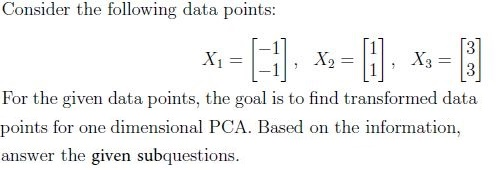
Which of the following represents the covariance matrix, C for the given data points?


What is the value of the projected variance? Enter the answer correct to two decimal places.

Answer key
- Q1 (MCQ, 0 marks): A
- Q2 (SA, 3 marks): 9
- Q3 (SA, 3 marks): 0.089 to 0.095
- Q4 (SA, 3 marks): 0.74 to 0.79
- Q5 (SA, 3 marks): 0.24 to 0.28
- Q6 (SA, 3 marks): 0.020 to 0.030
- Q7 (MSQ, 3 marks): A, B, D
- Q8 (MSQ, 3 marks): A, B, D
- Q9 (SA, 4 marks): 0.370 to 0.380
- Q10 (MSQ, 3 marks): B, C
- Q11 (MCQ, 2 marks): C
- Q12 (MCQ, 2 marks): B
- Q13 (MCQ, 2 marks): B
- Q14 (MCQ, 2 marks): C
- Q15 (SA, 2 marks): 5.30 to 5.37
- Q16 (SA, 2 marks): 10
Concepts this paper tests
Auto-generated summary from the source site. Handy as a checklist; the lessons above explain each idea from scratch.
Here’s a structured summary of core topics, concepts, principles, and equations for the exam, followed by Mermaid knowledge graphs to visualize relationships.
Core Topics & Concepts
1. Probability & Statistics
A. Random Variables (Discrete & Continuous)
| Distribution | PMF/PDF | CDF | Mean () | Variance () |
|---|---|---|---|---|
| Uniform (Discrete) | ||||
| Bernoulli | ||||
| Binomial | ||||
| Geometric | ||||
| Poisson | ||||
| Uniform (Continuous) | ||||
| Exponential | ||||
| Normal | No closed form | |||
| Gamma | ||||
| Beta | No closed form |
B. Theorems & Inequalities
- Markov’s Inequality:
- Chebyshev’s Inequality:
- Weak Law of Large Numbers (WLLN):
- Central Limit Theorem (CLT):
where .
- Maximum Likelihood Estimation (MLE):
For Exponential Distribution:
C. Joint & Conditional Distributions
- Joint PDF/PMF:
- Marginal PDF/PMF:
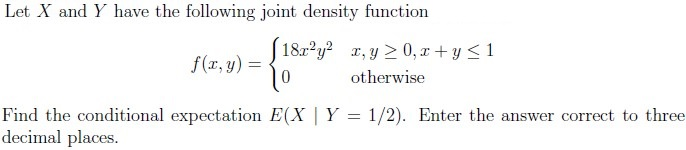
- Conditional Expectation:
2. Linear Algebra
A. Matrix Properties
Positive Definite Matrix:
- is positive definite if for all .
Properties:
- All eigenvalues .
- is positive definite for .
- is positive definite.
- Diagonal entries .
Eigenvalues & Eigenvectors:
- If has linearly independent eigenvectors, it is diagonalizable.
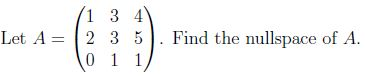
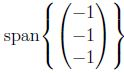
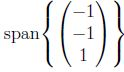
Nullspace:
B. PCA (Principal Component Analysis)
Steps:
- Center the data: .
- Compute covariance matrix .
- Find eigenvalues and eigenvectors of .
- Project data onto the top eigenvector(s):
- Projected Variance:
3. Optimization
A. Linear Programming
- Standard Form:
Subject to:
- Example:
Subject to:
B. Constrained Optimization
- Lagrange Multipliers:
Solve:
- Example: Maximize subject to .
4. Calculus & Continuity
Continuous Functions:
- is continuous at if:
Examples:
- (continuous at if defined as ).
- Piecewise functions must match at boundaries.
5. Convexity
- Convex Function:
Examples:
- (convex for ).
- (convex everywhere).
Composition Rules:
- If is convex and is convex + non-decreasing, then is convex.