Home / Past papers / MLF Quiz 1 / this paper
IIT M IMPROVEMENT AN EXAM QIM3 26 Oct - 26 Oct 2025
Elapsed 00:00
A bank wants to decide whether a loan applicant should be given a loan or not, based on features like income, credit score and past records. Which of the following machine learning techniques is applicable for this scenario?
- Regression
- Classification
- Clustering
- Dimensionality Reduction








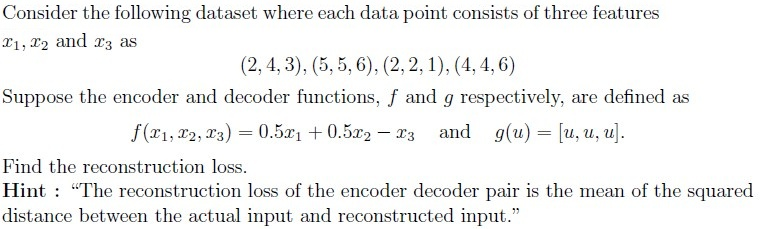


Comprehension passage - the questions below it refer to this
Based on the above data, answer the given subquestions.
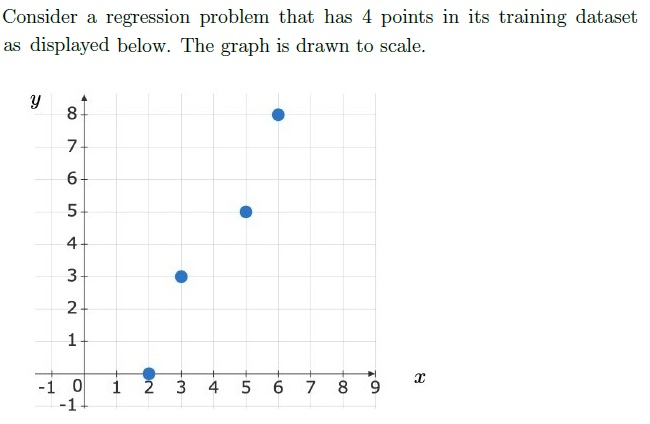
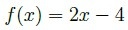
Which of these models has the smallest squared loss on this training dataset?



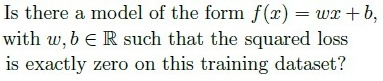
- No
- Yes
- Insufficient information to answer the question
Comprehension passage - the questions below it refer to this
Based on the above data, answer the given subquestions.
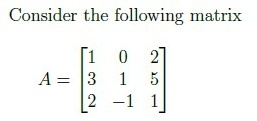
Which of the following sets forms a basis for the row space of A?
- {(1, 0, 2), (0, 1,−1)}
- {(1, 0, 2), (0, 1,−1), (0, 0,−1)}
- {(1, 0, 2), (0,−1, 1), (0,−1,−4)}
- {(0, 1,−1), (0, 0,−4)}
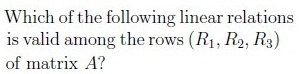



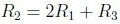
Comprehension passage - the questions below it refer to this
Based on the above data, answer the given subquestions.
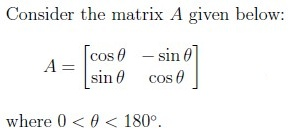
Which of the following is/are true?
- A is an orthogonal matrix
- A is invertible
- A is symmetric
Which of the following is true?
- A does not have real eigenvalues
- A has two distinct real eigenvalues
- A has two real eigenvalues, not necessarily distinct
Comprehension passage - the questions below it refer to this
There is no common data for this question. There are three independent sub-questions for which you have to answer True/False.If a square matrix A is diagonalizable, then A is invertible.
- True
- False
The eigenvalues of a real symmetric matrix are real.
- True
- False
A square matrix A of shape n x n is diagonalizable if and only if it has n distinct eigenvalues.
- True
- False
Comprehension passage - the questions below it refer to this
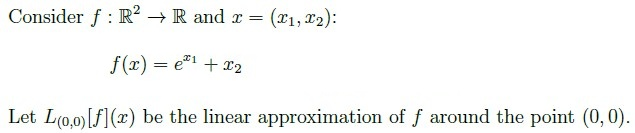
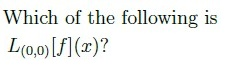
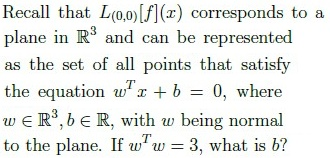
Based on the above data, answer the given subquestions.


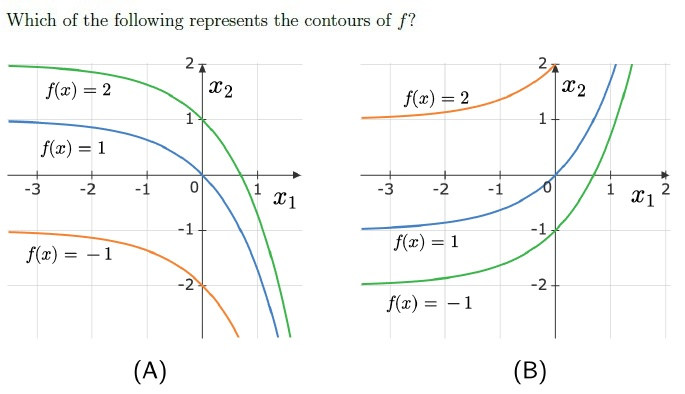
- (A)
- (B)
Answer key
- Q1 (MCQ, 1 marks): B
- Q2 (MCQ, 3 marks): A
- Q3 (MSQ, 2 marks): B, C, D
- Q4 (SA, 3 marks): 72
- Q5 (SA, 3 marks): 1024
- Q6 (SA, 2 marks): 0
- Q7 (MCQ, 3 marks): A
- Q8 (MCQ, 2 marks): A
- Q9 (MCQ, 3 marks): B
- Q10 (MCQ, 2 marks): C
- Q11 (MSQ, 2 marks): A, B
- Q12 (MCQ, 3 marks): A
- Q13 (MCQ, 2 marks): B
- Q14 (MCQ, 1 marks): A
- Q15 (MCQ, 2 marks): B
- Q16 (MCQ, 2 marks): A
- Q17 (SA, 2 marks): 1
- Q18 (MCQ, 2 marks): A
Concepts this paper tests
Auto-generated summary from the source site. Handy as a checklist; the lessons above explain each idea from scratch.
Here’s a structured summary of core topics, concepts, principles, and equations for the Diploma-Level Machine Learning Foundations (Computer-Based Exam), along with Mermaid knowledge graphs to visualize relationships.
1. Core Topics & Concepts
A. Machine Learning Basics
Supervised Learning:
- Classification (e.g., loan approval:
Yes/No). - Regression (e.g., predicting continuous values).
Key Algorithms:
- Linear Regression (Least Squares).
- Polynomial Regression (e.g., quadratic model: ).
Loss Functions:
- Squared Loss: .
- Reconstruction Loss (Autoencoders): Mean squared distance between input and reconstructed input.
- Classification (e.g., loan approval:
Unsupervised Learning:
- Clustering (grouping similar data points).
- Dimensionality Reduction (e.g., PCA, Autoencoders).
Model Evaluation:
- Overfitting/Underfitting: Check if a linear model can achieve zero loss (e.g., Q9: No, because points are not colinear).
B. Linear Algebra
Vectors:
- Orthogonality: Two vectors and are orthogonal if .
Linear Dependence/Independence:
- Vectors are linearly dependent if one is a scalar multiple of the other.
- Basis: A set of linearly independent vectors spanning a space (e.g., row space of a matrix).
- Projection: Projection of onto : .
Matrices:
Eigenvalues/Eigenvectors:
- .
- If the sum of columns of is the zero vector, is an eigenvalue.
- Diagonalizable Matrices: A matrix is diagonalizable if it has linearly independent eigenvectors (not necessarily distinct eigenvalues).
- Real Symmetric Matrices: Always have real eigenvalues.
Orthogonal Matrices:
- .
- Example: Rotation matrix .
Properties:
- Preserves vector lengths ().
- Eigenvalues: and (complex if ).
Determinant:
- For a matrix where every non-zero vector is an eigenvector with eigenvalue , , so .
- Example: matrix with eigenvalue for all vectors → .
Systems of Equations:
- Row Space: Spanned by the rows of .
- Linear Relations: e.g., .
C. Calculus & Optimization
Linear Approximation:
- For , the linear approximation at is:
- Gradient: .
- Plane Equation: , where and .
Contour Plots:
- For , contours are horizontal shifts of the exponential function.
D. Key Equations
| Topic | Equation |
|---|---|
| Quadratic Regression | |
| Least Squares | |
| Reconstruction Loss | |
| Dot Product | |
| Eigenvalue Equation | |
| Linear Approximation | |
| Plane Equation | (where , ) |
| Rotation Matrix |
Graph 2: Linear Algebra Concepts
Graph 3: Calculus & Optimization
Graph 4: Relationships Between Topics
3. Exam Preparation Tips
Focus Areas:
- Polynomial Regression: Know how to fit a quadratic model using least squares.
- Eigenvalues/Vectors: Understand conditions for diagonalizability, real symmetric matrices, and determinants.
- Linear Approximation: Compute gradients and plane equations.
- Orthogonality: Check dot products and projections.
- Basis/Row Space: Find bases for row spaces and linear relations between rows.
Practice Problems:
- Solve for in using least squares.
- Compute eigenvalues for simple matrices (e.g., rotation matrices).
- Derive linear approximations for multivariate functions.
- Verify orthogonality and linear independence of vectors.
Common Pitfalls:
- Confusing classification (discrete output) with regression (continuous output).
- Misapplying eigenvalue conditions (e.g., assuming all matrices with repeated eigenvalues are diagonalizable).
- Incorrectly computing projections or dot products.