Home / Past papers / MLF Quiz 1 / this paper
IIT M DIPLOMA AN EXAM QDD2 23 Feb 2025 - 23 Feb 2025
Elapsed 00:00

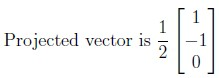
- 0.162
- 0.257
- 0.157
- 1.57
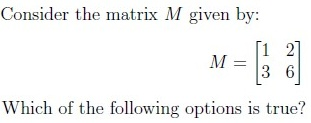
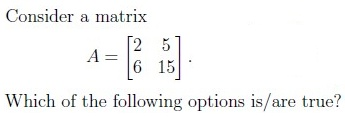
- Eigenvectors corresponding to the two different eigenvalues of M areorthogonal.
- The matrix M is not diagonalizable.
- The eigenvalues of M are 4 and 1
- The rank of M is 1.





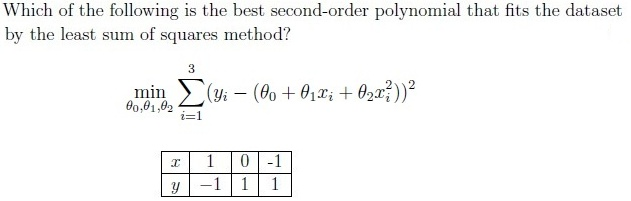
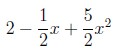
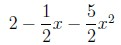
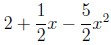
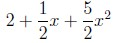
Which of the following options is/are true?


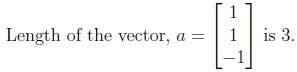
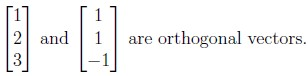
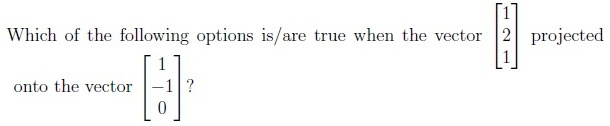
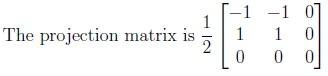
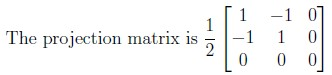
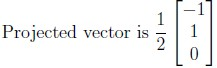
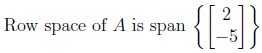
Which of the following statements is/are correct?









Comprehension passage - the questions below it refer to this
Based on the above data, answer the given subquestions.
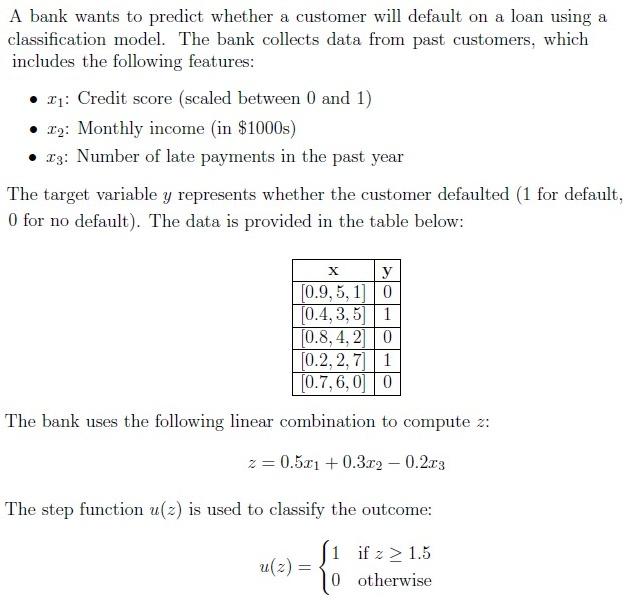
For the input x = [0.9, 5, 1], what will be the predicted output u(z)?
- 0
- 1
- 1.75
- Cannot be determined
If the threshold in the step function is changed to z ≥ 1.0, what will happen to the misclassification rate?
- Increase
- Decrease
- Remain same
- Cannot be determined
Comprehension passage - the questions below it refer to this
Based on the above data, answer the given subquestions.
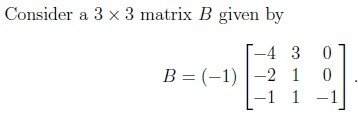
If B is diagonalizable, what is the invertible matrix P such that B = PDP−1?



If B is diagonalizable, which of the following is a diagonal matrix D such that B = PDP−1? Use the matrix P obtained in the previous question.



Answer key
- Q1 (MCQ, 3 marks): C
- Q2 (MCQ, 3 marks): D
- Q3 (MCQ, 3 marks): A
- Q4 (MCQ, 3 marks): B
- Q5 (MSQ, 3 marks): A, D
- Q6 (MSQ, 3 marks): B, C
- Q7 (MSQ, 3 marks): B, C, D
- Q8 (MSQ, 2 marks): A, B, C
- Q9 (SA, 2 marks): 15
- Q10 (SA, 3 marks): 6.37 to 6.43
- Q11 (MCQ, 3 marks): B
- Q12 (MCQ, 3 marks): A
- Q13 (MCQ, 3 marks): D
- Q14 (MCQ, 3 marks): A
Concepts this paper tests
Auto-generated summary from the source site. Handy as a checklist; the lessons above explain each idea from scratch.
Summary of Core Topics, Concepts, Principles, and Equations
1. Linear Approximation
- Concept: Linear approximation of a function around a point.
- Equation: For a function , the linear approximation around a point is given by:
2. Matrix Properties
- Concepts: Eigenvalues, eigenvectors, diagonalizability, rank, nullity.
Equations:
- Rank-Nullity Theorem: for an matrix .
- Eigenvalue equation: .
3. Directional Derivative
- Concept: Rate of change of a function in the direction of a unit vector.
- Equation: The directional derivative of at in the direction of is:
4. Least Squares Method
- Concept: Fitting a polynomial to a dataset using the least sum of squares.
- Equation: For a second-order polynomial , the least squares method minimizes:
5. Vector Projection
- Concept: Projection of one vector onto another.
- Equation: The projection of onto is:
6. Continuity and Differentiability
- Concepts: Continuity and differentiability of functions.
- Examples: , , , .
7. Gradient and Length
- Concept: Gradient of a function and its length.
- Equation: The gradient of is:
The length of the gradient is:
8. Classification Model
- Concept: Using a linear combination and step function for classification.
- Equation: Linear combination , and step function:
9. Diagonalization
- Concept: Diagonalization of a matrix.
- Equation: , where is a diagonal matrix and is the matrix of eigenvectors.