Home / Past papers / MAD2 End Term / this paper
IIT M DIPLOMA AN1 EXAM ETD1 11 Dec 2022 - 11 Dec 2022
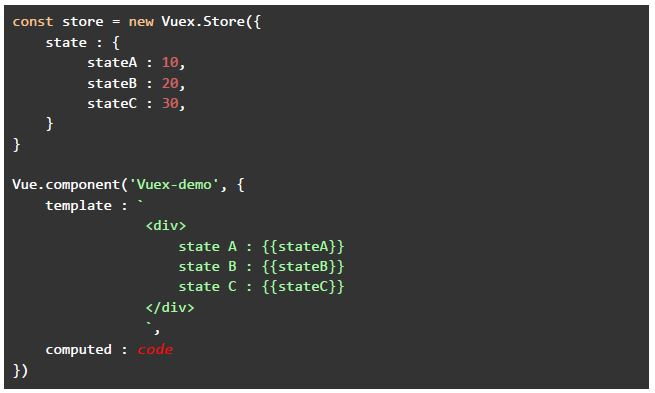 Consider the below Vue component and Vuex store definition. Which of the following is the best suitable definition of the “code” placeholder in the above app (assuming the store is binded with the Vue app, and the mapState is imported appropriately)?
Text of the picture (copyable)
```javascript
const store = new Vuex.Store({
    state : {
        stateA : 10,
        stateB : 20,
        stateC : 30,
    }
})

Vue.component('Vuex-demo', {
    template : `
        <div>
            state A : {{stateA}}
            state B : {{stateB}}
            state C : {{stateC}}
        </div>
    `,
    computed : code
})
```- …mapState(['state_1', 'state_2', 'state_3'])
- mapState(['state_1', 'state_2', 'state_3'])
- Both …mapState(['state_1', 'state_2', 'state_3']) and mapState(['state_1','state_2', 'state_3'])
- A Vue component cannot access Vuex store state.
- I, III, II
- III, I, II
- I, II, III
- The polling will be a better design.
- A shared cache is generally suitable for storing the personalized responses.
- A private cache is usually tied to a specific client.
- The caching helps in improving the performance of a web application.
- Caching at browser level provides the least latency, if compared with proxylevel.
- Local Storage
- Session Storage
- Cookie
- Any of these can be used
- http://origin2.com
- http://api.origin2.com
- http://origin1.com/api/
- All of these
 Which of the following shows the correct output, if the below program is executed?
Text of the picture (copyable)
```javascript
for (let i=1; i<4; i+=2)
    setTimeout(() => console.log(i), 0)
```- 13
- 123
- 55
- 555
- All the progress will always be lost on the force reload of the page.
- All the progress may not necessarily be lost on the force reload of the page.
- The application will not allow force reload of the page.
- The progress made in a machine can be accessed on another machine.
- Cross Site Scripting
- Cross Site Request Forgery
- Session Hijacking
- None of these
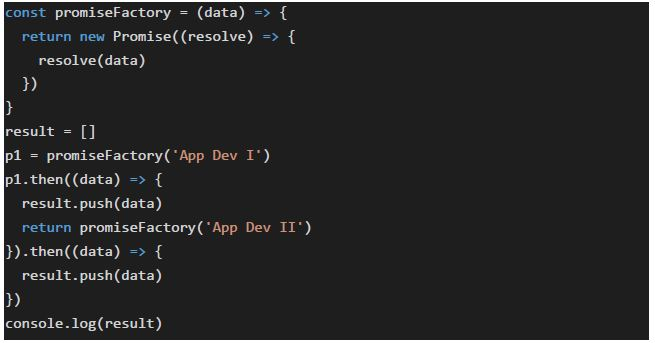 Consider the following javascript program. What will be logged on to console after executing the program?
Text of the picture (copyable)
```javascript
const promiseFactory = (data) => {
  return new Promise((resolve) => {
    resolve(data)
  })
}

result = []
p1 = promiseFactory('App Dev I')
p1.then((data) => {
  result.push(data)
  return promiseFactory('App Dev II')
}).then((data) => {
  result.push(data)
})

console.log(result)
```- []
- [‘App Dev I’, ‘App Dev II’]
- [‘App Dev II’, ‘App Dev I’]
- [‘App Dev I’]
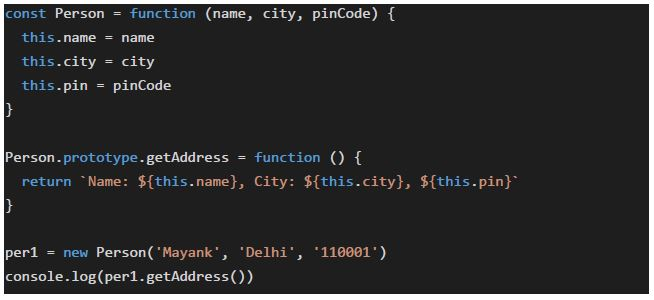 Consider the following javascript code. What will be logged on the console after executing this program?
Text of the picture (copyable)
```javascript
const Person = function (name, city, pinCode) {
    this.name = name
    this.city = city
    this.pin = pinCode
}

Person.prototype.getAddress = function () {
    return `Name: ${this.name}, City: ${this.city}, ${this.pin}`
}

per1 = new Person('Mayank', 'Delhi', '110001')
console.log(per1.getAddress())
```- Name: , City: , Pin:
- Name: Mayank, City: Delhi, Pin: 110001
- Name: Mayank, City: Delhi, 110001
- None of these
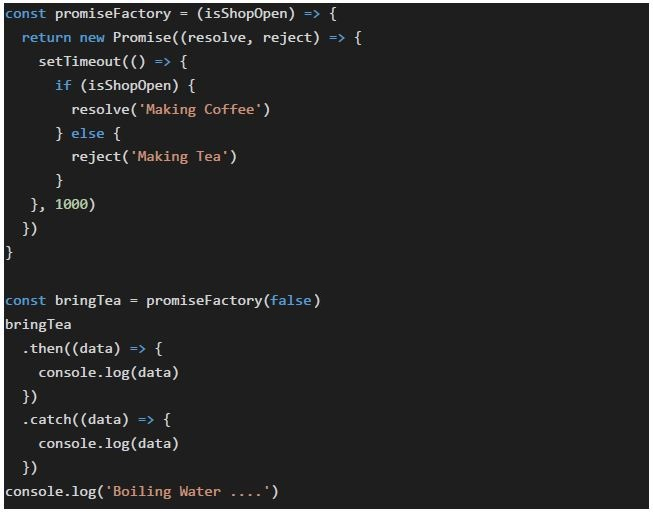 Consider the following javascript program. What will be logged on to console after executing this program?
Text of the picture (copyable)
```javascript
const promiseFactory = (isShopOpen) => {
  return new Promise((resolve, reject) => {
    setTimeout(() => {
      if (isShopOpen) {
        resolve('Making Coffee')
      } else {
        reject('Making Tea')
      }
    }, 1000)
  })
}

const bringTea = promiseFactory(false)
bringTea
  .then((data) => {
    console.log(data)
  })
  .catch((data) => {
    console.log(data)
  })
console.log('Boiling Water ....')
```- Boiling Water ….
- Boiling Water ….Making Coffee
- Boiling Water ….Making Tea
- Making CoffeeBoiling Water ….
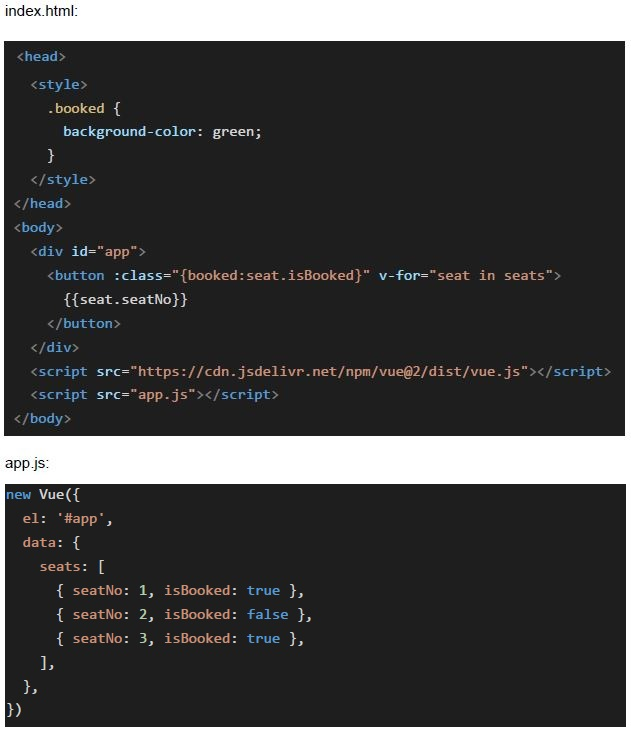 Consider the following Vue application with markup “index.html” and javascript file “app.js”. Suppose the application is running on ‘http://localhost:8080’. What will be the background colour of seat with seatNo 1 and 2 respectively, when the user visits the home page of the application (Assume the default background colour of button to be white)?
Text of the picture (copyable)
index.html:
```html
<head>
    <style>
        .booked {
            background-color: green;
        }
    </style>
</head>
<body>
    <div id="app">
        <button :class="{booked:seat.isBooked}" v-for="seat in seats">
            {{seat.seatNo}}
        </button>
    </div>
    <script src="https://cdn.jsdelivr.net/npm/vue@2/dist/vue.js"></script>
    <script src="app.js"></script>
</body>
```

app.js:
```javascript
new Vue({
    el: '#app',
    data: {
        seats: [
            { seatNo: 1, isBooked: true },
            { seatNo: 2, isBooked: false },
            { seatNo: 3, isBooked: true },
        ],
    }
})
```- Green, Green
- Green, White
- White, White
- White, Green
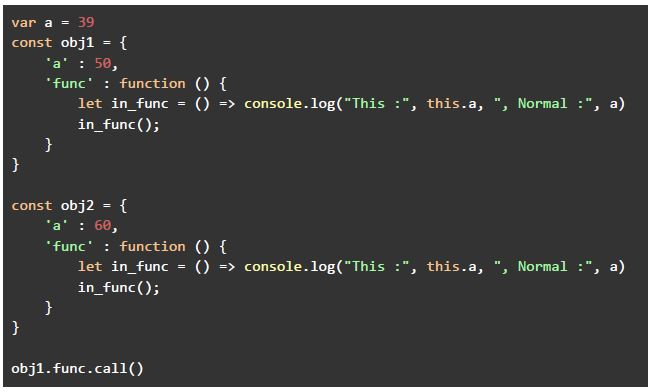 Consider the following javascript program, and predict the output, if executed in a REPL environment.
Text of the picture (copyable)
```javascript
var a = 39
const obj1 = {
    'a' : 50,
    'func' : function () {
        let in_func = () => console.log("This :", this.a, ", Normal :", a)
        in_func();
    }
}

const obj2 = {
    'a' : 60,
    'func' : function () {
        let in_func = () => console.log("This :", this.a, ", Normal :", a)
        in_func();
    }
}

obj1.func.call()
```- This : 39 , Normal : 39
- This : undefined , Normal : 39
- This : undefined , Normal : 50
- This : 39 , Normal : 50
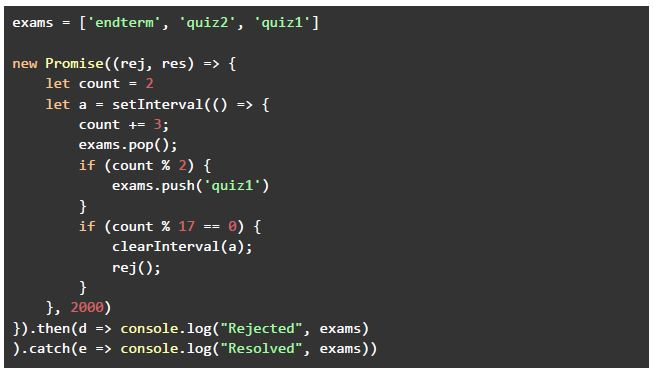 Consider the below javascript program, and predict the output, if executed. Also, what will be the minimum time taken by the program to execute?
Text of the picture (copyable)
```javascript
exams = ['endterm', 'quiz2', 'quiz1']

new Promise((rej, res) => {
    let count = 2
    let a = setInterval(() => {
        count += 3;
        exams.pop();
        if (count % 2) {
            exams.push('quiz1')
        }
        if (count % 17 == 0) {
            clearInterval(a);
            rej();
        }
    }, 2000)
}).then(d => console.log("Rejected", exams))
  .catch(e => console.log("Resolved", exams))
```- Rejected [‘quiz1’]Minimum Time taken: 10 seconds
- Rejected [‘quiz1’]Minimum Time taken: 8 seconds
- Resolved [‘quiz1’]Minimum Time taken: 8 seconds
- Resolved [‘quiz1’]Minimum Time taken: 10 seconds
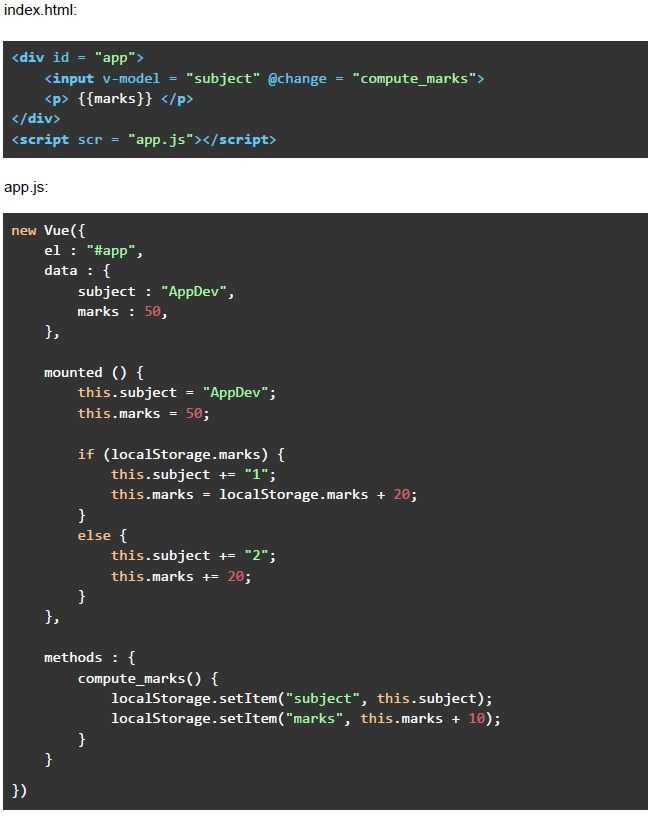 Consider the following Vue application with markup “index.html” and javascript file “app.js”. Suppose you open “index.html” file in a browser, and type the text “EndTermExam” in the text box shown (after removing the previous text, if any), and hard refresh the page thrice, without clicking anywhere. What will be the value shown in the text box, and the “marks” placeholder, respectively?
Text of the picture (copyable)
index.html:

```html
<div id = "app">
    <input v-model = "subject" @change = "compute_marks">
    <p> {{marks}} </p>
</div>
<script scr = "app.js"></script>
```

app.js:

```javascript
new Vue({
    el : "#app",
    data : {
        subject : "AppDev",
        marks : 50,
    },

    mounted () {
        this.subject = "AppDev";
        this.marks = 50;

        if (localStorage.marks) {
            this.subject += "1";
            this.marks = localStorage.marks + 20;
        }
        else {
            this.subject += "2";
            this.marks += 20;
        }
    },

    methods : {
        compute_marks() {
            localStorage.setItem("subject", this.subject);
            localStorage.setItem("marks", this.marks + 10);
        }
    }
})
```- AppDev1, 80
- AppDev2, 80
- AppDev1, 70
- AppDev2, 70
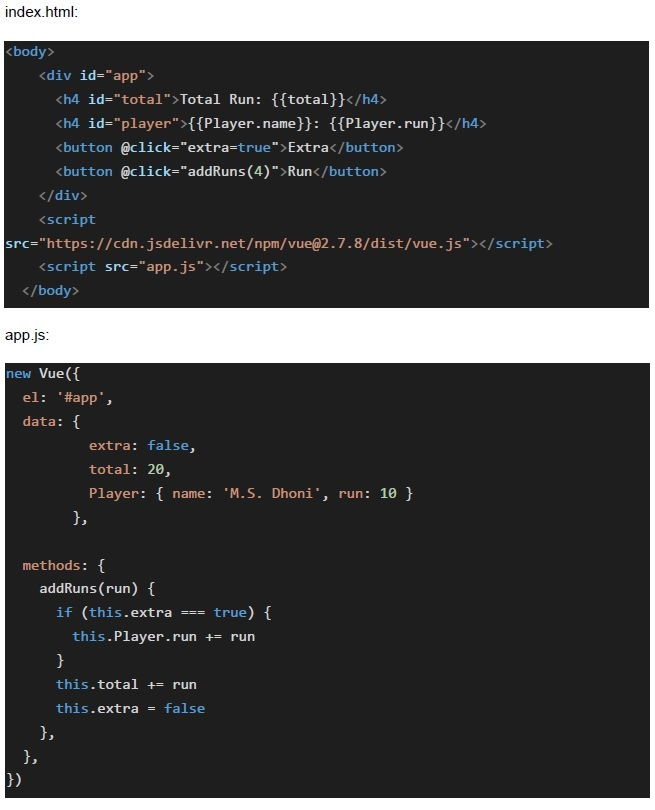 Consider the following Vue application with markup “index.html” and javascript file “app.js”. Suppose the application is running on ‘http://localhost:8080’. If the user clicks on the button with the text “Extra”, and then clicks on the button with the text “Run” thrice. What will be rendered inside the element with ID “total” and “player”, respectively?
Text of the picture (copyable)
index.html:
```html
<body>
    <div id="app">
        <h4 id="total">Total Run: {{total}}</h4>
        <h4 id="player">{{Player.name}}: {{Player.run}}</h4>
        <button @click="extra=true">Extra</button>
        <button @click="addRuns(4)">Run</button>
    </div>
    <script
        src="https://cdn.jsdelivr.net/npm/vue@2.7.8/dist/vue.js"></script>
    <script src="app.js"></script>
</body>
```

app.js:
```javascript
new Vue({
    el: '#app',
    data: {
        extra: false,
        total: 20,
        Player: { name: 'M.S. Dhoni', run: 10 }
    },

    methods: {
        addRuns(run) {
            if (this.extra === true) {
                this.Player.run += run
            }
            this.total += run
            this.extra = false
        },
    }
})
```- Total Run: 32, M.S. Dhoni: 14
- Total Run: 28, M.S. Dhoni: 14
- Total Run: 32, M.S. Dhoni: 18
- Total Run: 28, M.S. Dhoni: 18
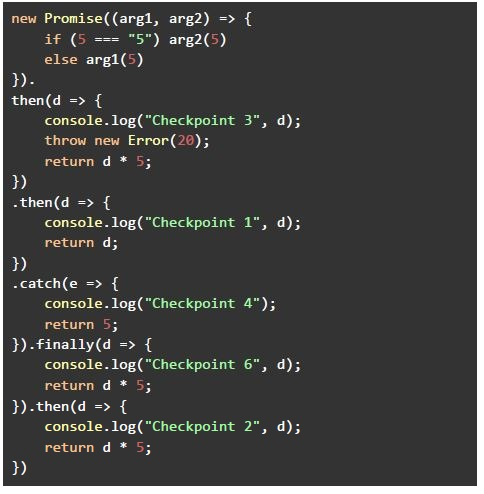 Consider the following javascript program, and predict the output if executed.
Text of the picture (copyable)
```javascript
new Promise((arg1, arg2) => {
  if (5 === "5") arg2(5)
  else arg1(5)
}).
then(d => {
  console.log("Checkpoint 3", d);
  throw new Error(20);
  return d * 5;
})
.then(d => {
  console.log("Checkpoint 1", d);
  return d;
})
.catch(e => {
  console.log("Checkpoint 4");
  return 5;
}).finally(d => {
  console.log("Checkpoint 6", d);
  return d * 5;
}).then(d => {
  console.log("Checkpoint 2", d);
  return d * 5;
})
```- Checkpoint 4 11Checkpoint 6 undefinedCheckpoint 2 25
- Checkpoint 4 11Checkpoint 6 25Checkpoint 2 125
- Checkpoint 3 5Checkpoint 4Checkpoint 6 undefinedCheckpoint 2 5
- Checkpoint 3 5Checkpoint 4Checkpoint 6 NaNCheckpoint 2 5
- In point-to-point communication, the number of connections grow with theorder of O(nlogn).
- If a central message broker is used, the number of connections grow with theorder of O(logn).
- If a central message broker is used, the number of connections grow with theorder of O(n).
- A message broker makes the network more scalable, if compared with point-to-point communication.
- The CSRF protection is not enforced by the flask framework, by default.
- The data stored in local storage is synchronized across the devices for a givenuser.
- A flask application returns CORS headers for cross domain javascript requests,by default.
- The flask application uses port number 5000, by default.
- They get deleted once the user closes the browser.
- They will be sent to the origin server with each request, by default.
- They will not be sent to the origin server with each request, by default.
- All of these
- JavaScript is a high level programming language.
- JavaScript moves the declaration of all the arrow functions to the top of theirscope.
- The language does not allow the global declaration of user defined functions.
- A function can be invoked inside another function in the language.
 Consider the below Vue class binding and select the incorrect option(s).
Text of the picture (copyable)
```html
<div v-bind:class="[isClassA ? classA : '', classB]"></div>
```
- The classes, namely “classA” and “classB” will always be applied to the divelement.
- The class, namely “classB” will always be applied to the div element.
- The class, namely “classA” will only be applied to the div element, if the variable“isClassA” evaluates to true.
- The class, namely “classB” will only be applied to the div element, if no variablewith name “isClassA” exists.
- Scaling out is always a preferred choice when the network traffic is growing.
- The horizontal scaling will typically clone the application as many times asrequired, and add a load balancer to maintain uniform traffic across the servers.
- The horizontal partitioning splits a given table into multiple tables, with eachtable having the same structure.
- The diagonal scaling refers to cloning the application first, and then scaling upthe different servers to meet the requirements.
- A flask application runs in a threaded mode by default.
- A fetch API call always returns a promise.
- The promise returned by fetch API resolves to an HTTP response status 500,with the “ok” property of the response set to true.
- A headless CMS aims to manage both the content and frontend via APIs.
- Slot ID: 1, Slot Status: Booked
- Slot ID: 1, Slot Status: Not Booked
- Slot ID: 1
- Slot Status: Booked
- Slot ID: 1, Slot Status: Booked
- Slot ID: 1, Slot Status: Not Booked
- Slot ID: 1
- Slot Status: Booked
- Page not Found
- Booked Slots
- Unbooked Slots
- None of these
- Page not Found
- Booked Slots
- Unbooked Slots
- None of these
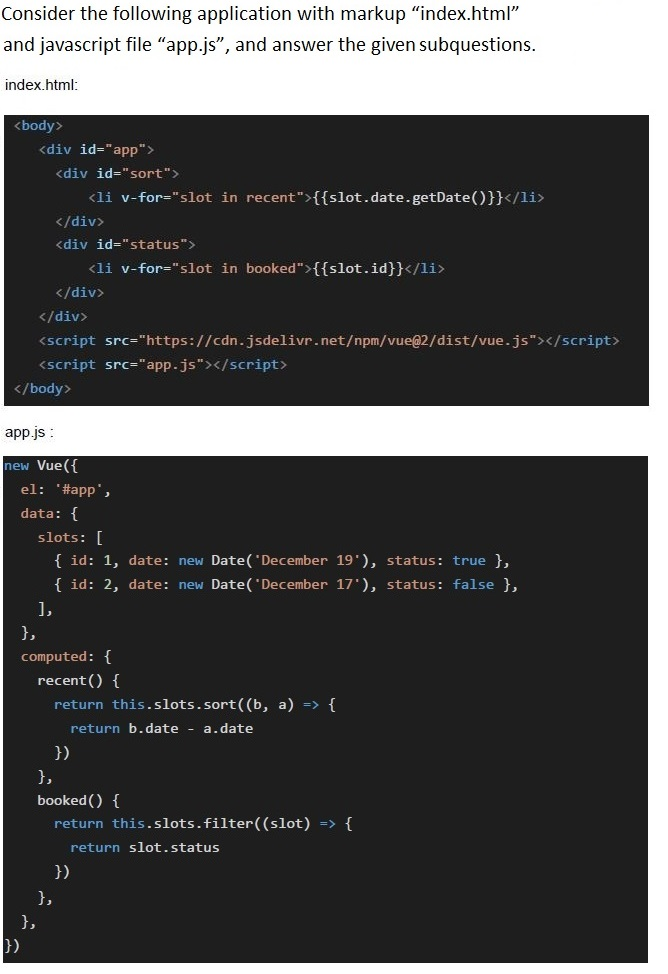
- 1917
- 19
- 17
- 1719
- 12
- 1
- 2
- None of these
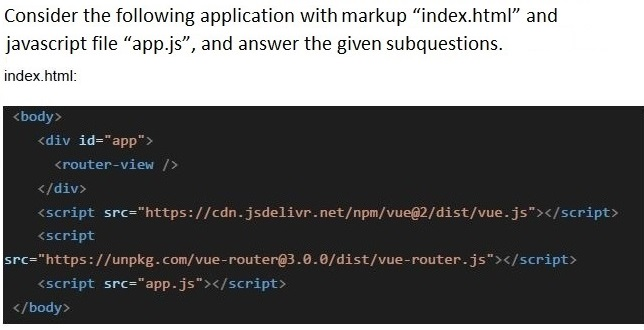
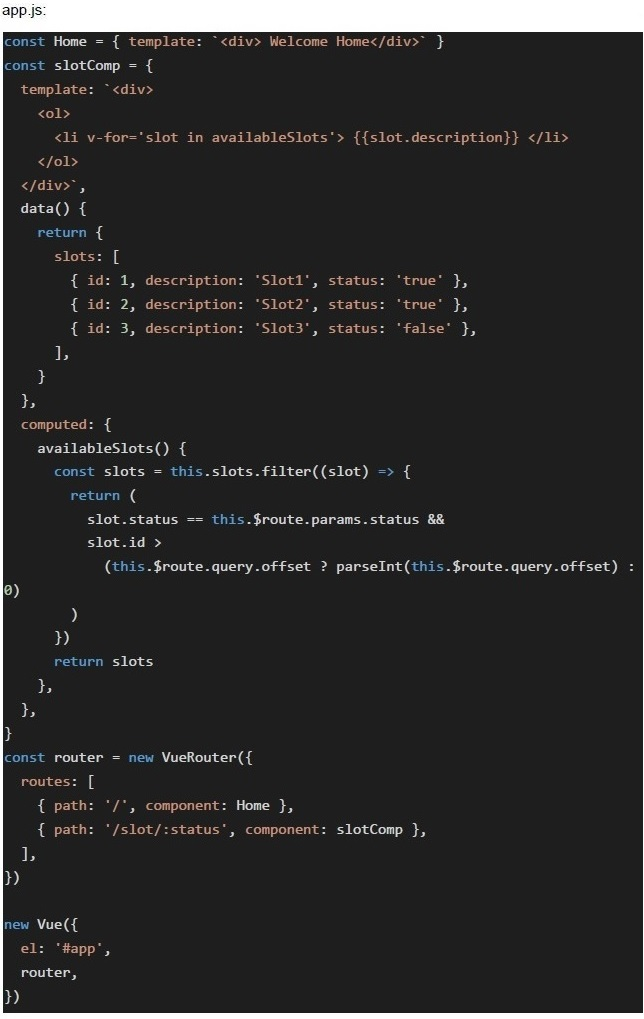
- 1. Slot12. Slot2
- 1. Slot22. Slot3
- 1. Slot1
- 1. Slot2
- 1. Slot12. Slot2
- 1. Slot22. Slot3
- 1. Slot1
- 1. Slot2
Answer key
- Q1 (MCQ, 2 marks): A
- Q2 (MCQ, 2 marks): B
- Q3 (MCQ, 2 marks): A
- Q4 (MCQ, 2 marks): C
- Q5 (MCQ, 2 marks): A
- Q6 (MCQ, 3 marks): A
- Q7 (MCQ, 3 marks): B
- Q8 (MCQ, 3 marks): B
- Q9 (MCQ, 3 marks): A
- Q10 (MCQ, 3 marks): C
- Q11 (MCQ, 3 marks): C
- Q12 (MCQ, 3 marks): B
- Q13 (MCQ, 4.5 marks): A
- Q14 (MCQ, 4.5 marks): A
- Q15 (MCQ, 4.5 marks): D
- Q16 (MCQ, 4.5 marks): A
- Q17 (MCQ, 4.5 marks): C
- Q18 (MSQ, 2 marks): A, B
- Q19 (MSQ, 2 marks): B, C
- Q20 (MSQ, 2 marks): A, B
- Q21 (MSQ, 3 marks): B, C
- Q22 (MSQ, 3 marks): A, D
- Q23 (MSQ, 3 marks): B, C
- Q24 (MSQ, 3 marks): A, B
- Q25 (MCQ, 3 marks): B
- Q26 (MCQ, 3 marks): A
- Q27 (MCQ, 3 marks): A
- Q28 (MCQ, 3 marks): B
- Q29 (MCQ, 4.5 marks): D
- Q30 (MCQ, 3 marks): B
- Q31 (MCQ, 4.5 marks): A
- Q32 (MCQ, 4.5 marks): D
Concepts this paper tests
Auto-generated summary from the source site. Handy as a checklist; the lessons above explain each idea from scratch.
Here’s a structured summary of the core topics, concepts, principles, and equations essential for the "Diploma Level: Modern Application Development 2" exam, along with Mermaid knowledge graphs to visualize relationships.
Core Topics & Concepts Summary
1. Vue.js & Vuex
Key Concepts:
- Vue Component Lifecycle:
created,mounted,updated,destroyed. Vuex Store: State management (
state,getters,mutations,actions).mapStateHelper: Maps Vuex state to computed properties in components.- Syntax:
...mapState(['stateA', 'stateB'])(spread operator required).
- Syntax:
Dynamic Class Binding:
v-bind:classwith conditional logic.- Example:
:class="{ 'active': isActive, 'error': hasError }".
- Example:
- Props & Events: Parent-child communication via
propsand$emit. Vue Router:
- Nested routes (
childrenin route config). - Dynamic route matching (
:param). - Query parameters (
?key=value). router-viewrenders matched components.
- Nested routes (
Key Code Snippets:
// Vuex Store
const store = new Vuex.Store({
  state: { count: 0 },
  mutations: {
    increment(state) { state.count++; }
  }
});

// MapState in Component
computed: {
  ...mapState(['count'])  // Correct (Option A in Q2)
}

// Dynamic Class Binding
<div :class="[isActive ? 'active' : '', 'static-class']"></div>
2. JavaScript (ES6+)
Key Concepts:
Closures &
letin Loops:letcreates block-scoped variables (unlikevar).Example (Q7):
for (let i = 1; i < 7; i++) {
  setTimeout(() => console.log(i), 2);  // Logs 1, 2, 3, 4, 5, 6
}
Promises & Async/Await:
.then()/catch()chaining.Promisestates:pending,fulfilled,rejected.Example (Q10, Q12, Q15, Q18):
new Promise((resolve, reject) => {
  if (condition) resolve("Success");
  else reject("Error");
})
.then(data => console.log(data))
.catch(err => console.error(err));
Arrow Functions &
this:- Arrow functions inherit
thisfrom the surrounding scope. Example (Q14):
const obj = {
  a: 10,
  func: () => console.log(this.a)  // `this` refers to global/window
};
- Arrow functions inherit
Prototypal Inheritance:
Example (Q11):
function Person(name) { this.name = name; }
Person.prototype.getName = function() { return this.name; };
Key Outputs:
| Question | Output Explanation |
|---|---|
| Q7 | 1 2 3 4 5 6 (due to let block-scoping in for loop). |
| Q10 | [] (async console.log executes before result is updated). |
| Q12 | Boiling Water ... → Making Tea (Promise rejects, .catch logs). |
| Q15 | Resolved ["quiz1"] after 10 seconds (interval runs 5 times: 2s × 5 = 10s). |
| Q18 | Checkpoint 3 5 → Checkpoint 4 → Checkpoint 6 undefined → Checkpoint 2 5. |
3. Web Technologies
Key Concepts:
Caching:
- Private Cache: Client-specific (e.g., browser cache).
- Shared Cache: Shared across users (e.g., CDN, proxy cache).
- Latency: Browser cache < proxy cache < origin server.
- False Statement (Q4): Shared cache is not suitable for personalized responses.
- Storage Mechanisms: | Mechanism | Persistence | Sent with Requests | Use Case | |-----------------|----------------------|--------------------|-----------------------------------| | Cookies | Expires (configurable)| Yes | Session management, tracking. | | Local Storage | Persistent | No | Client-side data (e.g., preferences). | | Session Storage | Tab-specific | No | Temporary session data. |
- Correct Answer (Q5): Cookies (sent with every request).
Same-Origin Policy (SOP):
- Default allowance: Same origin (scheme + host + port).
- Example (Q6):
http://origin2.comcan fetch from itself, nothttp://origin1.com.
CSRF (Cross-Site Request Forgery):
- Attack trick users into submitting malicious requests via authenticated sessions.
- Example (Q9):
<img src="http://example1.com/delete?id=1">triggers a DELETE request.
CORS (Cross-Origin Resource Sharing):
- Requires server-side headers (e.g.,
Access-Control-Allow-Origin). - False Statement (Q20): Flask does not enable CORS by default.
- Requires server-side headers (e.g.,
4. Backend & Scalability
Key Concepts:
Asynchronous Job Processing:
Order for Brute-Force Task (Q3):
- Dispatch a backend job (e.g., to a queue like RabbitMQ).
- Invoke a webhook on completion.
- Relieve the worker.
- Correct Order:
III → I → II(Option B).
- Scaling Strategies: | Term | Description | |--------------------|-----------------------------------------------------------------------------| | Scaling Out | Adding more servers (horizontal scaling). | | Scaling Up | Upgrading existing server resources (vertical scaling). | | Diagonal Scaling | Combining horizontal + vertical scaling. | | Sharding | Splitting a database table horizontally (e.g., by user ID). |
- True Statements (Q24): B (horizontal scaling), C (horizontal partitioning).
- Message Brokers vs. Point-to-Point: | Feature | Point-to-Point | Message Broker (e.g., RabbitMQ) | |-----------------------|-------------------------|---------------------------------------| | Connections | O(n²) | O(n) (central broker) | | Scalability | Poor | Better | | Complexity | High | Lower |
- False Statements (Q19): A (O(nlogn) is incorrect), B (O(logn) is incorrect).
5. Security
Key Concepts:
Session Cookies:
- Deleted on browser close (Q21: A).
- Sent to the origin server with every request (Q21: B).
Flask Defaults:
- Runs on port 5000 (Q20: D).
- CSRF protection is not enabled by default (Q20: A).
- Local Storage is not synced across devices (Q20: B).
6. Algorithms & Data Structures
Key Concepts:
Sorting in JavaScript:
array.sort((a, b) => a - b)for ascending.Example (Q30, Q31):
slots.sort((a, b) => a.date - b.date); // Ascending by date- Output (Q30):
17 19(sorted dates). - Output (Q31):
1(only booked slot ID).